
Last updated: November 20, 2026
Quick Answer: set your emergency fund goal at 1 to 6 months of required household expenses, then adjust for dependents, job stability, and any care costs. A single income household needs an emergency fund goal that covers the bills that keep one paycheck alive. This article on How to Set an Emergency Fund Goal for a Single Income Household shows how to size that goal without guessing.
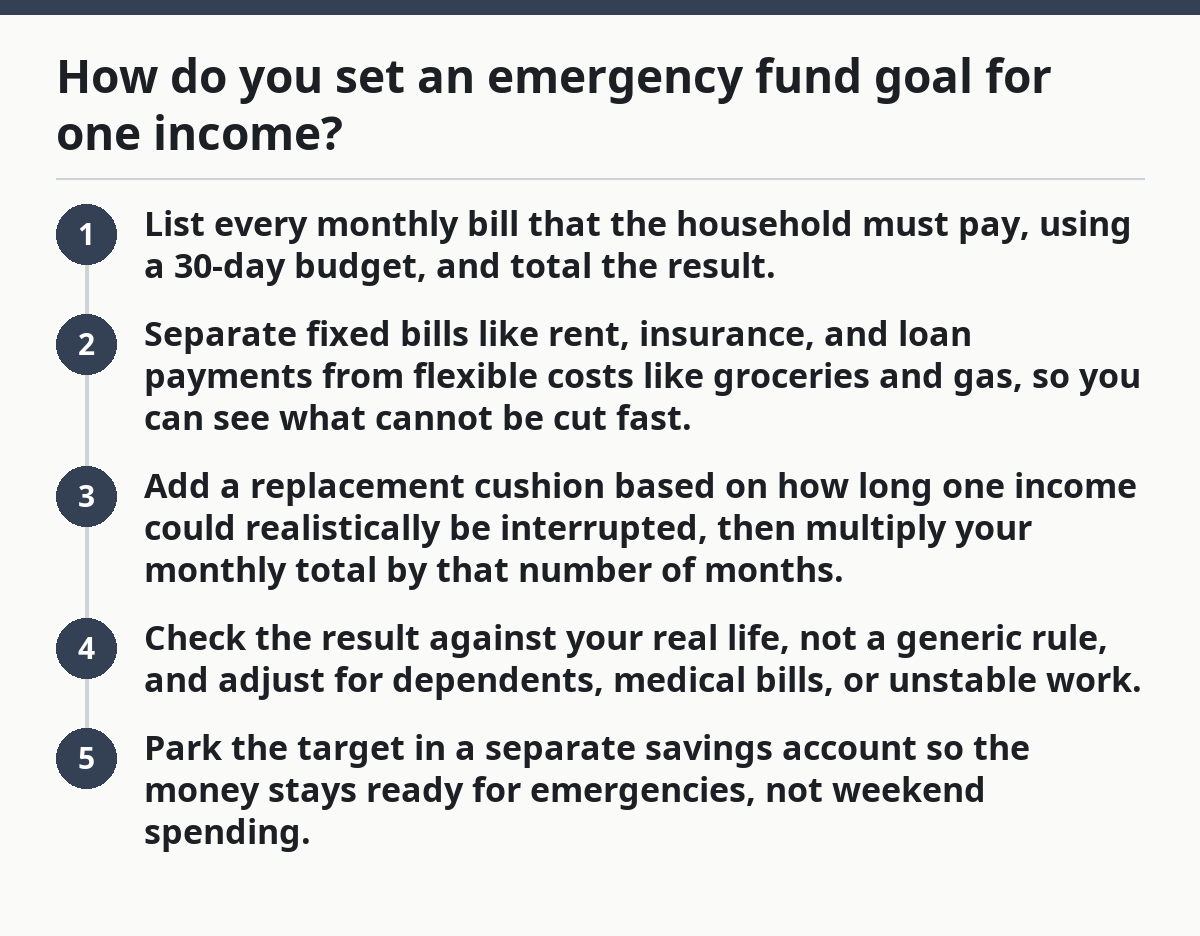
How do you set an emergency fund goal for one income?
You set it by listing the household bills that one paycheck supports, then choosing a cash target that covers those costs for a realistic stretch of time. That means rent, utilities, groceries, insurance, debt payments, and any child or elder care that would still need to be paid if income stopped.
Because you are setting How to Set an Emergency Fund Goal for a Single Income Household, start with your monthly expense total, then turn it into a target that fits your household’s risk.
- List every monthly bill that the household must pay, using a 30-day budget, and total the result.
- Separate fixed bills like rent, insurance, and loan payments from flexible costs like groceries and gas, so you can see what cannot be cut fast.
- Add a replacement cushion based on how long one income could realistically be interrupted, then multiply your monthly total by that number of months.
- Check the result against your real life, not a generic rule, and adjust for dependents, medical bills, or unstable work.
- Park the target in a separate savings account so the money stays ready for emergencies, not weekend spending.
The truth is, a single-income household has less room for error. If that one paycheck stops, the whole budget feels it at once. A target that looks fine on paper can be too small if it ignores the cost of keeping the household running.
What monthly expenses should go into the goal?

Your goal should include the bills that would still show up if income disappeared for a while. That usually starts with rent or mortgage, utilities, groceries, insurance, transportation, minimum debt payments, and child care or elder care if those costs are part of keeping the household going.
For How to Set an Emergency Fund Goal for a Single Income Household, the cleanest test is simple—if the expense keeps the household housed, fed, insured, or able to work, it belongs in the goal.
- Housing: rent or mortgage payment, plus any required HOA or lot fee
- Utilities: electricity, gas, water, trash, internet if it is needed for work
- Food: groceries and basic household supplies
- Insurance: health, auto, home, and any required coverage
- Transportation: gas, transit, parking, and minimum car payment if it cannot be paused
- Debt: minimum payments only, not extra payoff amounts
- Care costs: child care, elder care, or disability-related help
- Work costs: uniforms, required tools, or commuting costs tied to earning income
Leave out vacation savings, dining out, and other discretionary spending. Those are useful budget lines, but they are not the first things an emergency fund should protect.
On the flip side, do not slash the number so hard that the budget becomes fantasy. A household that needs $1,000 a month for groceries, fuel, and utilities does not become a $600 household just because the target feels smaller. The math has to match the life.
How do dependents change the emergency fund goal?
Dependents usually push the goal higher because they add fixed costs and slow down your ability to cut spending fast. A child, a disabled adult, or an aging parent in the household can mean more food, more care, more insurance use, and less flexibility if income stops.
If you are the only earner, a sick day can turn into a week, then a month. If other people rely on your paycheck, the fund has to protect more than your own rent. It has to keep the whole household stable.
A good way to think about dependents is to ask what they change in your budget:
- Food: more mouths means a higher grocery line.
- Care: child care or elder care may continue even when work income drops.
- Medical costs: copays, prescriptions, and ongoing treatment can rise fast; check costs with a professional and review a trusted source such as Healthcare.gov.
- Housing: a larger home may cost more, or a move may add costs you cannot avoid.
- Transportation: school drop-off, appointments, and work shifts can create extra mileage.
If a dependent’s needs are irregular, add a small buffer to the monthly total instead of pretending the cost is flat. A household with one child who needs after-school care has a different emergency fund goal than a two-adult household with no care costs at all.
This is also where many generic articles go wrong. They talk about “household size” like the count of people is the whole story. One adult plus one dependent with daily care needs can be more expensive than two adults with steady schedules and no child care bill.
Should you use income replacement or monthly expenses?

You should use monthly expenses as the base, then let income replacement guide the cushion on top. The goal is not to replace every dollar of take-home pay forever; the goal is to keep the household afloat until income returns or changes.
For How to Set an Emergency Fund Goal for a Single Income Household, one paycheck often means one month of expenses is the base number, and several more months are the cushion.
- Base number: one month of required household expenses.
- Buffer: several months of those expenses, depending on job stability and support.
- Goal: base number plus the cushion you can realistically save.
That structure keeps the target honest. If your monthly required expenses are high because of rent, insurance, and care costs, a small cushion may not be enough. If your income is uneven, the goal may need to sit higher because the next paycheck is not fully predictable.
Some readers want a simple rule like “three months is enough.” That can be too small for a single income household with dependents or a volatile job. Others chase a huge number and never start. The useful answer is the one that matches your monthly expenses and the real risk of losing the household’s only paycheck.
For a plain-language framework, a single-income family can think in ranges rather than a magic number. A household with stable work and low fixed bills may need a smaller cushion than a household with one paycheck, kids, and high rent. The target should reflect the weaker side of the budget, not the strongest.
What mistakes shrink the goal too much?
The most common mistake is undercounting the bills that keep the household running. That creates a goal that looks tidy but fails the first real emergency. The second mistake is using gross income or full take-home pay instead of actual spending, which often inflates or distorts the target.
If you are building How to Set an Emergency Fund Goal for a Single Income Household, watch for these errors:
- Using only rent and groceries: that ignores utilities, insurance, and transportation.
- Counting savings goals as expenses: vacation and holiday sinking funds are not emergency costs.
- Ignoring minimum debt payments: missed payments can snowball.
- Forgetting annual bills: car registration, premiums, and school fees can create gaps if they are not averaged into the month.
- Assuming two incomes when only one pays the bills: if one partner’s income is irregular or already spoken for, it should not count as a safety net.
Build the goal from the bills that show up every month, then add irregular but expected costs by dividing annual amounts into a monthly figure. That gives you a target that reflects the real calendar, not just the easy weeks.
A second mistake is setting the goal so high that it becomes unreachable. A fund you never build does nothing for you. A first target that protects one month of expenses is better than a perfect target that sits at zero.
How much cushion does a single-income household really need?
A single-income household needs enough cushion to cover the time it would take to recover from a job loss or a major interruption, not just a bad week. That cushion should be based on income replacement risk, because one lost paycheck hits harder when there is no second earner to absorb it.
For How to Set an Emergency Fund Goal for a Single Income Household, the right cushion depends on three things: income stability, spending flexibility, and dependents.
- How stable is the income? Salary work usually gives more predictability than commission, contract, or seasonal work.
- How fast could spending be cut? A household with low fixed bills can shrink faster than one locked into rent, child care, and insurance.
- How many people depend on the paycheck? More dependents usually means a larger cushion.
That is why the right target can differ even within single-income households. Two families can both earn on one paycheck, but one may have low rent and no kids while the other has a mortgage, two children, and a day care bill. The number should follow the budget, not the label.
If the household’s only income is also the main source of health insurance, the cushion often needs more room. A job loss can create both an income gap and a coverage gap. That does not mean you should panic and save everything at once. It does mean the emergency fund goal should be built with that risk in mind.
What should the final emergency fund goal look like?
Your final emergency fund goal should be a clear dollar amount tied to your monthly household expenses and the length of time you want that money to last. A good target is specific enough to track, but flexible enough to fit changes in rent, insurance, or care costs.
For How to Set an Emergency Fund Goal for a Single Income Household, the final number should be easy to explain and easy to revisit.
Instead of “I need to save more,” you can say, “I’m building my emergency fund goal around one month of required bills first, then I’ll move toward a larger cushion.” That statement turns the plan into a target you can actually reach.
Use this format:
- Step 1: total required monthly expenses.
- Step 2: multiply that total by the number of months you want covered.
- Step 3: add known irregular bills, like annual insurance or car registration, if they are not already in the monthly total.
- Step 4: round to a number you can remember and track.
For example, if your required monthly expenses are fully documented, your emergency fund goal is simply that monthly total times the coverage window you choose. If your budget changes, the goal should change too. A raise, a rent increase, a new baby, or a job shift can all move the number.
You do not have to guess at the perfect target on day one. You only need a number that reflects the household you have now. That is enough to start saving with purpose instead of drifting.
If you want the bigger framework behind this, the hub on emergency fund goal setting can help you compare your target with the other common sizing methods.
Key Takeaways
- A single-income household should size its emergency fund from the bills one paycheck actually supports.
- Start with required monthly expenses: rent, utilities, groceries, insurance, debt minimums, and care costs.
- Dependents usually raise the target because they add fixed costs and reduce flexibility.
- Use monthly spending as the base, then add a cushion for income replacement risk.
- A goal that fits your real budget is better than a perfect number you never save.
How much emergency fund should a single-income household keep?
A single-income household should keep enough cash to cover required monthly expenses for the time it would take to recover from a lost paycheck. The right number depends on rent, utilities, groceries, insurance, debt minimums, and care costs. A household with unstable income or dependents usually needs a larger cushion than one with low fixed bills.
Should a single-income household use 3 months or 6 months?
A single-income household should choose the side that matches its risk, not a rule copied from someone else’s budget. Stable work, low fixed bills, and no dependents may point toward the lower end; high rent, child care, or variable income push the goal higher. The better question is how long the household could stay current if income stopped.
What expenses should a single-income household include in the goal?
A single-income household should include the bills that keep life running: rent or mortgage, utilities, groceries, insurance, transportation, minimum debt payments, and any child care or elder care that must continue. The goal should also reflect irregular annual costs if they are not already built into the monthly budget. Discretionary spending belongs outside the emergency fund number.
Drafted with AI; not yet reviewed by a person.