Last updated: August 10, 2026
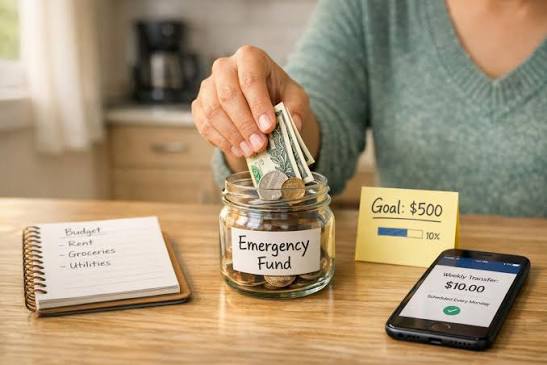
- A $300 target is easier to quote, track, and reach than an undefined “someday” fund.
- The first $20 can prevent one overdraft fee.
- The first $100 can keep a bill from bouncing.
- Small is how a fund gets started when the budget has no margin.
Quick Answer: To build an emergency fund on a low income, begin with $250 to $500, put aside a small amount on payday, and stash it in a separate savings account so you do not spend it by accident. This article is about how to build an emergency fund on low income without pretending your budget has room it does not.
Rent, food, transit, bills — and then the month still isn’t done. So no, the answer is not “save a lot right away.” Start tiny. Automate what you can. Keep the money out of sight. Build the fund around your real cash flow, not some ideal budget on paper. In a low-income emergency fund plan, steady progress beats perfection. Every time.
What an emergency fund is for when money is tight
A cushion like this is not a “nice to have” account. It is the money that keeps one flat tire, one doctor bill, one furnace repair, or one week of reduced hours from turning into debt, late fees, or a utility shutoff. In the U.S., the Consumer Financial Protection Bureau notes that even a small buffer can help people handle short-term shocks.
On a low income, I would not begin with the six-month target personal-finance articles love to repeat. Too far away. Too discouraging. I would start with a starter buffer you can actually reach. Think:
- a small cash cushion for the first surprise
- then a larger fund for bigger setbacks
- then, if your income stabilizes, a fuller reserve
The point is not perfection. It is to avoid being one bad week away from panic.
Honestly, there is a trade-off here: money set aside for emergencies can feel like money you need for groceries or overdue bills. That pressure is real. Still, the fund matters — you just have to build it in a way that does not create a fresh crisis today.
Start with a number you can actually reach
People often quit because the target is too big and too fuzzy. I would pick a starting point that fits your income and your current bills:
- $250 to $500 if you are constantly hit with small emergencies
- $1,000 if you want a first meaningful cushion and can reach it in steps
- One bill cycle of essentials if your pay is irregular and you need breathing room
There is no magic number. What matters is that the target feels possible within your current life, not someone else’s. A $300 target is easier to quote, track, and reach than an undefined “someday” fund. Nice and concrete. Better that way.
A useful way to set the amount is to list only true essentials:
- rent or mortgage
- utilities
- basic food
- transportation to work
- minimum debt payments
- medication or child-related essentials
Do not count streaming subscriptions, shopping, or “maybe” expenses. This number is for survival-level stability, not lifestyle comfort.
When your income changes from week to week, I would use a smaller target first. For example, if you work hourly, freelance, or rely on seasonal work, a tiny cushion can help with gaps between paydays. That is often more useful than chasing a large number you cannot yet hold onto.
Find the money without pretending there’s “extra”
Most low-income budgets do not have obvious spare cash. I would not start by cutting everything to the bone. That usually backfires. Look instead for money that already leaks out of your month.
The best places to look first
-
Automatic charges you barely notice
Old subscriptions, app fees, membership renewals, storage plans, delivery apps. Cancel the ones you do not use often enough to justify. -
Bills you can reduce without adding risk
Ask about lower-cost plans, hardship programs, utility budget billing, or reduced internet options. If you need the service to work or search for jobs, keep that in mind. Do not cut what protects your income. -
Windfalls and irregular income
Tax refunds, birthday money, overtime, side gig payments, cash gifts, rebate checks, and sold items can seed the account. I would direct a percentage, not necessarily all of it, so you do not rebound-spend everything out of frustration. -
Tiny daily leaks
One convenience purchase, one delivery fee, one store run you could batch later. This is not about guilt. It is about noticing where money leaves fastest when life feels busy.
A generic article often says, “Cut coffee and save the difference.” Too shallow. If you are low income, the bigger win is usually not one drink. It is finding several small leaks and redirecting them before the month starts.
A practical method that works better than vague budgeting
I like a simple rule: save the money the day it enters your account.
That can look like:
– moving $5 or $10 to savings on payday
– setting a fixed transfer after every deposit
– saving cash from a specific envelope before spending starts
– depositing side-job income directly into the emergency fund
The amount can be very small. Small is not silly. Small is how a fund gets started when the budget has no margin.
Keep the money separate and harder to touch
When the emergency fund sits in your checking account, it will get absorbed by normal life. That is not a character flaw; it is what happens when account boundaries are weak.
I would keep the fund in a separate savings account that is:
– easy enough to access in a real emergency
– hard enough to avoid casual spending
– not linked so tightly that you can move money impulsively
You do not want a lockbox you cannot use. You also do not want the money sitting in the same place as grocery spending.
Good habits for low-income savers
- Rename the account in your banking app if possible: “Car repair fund,” “Rent backup,” or “Emergency fund.”
- Keep only one purpose for the account.
- Turn off debit card access if the bank allows it and that would help you avoid impulse use.
- Set alerts so you know when the balance changes.
If your bank charges fees, that matters. I would not keep emergency savings somewhere that slowly drains it. When the fee structure is eating the fund, the account is working against you.
What if you don’t trust yourself not to spend it?
Then make the first target small and specific. For example: “This is only for job loss, car repair, or medical bills.” I also find it helps to write a short list of approved emergencies and keep it where you can see it.
This is not just about willpower. It is about making the money harder to misuse. Simple. And effective.
Build it in layers, not all at once
On a low income, the most realistic path is to build the fund in layers. That is how you make an emergency fund on low income feel manageable.
Layer 1: immediate buffer
This is the first small amount that keeps a minor emergency from becoming a disaster. A broken part, a copay, or a late transport repair often fits here.
Layer 2: one real shock absorber
Once you have the first layer, move toward a larger cushion. This gives you room for a bigger surprise without turning to credit cards or payday loans.
Layer 3: stable backup
If your income becomes steadier, you can keep building. That can eventually become a more traditional emergency fund.
This layered approach matters because it gives you wins before the account looks “complete.” A generic article can make saving sound like one long climb. In real life, people need checkpoints. Otherwise the thing feels like a treadmill.
Example of a low-income savings rhythm
When you can only save a small amount, a simple rhythm helps:
– save after every paycheck
– save tax refund money in part, not all
– deposit cash once a week if that works better
– add any unexpected income before you spend it
I would rather see someone save $10 consistently than wait months for the “perfect” amount and save nothing.
What to do when saving feels impossible
There are times when the honest answer is: your budget is in crisis, and an emergency fund alone will not fix it.
At that point, I would look at the bigger picture:
- Are rent and utilities too high for your income?
- Is debt payment taking too much of the paycheck?
- Are you paying fees for overdrafts, late payments, or high-cost borrowing?
- Do you need help from local assistance, a benefits office, a credit counselor, a community action agency, or a trusted nonprofit?
An emergency fund is a cushion, not a substitute for survival support. When you are choosing between food and savings every week, the problem may be too large to solve by cutting lattes and skipping lunches.
I would also avoid using a new emergency fund to justify new debt. A balance transfer, payday loan, or high-interest cash advance may feel like a bridge, but it can trap you longer than the original emergency would have. The CFPB warns that high-cost borrowing can make a short-term problem worse. When you are considering debt or benefits decisions, it is worth speaking with a qualified financial counselor or other professional who can look at your full situation.
Who this approach is not for
This method is not a fit when:
– your income is so unstable that any savings gets wiped out immediately and you need urgent outside help
– you are already missing rent, utilities, or essential medication
– you are trying to save while ignoring a debt spiral or income problem that needs direct intervention
In those cases, the first step may be stabilization, not savings. That is not failure. That is triage.
A simple plan you can start this week
If you want the shortest workable plan, I would use this:
- Pick a starter target you can reach.
- Open a separate savings account if you do not have one.
- Choose one small automatic transfer on payday.
- Put every windfall partially toward the fund.
- Label the money for real emergencies only.
- Review the amount monthly and increase it only when you can.
When you are paid in cash, keep a small envelope system until you can move the money to savings. If your income changes every week, save a percentage rather than a fixed amount.
You do not need to build the whole fund before it starts helping. The first $20 can prevent one overdraft fee. The first $100 can keep a bill from bouncing. The first few hundred dollars can change the tone of an emergency from panic to problem-solving.
Common mistakes that slow people down
I see the same missteps over and over:
- trying to save too much too fast
- keeping the fund in checking and spending it by accident
- using the fund for non-emergencies because the rules were never clear
- stopping after the first small goal and never rebuilding it
- saving only when there is “leftover” money, which usually means never
The fix is boring, but boring works: a separate account, a small automatic habit, and a target that fits your income.
Emergency fund FAQs for low-income savers
Should I save while paying off debt?
Usually, yes, at least a small amount. When you have no buffer at all, one surprise often becomes new debt. That said, when your debt situation is severe or you are behind on essentials, a financial counselor can help you decide what comes first.
Is cash better than a savings account?
Cash can help when you do not have bank access or need strict separation from spending. A savings account is usually safer and easier to keep organized. The best choice is the one you can protect from being spent.
What counts as an emergency?
I would define an emergency as something urgent, necessary, and hard to delay: job loss, medical costs, car repair needed for work, essential home repair, or a utility crisis. A sale, vacation, or new phone is not an emergency.
How fast should I build it?
As fast as your budget can handle without creating another problem. Fast is good only if it is sustainable. When a tiny weekly transfer is all you can manage, that still counts.
What if I keep dipping into it?
Then the target may be too small, the rules may be too loose, or your budget may be under too much pressure. That usually means you need a better savings boundary, a larger buffer, or outside help with the underlying problem.
The bottom line
On a low income, building an emergency fund is less about finding “extra money” and more about designing a system that survives real life. Start with a small target. Keep the money separate. Save tiny amounts on purpose. Use windfalls well. And be honest about when the problem is bigger than savings alone.
That is how the fund gets built: not in one dramatic move, but in steady pieces that protect you one emergency at a time.