Last updated: August 10, 2026
- Many online banks update rates regularly, and some pay around 4% APY , though rates change.
- A practical amount is often $100 to $500 in small bills.
- Quick Answer: For most people, keep an emergency fund equal to 3 to 6 months of expenses in an insured, separate, easy-to-access savings account .
- According to the FDIC, deposits are insured up to $250,000 per depositor, per insured bank, per ownership category .
Quick Answer: For most people, keep an emergency fund equal to 3 to 6 months of expenses in an insured, separate, easy-to-access savings account. A high-yield savings account is often the best starting point because it keeps the money liquid and usually pays more interest than a basic savings account. Keep it separate from checking and avoid putting it in stocks, crypto, or long-term CDs.
Three to six months. That is the target. For most households, the safest spot is an account you can reach quickly without turning a bad day into a bigger mess. Usually, a high-yield savings account makes the most sense, though a plain savings account or a money market account can do the job too if they are insured and easy to use. Not flashy. Just practical.
Keep your emergency fund somewhere safe, easy to reach, and separate from your everyday spending account. For most people, that means a high-yield savings account, a plain savings account, or a money market account at an FDIC- or NCUA-insured institution, or the Canadian equivalent deposit-insurance coverage if you bank in Canada. According to the FDIC, deposits are insured up to $250,000 per depositor, per insured bank, per ownership category. I would not park emergency money in stocks, long-term certificates of deposit, or anywhere that makes it hard to get cash fast when the car dies, the furnace quits, or you lose work.
The short answer: keep it safe, separate, and liquid
The right home for emergency savings comes down to safety, speed, and a little yield. In choosing a place for emergency savings, I would rank three things first:
-
Safety of principal
The money should not swing up and down with the market. -
Fast access
I should be able to get the money within a day or two, not after a waiting period that turns a real emergency into a scramble. -
A little yield, if it does not create friction
Interest matters, but not enough to justify risk or delays.
That is why I usually point people toward a high-yield savings account first. The label sounds promotional, but the idea is simple: it behaves like savings, not investing. Your balance stays available, and the bank or credit union pays some interest. The best fit is usually the account that keeps your money reachable in 1 to 2 business days without market risk.
A money market account can also work, especially if it has good transfer access or a debit card. A plain savings account is fine too if you value simplicity over a slightly better rate.
What I would avoid is putting your emergency fund in the same account as your checking account. That setup feels convenient until you start dipping into it for groceries, a concert ticket, or an oversized utility bill. Emergency money needs a fence around it. So the account should feel separate, even if moving money only takes a minute.
The best places to keep it, and when each one makes sense
The right account depends on how fast you may need the cash and how much temptation you need to resist. The best place is the one that balances access, safety, and your own spending habits. Simple enough? Maybe not. But that’s the trade-off.
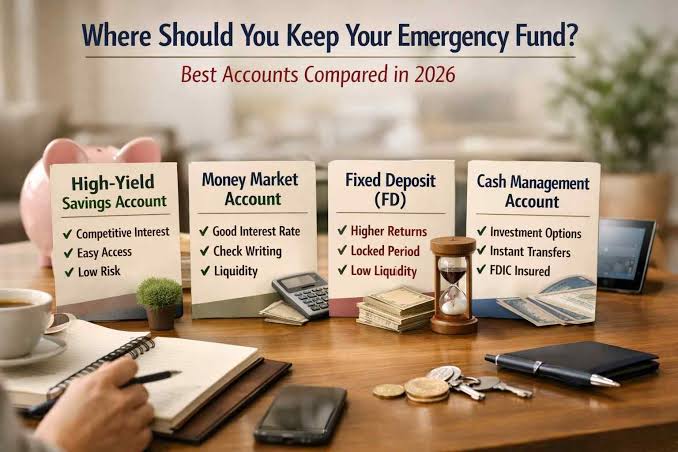
High-yield savings account
This is my default choice for most people. It is easy to open, usually easy to transfer from, and it keeps the money visible enough to remember while still being separate from daily spending. Many online banks update rates regularly, and some pay around 4% APY, though rates change.
Best for:
– Most households
– People who want a simple home for 3 to 6 months of expenses
– Anyone building an emergency fund for the first time
Trade-off:
Rates can change, and transfers may take a day or more. That is usually fine for an emergency fund, but not ideal if you need instant cash at the ATM.
Regular savings account at your main bank
This is the simplest option if you want zero friction and already bank there. It is not fancy, but it works.
Best for:
– Small starter emergency funds
– People who need easy transfers to checking
– Anyone who values convenience over yield
Trade-off:
The interest may be low. In some cases, it is low enough that inflation quietly eats a chunk of the value over time.
Money market account
A money market account can be a nice middle ground. Some come with check-writing or a debit card, which can help in a real emergency.
Best for:
– People who want better access features
– Households that may need to pay a contractor, mechanic, or medical bill quickly
Trade-off:
Minimum balances and account rules can be stricter than a basic savings account.
Short-term certificate of deposit
I do not think a CD should hold your whole emergency fund. The problem is timing: if you need the money before the CD matures, you may face penalties.
Best for:
– A small slice of money you truly will not need right away
– People with a very stable second layer of savings
Trade-off:
Reduced liquidity. That makes it a poor fit for true emergencies.
Cash at home
I only like a small amount of cash at home for power outages, natural disasters, or a temporary banking disruption. It is not a full emergency fund. A practical amount is often $100 to $500 in small bills.
Best for:
– Very short-term access during local disruptions
– Backup cash when cards or electronic transfers fail
Trade-off:
Cash can be lost, stolen, or damaged. It earns nothing and is not insured in the same way bank deposits are.
What I would not use for emergency savings
A generic article often stops at “keep it in a savings account.” That misses the bigger question: what should not hold the money?
I would not use stocks or index funds
The market can fall when you need cash most. If your emergency fund is invested, you may have to sell at a loss. That defeats the whole point. The S&P 500 has also had calendar-year drops of more than 20% in some years, which is exactly the kind of volatility emergency money should avoid.
This gets even shakier if your job is unstable, your household has one income, or you already have debt payments that would be hard to cover after a setback. The math stops working fast.
I would not keep it in crypto
Crypto can be hard to predict, hard to time, and hard to treat as emergency money. It may rise fast, but that does not make it dependable. If you are considering it anyway, consult a financial professional and check a source such as the Canadian Securities Administrators or your local securities regulator before treating it as a cash substitute.
I would not tie it up in retirement accounts
Retirement money has a different job. Yes, some accounts have loan or withdrawal rules, but that is usually the wrong place to solve a short-term problem. Pulling from retirement can also trigger taxes or penalties. If the issue is financial stress, I would not make it worse by raiding money meant for later.
I would not leave the fund in checking
Checking accounts make spending too easy. If every dollar sits there, your “emergency fund” tends to become your “life happens” fund.
How much access is enough?
So, the more useful question is: how fast do I need this money to move?
I think of emergency funds in layers.
Layer 1: immediate cash
This is a small amount you can get right away for urgent needs, especially if cards fail or electronic systems are down.
Layer 2: accessible savings
This is the main emergency fund. It should be easy to transfer to checking, but not so easy that you spend it casually.
Layer 3: backup reserves
If your household has stronger finances, you may keep extra emergency money in a separate account or a very conservative short-term place. This is for larger shocks, not everyday disruption.
Because of that, if your work is seasonal, your income is irregular, or you support kids or older relatives, I would lean toward more liquidity, not less. A slightly higher yield is not worth losing access when life gets messy. Same-day transfer can matter more than an extra 0.25% in interest.
A simple setup that works for most people
If you want a practical structure, here is the one I would use as a starting point:
- Checking account: bill paying and daily spending
- Emergency savings account: separate high-yield or regular savings
- Optional small cash stash: a little physical backup for outages or immediate needs
That structure does two things. It protects the money from impulse spending, and it keeps the emergency fund close enough to use without drama. It also gives you three layers, which is usually enough for most households.
If you already have multiple bank accounts, I would make sure the emergency fund is not at the same institution as every other household account unless you trust your own discipline. Separation can help when a debit card swipe feels easier than a transfer.
For people in Toronto, Mississauga, Brampton, Vaughan, Markham, Scarborough, and the surrounding GTA, this same rule still applies: keep the fund liquid and separate, because winter storms, commuting costs, job changes, and sudden repair bills tend to show up without asking where the money is parked. For example, a furnace repair or car tow can land in the $300 to $1,500 range, and that is exactly why quick access matters. No drama. Just cash that moves.
Local cost and account features to watch for
I cannot give a real price list for every bank in every neighborhood, because account terms change and vary by institution. What I can give you is the kind of cost structure I would check before opening an account in the GTA or anywhere nearby.
| Emergency-fund home | What to look for | Common cost concern | Best use |
|---|---|---|---|
| High-yield savings account | Easy transfers, no monthly fee, insured deposits | Low or variable interest, transfer delays | Main emergency fund |
| Regular savings account | Simple access, linked checking | Low yield | Starter fund or backup |
| Money market account | Debit/check access, insured deposits | Minimum balance requirements | Fund that may need faster payment access |
| Short-term CD | Fixed term, insured deposits | Early withdrawal penalty | Only for money you can spare |
| Cash at home | Immediate physical access | Theft, loss, no interest | Small backup only |
A local bank or credit union in Toronto, Etobicoke, North York, Richmond Hill, or Oakville may also have account rules that affect transfers, ATM access, or minimum balances. I would read the fee schedule before opening anything. A “good rate” is not good if monthly fees eat the benefit.
How to pick the right account if you live in a city with real-life emergencies
In the GTA, the emergency fund has to handle more than theory. Apartment turnover, winter car trouble, flooded basements, transit delays, contractor waitlists, and temporary layoffs all create different timing needs.
If you rent in downtown Toronto or Liberty Village, you may care more about quick access and mobile transfers than check-writing. When you live in Brampton, Ajax, or Pickering and drive a lot, you may want the money close enough to cover a repair shop bill fast. For those in Hamilton, Burlington, or Milton, where commuting and weather can both stress a budget, I would still keep the same basic setup: liquid, separate, insured.
Local housing and weather can change what “emergency” looks like, but they do not change the basic rule. If the money must be available next week, it should not be locked for a month. If it might be needed this weekend, it should not be in a market account that can fall with the market.
Red flags that the account is wrong for your emergency fund
I watch for a few warning signs.
The money is too easy to spend
When it sits beside your checking balance, it will probably get used for non-emergencies.
The money is too hard to move
When transfers take too long, if there are penalty fees, or if the account has odd withdrawal limits, I would move on.
The account has sneaky fees
Monthly fees, minimum balance fees, or transfer charges can quietly weaken the fund. A small balance does not belong in a high-fee account.
The rate is being used to distract you
A slightly higher rate is not worth losing access or taking risk. Emergency savings is not a return-maximizing portfolio. It is a reserve.
The institution is not insured
I would only keep emergency money in an account backed by deposit insurance through the appropriate Canadian or U.S. system, depending on where the account is opened. If you are unsure, ask the bank or credit union directly and verify the coverage yourself.
Questions people ask when they need the money fast
Because of that, here are the most common follow-up questions.
Can I keep part of it in cash and part in the bank?
Yes. I think that is often sensible. Keep a small amount of cash for immediate disruption, then put the rest in an insured savings or money market account.
Should I keep the emergency fund at my main bank?
Maybe. It is convenient, but convenience cuts both ways. If your main bank also holds your checking account, payroll deposit, and everyday bills, I would think about separating at least one layer of the fund.
Is a high-yield savings account really better than a checking account?
Usually, yes, because it creates separation and often pays more interest. But if access speed is your top priority, a linked savings or money market account can be better than chasing a slightly higher rate.
What if I need same-day access?
Then choose an account with fast internal transfers or ATM/debit access, and keep a small cash buffer. When you are in a city like Toronto or Mississauga where banking is easy but emergencies can still be sudden, that flexibility matters.
Can I get a free estimate or open the account online?
For bank accounts, “free estimate” is not the right phrase the way it is for repairs, but many institutions let you compare terms and open accounts online. I would still read the fee schedule and transfer rules before moving money.
My bottom line
If you want the cleanest answer, here it is: keep your emergency fund in an insured savings account that is separate from checking, easy to access, and boring on purpose. A high-yield savings account is usually my first pick. A regular savings account is fine if simplicity matters more than yield. A money market account can work if it gives you useful access features. I would avoid investing the fund, locking it in a CD, or mixing it with everyday spending money.
A better emergency fund is not the one with the flashiest return. It is the one that will still be there, reachable, when your car stops working on the 401, your furnace dies in February, or your next paycheck arrives late.