
Last updated: November 19, 2026
Quick answer: for How Long Does It Take to Build an Emergency Fund From Zero?, a small starter fund may take a few months, while a fuller reserve can take a year or more; the exact timeline depends on your monthly savings, income, and expenses. If you are starting from zero, the emergency fund timeline is often fastest when you treat it as a simple math problem: target amount divided by what you can set aside each month, and if you are unsure about what target fits your situation, consider consulting a qualified financial professional. For budgeting basics and emergency savings guidance, see the Consumer Financial Protection Bureau and the FDIC.
In short: a small fund can take 1 to 3 months to build if you save aggressively, while a larger full fund can take 6 months or longer if your budget has little room. The exact timeline changes with every extra dollar you can redirect.
How long does it take to build an emergency fund from zero?
It usually takes 3 to 12 months to build an emergency fund from zero, and sometimes longer if your expenses are high or your cash flow is uneven. That range is wide because the timeline is driven by one thing: how much you can save each month without breaking your budget.
The clean way to estimate it is:
- Decide the target amount.
- Divide that amount by your monthly contribution.
- Add a little time for irregular months, like a car repair or a medical bill.
A simple example makes the math easier. If your target is $3,000 and you can save $300 a month, the timeline is 10 months. If you can save $500 a month, it drops to 6 months. If you can only set aside $150 a month, it stretches to 20 months. Same goal, different pace.
That is why the answer is not “three months” or “one year” for everyone. The timeline is a function of income, fixed expenses, debt payments, and how much slack your budget has after rent, food, transport, and minimum debt obligations. A person with a $4,000 monthly income and modest expenses can usually move faster than someone whose budget is already tight, even if both want the same dollar target.
This is also where a lot of generic advice goes wrong. It talks about “saving more” without saying how the timeline changes when the monthly contribution changes by $50, $100, or $200. Those numbers matter. A $100 monthly increase shortens a 12-month goal by several months, not by a vague amount.
For a broader framework on methods and trade-offs, the hub article on emergency fund building methods fits here.
What numbers do you need before you can estimate the timeline?
You need three numbers: your target amount, your monthly savings, and your monthly expenses. Without those, the timeline is guesswork.
The target amount is the total cash buffer you want to reach. Many people think in terms of one month, three months, or six months of essential expenses, because those are easy milestones to plan around. Essential expenses means the bills that keep life running: housing, utilities, food, transport, insurance, and the minimum debt payment amount you must make.
Your monthly contribution is the part you can set aside after those bills. It does not have to be a neat round number. Even $75 a month gives you a real timeline, and a real timeline is more useful than a wish.
Your expenses set the floor. If your fixed costs are high, the emergency fund timeline stretches unless your income rises or you trim spending. If your expenses are low, the same target becomes much easier to hit.
A quick planning lens helps:
- Low contribution: under $100 a month.
- Moderate contribution: $100 to $400 a month.
- Higher contribution: over $400 a month.
Those bands are not rules; they are just a practical way to think about pace. At $100 a month, a $1,200 goal takes a year. At $300 a month, that same goal takes 4 months. That difference is why budget clarity matters more than optimism.
I would not estimate a timeline without first writing down actual monthly numbers. Guessing usually makes the plan look faster than it is, which sets up discouragement later.
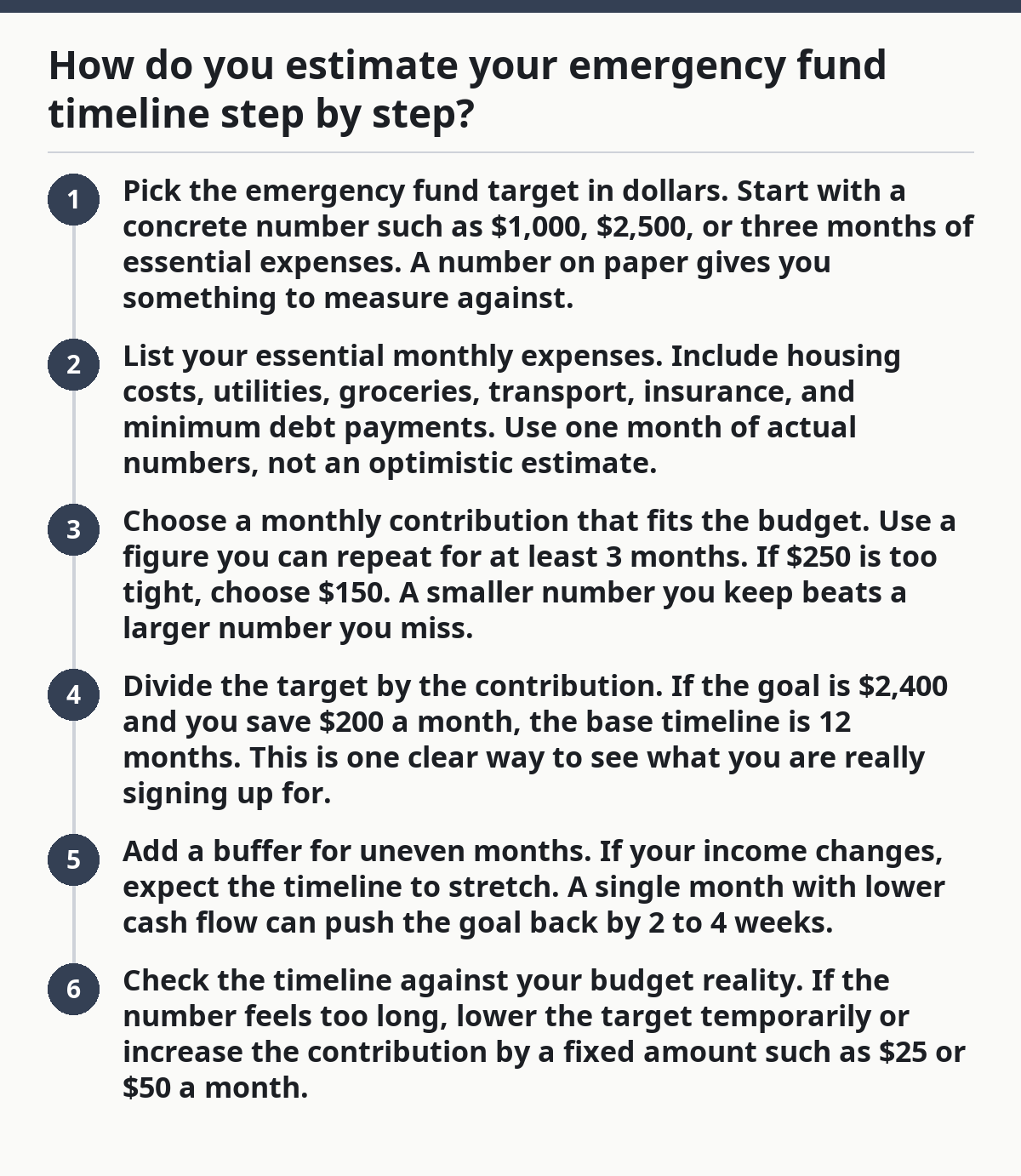
How do you estimate your emergency fund timeline step by step?
You estimate it by turning the goal into months, then checking whether your budget can actually sustain that pace. This is a basic planning exercise, not a test of discipline.
-
Pick the emergency fund target in dollars.
Start with a concrete number such as $1,000, $2,500, or three months of essential expenses. A number on paper gives you something to measure against. -
List your essential monthly expenses.
Include housing costs, utilities, groceries, transport, insurance, and minimum debt payments. Use one month of actual numbers, not an optimistic estimate. -
Choose a monthly contribution that fits the budget.
Use a figure you can repeat for at least 3 months. If $250 is too tight, choose $150. A smaller number you keep beats a larger number you miss. -
Divide the target by the contribution.
If the goal is $2,400 and you save $200 a month, the base timeline is 12 months. This is one clear way to see what you are really signing up for. -
Add a buffer for uneven months.
If your income changes, expect the timeline to stretch. A single month with lower cash flow can push the goal back by 2 to 4 weeks. -
Check the timeline against your budget reality.
If the number feels too long, lower the target temporarily or increase the contribution by a fixed amount such as $25 or $50 a month.
This process works because it makes the goal visible. A person who sees “10 months” can plan around it. A person who only hears “save more” cannot.
The main mistake here is using gross income instead of what is actually left after bills. That mistake can cost months of frustration. The fix is simple: base the plan on net take-home income and real expenses, not idealized numbers.
What shortens the timeline most?
A higher monthly contribution shortens the timeline most, because every extra dollar goes straight to the goal. That is the math, and it is more powerful than almost any savings trick.
If the target is $3,000:
- At $100 a month, the timeline is 30 months.
- At $200 a month, it is 15 months.
- At $300 a month, it is 10 months.
- At $500 a month, it is 6 months.
Those examples show the real lever: contribution size. Income matters because it determines contribution size, and expenses matter because they limit it. But the direct driver is monthly cash set aside for the fund.
That said, a higher rate is not always realistic. A plan that depends on sacrificing essentials, skipping bills, or going into debt is a bad plan. It may look fast on paper and fail in real life. A slower target that you can sustain for 6 or 12 months is better than a heroic pace that collapses after one hard month.
The smartest way to shorten the timeline is to raise the contribution in small, repeatable steps. For example, moving from $100 to $150 a month cuts the finish date without forcing a major lifestyle change. Another $25 or $50 after a raise, tax refund, or lower bill can move it again.
This is why emergency fund planning is really budget planning. If your monthly expenses are fixed at $2,600 and your net income is $3,000, you have only $400 to work with before the month even starts. That means every timeline estimate has to respect the gap between income and expenses.
I would not recommend a plan that ignores that gap. It is one way to create a fund on paper and a shortfall in practice.
Should you aim for a starter fund or a full fund first?
The timeline is shorter if you begin with a starter fund and longer if you go straight to a full fund. A starter fund is a smaller milestone, often around $500 to $1,500, while a full fund is usually measured in months of essential expenses.
A starter fund gives you a faster win. If you can save $200 a month, a $1,000 starter goal takes 5 months. A $6,000 full-fund target at the same rate takes 30 months. That is a big difference, and it changes how the goal feels in daily life.
This matters because the first phase is about momentum. A smaller milestone can absorb a tire blowout, a copay, or a utility bill without wiping out your progress. It also gives you a working buffer while you keep building.
A full fund is the more durable target, but it takes patience. If your budget is tight, the timeline can stretch beyond a year. That is not failure; it is the cost of building a larger reserve from zero. The mistake is pretending both goals are the same thing. They are not.
I would treat these as two separate planning questions:
- How fast can I build a small buffer?
- How long will it take to build a larger reserve?
Those answers are often different by several months. If you only look at the second one, the goal can feel too far away. If you only look at the first one, you may stop too early.
A smaller initial target shortens the timeline, but it does not solve the whole problem. A starter fund helps with early surprises; a full fund helps with bigger ones.
What mistakes make the timeline longer than it should be?
The biggest mistakes are setting an unrealistic monthly contribution, forgetting irregular expenses, and changing the target every few weeks. Each one stretches the timeline in a different way.
A contribution that is too high causes missed months. Missed months cost time because the balance stops growing. A person who plans on $300 a month but only manages it twice in 5 months does not have a 10-month timeline anymore; the real timeline is much longer.
Irregular expenses are another problem. Annual insurance premiums, holiday spending, school fees, or vehicle maintenance can interrupt progress if they are not built into the budget. A fund plan that ignores one $400 bill can be thrown off for 2 or 3 months.
Changing the target too often is slower in a different way. If you start with $1,500 and then increase it to $4,000 before the first goal is done, the finish line keeps moving. That may be sensible in the long run, but it makes the timeline hard to track. A better approach is to finish one milestone, then reset.
The fix is straightforward:
- Pick one target for the next 3 to 6 months.
- Choose one monthly contribution you can repeat.
- Build in known irregular bills.
- Review the plan after a raise, refund, or major expense change.
That last point matters. The timeline is not fixed forever. A better job, a lower rent payment, or a reduced insurance bill can shorten it. A new car payment can lengthen it.
I would not call this a failure of discipline. It is normal budget friction. The point of the timeline is to show the truth early, before the surprises arrive.
How do you know if your timeline is realistic?
Your timeline is realistic if you can save the same amount for 3 straight months without missing a bill or emptying the account later. That is the cleanest test.
A realistic timeline usually has three features:
- The contribution fits inside your current budget.
- You can keep paying it after a normal bad month.
- The goal is specific enough to track, such as $2,000 or three months of essentials.
If those three things are true, the timeline is probably workable. If the plan only works when nothing goes wrong, it is too fragile.
This is also where honesty matters most. A 4-month timeline looks attractive, but if it depends on every month being perfect, it is a weak plan. A 9-month timeline that survives car repairs, holiday spending, and a slow month at work is stronger.
For financial planning, the better question is not “How fast can I force this?” It is “How long will it take if I keep going after an ordinary setback?” That question gives a more useful answer because life does not wait for the calendar.
The right expectation is steady progress that matches your income and expenses. If that means the emergency fund timeline is 8 months instead of 4, the slower path may still be the better one.
Key Takeaways
- The timeline starts with math: target amount divided by monthly contribution.
- A small fund can often be reached in a few months; a full fund can take much longer.
- Monthly savings matters most because it directly changes the finish date.
- Income and expenses shape what contribution is realistic.
- Starter milestones can make the first phase feel manageable.
- A plan is only useful if it survives a normal bad month.
How many months does it usually take to save an emergency fund?
It usually takes several months to a year for many people, but the exact timeline depends on the goal size and monthly contribution. A small buffer can be built in 3 to 6 months with steady deposits, while a larger reserve may take 12 months or more if the budget is tight.
What savings rate shortens the timeline most?
A higher monthly contribution shortens the timeline most. The fastest progress comes from increasing the amount you can set aside each month, even by $25 or $50, because every extra dollar goes directly to the goal. A rate you can keep for months matters more than a dramatic pace you cannot sustain.
Can I build an emergency fund in stages?
Yes, building it in stages is often the most realistic way to do it. A smaller first target creates momentum and gives you a working cushion while you keep saving. After that, you can move to a larger reserve based on your essential monthly expenses and budget room.
Drafted with AI; not yet reviewed by a person.