Last updated: November 19, 2026
Key Takeaways
- Keep one separate savings bucket, one clear nickname label, and one rule for true emergencies only.
- Add a transfer delay, bank alerts, and a written budget rule so emotion cannot move the money alone.
- Separate accounts help because they move the emergency fund away from the money you spend every day.
- Alerts and delays make every transfer visible and slower, which helps protect the fund.
Quick Answer
Protecting an emergency fund from impulse spending usually starts with three barriers: a separate savings account, bank alerts, and a 24-hour transfer delay. That setup makes the money harder to grab, easier to notice, and less likely to leave on emotion alone.
The fastest way to protect an emergency fund from impulse spending is to add spending barriers: keep the money in a separate savings bucket, turn on bank alerts, and build a transfer delay so the cash is not one tap away. That setup works because it adds friction between a bad mood and your emergency money.
The fastest setup that stops most impulse withdrawals
Start with one savings account, one nickname label, and one rule that says the money is for true emergencies only. If you are setting this up today, the first goal is not perfection; it is making the fund annoying to spend from.
Impulse spending usually wins when the money sits in the same checking account you use for food, rides, and online checkout. The fix is physical separation inside the bank app or at another bank entirely. If your bank offers separate savings buckets or sub-accounts, move the emergency fund there first. If it does not, open a plain savings account with no debit card attached and no automatic bill pay linked to it.
What success looks like: you can see the emergency fund balance, but you cannot spend it without a deliberate transfer.
A useful starting rule is simple: no emergency withdrawal without a 24-hour pause, unless the expense is urgent and unavoidable. That delay sounds small, but it changes the moment from “buy now” to “decide later.” For many people, that one day is enough for the urge to pass.
This page is the practical guide to how to protect an emergency fund from impulse spending, which sits inside the larger emergency fund storage and maintenance topic. If the goal is to keep the money reserved, the storage method matters as much as the savings amount.
How do I stop myself from using emergency savings for non-emergencies?
Use a transfer delay, a bank alert, and a written budget rule so the money cannot move on emotion alone. The simplest version takes about 15 minutes to set up, and it is usually enough for the first line of defense.
- Move the emergency fund into a separate savings bucket or separate savings account. Pick an account with no debit card and no easy bill-pay link. The result you want is obvious separation: checking for spending, savings for reserve.
- Rename the account with a hard reminder, such as “Car repair only” or “Job loss fund.” A nickname label works because it turns a generic balance into a specific purpose every time you open the app.
- Turn on bank alerts for every transfer out of the account. Many banks let you set alerts by text or email for withdrawals, low balances, or login activity. The result should be immediate notice if money starts moving.
- Set a transfer delay of at least 24 hours for any withdrawal that is not a real emergency. If your bank cannot delay transfers, build the delay yourself: write the reason down, wait one full day, then review it again.
- Put a budget rule in writing. Example: “Emergency money is only for repair, medical, housing, income interruption, or travel required by a true emergency.” If you can say the rule in one sentence, you will use it more often.
The point is not to make spending impossible. It is to make it slower, more visible, and easier to question. If a withdrawal still feels justified after the delay, it is more likely to be a real need than a passing urge.
Use account separation so the money is harder to raid
Account separation works because it removes the emergency fund from the same place you shop, pay bills, and check your balance 20 times a day. That one change often does more than any spreadsheet.
A generic article will tell you to “keep it in savings,” but that leaves out the important detail: not all savings accounts are equally easy to touch. Some banks let you move money instantly between checking and savings in the mobile app. That convenience is helpful for real emergencies, but it also means the money is one tired evening away from disappearing into takeout, concert tickets, or a flash sale.
A better setup is one of these three patterns:
- A separate savings account at the same bank, but with no debit card and no ATM card.
- A savings bucket or sub-account inside the same banking app, labeled clearly as emergency-only.
- A separate bank entirely, used only for the fund.
The third option creates the most friction. That is the trade-off. It can also be the most annoying when you truly need the money fast. If you expect a same-day need, keep the emergency fund accessible enough to move in a few hours, not a few business days. The right level of friction depends on your life, but the account should still be less convenient than your checking account.
What success looks like: you cannot accidentally spend from the fund while paying a regular bill.
The simplest visual barrier is to hide the balance from your home screen if your app allows it. If seeing the number tempts you to “borrow” from it, do not keep the account front and center like a daily balance. A fund you do not stare at is easier to leave untouched.
For setup guidance, many financial institutions and consumer finance resources discuss separate savings accounts and transfer friction as behavior tools. The Federal Trade Commission and consumer finance education pages from banks and credit unions often describe these kinds of account controls in plain language; the exact menu names vary by institution.
What bank alerts and transfer delays help protect an emergency fund?
Bank alerts and transfer delays protect an emergency fund by making every move visible and every move slower. That is the whole job: catch the impulse before it becomes a withdrawal.
Set alerts for three events if your bank offers them:
- Any transfer out of the emergency account.
- Any login to the banking app from a new device.
- Any balance drop below a threshold that matters to you.
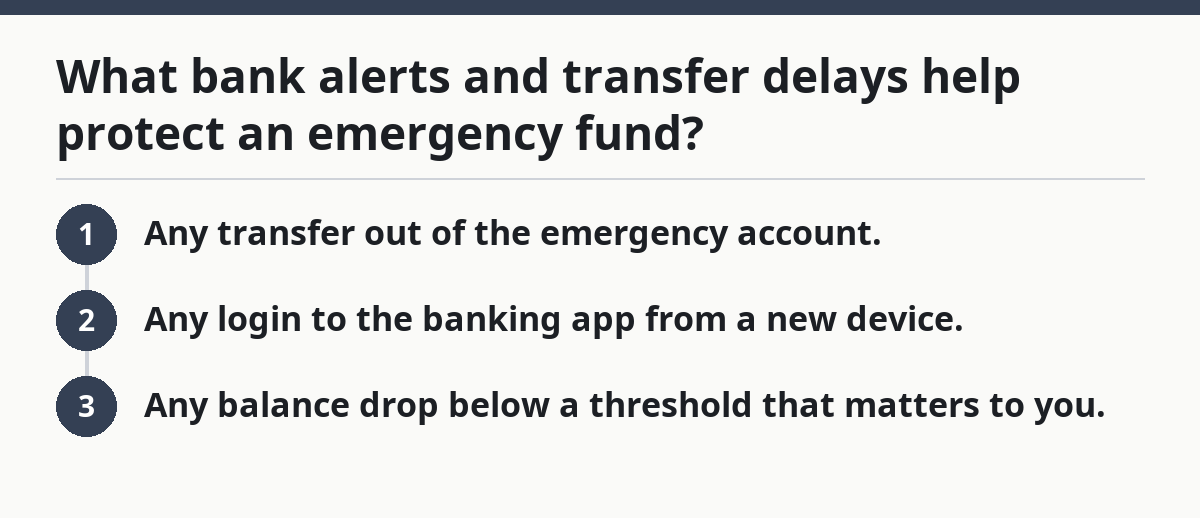
Even a simple text alert can interrupt the “I’ll just move a little” mindset. The message arrives, you see the account name, and the withdrawal stops being invisible.
A transfer delay is the second layer. If your bank offers same-day transfers between your own accounts, do not use that feature for impulse-prone money. Instead, decide that withdrawals require a 24-hour waiting period unless the expense is a true emergency. If the bank has an external transfer hold or processing time, that helps too, but do not rely on it as your only barrier because many transfers between your own accounts can still happen quickly.
One honest limitation: alerts do not stop you if you are determined and impatient. They only give you a second chance. That is why they work best when paired with a rule and a separate account.
What success looks like: when you consider a withdrawal, you first receive a message, then you have to wait, then you reconsider.
If the bank app lets you set daily transfer limits, use them. A lower limit can keep a “temporary loan” from turning into a large raid. This is a good fit for people who know their weak spot is the amount, not the decision itself.
For a deeper reference point, consumer banking education from the Consumer Financial Protection Bureau and similar organizations often explains how account alerts and transfer controls help reduce errors and unauthorized activity. The language is different across banks, but the behavior goal is the same.
Nickname labels and visual barriers make the fund feel off-limits
Nickname labels and visual barriers work because money is easier to spend when it feels generic. A balance called “Savings” invites borrowing. A balance called “Emergency: rent, car, medical only” feels narrower and more serious.
Use the app’s nickname field if it has one. If the bank does not support custom names, write the purpose in a note outside the app and keep it visible where you review money, such as on a budgeting sheet or a phone note. The key is repetition: every time you check the balance, the purpose should hit you first.
A visual barrier can be as simple as removing the emergency account from the front page of your banking app. Some apps allow you to hide accounts or reorder them. If you cannot hide it, at least move it below checking and bills. Put the most spendable money where your eyes land first, and the protected money where it takes effort to find.
This is not about shame. It is about reducing casual access. People rarely rob their emergency fund in one dramatic moment. More often they make three small decisions: “I deserve this,” “I’ll pay it back next week,” and “It’s only $80.” Visual barriers interrupt that chain.
What success looks like: the account name and balance no longer feel like available spending money.
The trade-off is that strong visual barriers can make the money easier to forget. That is a problem if you are trying to build the habit of saving. It is not a problem if your main threat is spending the money too early. If you are a chronic impulse spender, hiding the balance is usually smarter than displaying it.
Make a budget rule for emergencies only
A budget rule protects an emergency fund when your brain is tired, because it replaces mood-based judgment with a simple test. If the expense does not fit the rule, the money stays put.
A short rule is easier to remember, and a narrow rule is easier to use. For example: “Use this fund only for unplanned expenses that threaten housing, transportation, health, or income.” That covers the purpose without turning the fund into a catch-all account for wish lists.
A weak rule is “Use it when needed.” That sounds responsible but gives you no line to hold. A better rule names what counts and what does not count. A broken phone may or may not qualify depending on whether it affects work or safety. A sale on a new phone usually does not. A repair that keeps you working probably does.
Write the rule somewhere visible and attach a 24-hour review to it. If the expense still feels urgent after one full day, look again with a clear head. If you are still unsure, ask a person you trust to sanity-check the decision. For a financial choice that affects your buffer, a second opinion is often cheaper than a mistake.
What success looks like: you can say yes or no to a withdrawal without improvising a definition in the moment.
This is also where the biggest honest drawback shows up. A rule can be too strict if it blocks a genuine emergency. If your car repair keeps you from getting to work, the fund is doing its job. If the rule is so tight that you cannot use the money when life actually breaks, loosen the language, not the discipline.
For a more formal perspective, consumer finance guidance from the Consumer Financial Protection Bureau and reputable credit union education pages often emphasize setting clear purposes and guardrails for savings accounts. The exact wording is yours to choose.
Common mistakes that drain the fund anyway
The most common mistake is mixing the emergency fund with everyday cash, which turns it into backup checking and drains it fast. The fix is separate accounts and a no-card setup.
Another mistake is calling every annoyance an emergency. A holiday sale, a dinner out, or a nicer phone case is not an emergency just because it feels urgent at 9 p.m. The cost of that mistake is obvious: the fund disappears before a real problem arrives. Use your written rule and the 24-hour delay to slow the decision down.
A third mistake is keeping the fund too visible. If the balance sits right next to your spending account and your checking balance in the same app screen, it becomes mental spending money. Move it out of sight or change the display order.
A fourth mistake is using one big account for both reserve money and planned short-term goals. A vacation fund, holiday fund, and emergency fund should not share one unlabeled pile if impulse spending is the risk. Separate buckets make the purpose of each dollar clearer.
What success looks like: the emergency fund stays available for the unexpected instead of becoming the first place you tap for ordinary wants.
The right amount of friction depends on your habits. If impulse spending is a rare issue, a separate savings bucket and alerts may be enough. If it happens often, use a separate bank, no card access, and a 24-hour rule. That stronger setup is not for people who need instant access for frequent true emergencies, but it is right for anyone who keeps “borrowing” from savings.
Keep the barrier system working month after month
The system keeps working when you review it every 1 to 3 months and tighten any weak spot before it becomes a habit. Protection is not a one-time setup; it is maintenance.
Check three things on a regular schedule:
- Are the alerts still turned on?
- Does the account still have a clear nickname label?
- Is the transfer delay still enough to stop quick decisions?
If your bank changed its app or renamed features, re-set the controls. Banking interfaces change often, and a setting that used to be obvious can disappear behind a new menu. If you changed jobs, moved, or had a major life event, revisit the budget rule too. A car-dependent commute, for example, makes transportation emergencies more likely and changes what the fund needs to cover.
What success looks like: the fund still feels protected even after the novelty of setting it up has worn off.
The goal is not to make the money untouchable. It is to make every withdrawal deliberate, visible, and rare. That balance is what keeps the fund useful when life turns.
How do I stop myself from using emergency savings for non-emergencies?
Use a separate account, alerts, and a 24-hour delay before any withdrawal. That combination interrupts the urge long enough for the decision to become rational instead of emotional. A written budget rule helps too, because it gives you one standard instead of deciding case by case.
What barriers help protect emergency savings?
The strongest barriers are a separate savings bucket, a nickname label that says what the fund is for, bank alerts for withdrawals, and a transfer delay of at least 24 hours. A no-card account adds another layer. If impulse spending is frequent, keep the fund at a different bank so it is harder to raid.
Should I hide my emergency fund?
Hide it if seeing the balance makes you more likely to spend it. A hidden or less visible account can reduce temptation, especially when the fund sits inside the same banking app as your everyday money. Do not hide it so well that you forget it exists; review it every 1 to 3 months.
Drafted with AI; not yet reviewed by a person.