
Last updated: November 19, 2026
In short: build a starter emergency fund by setting one 30-day target, moving a small amount from each paycheck into a separate cash buffer, and using quick wins like a one-time windfall or a short side income push to reach the first milestone. Keep the goal small enough that you can hit it in a month without wrecking your budget.
A starter emergency fund is the first layer of protection for short, surprise bills. It is not your full long-term fund. It is the money that keeps a flat tire, an urgent copay, or a broken appliance from turning into a crisis. If you need a simple plan, this one is designed to work with a normal paycheck, a real budget, and 30 days on the calendar.
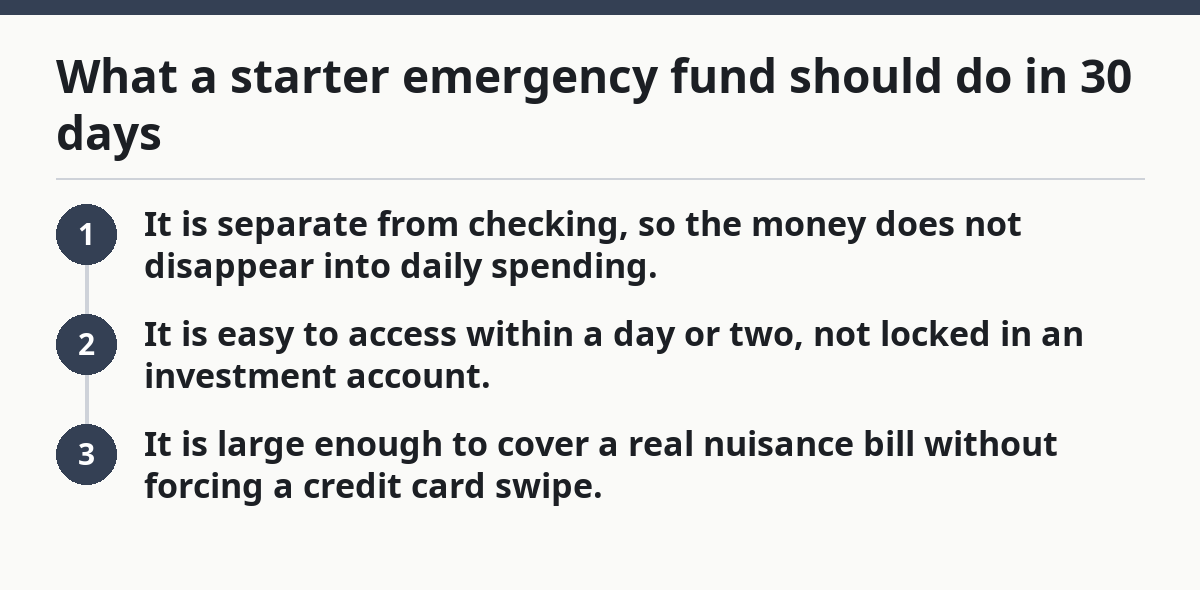
What a starter emergency fund should do in 30 days
A starter emergency fund should get you to a small, reachable cash buffer fast enough to matter. The job is not perfection; the job is to create breathing room before the next surprise bill lands.
Start by choosing a number you can actually hit in 30 days. For many people, that means one paycheck gap, one month of bare-bones bills, or a few hundred dollars set aside in a separate savings account. The exact amount depends on income stability, rent, debt payments, and how thin your budget already is. If your hours swing from week to week, the starter fund needs to be smaller and faster to build.
A good starter fund has three traits:
- It is separate from checking, so the money does not disappear into daily spending.
- It is easy to access within a day or two, not locked in an investment account.
- It is large enough to cover a real nuisance bill without forcing a credit card swipe.
That third point matters. A starter fund is meant to reduce stress, not solve every financial problem. It is a first milestone, not the final destination. If you have no cushion at all, even a modest target can change the way the next emergency hits.
The main trade-off is speed versus size. A larger target feels safer, but a target that is too ambitious can stall for months. A smaller target can be finished in 30 days and gives you momentum. For this article, I would rather have you finish a smaller fund than quit halfway through a larger one.
If you want the broader framework after this first milestone, the hub on emergency fund building methods can sit behind this page. This guide stays on the 30-day starter plan.
How do I build a starter emergency fund in 30 days?
You build a starter emergency fund in 30 days by combining paycheck transfers, budget cuts, and one-time money into a single short plan. A workable version is: decide the target on day 1, automate a transfer from each paycheck, cut three to five expenses for 30 days, and send any windfall straight to the fund.
Here is the core procedure in order.
-
Pick the first-milestone number on day 1.
Choose a target that fits your situation, such as $300, $500, or one essential bill cycle. Put the number in writing. When this step works, you can say exactly how much has to land in the account by day 30. -
Open or label one separate savings account.
Use an account that is not tied to daily spending. If you already have one, rename it in your mind and on paper as your emergency fund so the purpose stays clear. When this step works, the money has a home that is not your checking account. -
Break the target into weekly or per-paycheck amounts.
If you are paid every 2 weeks, divide the target by the number of paydays left in the month. If you are paid weekly, divide it by 4. When this step works, the goal no longer feels like one giant number; it becomes a series of smaller transfers. -
Set an automatic savings transfer for each paycheck.
Move the money on the day you are paid, or the next business day if your bank requires it. A transfer that happens before you spend is more reliable than one you “remember” to do later. When this step works, the cash buffer starts growing without extra decisions. -
Cut 3 to 5 spending leaks for 30 days.
Pause one subscription, make coffee at home, skip delivery, or cap dining out at a fixed amount. The point is not misery; it is a temporary margin. When this step works, your budget has slack that can feed the fund. -
Add one quick win from side income or a windfall.
Sell an unused item, take one extra shift, cash a small refund, or direct a bonus into the fund. Put the entire amount into the account instead of splitting it. When this step works, one action can cover a large chunk of the target. -
Protect the fund from being spent on non-emergencies.
Write down what counts: urgent repair, medical bill, job loss gap, or similar necessity. A sale or a want does not count. When this step works, the fund stays intact long enough to matter.
That is the short version. The reason it works is simple: the plan does not depend on motivation every day. It uses the paycheck schedule, the budget you already live on, and any unexpected money that shows up during the month.
What should I do first if I have no emergency savings?
You should start by stopping the leak in your budget and creating a tiny first buffer, even if it is only $25 to $100. If you begin with a huge goal and no structure, the month can pass with nothing moved.
The first move is to find money that is already available this week. Look at your paycheck schedule, then check the next 7 days of spending. You are looking for one immediate cut and one immediate transfer. The cut makes room; the transfer makes the fund real.
A practical first-day sequence looks like this:
- Check the next payday and decide the amount that can move within 24 hours.
- Review the current budget for one expense you can pause for 30 days.
- Create the separate savings account or designate one you already have.
- Transfer the first amount immediately, even if it is small.
That first deposit matters more than the perfect target. A $50 transfer on day 1 creates motion. A $500 target that never starts creates frustration. If you are starting from zero, the account balance can feel embarrassingly small for a few days. That is normal. The point is to establish the habit and the separate place for the money.
This is also where people make a common mistake: they wait for a windfall before they start. That can cost a full month of progress. Windfalls are useful, but they are not a starting requirement. If a tax refund, bonus, or gift arrives, it can speed things up. It should not be the reason the plan begins.
Another mistake is using a credit card as the “plan” instead of a cash buffer. That can solve one bill and create another. A starter fund is meant to reduce dependence on borrowing for small shocks.
If your income is unstable, keep the first step tiny and fast. A smaller target with a 30-day deadline is better than a larger target that demands a perfect month. The plan can be revised upward later, after the first cushion exists.
How do I use each paycheck without wrecking my budget?

You use each paycheck by giving the fund a fixed slice before the rest of your spending gets a vote. The simplest version is to assign the same dollar amount to every paycheck until day 30, then let the final transfer catch up any gap.
If that helps, think in percentages. The important part is the order. The transfer comes first, then the budget. If your paycheck lands on Friday, move the emergency amount that day or the next morning. If you wait until the end of the week, you are asking leftover money to survive 7 days of regular life, and that often fails.
A clean 30-day structure looks like this:
- Paycheck 1: move the first installment to the emergency fund.
- Paycheck 2: move the second installment.
- Paycheck 3, if you have one: finish the target or close the gap.
- Any extra cash during the month: go straight to the fund.
To avoid wrecking the budget, lower spending in just a few categories instead of trimming everything. Restaurant meals, subscriptions, convenience purchases, and impulse buys are often the easiest to delay for 30 days. If one category is already tight, do not squeeze it harder than the month can bear. Move to a different category.
The trade-off here is clear: a sharper cut today can feel uncomfortable, but it keeps the emergency fund from competing with rent or groceries. The goal is not to make the month perfectly lean. The goal is to reroute a little cash each pay cycle into a protected bucket.
One useful rule: do not rely on the same money twice. If a bill is already committed to rent, groceries, or transit, leave it alone. Use uncommitted cash, side income, or temporary cuts. That keeps the plan honest and, if you are unsure how to classify a deposit or transfer, it is worth checking with a financial professional or a trusted banking resource so the fund is recorded correctly. Consumer Financial Protection Bureau explains basic savings habits that support this kind of setup.
Quick wins that can fill the gap faster
Quick wins can fill the gap faster because they add money outside the normal paycheck rhythm. The usable ones are simple, legal, and possible within 30 days. FDIC also emphasizes using insured deposit accounts for cash you may need quickly.
A useful quick-win list includes:
- Selling items you no longer use, such as small electronics, tools, or furniture.
- Taking one extra shift or a short freelance task.
- Routing a tax refund, bonus, or rebate directly into the account.
- Pausing a subscription and moving that freed-up amount for the month.
- Using a one-time cash gift for the fund instead of spending it elsewhere.
The point is not to build a side hustle empire in 30 days. The point is to create one or two lump sums that shorten the path to the target. If you can sell three items and free up a modest amount of cash, that may cover an entire weekly transfer. If you can add one overtime shift, that may finish the fund early.
There is a catch: quick wins are uneven. Some people can sell items easily; others cannot. Some can pick up extra hours; others have fixed schedules or caregiving limits. If that is your situation, do not force the issue. Use the regular paycheck plan and keep the target smaller. The 30-day goal should fit your life, not punish it.
Also, do not confuse a windfall with extra spending money. A windfall is the cleanest source of starter-fund money because it is unplanned. It is also the easiest money to let drift. The clearest use for it is immediate transfer, not slow decision-making.
If you have to choose between a quick win and a bigger budget cut, pick the one you can complete this week. Fast action beats theoretical savings that never happen.
What mistakes slow down a 30-day emergency fund?
The biggest mistakes are setting the target too high, keeping the money in checking, and waiting for “extra” money that never arrives. Each one costs time, and time is the whole game in a 30-day plan.
A too-large target can make the fund feel impossible. If you tell yourself you need several months of expenses before you can start, the first transfer may never happen. That belongs to a long-term plan, not a starter fund. For this 30-day version, a smaller first milestone is the better choice.
Keeping the money in checking is another problem. It makes the cash too easy to spend on something non-urgent. A separate savings account or clearly labeled bucket creates friction, and friction helps protect the balance.
Waiting for a windfall is a third mistake. A bonus or refund can help, but the month cannot depend on one event that may not show up. Build the fund around ordinary paychecks first, then use any surprise money to close the gap.
The fourth mistake is trying to fund everything at once. If you are also paying down debt, starting multiple goals at full speed can stretch your budget thin. For this short plan, the emergency cushion gets priority because it reduces the chance that one problem creates a second one. That said, this page is not a substitute for a full debt plan or a long-term savings plan.
The honest limitation of this method is that it may only create a small buffer. That is fine. A starter emergency fund is not meant to solve every financial shock. It is meant to get you past the first hit. If you need a more complete roadmap after the first 30 days, the emergency fund building methods hub is the next stop.
What should happen on day 30?
By day 30, you should have a separate cash buffer with a clearly defined first milestone sitting in it. If the target is not fully reached, you should still have a live plan, a partial balance, and a clear next deposit date.
The clearest end state is simple:
- The money exists in a separate account.
- The balance is enough to handle one modest emergency without borrowing.
- The plan for the next 30 days is already written down.
If you hit the full target early, do not stop the habit. Keep the transfer going until you have enough to handle a slightly larger surprise, then move to the next stage. If you miss the full target, do not treat that as failure. A partial fund is still useful. A $200 buffer can soften a repair bill or a gap in income much better than zero.
What matters most after day 30 is consistency. A starter fund works only if you protect it and continue adding to it. The first month is about proving that you can build the habit under real conditions, not ideal ones.
Key takeaways
- Pick a small first milestone you can finish in 30 days, not a long-term target you will abandon.
- Move money from each paycheck before it gets mixed into day-to-day spending.
- Use one-time cash, extra shifts, or small item sales to speed up the fund.
- Keep the money separate from checking so it stays available when a real emergency shows up.
- A partial buffer is still worth having; the first win matters more than a perfect plan.
What is a starter emergency fund?
A starter emergency fund is a small cash buffer set aside for urgent, unexpected costs.
Drafted with AI; not yet reviewed by a person.