
Last updated: November 19, 2026
Key Takeaways
- Set the goal from your possible layoff date, not a generic savings rule.
- Cover the gap until replacement income actually starts.
- Subtract only verified cash that will arrive on time.
- Turn the uncertainty into fixed, step-by-step decisions.
If you expect a layoff, How to Set an Emergency Fund Goal If You Expect a Layoff starts with the gap between your last paycheck and the first bill you must still cover. The quick answer: for many readers, the right emergency fund goal is 1 to 3 months of essential spending after subtracting verified severance, final pay, and unemployment timing, but you should confirm the numbers with a financial professional if your situation is complicated. In a layoff-risk plan, that usually means counting your severance, your unemployment benefits timing, and the monthly costs you cannot cut fast enough.
Set the layoff-risk plan before you count a single dollar

A layoff-risk plan starts with the date your income could stop, not with a vague “six months of expenses” rule. If a manager has hinted at restructuring, a contract is ending, or your company is freezing hiring and trimming teams, the first job is to map the runway between today and the first stable paycheck after a layoff.
However, the emergency fund is really one piece of a larger bridge. That bridge includes severance, unemployment benefits, health insurance premiums, and the time it may take to find work in your field. If you ignore any one of those, your goal will be off.
A layoff-risk plan is not for someone with a fully secure job and no warning signs. It is for the person who can see the cliff edge coming and wants a number that reflects reality. If the risk is real, the plan should be concrete enough to use in a spreadsheet tonight, and if you are unsure how to weigh the risk, a financial professional can help.
Here is the first pass:
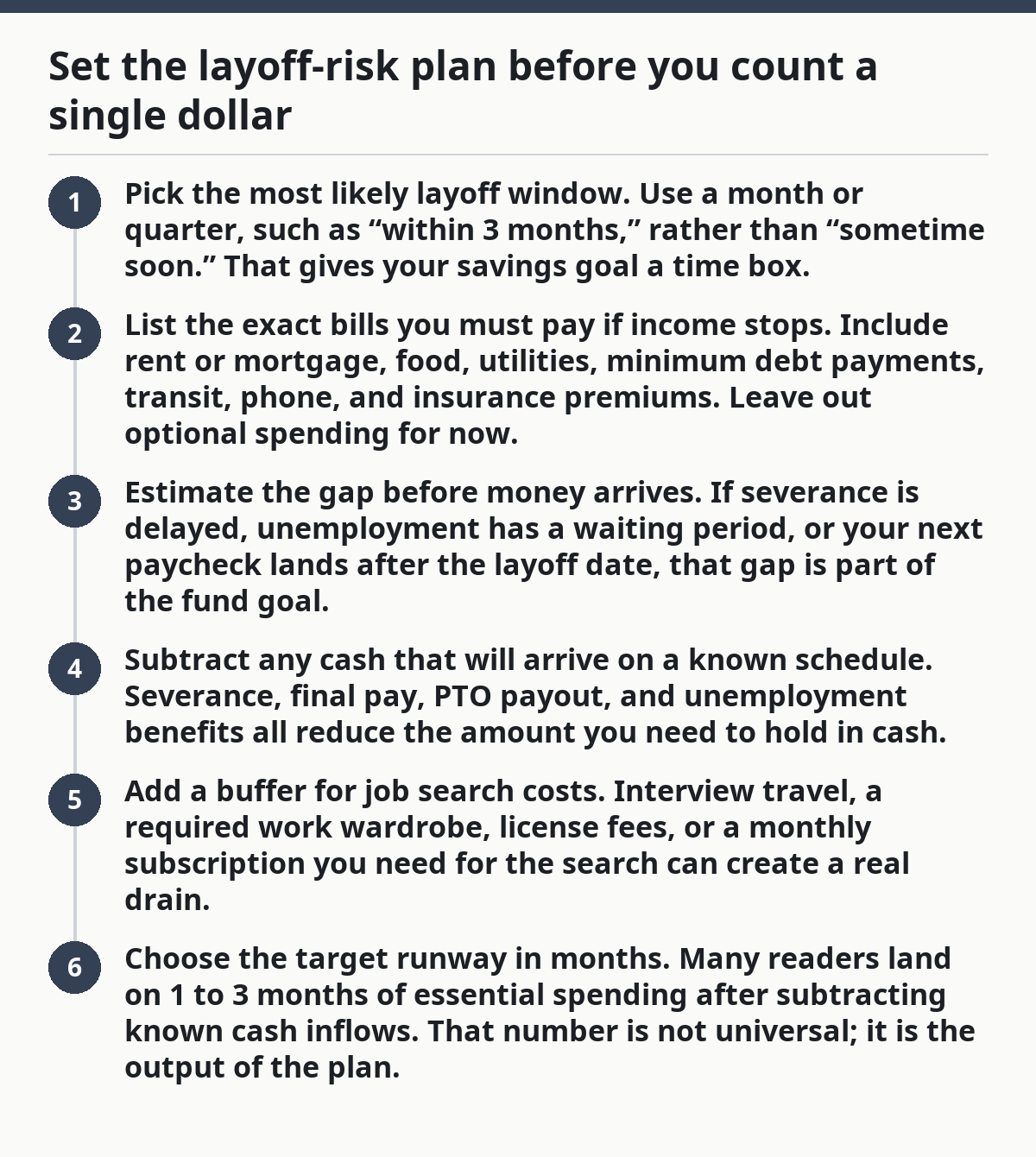
- Pick the most likely layoff window. Use a month or quarter, such as “within 3 months,” rather than “sometime soon.” That gives your savings goal a time box.
- List the exact bills you must pay if income stops. Include rent or mortgage, food, utilities, minimum debt payments, transit, phone, and insurance premiums. Leave out optional spending for now.
- Estimate the gap before money arrives. If severance is delayed, unemployment has a waiting period, or your next paycheck lands after the layoff date, that gap is part of the fund goal.
- Subtract any cash that will arrive on a known schedule. Severance, final pay, PTO payout, and unemployment benefits all reduce the amount you need to hold in cash.
- Add a buffer for job search costs. Interview travel, a required work wardrobe, license fees, or a monthly subscription you need for the search can create a real drain.
- Choose the target runway in months. Many readers land on 1 to 3 months of essential spending after subtracting known cash inflows. That number is not universal; it is the output of the plan.
If you want the broader framework behind that math, the hub article on how much emergency fund you need can sit beside this one.
How much cash do you need before the layoff date?
Therefore, you need enough cash to cover the months when your income is uncertain and your replacement money has not arrived yet. The right goal is not “as much as possible.” It is the amount that lets you pay essentials while you wait for severance, unemployment benefits, or a new job.
The common error is to build a fund based on gross salary. That inflates the target. Salary is not what keeps the lights on; required monthly spending does. A person making a high income can still be underprepared if their rent, car payment, and insurance total a large fixed amount. A person with a modest salary can be better prepared if their monthly essentials are lean.
Next, use this approach:
- Start with one month of bare-bones spending. List only the bills that would keep your household running for 30 days. For many people, that is rent, utilities, groceries, transportation, minimum debt payments, and insurance.
- Mark which costs disappear in a layoff. Commuting, dry cleaning, child care tied to work hours, and workplace meals may drop immediately. Remove them from the target.
- Mark which costs get worse. Health insurance, prescription copays, and interview expenses may rise, not fall.
- Count known incoming money by timing, not just by total. A severance package that arrives after 2 weeks helps less than one that lands on day 1. Unemployment benefits usually matter only after any waiting period and processing delay.
- Set a floor and a ceiling. The floor is the cash needed before the first replacement income arrives. The ceiling is the amount needed if the job search takes longer than expected.
- Choose the higher of the two if your industry is unstable. In fields with slow hiring or narrow roles, the job-search runway matters more than a neat formula.
A practical target often looks like this: essential monthly spending times the number of months you realistically need to bridge, minus severance and expected unemployment benefits that arrive in time. The result may be lower than a generic emergency-fund rule, or higher if your benefits start late.
This is one of the few times where precision pays. A spare $500 matters less than knowing whether your first hard stop is 30 days, 60 days, or 90 days away. For a personalized estimate, a financial professional can help.
What should you subtract for severance, unemployment benefits, and final pay?

However, you should subtract only the money you are confident will arrive on time and in a usable amount. Severance, unemployment benefits, and final pay can shrink your cash target, but each one has timing risk, eligibility rules, or tax effects that make overconfidence expensive.
Severance is the easiest place to make a mistake. If your employer offers 2 weeks or 8 weeks of pay, that does not mean the money is instantly available for rent. Some companies pay it on the normal payroll cycle, some require a signed release, and some spread it across several pay periods. If your layoff date is near the end of the month, timing matters as much as the dollar amount.
Unemployment benefits are also not immediate. In many places, there can be a waiting period, a claim-processing delay, or a pause if paperwork is incomplete. That means unemployment benefits should reduce your emergency fund goal only after you account for the first several weeks with no deposit. The U.S. Department of Labor notes that state systems and waiting periods vary, so check your state rules before you count the money. See U.S. Department of Labor unemployment insurance information and USA.gov unemployment benefits.
Final pay and accrued PTO can help, but they are often smaller than people expect once taxes are withheld. They are useful in the math, not safe enough to treat as the full plan, and a benefits or tax professional can help if you are unsure how much will actually land in your account.
A clean way to count these dollars is:
- Count severance at the amount and timing you can reasonably verify.
- Count unemployment only after the waiting period and only at the likely weekly amount.
- Count final pay and PTO payout as one-time offsets, not recurring income.
- Do not count future bonuses, commissions, or a “maybe” freelance gig.
This is the point where many plans get too optimistic. If you count every possible dollar at face value, your savings goal shrinks on paper and grows painful in real life. A better approach is to treat uncertain money as delayed money until it shows up.
For a reader facing a possible layoff, a conservative plan is usually smarter than a precise but fragile one. If the number feels tight, that is a signal to save more cash, cut more spending, or start the job search earlier.
How do you budget for a job loss you can see coming?
Because of that, you budget for a visible job loss by cutting recurring spending now, before the paycheck disappears, and by using a 30-day or 60-day runway plan that tells you what to do first. The goal is to turn uncertainty into a sequence of fixed decisions.
This is where expense triage matters. Triage means deciding what stays, what pauses, and what gets canceled if income stops. A generic budget review is too slow. A layoff-risk plan needs you to sort spending into three buckets in one sitting.
Then, use this list:
- Keep: rent or mortgage, utilities, groceries, transportation to interviews, minimum debt payments, core insurance, child care you cannot remove.
- Pause: subscriptions, app renewals, gym memberships, extra data plans, nonessential shopping, dining out.
- Cut fast if needed: vacations, large home projects, premium cable or streaming bundles, impulse purchases, and any recurring cost that can be removed in under 24 hours.
The job search itself also belongs in the budget. A few concrete costs are common: a resume review, printing, interview clothes, transit fares, parking, and, if you are in a specialized field, a paid certification or license renewal. Those are not luxury items if they help you shorten the unemployment gap.
A useful move is to build two monthly numbers. The first is your survival budget, which covers only must-pay items. The second is your search budget, which adds the costs of finding the next job. Your emergency fund goal should cover both if the layoff is likely to last more than a couple of weeks.
A 30-day plan works well for many people:
- Freeze nonessential spending today.
- Move any spare cash into the emergency account within 1 business day.
- List bills due in the next 30 days.
- Call or log into lenders, insurers, and service providers before payments are missed.
- Start the job search before the layoff date if possible.
That sequence beats waiting until the final day. The money you save before a layoff is usually more valuable than the same dollar saved after income stops, because it buys time, calm, and options.
What does health insurance change in your emergency fund goal?
Meanwhile, health insurance can raise your emergency fund goal quickly because the premium, deductible, and out-of-pocket costs may shift when your employer coverage ends. If you expect a layoff, do not treat health coverage as a side note; it can become one of the largest line items in the runway, and a benefits adviser or insurance professional can help you check the numbers.
This is one area where the gap can surprise people. Employer coverage often feels invisible until it ends. Once it does, you may face a monthly premium, a shorter payment deadline, and higher prescription or visit costs. Even if you qualify for a continuation option such as COBRA in the United States, the price can be much higher than the employee share you were used to paying. That reality can change the cash target by hundreds of dollars a month, though the exact amount depends on the plan.
Your emergency fund should cover whatever insurance costs hit before the next stable paycheck. That may include:
- The monthly premium under a continuation plan
- Prescription refills you need during the transition
- Deductible expenses if care is already scheduled
- A buffer for a new plan with different coverage rules
A good rule is to check the insurance transition before you finalize the savings goal. If your layoff is expected, ask for the plan documents now, not after the separation date. You are looking for the premium amount, payment deadline, and the last day of active coverage.
This matters because a job-loss runway is not only about rent and groceries. A single medical bill can break a budget that looked fine on paper. If your household has ongoing care, a chronic condition, or planned treatment, the insurance piece deserves its own line in the plan, and professional advice is worth considering if the coverage choice is unclear.
This is also where a professional consultation can help. A benefits administrator, HR representative, or licensed insurance broker can clarify what happens to your coverage after separation. The emergency fund goal should reflect that answer, not guesswork.
How to choose a target you can actually build in 30 to 90 days
Ultimately, you can choose a realistic target by working backward from the layoff date and deciding what you can save before income changes. If you have 90 days, your emergency fund goal should be ambitious but reachable, not perfect on paper and impossible in practice.
The trap here is aiming for a full 6-month cushion when the layoff is already close. That may be the right long-term target, but it is a poor short-term one if it prevents action. A better plan splits the job into two stages: a pre-layoff goal and a post-layoff rebuild plan.
So, try this:
- Set the minimum viable target. This is the amount that covers the first 30 days of essentials after the layoff, plus any health insurance premium you know is coming.
- Set the stronger target. This covers 60 to 90 days of essentials, minus severance and expected unemployment benefits that will arrive in time.
- Compare each target to your current cash. The gap tells you whether you need a spending cut, a savings boost, or a faster job search.
- Pick the target you can hit before the layoff date. If you can save $2,000 in 8 weeks but not $6,000, the smaller target is the right pre-layoff goal.
- Plan the rebuild after separation. Once unemployment benefits and any severance are in motion, you can revise the fund goal for the longer term.
This is the honest trade-off: a smaller target is better than no target, but too small a target can create panic if the layoff lasts longer than expected. A larger target is safer, but only if it does not delay your job search or force you to drain retirement money, rack up credit card balances, or ignore fixed bills.
The best layoff-risk plan is the one that matches your timeline. If the layoff is a possibility rather than a certainty, your job is to buy time without freezing the rest of your finances.
What not to do when you expect a layoff
However, do not count on optimistic numbers, because that creates a false sense of safety and can leave you short on day 1. The most common mistake is assuming severance, unemployment benefits, and final pay all arrive quickly enough to replace a cash cushion. They often do not.
Three costly mistakes show up again and again:
- Using salary instead of essentials. That makes the goal too high in some cases and oddly too low in others, because salary does not show fixed bills or insurance costs.
- Counting uncertain income too early. A future freelance project, bonus, or quick job offer is not the same as money already in the bank.
- Ignoring the job-search runway. Interview costs and coverage gaps can eat cash even when the rent is covered.
The correction is simple, though not always comfortable. Build the fund around the bills that do not wait, subtract only the money you can reasonably verify, and keep the search moving while the cash cushion is still intact.
One more hard truth: if your emergency fund goal is so aggressive that you cannot save anything before the layoff, it may be the wrong near-term goal.
Drafted with AI; not yet reviewed by a person.