Last updated: November 19, 2026
Quick answer: for Where to Keep and Structure Emergency Savings, start with a separate emergency account that can be accessed in 1 to 3 business days, keep a small first layer available right away, and place the rest in an insured savings account or another cash bucket that is harder to spend by accident. The right setup is boring on purpose.
This guide answers the question most people really have: where should emergency savings live so they are safe, accessible, and not too tempting to spend? The best answer is usually not one account. It is a structure for Where to Keep and Structure Emergency Savings.
A plain checking account is too easy to drain. An investment account can drop in value right when you need the money. A mattress is not a plan. The sweet spot is usually a high-yield savings account, or a combination of savings and cash-like accounts, built around the speed of a real emergency.
Start with the fastest workable setup
Start with the fastest workable setup by putting the first layer of emergency cash in a high-yield savings account at an FDIC- or NCUA-insured institution, then keep your checking account for day-to-day bills and use a second savings bucket for anything beyond the first month of expenses. A simple setup is enough to start.
Here is the order that works:
-
Open one separate savings account for emergencies.
Pick an account that is not tied to your spending debit card if possible. When it works, you should be able to log in and see a separate balance labeled for emergencies, not a pile of general cash. -
Move your first target amount there.
For many households, that first target is often $500 to $1,000, because it covers many car repairs, copays, and travel changes without forcing a credit card decision. -
Automate a transfer on payday.
Even $25 or $50 per paycheck matters. When the transfer is visible on a schedule, the plan is working. When it stalls for months, the plan is not actually a plan. -
Keep the money easy to reach, but not too easy.
A transfer that takes 1 to 3 business days is usually fast enough for a true emergency and slow enough to discourage impulse spending. If the account has a debit card attached, that often makes it too easy to use. -
Build a second layer after the first one is funded.
Once the first cushion exists, add a larger reserve for job loss or a long repair cycle. That second layer can stay in the same bank or a different one, as long as it is clearly labeled and not mixed with sinking funds for vacations or yearly insurance bills.
When this setup works, you should see three things: your checking account stays cleaner, the emergency balance grows without constant effort, and you do not have to decide from scratch every time a surprise bill arrives.
What kind of account should hold emergency money?

A high-yield savings account is the usual default because it keeps principal safe, pays some interest, and lets you withdraw without market risk. A money market deposit account can also work, but a money market mutual fund is not the same thing and may not be the right choice for money you truly need to preserve.
The main contenders are:
- High-yield savings account: usually best for most people
- Money market deposit account: good if the terms are competitive and the account is easy to use
- Money market mutual fund: better for some cash management setups, but not the first choice for an emergency reserve
- Regular savings account: acceptable if convenience matters more than rate
- Checking account: only for the very small first layer or the portion you need instantly
- Brokerage account: not appropriate for core emergency funds because market losses can hit at the worst moment
The question is not which account has the highest advertised rate. The question is which one behaves correctly when life goes sideways. A savings account at an insured bank or credit union is usually the simplest answer.
A useful standard to check is FDIC insurance for banks and NCUA insurance for credit unions. Those protections are capped per depositor, per institution, and by ownership category. If your balance is above the insured limit, or if you have multiple accounts at the same institution, the exact coverage math matters. The FDIC and NCUA both explain that structure on their official sites, and that is worth checking before you park a large balance in one place.
If you want the official sources, start here:
- FDIC deposit insurance overview: https://www.fdic.gov/resources/deposit-insurance/
- NCUA share insurance overview: https://www.ncua.gov/support-services/share-insurance-fund
These are the kinds of pages worth reading before you move a large reserve.
For related guidance on cash placement, see also our guides on high-yield savings accounts, money market accounts, and checking account basics.
How should emergency savings be structured?
Structure it in layers: immediate cash, near-cash, and long-term backup, with each layer assigned a job. That keeps you from raiding the wrong pot when a bill shows up.
A practical structure looks like this:
Layer 1: instant access money
This is the amount that covers the first surprise, usually a few hundred dollars up to one month of bare-bones expenses for many households. Keep it in a savings account you can transfer from quickly, or in checking if you need same-day access.
This layer should handle:
- a flat tire
- an urgent prescription
- a small appliance failure
- a same-week travel change
The goal is not return. The goal is speed. If the money is in a place where you hesitate, the structure is wrong.
Layer 2: true emergency reserve
This is the larger fund for job loss, medical gaps, major car work, or a move you did not plan. It usually belongs in a separate savings account, sometimes at a different institution from your everyday bank.
This layer should handle:
- 1 to 3 months of essential expenses for a starter reserve
- more if your income is irregular, your household has one earner, or you have dependents
- replacement of the first layer after it gets used
The exact target depends on income stability. A salaried worker with a long runway and two earners can sometimes hold less than a self-employed household with seasonal income. That is not a moral judgment; it is a cash-flow reality.
Layer 3: known-but-irregular bills
This is not emergency money, even though people often mix it in. Car registration, deductibles, annual insurance, school costs, and holiday travel should usually sit in separate sinking funds so they do not blur the emergency line.
If you use one account for everything, the balance may look healthy while half of it is already spoken for. That is a common and costly mistake.
A clean structure has labels. When the labels are working, you should know what the money is for without opening a spreadsheet and guessing.
For practical budgeting help, our related pages on sinking funds and budgeting basics can help keep the layers separate.
How much should be in the first layer?

The first layer should cover one immediate disruption, not your whole life. For many people that means $500 to $2,000, but the right number depends on the bills that actually hit fast in your household.
Use this order to size it:
-
List the 3 most likely urgent costs.
For example: car repair, urgent care copay, and a utility bill catch-up. If the list is impossible to make, start with $500. -
Pick the smallest number that handles a real emergency without making you borrow.
A starter fund that exists is better than a “perfect” target that never gets funded. -
Stop using the first layer for predictable spending.
If the same car repair appears every 8 months, it is a maintenance fund, not an emergency. If annual insurance arrives every year, it is not an emergency either. -
Refill the layer immediately after use.
A working fund is one that comes back after it is spent. If you dip into it and never restore it, the structure is broken.
The common mistake is waiting until the larger goal is complete before treating anything as “done.” That creates a false all-or-nothing setup. A $750 buffer can keep a normal month from turning into debt today, and if you are unsure how much risk you can safely carry, it is reasonable to consult a qualified financial professional. The Consumer Financial Protection Bureau’s emergency-savings guidance also emphasizes starting small and building from there.
Where should you keep emergency savings if you are trying to earn more?
Keep the main fund in an insured savings account, and only move a portion into slightly higher-yield cash products if you fully understand the trade-off between rate, access, and safety. A few extra basis points are not worth losing quick access.
Here is the honest trade-off:
- A higher rate can help your cash keep up a little better with inflation.
- A better rate may come with transfer delays, balance limits, or rules that make the account less useful in a real emergency.
- A brokerage sweep account or money market fund can look attractive, but market behavior and settlement timing make it a worse fit for the core reserve than a bank or credit union savings account.
That means the question is not “Where can this cash earn the most?” It is “What account will still be there, unchanged, when I need it on a stressful Tuesday?”
There is one exception: if your emergency reserve is so large that the balance far exceeds your short-term need, a portion may be better parked in a secondary cash account with stronger yield. Even then, the core amount should stay in the easiest place to access.
Who this is not for: anyone who needs the money within days for a planned expense, anyone who is likely to spend extra cash if it sits in the same app as shopping money, and anyone who is tempted to “invest” the emergency fund because it feels idle. Idle is the point. Emergency money should be boring.
For more on choosing cash products, see our related page on money market accounts and the FDIC and NCUA pages above.
How do you keep emergency money from getting spent by accident?
Separate it from your everyday spending and make the transfer path slightly inconvenient. If you can tap the balance for coffee, the setup is too weak.
Use these controls:
-
No debit card on the emergency account if you can avoid it.
A linked card turns the fund into accessible spending money. That is the opposite of what you want. -
Give the account a clear name in your banking app.
“Emergency fund” works better than “Savings 2.” The label matters when you are tired and stressed. -
Keep the account at a different institution if temptation is a problem.
A separate login adds friction. That friction can save the balance. -
Use automatic transfers, not manual discipline alone.
Discipline is unreliable at 11:30 p.m. when a sale appears online and the checking balance looks roomy. -
Avoid mixing it with sinking funds.
If vacation money and emergency money live together, you will eventually misread the balance and spend the wrong dollars.
A simple test tells you whether the structure is working: if you can explain, in one sentence, what the account is for and why you should not touch it, the setup is probably clear enough.
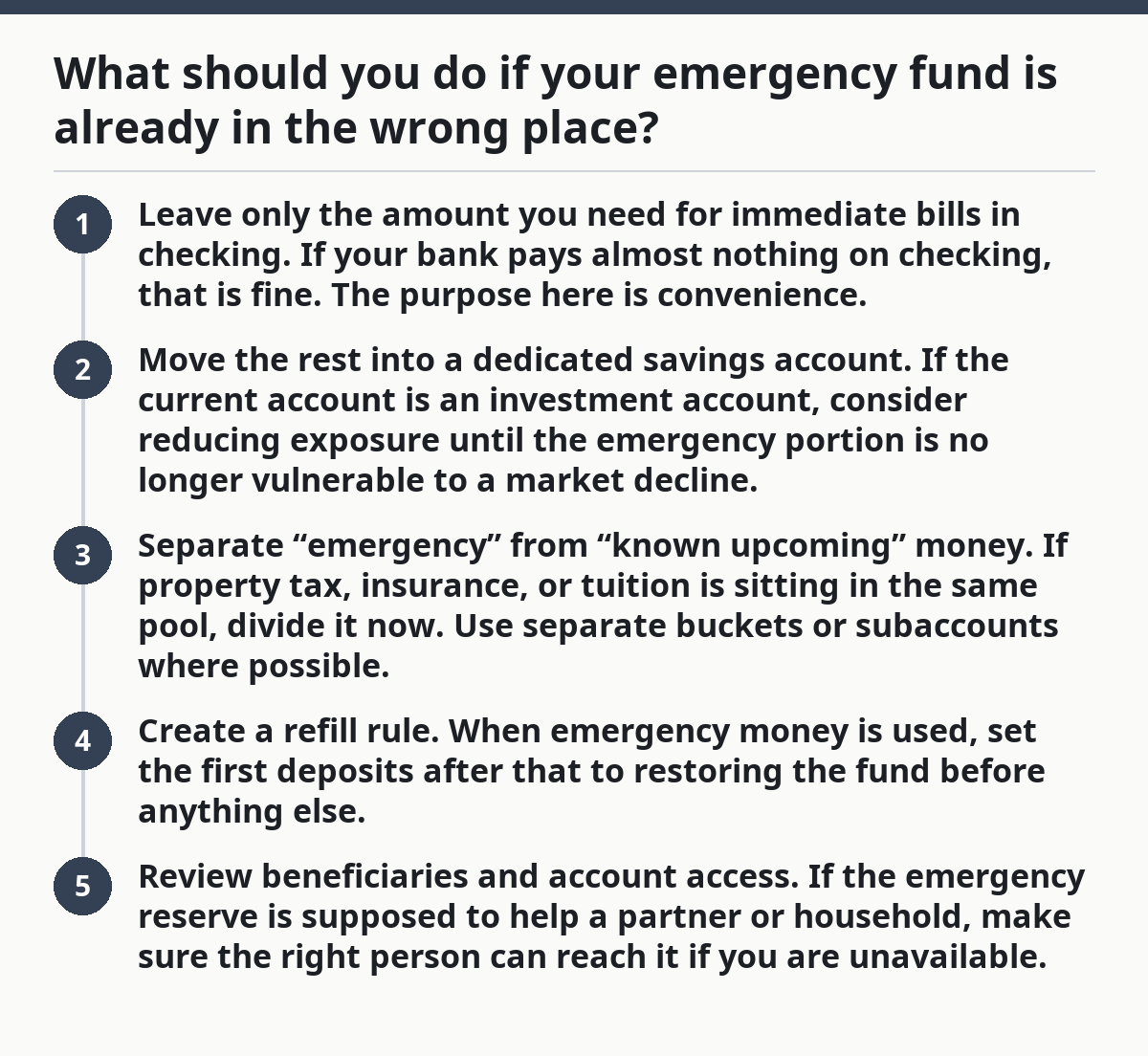
What should you do if your emergency fund is already in the wrong place?
Move it in stages if necessary, but do not leave the money in a risky or hard-to-access place just because moving it feels awkward. The structure matters more than the label on the old account.
A useful migration order is:
-
Leave only the amount you need for immediate bills in checking.
If your bank pays almost nothing on checking, that is fine. The purpose here is convenience. -
Move the rest into a dedicated savings account.
If the current account is an investment account, consider reducing exposure until the emergency portion is no longer vulnerable to a market decline. -
Separate “emergency” from “known upcoming” money.
If property tax, insurance, or tuition is sitting in the same pool, divide it now. Use separate buckets or subaccounts where possible. -
Create a refill rule.
When emergency money is used, set the first deposits after that to restoring the fund before anything else. -
Review beneficiaries and account access.
If the emergency reserve is supposed to help a partner or household, make sure the right person can reach it if you are unavailable.
If the current setup involves a volatile account, this is one of the few places where doing nothing is the riskier choice. A market dip can turn a “good” balance into a bad one at exactly the wrong time.
What should you keep out of emergency savings?
Do not keep medium-term goals, regular bills, or speculative money in the same pile as emergency cash. Blending them makes the balance look stronger than it is.
Keep these elsewhere:
- vacation funds
- holiday spending
- car replacement money
- tax money
- insurance deductibles if you know the timing
- home repair plans
- down payment money if the purchase is likely within the next few years
- investment cash you plan to deploy later
The reason is simple: emergency money needs to be available without a debate. If the same dollars are meant for a trip, a roof repair, and a job loss, you have already lost clarity.
A separate bucket for each goal also helps with timing. A car replacement fund may belong in a savings or money market account. A down payment for a purchase several years away may belong in a more growth-oriented place, but not in the emergency reserve itself. The time horizon changes the right home for the cash.
A clean example of how one household can set this up
A household with stable paychecks might structure cash like this:
- Checking: one month of normal bills, so rent, utilities, and groceries clear smoothly
- Emergency Layer 1: $1,000 in a high-yield savings account for immediate shocks
- Emergency Layer 2: 2 to 3 months of essential expenses in a second savings account
- Sinking funds: separate buckets for insurance, car maintenance, and travel
- Investing account: long-term money only
That structure works because each dollar has one job. The checking account is not carrying the entire burden. The emergency fund is not doing the work of a vacation account. The investing account is not asked to save the day in a week when the market is down 12%.
The exact dollar amounts can change, but the architecture should not. Separate jobs keep the money readable.
When is a checking account actually fine?
A checking account is fine for the first few hundred dollars if speed matters more than yield. It is also fine for people whose cash flow is tight and who need the reserve to be instantly visible and usable.
This is the trade-off:
- Pros: instant access, simple to understand, no transfer lag
- Cons: easier to spend, usually low or no interest, more likely to blur with daily spending
If your emergency reserve is tiny and you are building it from zero, keeping the first layer in checking can be better than having no reserve at all. That said, once the first layer exists, a separate savings account usually becomes the cleaner home.
A checking account becomes a poor choice when the balance grows enough that you start using it as a cushion for non-emergencies. That is when the money stops acting like a reserve and starts acting like loose cash.
Bottom line: what is the best structure?
The best structure is a small instant-access layer in checking or savings, a larger core reserve in an insured savings account, and separate buckets for every other non-emergency goal. That gives you speed, safety, and clarity at the same time.
The worst structure is a single large pile of money that is easy to spend, hard to classify, and tempting to invest too aggressively. That kind of setup looks simple until the day it is needed.
If you want the shortest possible rule, use this: keep emergency money where you can get it fast, but not so fast that ordinary spending can raid it. Then split it into layers so the first layer solves the small crisis and the second layer handles the bigger one.
Key Takeaways
- Put the emergency reserve in a place that is easy to transfer from, not easy to swipe from.
- Use at least two layers: a small instant cushion and a larger backup reserve.
- Separate emergency money from vacation, tax, and maintenance funds.
- Insured savings accounts are the usual default because they protect principal and keep access practical.
- A slightly higher rate is not worth giving up clarity, safety, or speed.
- If your setup is hard to explain in one sentence, it is probably too complicated.
Drafted with AI; not yet reviewed by a person.