How to Calculate Your Emergency Fund From Monthly Expenses

Last updated: November 19, 2026

In short: if you are learning how to calculate your emergency fund from monthly expenses, start with rent, utilities, groceries, minimum debt payments, and other bare-bones costs, then multiply that monthly total by the number of months you want to cover.
Key Takeaways
- Count the essentials needed to keep your household running for a month, and leave out pauseable costs.
- Add essential monthly expenses, then multiply by your coverage months.
- A bare-bones budget shows the true floor for this fund.
- Include only costs that are necessary to keep the household stable for one month.
If you only remember one idea, make it this: a solid emergency fund starts with a tight number, not a rough guess. The point is to know exactly what your life costs when everything nonessential is stripped out, and that is the core of how to calculate your emergency fund from monthly expenses.
Monthly essential expenses are the number that matters

Your emergency fund should be based on monthly essential expenses because that is the amount you would need to keep the lights on, the rent paid, and debt current if your income stopped for a while. That number is different from your normal monthly spending, so a dinner out, a streaming app, and a vacation fund do not belong in the calculation.
The best practical approach is to work from a bare-bones budget. That means you list the costs you would still have in a disrupted month and leave out anything you can pause. The categories usually include:
- Rent or mortgage
- Utilities such as electricity, gas, water, and internet
- Groceries and household basics
- Minimum debt payments
- Insurance premiums you must keep current
- Transportation needed for work, such as gas, transit, or a basic car payment if it cannot be avoided
- Child care or dependent care if it is required to keep working
A generic budget often hides the real answer because it mixes fixed expenses with variable expenses. Fixed expenses stay about the same each month, like rent or a car payment. Variable expenses change, like groceries or gas. For this calculation, both count only if they are necessary.
The mistake I see most often is using “average monthly spending” from a budgeting app and calling it the emergency number. That can overshoot the target by hundreds of dollars because it includes takeout, gifts, hobby spending, and one-off purchases. The cost of that mistake is simple: the target gets too big, and the fund feels impossible. A tighter bare-bones budget makes the goal realistic.
If you need a broader explanation of where this fits in the bigger savings plan, the hub on emergency fund basics and savings targets covers the framework around it.
What to count and what to leave out
What to count and what to leave out becomes clear once you separate the essentials from everything else. Count every expense that is necessary to keep your household running for one month, then remove everything you could pause without causing a basic problem.
Use recent bank statements and a budget spreadsheet for this step. Pull 2 or 3 months of records if your spending changes a lot, because one unusual month can distort the result. If you pay bills by autopay, scan the statements line by line so you do not miss a small recurring charge. For a simple budgeting method, see the guide to monthly budget categories.
Here is the rule that keeps the calculation honest:
- Count rent or mortgage.
- Count utilities you cannot skip.
- Count groceries, but not restaurant meals.
- Count minimum debt payments.
- Count insurance premiums that protect the household.
- Count fuel, transit, or parking if you need them to get to work.
- Count prescription costs if they are recurring and necessary.
- Leave out subscriptions, eating out, travel, upgrades, gifts, and side expenses that can pause for a month.
A few items sit in the middle. Internet can count if you need it to work from home or manage jobs and bills. A car payment can count if public transit is not a real substitute. Child care can count if losing it would make work impossible. This is where judgment matters.
One clean test helps: ask, “If income stopped tomorrow, would I still have to pay this in the next 30 days?” If the answer is yes, it probably belongs in the total. If the answer is no, leave it out.
Don’t inflate the figure by including every monthly wish. That turns a survival budget into a lifestyle budget, which defeats the point. It also makes the fund harder to build and can push you into keeping too little cash on hand because the target feels out of reach. For more on separating needs from wants, see how to build a budget.
How do I calculate my emergency fund from monthly expenses?

You calculate it by adding your essential monthly expenses and multiplying that number by the number of months you want covered. The formula is simple: monthly essential expenses × months of coverage = emergency fund target.
Use this step-by-step process:
- Open your bank statements and budget spreadsheet, then list every recurring bill from the last 2 or 3 months. The result should be a full inventory, not a guess from memory.
- Mark each expense as essential or nonessential. Rent, utilities, groceries, and minimum debt payments stay. Streaming services and restaurant spending do not.
- Add only the essential items into one monthly total. If the number changes from month to month, use the highest normal month, not the lowest, so you are not underfunded.
- Choose the coverage period you are using for your plan, then multiply. For example, $2,400 in essential expenses for 3 months equals $7,200.
- Round the result to a number you can actually save toward, such as the nearest $100. A clean target is easier to track than a messy one like $7,183.42.
A second example helps if your costs are uneven. Suppose your bare-bones budget is $3,100 a month because rent is $1,650, utilities are $220, groceries are $500, minimum debt payments are $430, transportation is $200, and insurance is $100. If you want 4 months of coverage, the target is about $12,400. That example shows the arithmetic, not a universal rule; your own figure should come from your actual essential expenses.
Do not add discretionary spending back into the formula just because it feels safer. That gives you a larger target, but not a better one. The whole point of this calculation is to estimate what life costs at the bare minimum, and this emergency savings calculator can help you sanity-check the math.
A bare-bones budget makes the calculation accurate
A bare-bones budget is the stripped-down version of your monthly plan, and it is a strong tool for calculating this fund because it shows your true floor. This is where fixed expenses and variable expenses need to be separated with care.
Start with fixed expenses that are truly unavoidable: rent, minimum debt payments, insurance, and any locked-in subscription or service you cannot cancel without creating a bigger problem. Then add variable essentials: groceries, gas, prescription costs, and basic household items. For each variable line, use a realistic amount based on recent statements, not a hopeful estimate.
A lot of people make the same mistake here: they use their full grocery budget even though they know it includes extra snacks, takeout, and convenience items. The cost is a target that is too high and hard to maintain. The fix is to build a true survival number, then track your actual spending for 1 or 2 months to see whether the estimate holds.
Think of this budget as a minimum operating budget, not a perfect one. If your rent is due on the first, your utilities are monthly, and your minimum debt payments are fixed, those items belong in the plan. If you can pause a category for 30 days without causing damage, it should not go into the emergency calculation.
This is also where expense tracking matters. A spreadsheet with columns for category, amount, and essential/nonessential keeps the math visible. Even a simple 3-column sheet is enough. What matters is that every line can be defended, and the budget spreadsheet template can make that easier.
If the number you get feels too low to be useful, the problem may not be the math. The problem may be that your essential spending is high relative to your income, which means the next step is not to inflate the fund target but to reduce the cost base. See also the monthly expense tracker for a simple way to review the numbers.
Which expenses belong in the calculation and which do not?
Which expenses belong in the calculation comes down to one test: if the cost must be paid to keep your household stable for 1 month, include it; otherwise, leave it out. That sounds obvious, but the edge cases are where people usually go wrong.
Here is a practical split:
Include
- Rent or mortgage
- Utilities: electricity, gas, water, internet if needed for work
- Groceries
- Minimum debt payments
- Insurance premiums
- Transportation required for work
- Child care or dependent care if it is necessary to keep earning
- Prescription medication and basic medical costs
Exclude
- Restaurant meals
- Streaming and entertainment subscriptions
- Vacation spending
- Gifts
- Clothing upgrades
- Hobby purchases
- Extra debt paydown above the minimum
- General “fun money”
The hard calls are usually internet, a second car, and recurring app subscriptions. Internet can be essential if your job depends on it. A second car may be essential if one adult needs transportation to work at the same time another adult does. A subscription is almost never essential unless it is tied directly to work or required household services.
One limitation deserves to be stated clearly: a bare-bones budget is not a perfect safety plan for every household. If you have highly variable medical costs, seasonal income, or support obligations that change month to month, the essentials list can shift. In that case, use the highest normal month for the items that swing, and consider asking a qualified financial professional how to stress-test the number for your situation. For household planning, NerdWallet’s emergency fund guide is a useful external reference.
The goal is not to be clever. The goal is to make a number you can trust when life gets messy.
How to use your figure without overbuilding it
Use the number as a target, not as a reason to freeze every other financial goal. Once you have your monthly essential expenses, the next move is to decide how much cash buffer you want to hold and where to keep it, but this page stops at the calculation itself.
A useful way to think about the result is as a floor, not a trophy. If your essential expenses total $2,800 a month, that number tells you the monthly cost of basic stability. It does not mean you need to keep every penny in a checking account forever. It means your emergency target should be built from a real monthly cost base, not from an emotional guess.
This is also where people overcorrect. Some readers make the target so high that they stop saving for retirement, debt reduction above the minimum, or a major repair fund. That can leave them cash-heavy and progress-poor. Others go too low because they want a fast finish. Both mistakes come from using the wrong monthly number.
A better approach is to revisit the essentials total whenever your living situation changes. A move, a new lease, a new car, a child, a job change, or a refinance can shift the number by a meaningful amount. Even a $150 change in rent or utilities changes the end target by $600 over 4 months.
If the calculation feels uncomfortable, that is usually useful information. It means the budget is revealing the real cost of your baseline life. That is the number you need, not the one you wish you had.
A simple worksheet example you can copy
A simple worksheet gives you a clean answer in under 10 minutes if you already have your bills in front of you. The format matters less than the discipline of keeping it to essentials only.
Use this layout:
| Category | Monthly amount | Include? |
|---|---|---|
| Rent | $1,600 | Yes |
| Utilities | $240 | Yes |
| Groceries | $450 | Yes |
| Minimum debt payments | $320 | Yes |
| Gas and transit | $180 | Yes |
| Insurance | $130 | Yes |
| Streaming | $45 | No |
| Dining out | $250 | No |
| Miscellaneous | $175 | No |
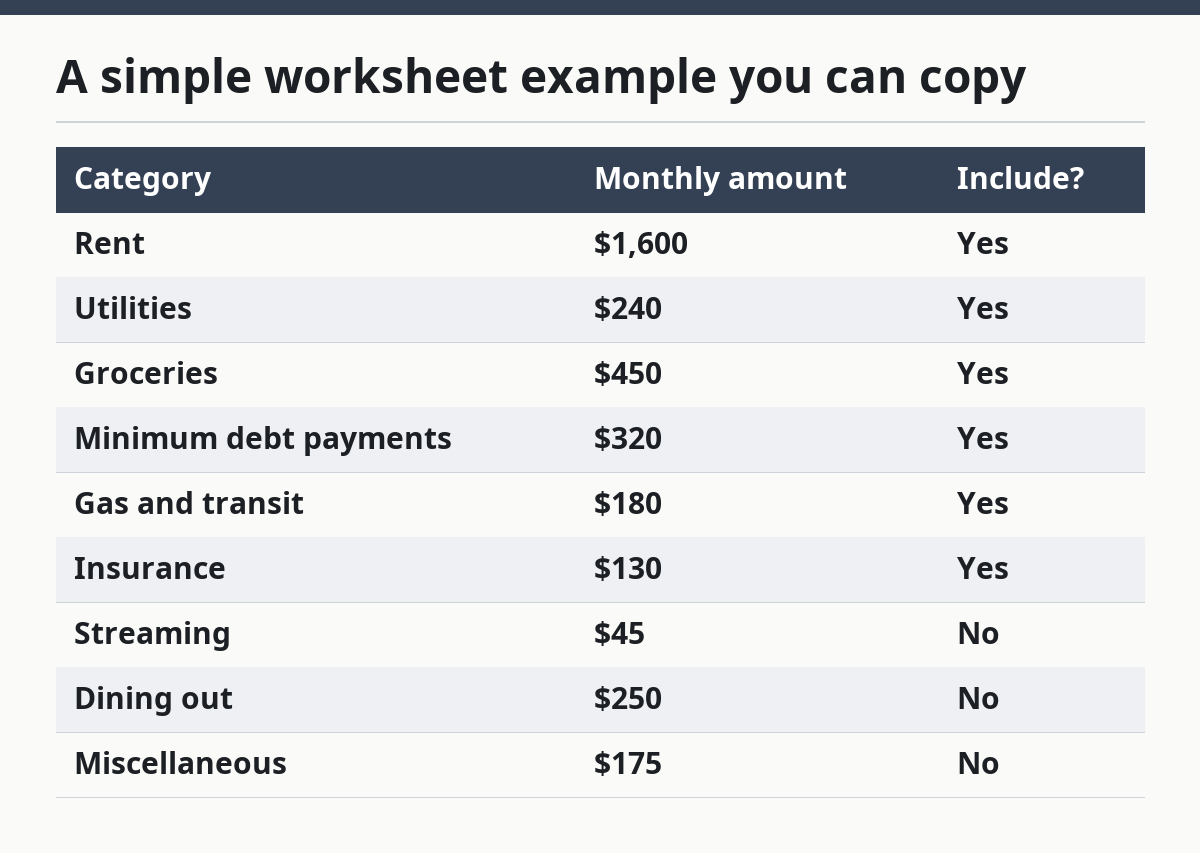
Add the “Yes” items: $1,600 + $240 + $450 + $320 + $180 + $130 = $2,920.
If your goal is 3 months of coverage, multiply by 3: $2,920 × 3 = $8,760. If your goal is 6 months, multiply by 6: $17,520.
That worksheet does two jobs at once. It shows which expenses are driving the target, and it reveals where the budget has room to shrink. If groceries or transportation are unusually high, the fix may be in the spending pattern, not in changing the emergency fund formula.
A final warning: keep the spreadsheet focused on the calculation. The point is not to make the cleanest chart; it is to get a number that reflects monthly essential expenses accurately enough to guide your cash goal.
What to do next after you have the number
Once you have the total, write it down as your emergency fund target and put the monthly essential expenses figure beside it. That keeps the logic visible when you review the plan later.
Then check the number against your real bills every few months and after any major change in rent, utilities, insurance, debt payments, or transportation. A target based on a stale budget is only half useful. The calculation works best when the inputs stay current, and the Consumer Financial Protection Bureau offers a useful budgeting reference.
If you want a one-line rule, use this: add only what you must pay in a normal month stripped down to essentials, then multiply by the months you want covered. That is the calculation, and it is enough to get a precise answer without drifting into guesswork.
What expenses should I include?
Include the costs you would still have if income stopped for a month. Rent, utilities, groceries, minimum debt payments, insurance, and basic transportation are the usual starting points. If a bill is optional or easy to pause, leave it out. The test is whether the expense keeps your home, work, or required obligations functioning.
Should I include savings goals?
No, not in the emergency fund calculation itself. Savings goals are not essential monthly expenses, so they do not belong in the bare-bones number. If you want to keep saving for other goals, treat that as a separate plan. The emergency fund is built from survival costs only, not from future wish-list items.
Do I include subscriptions?
Usually no, because most subscriptions are nonessential. Streaming, premium apps, and entertainment services should stay out of the calculation. If a subscription is tied directly to work or a necessary household service, it may belong in the essentials list. The standard is simple: if you can pause it for 30 days without real damage, leave it out.
Drafted with AI; not yet reviewed by a person.