Last updated: November 19, 2026
Quick answer: keep at least $500 to $1,000 in a separate, insured account first, then build toward 3 to 6 months of essential expenses. An emergency fund keeps you from using a credit card, payday loan, or retirement account when a car dies or a job ends. In this guide to Emergency Fund Setup and Access Rules — The Complete Guide, keep it easy to reach, keep it separate from checking, and set written rules for what counts as an emergency. The sections below settle where to keep it, how much to aim for, and when to touch it.
Key Takeaways
- Put the money in a separate account so it does not get spent by accident.
- Use an account that stays liquid and does not punish you for withdrawals.
- Write down the exact events that qualify, then follow those rules the same way every time.
- Build the fund in stages if a full 3 to 6 months of expenses feels far away.
- If you have high-interest debt, your emergency plan still needs cash for true surprises.
What counts as an emergency fund?
An emergency fund is cash reserved for one job: covering surprise costs or income loss without derailing the rest of your budget. It is not for vacations, home upgrades, planned car repairs, or a big sale that looks too good to pass up.
The cleanest test is simple: unexpected, necessary, and urgent. If the answer is yes to all three, the expense may fit. If it can wait, be planned for, or be skipped, it usually does not.
Here’s the catch:
- A broken furnace in winter fits.
- A new couch because the old one is ugly does not.
- A medical bill after insurance fits.
- A weekend trip because you “need a reset” does not.
A generic savings account can hold extra money, but that does not make it an emergency fund. The fund needs rules, not just a label. A fund with no rules gets used for everything.
How much should you keep in an emergency fund?
A common target is 3 to 6 months of essential expenses, but the right number depends on job stability, income type, dependents, rent, and insurance coverage. A single person with a steady paycheck and no dependents may need less than a contractor with variable income and a family.
Start with the number that covers the basics, not the lifestyle you wish you had. Use rent or mortgage, groceries, utilities, minimum debt payments, transport, insurance, and prescriptions. Leave out streaming, dining out, and travel.
For a quick planning check, use monthly essentials and multiply them by the number of months you want to cover. If essentials are $2,000 per month, then 3 months is $6,000 and 6 months is $12,000. If essentials are $3,500 per month, then 3 months is $10,500 and 6 months is $21,000.
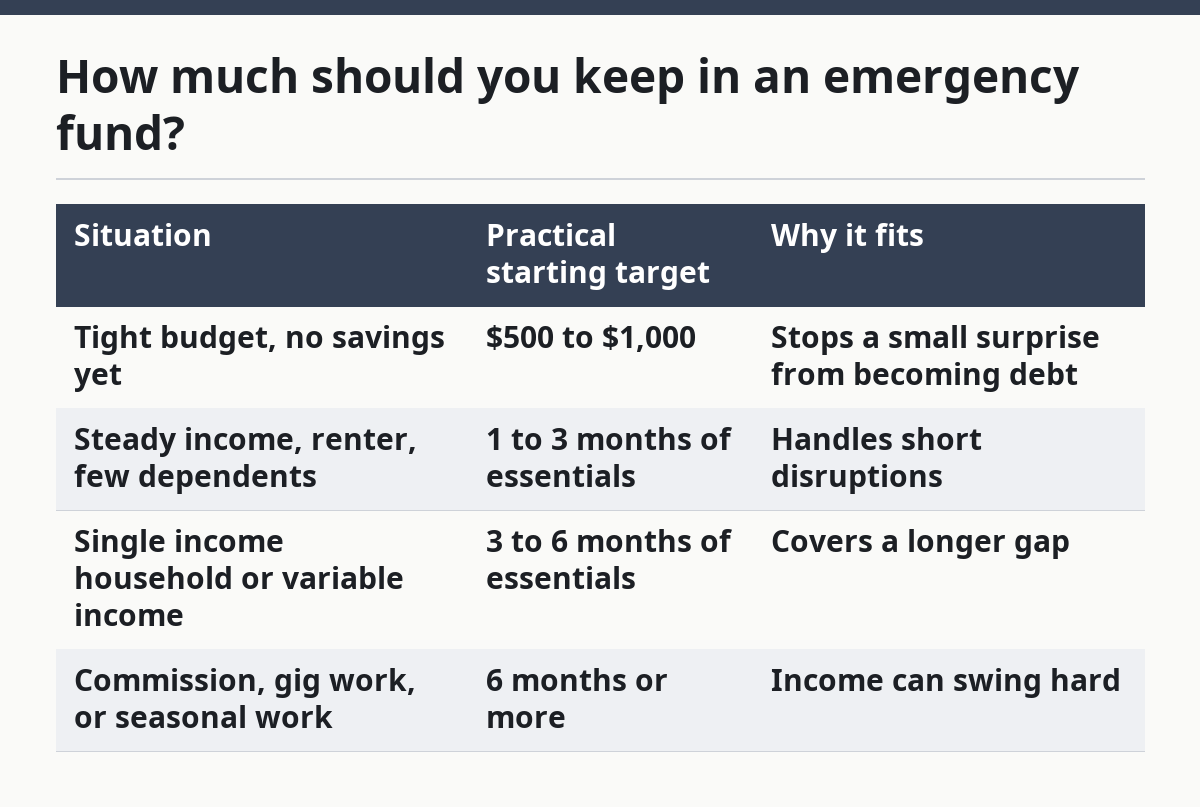
A simple starting table:
| Situation | Practical starting target | Why it fits |
|---|---|---|
| Tight budget, no savings yet | $500 to $1,000 | Stops a small surprise from becoming debt |
| Steady income, renter, few dependents | 1 to 3 months of essentials | Handles short disruptions |
| Single income household or variable income | 3 to 6 months of essentials | Covers a longer gap |
| Commission, gig work, or seasonal work | 6 months or more | Income can swing hard |
Use a smaller starter fund first if a full target feels impossible. A $500 to $1,000 buffer can keep one flat tire or urgent copay from turning into a balance transfer. Then keep going. The first milestone matters.
Where should you keep an emergency fund?
Keep it in a separate, FDIC- or NCUA-insured account that is easy to move money out of and hard to spend from by accident. A high-yield savings account, money market deposit account, or plain savings account at a different bank or credit union from checking often fits that job well. The Consumer Financial Protection Bureau recommends keeping emergency savings in a safe, accessible place rather than in investments that can lose value when you need the money most. See CFPB emergency savings guidance.
The goal is fast access without friction. You want the money available in 1 to 3 business days or less, depending on how the account moves funds. You do not want it tied up in stocks, crypto, a CD with penalties, or an account with a long transfer delay.
- Separate bank: harder to raid on impulse.
- Insured account: lowers the risk of loss if the institution fails.
- Simple transfer path: easier to use in a real emergency.
A checking account is usually too convenient, because debit-card spending blurs the line between reserve cash and daily cash. On the other hand, investments can drop right when you need the money most. An emergency fund should not ride the market. For deposit insurance details, see FDIC deposit insurance basics. Credit unions insured by the NCUA work similarly.
How do I set up the account the right way?
You set it up by making access simple for emergencies and awkward for routine spending. Open one separate savings account, turn on a transfer route from checking, and name the account clearly so the purpose is obvious.
If your bank allows sub-accounts or buckets, use them for tracking, but keep the actual emergency money in one place. A clean setup beats a clever one. Too many small places create confusion.
- Open a separate savings or money market deposit account.
- Link it to your checking account.
- Turn off debit-card access if the account offers it and you do not need it.
- Set an automatic transfer on payday, even if it is small.
- Add the account to your budget under “emergency reserve.”
- Keep the balance visible, but not tempting.
A good rule is to make deposits automatic and withdrawals intentional. That one move solves most bad habits. If you rely on memory, you will forget. If you rely on willpower, you will lose to convenience. If you want a broader budgeting system around the fund, see how to build a simple budget and how to automate savings.
What access rules should I write down?
You should write down exactly what counts as an emergency, who can approve the withdrawal, and how the money gets moved back after use. Written rules stop you from re-labeling ordinary wants as urgent needs when stress is high.
A strong access rule sheet can be short. Keep it specific.
- Use the fund only for job loss, medical bills, essential car repair, urgent home repair, or another expense that blocks basic life functions.
- Do not use it for planned travel, gifts, sales, hobbies, or upgrades.
- Withdraw only the amount needed, not the full balance.
- Refill the fund before extra spending resumes.
- Review the rules every 6 months.
If you share finances with a partner, agree on the same list before the first withdrawal. Mixed rules cause arguments fast. One person thinks “emergency,” the other thinks “bad planning.” Write it down now and save the fight later. If your household is managing variable income, consider the guidance in irregular income budgeting.
How do I access the money in a real emergency?
You access the money through the fastest safe path your account offers, usually an electronic transfer to checking or an in-network withdrawal, then use the money only for the approved cost. Speed matters, and so does proof. Keep the paper trail.
A practical access plan looks like this:
- For a bill you can pay online, transfer the amount needed to checking and pay from there.
- For a car repair, transfer the estimate or approved amount before pickup if the shop will wait.
- For medical or home costs, keep the receipt and note the reason.
- For a job loss, move money in stages so the balance lasts.
If timing is tight, know the transfer cutoff times for your bank. A same-day transfer may be available at some institutions, but it is not universal, and weekends can slow things down. Cash is still useful in a true pinch, but storing a large amount of bills at home creates theft and fire risk. Most people should keep the fund in the bank and use transfers first. If you want a backup plan for short outages, see how to keep a small cash buffer.
How should I refill the fund after using it?
You refill it by making repayment part of the next month’s budget, not a vague promise to “get around to it.” A drained emergency fund is a warning light, not a finished job.
The refill plan can be simple:
- Put a fixed amount back each payday.
- Pause nonessential savings goals until the fund is back on target.
- Use tax refunds, bonuses, or side income to speed recovery.
- If the withdrawal was large, split the refill into a 3 to 12 month plan.
Do not punish yourself with impossible refill rules. If you empty the fund after a layoff, a full refill in one month may be unrealistic. The smart move is steady rebuilding. Slow still counts. The mistake is leaving it empty. For examples of refill pacing, see sinking funds vs. emergency funds.
What mistakes ruin an emergency fund?
The biggest mistakes are making the fund hard to reach, mixing it with spending money, and using it for things that were never emergencies. A second common error is keeping the balance too low to matter.
A short list of expensive mistakes:
- Keeping the fund in a volatile investment account.
- Storing it in the same checking account you use for bills and dining.
- Using it for known annual costs like holiday gifts or insurance premiums.
- Borrowing from it and never paying it back.
- Calling every inconvenience an emergency.
Another trap is waiting for the “perfect” amount before starting. That delay can last years. A small reserve beats none. The right first step is not fancy. It is funded. If you are deciding between debt payoff and savings, compare the trade-offs in emergency fund vs. debt payoff.
How does an emergency fund fit with debt?
An emergency fund still matters if you have debt, because no reserve often pushes people into deeper debt when something breaks. The balance between debt payoff and savings depends on your interest rates, job stability, and how often your life throws curveballs.
If you have high-interest debt, a small starter fund can come first so one surprise does not send you back to square one. Then you can attack the debt more aggressively. If your income is unstable, a larger cash cushion may protect you better than extra debt payments would.
- Small starter emergency fund.
- High-interest debt payoff.
- Build the full emergency fund.
- Expand other savings goals.
This is not a moral contest. It is a risk problem. A car repair does not care whether your balance sheet looks neat. The Consumer Financial Protection Bureau notes that a small reserve can help people avoid more expensive borrowing when an unexpected expense hits.
What if I live on irregular income?
If your income changes month to month, your emergency fund should be larger and your access rules should be tighter. Freelancers, commission workers, gig workers, and seasonal employees need the fund to cover both surprise expenses and slow income months.
A practical move is to calculate your lowest safe monthly spending number and then hold enough cash to survive a dry stretch. That number may be closer to 6 months than 3. If income swings badly, talk with a financial professional or tax professional about whether to treat the fund partly as income smoothing, not just crisis coverage.
- Keep a larger target than a salaried worker would.
- Move extra income into the fund during strong months.
- Pay fixed bills first.
- Use the fund only when income drops below essentials or a true emergency hits.
This setup is not fancy, but it works. A person with irregular income needs more slack, not less. Tight cash flow punishes optimism.
What do good access rules look like in practice?
Good access rules make the decision obvious under stress. They tell you when to use the money, how much to use, and how to replace it without guessing.
A plain example works well:
- Allowed: urgent medical bill, emergency vet care, furnace repair, essential car repair, rent after job loss.
- Not allowed: vacation, holiday shopping, home decor, convenience spending, routine maintenance you should have planned for.
- Process: use the lowest-cost fix first, withdraw only what you need, save receipts, rebuild the balance immediately.
You do not need a long policy document. Two pages is enough for most households. The point is to remove debate when emotions are high. Rules written in calm weather protect you in bad weather.
FAQ
Should I keep my emergency fund in cash at home?
No, most people should not keep the whole fund at home. A small amount of cash for power outages or travel can make sense, but a full fund at home raises theft and fire risk. A bank account with quick transfer access is usually the safer choice.
Can I use a credit card instead of an emergency fund?
No, a credit card is not a substitute for an emergency fund. It can bridge a short gap, but it turns a surprise into debt and interest if you cannot repay fast. Cash gives you more control and less cost.
How fast should I be able to get to the money?
You should be able to move it in 1 to 3 business days or faster, depending on your account. If the money takes too long to reach checking, it may not work for a true emergency. Test the transfer path before you need it.
Is a high-yield savings account the best place?
Often, yes, if it is insured, easy to move money from, and separate from daily spending. The highest yield is not the only factor. Liquidity, safety, and simple access matter more than chasing an extra fraction of a percent. See also best savings accounts.
Should I build the fund before paying off debt?
Not always. A small starter fund often makes sense first, especially if one repair would force you back onto a credit card. After that, the better move depends on your interest rates and how steady your income is.
Drafted with AI; not yet reviewed by a person.