Last updated: November 20, 2026
If you rent, a solid emergency fund is usually 3 months of essential expenses. If you own a home, 3 to 6 months is the safer target, and a separate home repair buffer makes sense on top of that. For an emergency fund, the right number depends on job stability, debt, and whether one surprise bill could knock out your month.
Key takeaways
- Renters usually need a smaller cushion than homeowners because they do not carry roof, furnace, or plumbing costs.
- Homeowners need to plan for both income loss and repair bills, so the same “3 months” rule is often too thin.
- A separate savings bucket for home repairs keeps an emergency fund from disappearing the first time an appliance dies.
- The Consumer Financial Protection Bureau says an emergency fund can help cover three to six months of essential expenses, which is a good baseline for both groups.
- If your income is uneven, or you live alone on one paycheck, aim higher than the base range.
What is the right starting number?
Therefore, the right starting number is 1 month of bare-bones expenses if you are still building from zero, then 3 months as the first real target. The Consumer Financial Protection Bureau recommends saving enough to cover 3 to 6 months of essential expenses, which is a practical range for most households (CFPB). The FDIC also recommends building savings gradually and keeping emergency cash accessible in a safe account (FDIC).
That range is not a prize for hitting a round number. It is a buffer against the kinds of costs that arrive without warning: job loss, medical bills, car trouble, rent increases, or a home repair that cannot wait. If you own a home, the buffer has to do more work because housing itself can create emergencies.
A simple way to think about it is this: renters are mainly protecting cash flow, while homeowners are protecting cash flow plus the house. That is why the same emergency fund can be enough for one person and too small for another, even at the same income. For more on building the first layer of savings, see the emergency savings guide.
How much should a renter keep?
However, a renter should usually keep 3 months of essential expenses, and a very cautious renter may want closer to 6 months. Essential expenses mean the bills that keep life stable: rent, utilities, groceries, transport, insurance, minimum debt payments, and child care if that is part of the monthly baseline.
Renters often get by with less than homeowners because they do not need to set aside cash for a leaking water heater or a failed air conditioner. If the landlord handles major repairs, your emergency fund can focus more on income shocks than property shocks. That lower risk is real, but it does not make the fund optional.
This amount fits renters best when the lease is stable and the monthly rent is predictable. It is weaker if your job is contract work, your rent is already high relative to income, or you have only one paycheck in the household. In those cases, the emergency fund should move toward the top of the range, because a single missed paycheck can force bad decisions fast. If you are comparing where to keep that cash, the high-yield savings account guide explains the basics.
How much should a homeowner keep?
Meanwhile, a homeowner should usually keep 3 to 6 months of essential expenses, plus a separate repair reserve for the house. That is the cleaner answer because a house can create expenses that renters never face: a broken furnace, roof damage, plumbing leaks, appliance replacement, or a deductible after a claim.
The second bucket matters. If the emergency fund has to cover both job loss and a roof leak, it can vanish in one event. A separate home repair reserve keeps the main emergency fund intact for income shocks. That separation is especially useful for older homes, homes with aging systems, or owners who know a large repair is likely within the next few years. For a deeper look at where that money can sit, see the money market account guide.
Homeownership also adds timing risk. A repair rarely waits until payday, and some costs show up in a difficult month. That is why the homeowner target is not just “save more.” It is “save enough to handle a bill that arrives before you can spread the pain out over time.”
Rent vs own: what changes?
Because of that, the main difference is repair risk, and that single factor changes the size of the fund more than the mortgage does. Renters may have bigger fixed housing payments in some markets, but owners have larger surprise costs, so their emergency fund needs to absorb more kinds of shocks.
| Criteria | Rent | Own | Winner for this condition |
|---|---|---|---|
| Surprise housing repairs | Landlord usually handles major fixes | Owner pays for repairs and replacements | Own, for total risk |
| Monthly payment stability | Often set by lease term | Mortgage may be steadier, but taxes/insurance/repairs can change | Rent, for simplicity |
| Need for a separate repair fund | Usually lower | Strongly recommended | Own |
| Income-loss protection only | 3 months can be enough for many | 3 months can be too thin | Rent |
| Total emergency buffer | Lower on average | Higher on average | Rent |
| Cash tied up in housing costs | Rent can be less flexible | Owners may face maintenance spikes | Own |
| Risk of a single large bill | Lower if landlord is responsive | Higher because the house is yours | Own |
| Best starter target | 3 months essential expenses | 3 to 6 months essential expenses | Depends on ownership |
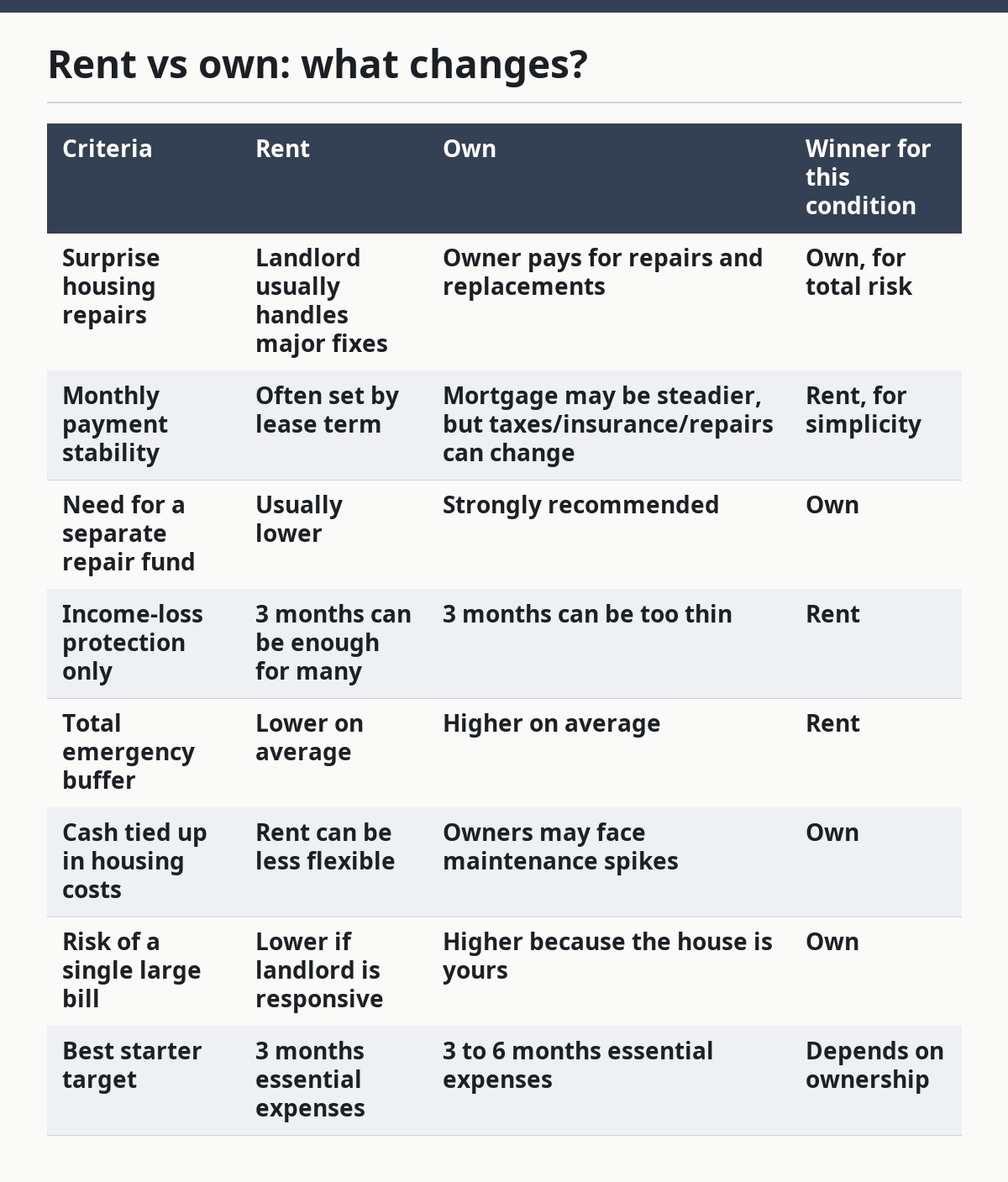
The table is the headline: owning a home pushes the number up because your emergency fund is no longer just an income buffer. It becomes a house buffer too. That is why a homeowner with only 1 month of savings is in a much shakier spot than a renter with the same amount.
When should you save more than the base amount?
Specifically, you should save more than 3 months if one of these applies: your income is unstable, your job is hard to replace, your spouse or partner does not have income, or your housing cost would be hard to cut quickly. Those conditions make the usual rule too optimistic.
The same is true if you own an older home. A house with older roofing, plumbing, or heating systems is more likely to throw a large bill at you, and a homeowner’s emergency fund should reflect that reality. A newer home is not risk-free, but it usually needs less “just in case” money set aside for repairs.
You should also save more if your deductible is large, your insurance coverage leaves gaps, or you already know about a near-term repair. In that case, the emergency fund should not be doing all the work. A planned repair is not the same as an emergency, and mixing the two can make the fund look healthier than it is. For homeowners, that distinction matters even more when you are deciding how much to keep in your high-yield savings account.
Where should the money sit?
Because the money should sit in a separate, easy-to-access account, not in your checking account and not in anything that can drop in value before you need it. For the readers on this site, the practical comparison is usually a high-yield savings account vs. a money market account.
A high-yield savings account is often simpler for pure emergency money because it is built for parking cash and keeping it liquid. A money market account can also work well if it gives you easy access and you are comfortable with its rules, but it is worth checking whether there are balance requirements, transfer limits, or branch access features that matter to you.
The key point is that the account is secondary to the amount. A perfect account with too little cash is still a weak emergency plan. A plain account with the right balance is far better than a fancy one with no buffer at all. If you want a broader overview, the savings accounts guide compares common options.
What if you are still building it?
Since you are still building it, the first target is $1,000 or one month of essentials, whichever is more workable for your budget. After that, push toward 3 months, then, if you own a home or have shaky income, toward 6 months.
That step-up approach matters because a lot of people get stuck trying to jump straight to the full number. A smaller first target gives the fund momentum. Once that first layer is in place, one car repair or vet bill will not wipe out your progress.
If you rent and have stable income, that first 3-month target may be enough for a while. If you own, do not stop there unless your housing costs are very predictable and your home is low-risk. A homeowner with only a tiny reserve is one repair away from debt.
What is the best choice for you?
Ultimately, choose 3 months if you rent, have stable income, and can handle a moderate bump in expenses without borrowing. Choose 3 to 6 months plus a separate home repair reserve if you own, especially if your house is older, your income is uneven, or you live on one paycheck. Neither is enough if you have high debt, unstable work, and no room to cut spending at all; in that case, start with a smaller first goal and build fast.
The cleanest rule is this: renters need a cash cushion, homeowners need a cash cushion plus a house cushion. That is the difference that matters.
FAQ
Is 3 months enough if I rent?
Yes, 3 months is enough for many renters if the job is stable and the lease is predictable. It covers the most common shock: a temporary income hit. If your income changes month to month, 3 months may be the floor rather than the finish line.
Is 6 months too much for a homeowner?
No, 6 months is not too much for many homeowners, especially if the house is older or the income is uneven. The extra cash helps with both repairs and a longer stretch without pay. The downside is simple: more cash sits idle, so the balance between safety and return matters.
Should I count credit cards as part of my emergency fund?
No, credit cards are not the same as an emergency fund because they create debt instead of removing it. They can be a backup, but they are not the cushion itself. A real emergency fund is money you already have.
Do I need a separate home repair fund if I already have an emergency fund?
Yes, if you own a home, a separate repair fund is smart because it protects the main emergency reserve. A furnace repair should not drain the cash you need for a job loss. Keeping the buckets separate makes both numbers more honest.
Drafted with AI; not yet reviewed by a person.