How to Create an Emergency Fund Review Day After a Withdrawal

Last updated: November 20, 2026
Quick answer: spend 20 to 30 minutes the next day on an emergency fund review day after a withdrawal. Put a calendar reminder on the next day, pull up your budget and expense tracker, and check what the withdrawal was really for, what it did to your cash flow, and what rule needs to change before the next emergency hits.
Key takeaways
- Review the withdrawal within 24 hours while the details are still clear.
- Check the budget first, then the expense tracker, then the savings goal.
- Separate one-time bad luck from a pattern that needs a rule change.
- Reset the cash flow plan before you focus on refilling the fund.
- Keep the process short: one reminder, one checklist, one decision.
What is a post-withdrawal review day?
An emergency fund review day after a withdrawal is a short, scheduled check-in that happens the day after you use your emergency fund. It gives you a clear picture of what happened while the transaction is still fresh, which makes the next decision easier than waiting a week or a month.
Therefore, the point is not to feel bad about the withdrawal. The point is to answer three practical questions in about 20 to 30 minutes: what the money covered, whether the expense was truly urgent, and what needs to change so the next withdrawal is smaller or less likely. That review also gives you a clean place to start replenishment instead of guessing.
Treat this as a reset, not a punishment, and if the withdrawal connects to medical, housing, debt, or other high-stakes decisions, consult a qualified professional or nonprofit counselor before making a major change. A fund that gets reviewed after use usually improves over time because the withdrawal exposes weak spots in the budget, the cash flow, or the spending rule. A fund that never gets reviewed can refill and still fail the next time. For general consumer guidance, see the CFPB savings resources.
How do I review the budget after a withdrawal?
You review the budget after a withdrawal by checking the exact category that failed, then deciding whether the problem was timing, size, or a missing line item. Start with the budget itself, not the savings balance, because the withdrawal usually points to a budget problem first.
After that, use this 4-step process the day after the withdrawal:
- Calendar reminder: Set a reminder for the next day and block 30 minutes so the review happens before the week gets busy.
- Expense tracker: Open the transaction and label the withdrawal with the reason, the date, and the category it covered.
- Budget: Compare the withdrawal to the current month’s budget and see whether the category was underfunded, overused, or missing.
- Savings goal: Write the new fund balance next to the amount you withdrew so you know how far the refill has to go.
If the withdrawal covered a bill that should have been predictable, the budget needs a category fix. If it covered a true surprise, the budget may need a buffer line or a higher monthly transfer. If the withdrawal was caused by several small overspends, the issue is usually cash flow, not one large event.
For example, if the fund paid for a car repair, the budget question is not just “Can I refill later?” It is “Did the car category stay too small for a repair that was likely to happen?” That question leads to a better plan than guilt does. For more on emergency savings planning, see the FDIC deposit insurance information and the CFPB savings guidance.
What should I write down on review day?
You should write down the reason for the withdrawal, the amount, the trigger, and the next rule change in one note. A single page or note app entry is enough if it captures the facts in plain language.
Then use a simple checklist with 5 items:
- What happened
- What date it happened
- What category paid for it
- What the fund balance became after the withdrawal
- What I will change before the next month starts
That list matters because memory gets fuzzy fast. A note that says “medical bill,” “work gap,” or “home repair” is more useful than a vague reminder like “bad month.” The clearer the note, the easier it is to spot patterns after the second or third withdrawal.
Meanwhile, this is also the right place to record whether the expense was truly emergency spending or just inconvenient spending. If the purchase was urgent but not essential, it may belong in a sinking fund or a separate category next time. That distinction helps keep the emergency fund reserved for real shocks.
If the withdrawal was partly avoidable, write that down without turning the note into a lecture. The goal is not to judge the past. The goal is to make the next decision easier when the same pressure shows up again.
Which rule should I adjust first?
You should adjust the rule that failed first, not every rule at once. One change is easier to follow than a full reset, and a single adjustment gives you a cleaner test for the next 1 to 3 months.
Specifically, use this comparison to decide where to start:
| Problem you saw | Rule to adjust first | Why this comes first | Who should not start here |
|---|---|---|---|
| The withdrawal was too large for the fund | Savings goal | The fund size may be too small for the risk | Anyone whose cash flow is already tight |
| The expense was predictable | Budget category | The category likely needs a higher monthly amount | Anyone who has not checked the rest of the budget yet |
| Several small leaks added up | Spending rule | The issue is day-to-day cash use | Anyone who still does not know what caused the withdrawal |
| The balance stayed low after a refill | Replenishment pace | The refill plan may be too slow | Anyone with unstable income |
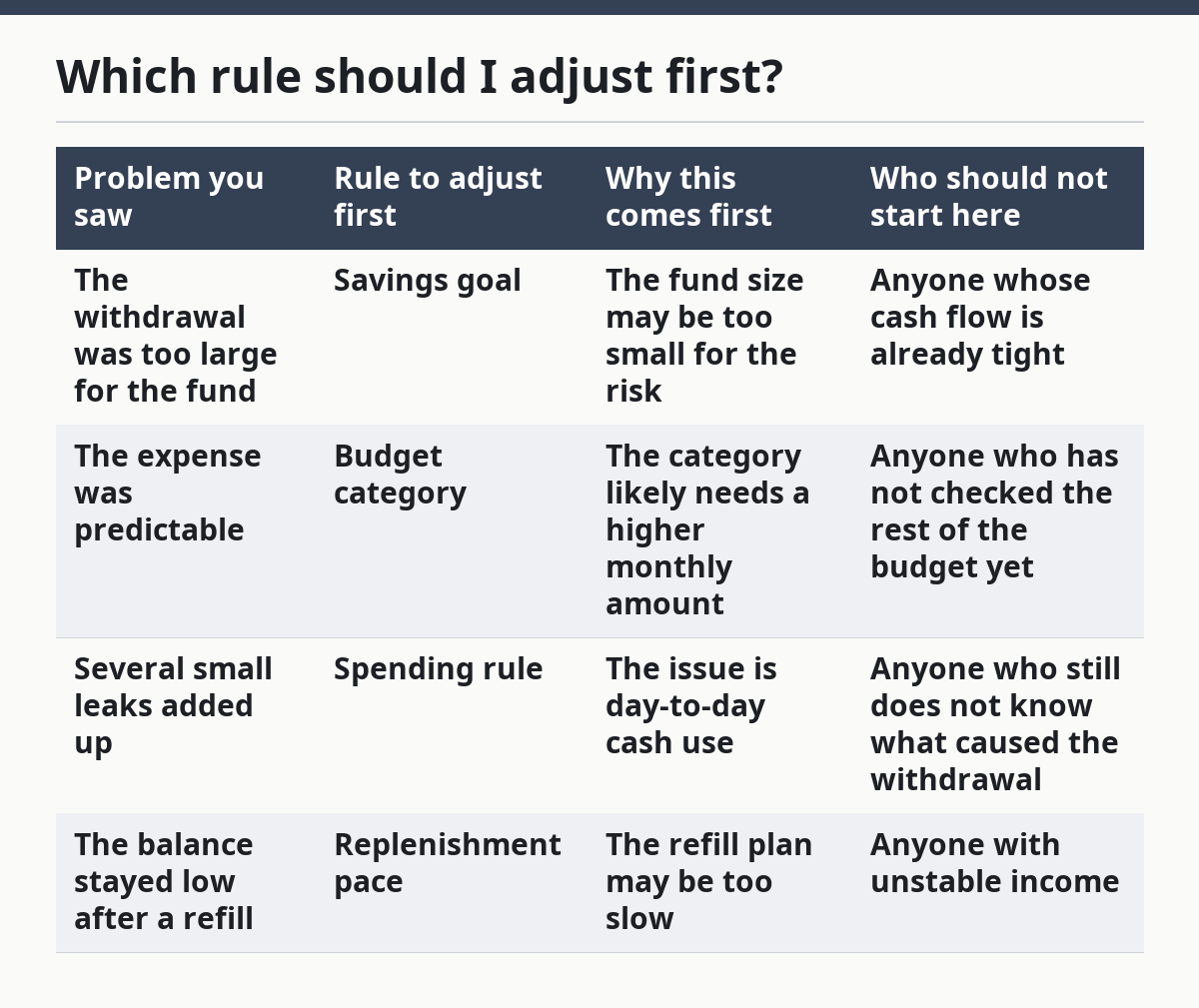
This is where a lot of generic advice goes wrong. It tells you to “rebuild the fund” without checking whether the real problem is the size of the fund, the way the budget is built, or the speed of replenishment. Those are different fixes.
If you want one source of truth for the decision, write the rule change next to the withdrawal note and give it a review date. A calendar reminder for 30 days later is often enough to tell whether the change helped or whether it needs another round.
For plain guidance on where emergency money is usually kept and why liquidity matters, the Consumer Financial Protection Bureau and the FDIC both publish general savings guidance that is useful background when you decide how quickly to refill and where to keep the money. See the CFPB savings pages and the FDIC deposit insurance pages.
How do I reset cash flow without raiding savings?
You reset cash flow by deciding which bill, transfer, or spending category gets the first dollar after the withdrawal, then matching that plan to the next pay date. The point is to stop the fund from doing the work of a checking account.
After that, start with the next 1 or 2 paychecks and map out the fixed costs first: housing, food, transport, debt minimums, and the replacement transfer to the emergency fund. Then look at the nonessential categories and trim the easiest one for a short period. A smaller dining-out budget for one month is easier to live with than a vague promise to “do better.”
If the withdrawal created a short-term hole, avoid treating the fund as the place to smooth it over again; if the hole is larger than you can safely cover, consult a qualified professional or nonprofit credit counselor before shifting more money. That only delays the problem. Instead, make the cash flow reset visible on paper or in an app so you can see what needs to happen before the next payday.
This step is where a lot of people skip ahead and miss the real fix. Rebuilding the balance matters, but a fund that gets used for everyday shortfalls will keep shrinking. A better reset makes the checking account carry daily life and lets the emergency fund stay reserved for actual emergencies.
How do I set the review on a calendar?
Once you know the date, you set the review on a calendar by making the next day non-optional and tying it to a fixed time, such as 8:00 a.m. or 7:00 p.m. The time matters less than the fact that it is written down.
Use one calendar reminder for the review day and one second reminder for the refill check 7 days later. The first reminder handles the diagnosis. The second reminder checks whether the budget change and cash flow reset are actually working.
Put the reminder name in plain language, such as “Emergency fund review day after withdrawal.” That title is clearer than “money task” or “finance cleanup,” and it is easier to spot in a crowded calendar. If the reminder lives inside the same app you use for bills, the review is less likely to disappear.
A short calendar habit also keeps the process from turning into a monthly crisis. One day for review, one day for follow-up, and one written change are usually enough to keep the fund moving in the right direction. The goal is a system you can repeat, not a dramatic one you can only do once.
What mistakes make the review less useful?
The biggest mistake is reviewing the withdrawal without changing anything. That costs you the same weak spot the next time the same problem shows up, and the fund ends up acting like a revolving door. The fix is to leave the review with one written rule change, even if it is small.
A second mistake is focusing only on the balance. A balance check tells you how much is left, but it does not tell you why the money left. Without the reason, the refill plan is guesswork. Use the balance as a number, not as the whole story.
A third mistake is making too many changes at once. If you change the budget, the savings goal, and the spending rule on the same day, it becomes hard to tell what helped. One change at a time works better for the next 30 days.
A fourth mistake is treating the withdrawal as proof that the fund failed. If that reaction starts to push you toward panic saving or giving up, consult a qualified financial professional or nonprofit counselor before making a large decision. The better reading is simpler: the withdrawal gave you data. Use that data to improve the next version of the plan.
Where this fits in the bigger emergency fund plan
Overall, a post-withdrawal review day is the reset point that keeps the whole emergency fund system honest. It belongs in the same larger framework as withdrawal rules and replenishment rules, but it does a different job: it turns one event into a better plan.
If you are building the wider system, this page belongs next to the site’s hub on emergency fund withdrawal rules and emergency fund replenishment rules. The hub handles the bigger framework; this review day handles the immediate cleanup after money leaves the fund.
That split matters because a withdrawal is not just a transaction. It is feedback. The faster you write down what the withdrawal taught you, the sooner the fund starts working like a real safety net instead of a balance you hope will be there later.
What should I review after using my emergency fund?
After you use your emergency fund, review the reason for the withdrawal, the category it hit, and the cash flow that led up to it. That gives you the clearest picture of whether the problem was a true emergency, a budget gap, or a spending pattern. Write down the amount, the date, and the one change you will make next.
How do I make sure I do not repeat the same withdrawal?
Because the cause matters more than the symptom, make one rule change based on the cause, not the symptom. If the withdrawal came from a predictable expense, raise that budget line. If it came from uneven cash flow, adjust the timing of your transfers and your refill plan.
When should I update my emergency fund rules?
As soon as the review shows a pattern, update the rules instead of waiting for several repeat withdrawals. A same-day or next-day change is usually enough when the issue is clear. If the cause is still unclear, keep the rule simple and revisit it after the next 30 days of spending.
Drafted with AI; not yet reviewed by a person.