How to Organize Emergency Fund Access for a Family Member or Partner

Last updated: November 19, 2026
Key Takeaways
- A shared access arrangement should let the right person reach the right money quickly, without open-ended control.
- How to organize emergency fund access for a family member or partner is mostly a process of narrowing permission before you need it.
- Different access tools solve different problems, and mixing them up causes delays.
- Keeping control without making access useless is the real balancing act.
A shared access arrangement for How to Organize Emergency Fund Access for a Family Member or Partner lets a family member or partner get emergency money quickly without handing them full control of your finances. The cleanest setup is usually a mix of permissions, written instructions, and a backup path if the first person cannot act. For families with larger balances or more complex accounts, a qualified professional can help tailor the arrangement.
What a shared access arrangement should do
A shared access arrangement should let the right person reach the right money in under 10 minutes, without giving them open-ended control over every account. The goal is simple: if you are unreachable, someone can pay for a tire, hotel room, flight change, prescription, or deductible without guessing.
Start by deciding what “emergency” means in your household. Put that definition on paper in 3 to 5 examples, such as job loss, medical travel, car repair, or a home emergency. That keeps the account from becoming a general spending pool.
Then decide what the helper actually needs access to:
- the account login for viewing only
- a debit card tied to a specific account
- authorized-user status on one account
- a separate emergency card with a small limit
- a power of attorney for broader authority
- a trusted contact on the account for alerts, not spending authority
Not every tool does the same job. A beneficiary is for what happens after death; it does not help someone pay a bill next Tuesday. A trusted contact can help a financial institution reach someone, but it usually cannot move money. A power of attorney can be broad enough to allow actual transactions, but it is a legal instrument and should be drafted carefully.
The mistake to avoid is giving access that is too broad for the problem. If a partner only needs to cover a hotel night after a canceled flight, full account access is overkill. If a family member may need to pay rent while you are hospitalized, a note in your phone is not enough. Match the tool to a realistic serious scenario, not to the easiest one.
For background on where the money should live in the first place, the hub on where to keep an emergency fund is the right companion piece; this article stays focused on handoff and permissions, while the linked guide covers account placement. See the CFPB’s emergency-savings guidance at consumerfinance.gov and NerdWallet’s overview of emergency fund basics at nerdwallet.com.
How to organize emergency fund access for a family member or partner
How to organize emergency fund access for a family member or partner is mostly a process of narrowing permission before you need it. The setup works best when you choose one primary path, one backup path, and one person who knows where the instructions are kept. Because the details can affect banking, estate, and tax issues, a qualified professional may be helpful for the final setup.
Use this order:
-
Pick the access route for the money.
Choose one account or cash source that will be used only for emergencies. If it is a bank account, note the account type, the last 4 digits, and the institution name. That gives the helper a precise target instead of a vague “our savings somewhere.” -
Assign the lightest permission that still works.
If the helper only needs to view balances, give account login access with view-only permissions if your bank offers it. If they need to spend money, a debit card or authorized-user setup may be more practical. If they may need to act for you while you are incapacitated, ask an attorney about a power of attorney, since the wording matters and institutions may apply their own rules. -
Write the emergency rules on one page.
Keep the page short: when the money can be used, the maximum amount per incident, who must be told afterward, and what counts as proof of need. A 1-page instruction sheet is easier to follow than a long message thread. -
Store the login and backup details in two places.
Put the account login, emergency passwords, and recovery codes in a password manager, then add a sealed paper copy in a secure place your helper can reach; if the setup involves sensitive credentials or larger balances, consult a professional about the safest storage method. If the helper cannot open the password manager because of a phone lock or lost device, the paper copy becomes the fallback. For password-storage practices, see the FTC’s guidance at consumer.ftc.gov and NIST’s digital identity guidance at nist.gov. -
Tell the institution what role each person has.
If the bank or brokerage allows authorized users, trusted contacts, or delegated access, set those up directly in the account profile. That reduces the chance that a fraud filter blocks the transaction later. -
Test the handoff with a small task.
Have the helper practice reading the instructions, finding the login, and locating the account number with a pretend scenario. A dry run takes 15 minutes and exposes vague wording fast.
The point is not to create a maze. It is to make the first 2 minutes of an emergency boring and predictable.
Which access tools do different jobs?
Different access tools solve different problems, and mixing them up causes delays. A beneficiary, for example, is not an access tool at all; it is a transfer instruction after death. A trusted contact is a communication tool, not a spending tool. A power of attorney can authorize action, but it usually needs to be drafted and accepted in a way that fits the financial institution’s rules.
Here is the practical difference:
- Account login: Good for viewing balances, documents, and transaction history. Risky if the person can also reset passwords or move money without limits.
- Authorized user: Useful when the institution supports it, especially for cards or certain accounts. It can create clear, recordable permission, but it may still be broader than you want.
- Power of attorney: Best when another person may need to pay bills, transfer funds, or handle accounts if you are unable to act. It is serious legal authority, so it should be reviewed before signing.
- Trusted contact: Helpful when a bank needs someone to reach out to if there is concern or an emergency. It is usually not a way to withdraw money.
- Beneficiary: Useful for estate transfer, not for same-day access.
The cleanest family setup often uses two layers: a practical access tool for routine emergencies, and a legal backup for incapacity. For example, a partner might have the login to a low-balance emergency account plus a power of attorney kept unused unless a serious event happens. That sounds redundant until the first device fails, the bank requires extra verification, or one person is traveling with no signal.
The trade-off is privacy. More people with more access means more chances for mistakes, accidental transfers, or awkward conversations later. If the relationship is unstable, the risk rises fast. In that case, limit the helper to a narrow role, such as a trusted contact or a one-time payment method, rather than broad account control.
Financial institutions do not all treat these roles the same way. Some institutions will recognize a power of attorney only after reviewing their own form. Others may let you add a trusted contact but still require the account holder to approve changes. A quick call to the institution’s customer service line can prevent a lot of confusion, but for legal authority, a lawyer should review the document. For more on these distinctions, see FINRA’s trusted-contact overview at finra.org and the CFPB’s power-of-attorney resource at consumerfinance.gov.
What to write down before you hand over access
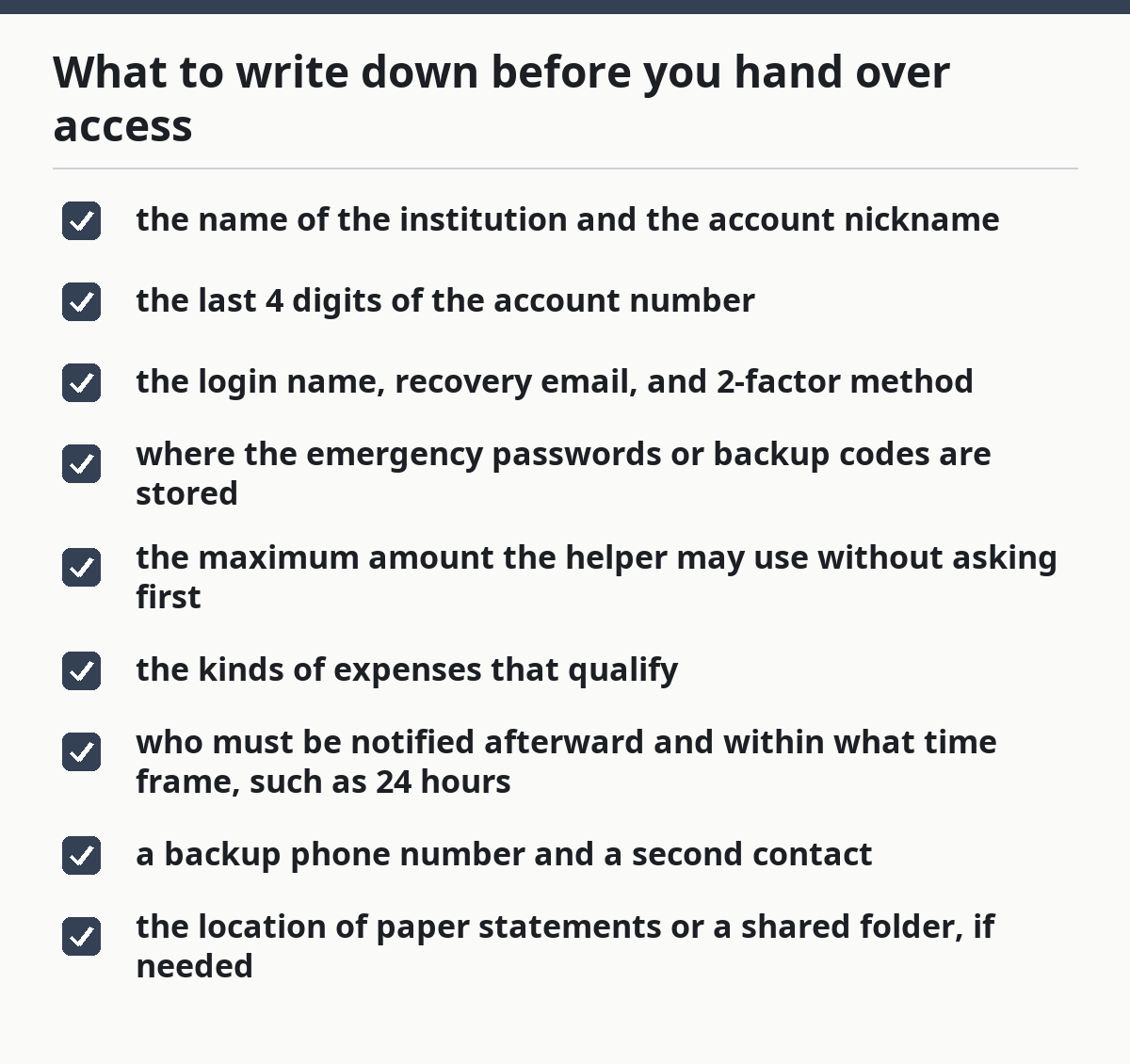
What to write down before you hand over access is the difference between “someone knows” and “someone can actually do it.” A complete handoff packet can fit on 2 pages, and that is enough if it is specific.
Include these items:
- the name of the institution and the account nickname
- the last 4 digits of the account number
- the login name, recovery email, and 2-factor method
- where the emergency passwords or backup codes are stored
- the maximum amount the helper may use without asking first
- the kinds of expenses that qualify
- who must be notified afterward and within what time frame, such as 24 hours
- a backup phone number and a second contact
- the location of paper statements or a shared folder, if needed
Do not write the main password plainly on a sticky note taped to a monitor. That is not a plan; it is a shortcut to trouble. Use a password manager with a strong master password, then keep the recovery instructions somewhere physically separate. If you prefer paper, seal the instructions in an envelope and label the outside with a clear opening condition, such as “Open only if I am hospitalized or unreachable for 12 hours.”
Use plain language. “Pay the vet if the dog needs urgent treatment” is better than “Handle pet matters as needed.” “Use up to $750 for travel disruption or temporary lodging” is better than “Use as appropriate.” Specific thresholds prevent guilt, second-guessing, and unnecessary arguments. If the family situation is complex, a professional can help translate the wording into something the institution will accept.
If you share records, make them easy to audit later. A shared spreadsheet with date, amount, purpose, and receipt link is enough for most families. Keep the file simple so a partner can update it on a phone in under 2 minutes.
How to keep control without making access useless
How to keep control without making access useless is the real balancing act. If the setup is too loose, you risk misuse; if it is too tight, the person cannot act when the need is real.
A useful pattern is “permission plus limits.” That means the helper can access the account, but only within boundaries you set in writing. Typical limits include:
- a dollar cap per event
- a list of approved uses
- a requirement to text or call before transfers above a threshold
- a separate savings pot for true emergencies only
- no password changes without telling you
If you are using account login sharing, turn on notifications for logins, transfers, and password changes. Most banks and password managers can send alerts by text or app push. Those alerts give you a paper trail if something looks off.
If you are using a power of attorney, keep the original where it can be found quickly and a copy where the helper can reach it. Many institutions want to inspect the document before accepting it, and some will ask for their own internal forms. That is not a sign that the document failed; it is part of how these systems work. If the powers, balances, or family arrangement are unusual, a lawyer or financial professional can check whether the paperwork should be updated.
One limitation matters more than people expect: a shared setup can be hard to reverse in a hurry. If the relationship changes, you may need to revoke access, replace cards, change passwords, and update records in more than one place. Plan for that on day one. A note with the revocation steps, dated and stored with the access packet, saves time later.
Who this is not for: if the person you want to help has a history of impulsive spending, debt, or boundary problems, broad access is a bad fit. In that case, use a tighter arrangement such as a limited debit card, a one-time transfer plan, or a designated trusted contact instead of shared login rights.
A simple setup you can finish in an afternoon
A simple setup you can finish in an afternoon is usually enough for most families. The goal is not perfect legal architecture; it is a workable path to money when time is short. For many households, a basic plan beats an elaborate one that nobody can use.
Use this 90-minute checklist:
- 15 minutes: choose the emergency account and decide what counts as an emergency.
- 20 minutes: decide whether the helper needs view-only access, spending access, or legal authority.
- 20 minutes: write the 1-page instruction sheet.
- 15 minutes: store the login, recovery codes, and backup contact details in a password manager or sealed paper file.
- 10 minutes: add notifications and update account settings with the institution if available.
- 10 minutes: do a dry run with a fake scenario.
A setup like this works well because it makes the first action obvious. The helper should not have to wonder whether to log in, call a bank, or search old emails. One sheet, one account, one backup route.
The best time to do this is before anyone is sick, traveling, or in the middle of a breakdown. The second-best time is today, and a qualified professional can help if you are setting this up under pressure.
Common mistakes that make emergency access fail
Common mistakes that make emergency access fail are usually boring, which is why they get missed. They also cost the most time when the clock is already running.
The first mistake is relying on memory. If only one person knows the password, the emergency fund is not actually accessible. The fix is a password manager plus a fallback copy that another person can reach.
The second mistake is over-sharing. Giving a partner full login control for a $2,000 emergency fund can expose every statement, linked account, and recovery setting. The fix is to limit the account’s purpose and the helper’s permission.
The third mistake is using the wrong tool. A beneficiary will not help with a same-day bill. A trusted contact will not pay a hotel deposit. The fix is to match the tool to the task before anything goes wrong.
The fourth mistake is not documenting the limit. If a helper does not know whether they may spend $200 or $2,000, they may either freeze or overspend. The fix is a written cap and a simple receipt rule.
The fifth mistake is forgetting the legal side. A bank may accept one form of authority and reject another. The fix is to confirm the institution’s process before an emergency, especially if you are relying on a power of attorney.
For legal or financial authority, a qualified professional should review the arrangement if the amounts are large, the family situation is complicated, or the institution asks for formal paperwork. A short review now is cheaper than a rejected transfer later.
Should my spouse know how to access my emergency fund?
Yes, if you want the fund to work when you cannot act. A spouse does not need every financial detail, but they should know the account location, the login path, and the rules for using it. A 10-minute walkthrough is usually enough to remove panic later.
How do I give someone emergency access without giving up control?
Give them the narrowest permission that still solves the problem. A view-only login, a limited debit card, or a written power of attorney for specific tasks gives more control than handing over every password. Keep alerts on, set a dollar cap, and store the revocation steps in the same file. If you are unsure which arrangement fits your accounts, consult a qualified professional.
What documents help a family member use my emergency fund?
The most useful items are a one-page instruction sheet, the account details, recovery codes, and any legal document that authorizes action. A power of attorney may help if the helper must pay bills or transfer funds, while a beneficiary form does not help with immediate access. Keep copies where they can be found quickly.
Drafted with AI; not yet reviewed by a person.