Last updated: November 19, 2026
Key Takeaways
- Build your fund around housing bills and move-in costs, not rent alone.
- Turn your housing setup into fixed bills, then size the fund for the costliest disruption.
- High-rent cities often push your target higher because each missed month is expensive.
- Local market pressure can raise the cash needed for deposits, faster moves, and qualification hurdles.
High rent makes your emergency fund target bigger than a low-rent city target, because you have more housing costs to cover if income drops. This guide shows how to size that goal without guessing. How to Set an Emergency Fund Goal for a High-Rent City starts with what to count, what to skip, and how to avoid setting a target so small it fails the first real bill. For general emergency savings guidance, see the Consumer Financial Protection Bureau and the FDIC. CFPB, FDIC
Set the goal around housing replacement cost, not rent alone
Picture this: your paycheck is steady until it isn’t, and the first bill that still shows up is rent. Your emergency fund should cover rent, utilities, and move-in costs, not just one month of housing. That is the target that protects you when a lease ends, a roommate leaves, or a job gap lasts longer than planned.
The easiest mistake is to treat rent as the whole story. A high-rent city also brings utility bills, transit costs tied to where you live, deposits if you need to move, and the ugly overlap when you pay rent at two places for a short stretch. The CFPB recommends building emergency savings around real expenses, and a professional financial planner can help you tailor the target to your situation. That’s where the target gets real.
A useful way to think about it is housing replacement cost: what it would take to keep a roof over your head if your situation changed fast. That includes the monthly lease payment, basic utilities, and the cash you’d need to switch homes without panic.
What to count first
- Rent or mortgage-equivalent housing payment if you rent
- Electric, gas, water, trash, and internet if you can’t cancel them immediately
- Move-in costs, like deposits and application fees
- Short-term overlap, like 1 extra month of rent if you may need to move
What not to count here
- Vacations
- Furniture upgrades
- Long-term wish-list expenses
- Annual expenses that don’t affect a housing emergency right away
The truth is, a high-rent city changes the shape of the fund. It does not give you a reason to make the fund random.
How do I account for housing costs in my target?
You account for housing costs by turning your living setup into a short list of fixed bills and then sizing the fund around the most expensive disruption. Start with 3 buckets: monthly housing, moving cash, and a small buffer for overlap. That gives you a goal you can explain in one sentence.
Here’s the catch: rent alone can make the target look smaller than it really is. If your rent is $2,800 and utilities add $250, your “housing cost” is already $3,050 before you think about deposits or a storage unit. The target should reflect the full bill stack, not the headline rent.
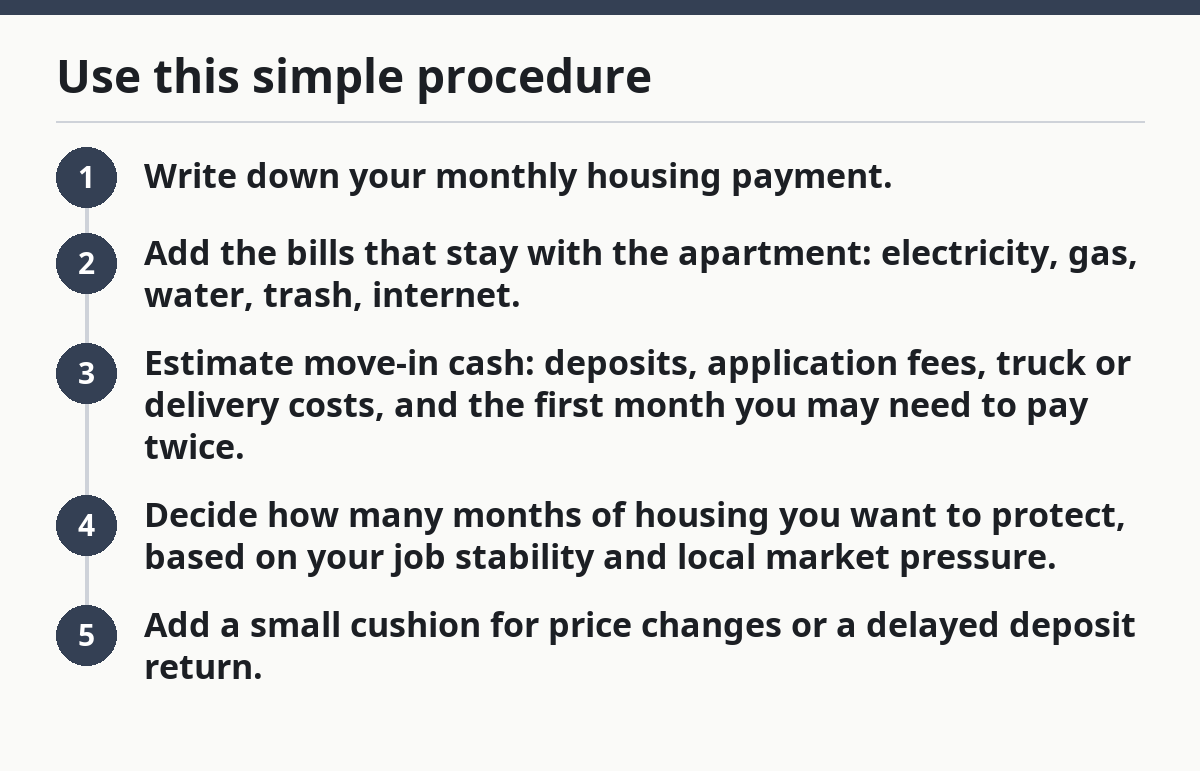
Use this simple procedure
- Write down your monthly housing payment.
- Add the bills that stay with the apartment: electricity, gas, water, trash, internet.
- Estimate move-in cash: deposits, application fees, truck or delivery costs, and the first month you may need to pay twice.
- Decide how many months of housing you want to protect, based on your job stability and local market pressure.
- Add a small cushion for price changes or a delayed deposit return.
That gives you a goal that reflects the city you live in, not a generic rule from somewhere cheaper. For more on housing budgets and local rent context, see HUD rental data and the Zillow Observed Rent Index. HUD, Zillow
A quick example
- Rent: $2,800
- Utilities: $250
- Move-in and overlap cash: $4,000
- One month of housing protection: $3,050
That simple setup already points to a much larger need than rent alone would suggest. It also tells you where your money goes if you need to move fast.
How many months should a high-rent city fund cover?
A high-rent city usually pushes you toward the upper end of your comfort range because every month without income is expensive. The real question is not “what is the textbook number?” It’s “how much time does this city give me before money gets tight?”
If your housing bill is high and easy to escape only with cash, the fund needs more room. A person with a stable salary, strong employer benefits, and low debt may need less cushion than someone in contract work or a city with brutal move-in costs. Same rent. Different risk.
I’d split the decision into 3 levels:
- Short gap: you want enough to survive a brief income interruption and keep housing current.
- Medium gap: you want breathing room for a job search, a lease change, or a move.
- Long gap: you want to handle a stretch where housing costs keep coming while income is uncertain.
If you’re weighing those levels against your local prices, start with the one that matches your actual risk. Now, you might be wondering whether a huge rent payment means you should automatically save for a huge fund. If your rent is high but your job is very stable and you have another strong backup, the target can be smaller than someone with a lower rent and unstable income.
You don’t need a perfect model. You need a target that is hard to fail and easy to explain.
Three tests for your month count
- Could you cover rent and utilities if income stopped for 30 days?
- Could you keep housing stable if a move took longer than expected?
- Could you pay a deposit and overlap costs without putting rent on a card?
If the answer is no, your target is too low.
The local pressure test: why city costs change the goal
Picture this: you find a job loss, a roommate change, or a lease break in a city where every spare apartment costs more than your current one. Local expense pressure changes how much cash you need because the replacement apartment can be pricier, faster to claim, and harder to qualify for.
A generic emergency fund ignores the city itself. A high-rent market does not. In a tight rental market, you may need more cash for applications, deposits, and fast decisions. That makes the emergency fund more than a bill-paying stash; it becomes a housing bridge.
This is where people miss the trade-off. If rent eats most of your paycheck, saving a large fund can feel impossible. The answer is not to give up on the target. It’s to make the first goal smaller and specific enough to reach.
Use local pressure as a check, not a guess
- Look at current listings in your area and note whether cheaper units are actually available.
- Add likely move-in costs if most landlords ask for deposits, first month, and fees.
- Think about timing. If good apartments disappear in days, you need cash ready now, not later.
- Check your overlap risk. If leases don’t line up, one extra month of rent can matter more than the utilities.
That local pressure test often reveals a painful truth: a fund sized for a calm market may be too thin for a city with scarce apartments and high upfront costs. For tenant-focused guidance, see the FTC and HUD resources on renting and housing. FTC, HUD
Common mistake
- Mistake: building a fund that covers one rent payment and calling it done.
- Cost: you may still be unable to move, re-lease, or hold housing during a gap.
- Better move: include move-in costs and one realistic overlap month if your market is tight.
What to do if rent takes most of your paycheck
If rent takes most of your paycheck, set a smaller first goal and build it in stages. A huge target can freeze you. A staged target gets you cash faster and lowers the chance that a small emergency turns into debt.
Here’s the hard part: a high-rent city can make saving feel like stacking sandbags during a storm. You still need a plan. The plan just has to fit your pay cycle and your fixed bills.
Use a 3-step ladder
- Stage 1: protect one month of housing costs.
- Stage 2: add the cash needed for move-in costs and overlap.
- Stage 3: raise the fund until it can handle a longer job gap or lease disruption.
That ladder works because it gives you a win early. If your rent is $3,000 and utilities run $250, Stage 1 is not your final answer. It is the first wall between you and a missed payment.
The truth is, high rent can crowd out savings everywhere else. That’s why the fund goal has to compete with real life, not with a clean spreadsheet. If you can only save $150 a month, a smaller target with a deadline beats a vague “someday” number.
A practical rule
- Start with the amount that would keep housing current for 30 days.
- Add a second layer for move-in and transfer costs.
- Revisit the target after any raise, roommate change, or lease renewal.
If the fund is still impossible after that, the problem is not discipline. It is the size of the housing burden.
Mistakes that make a high-rent emergency fund fail
A high-rent emergency fund fails when the target is built on wishful thinking, not housing reality. The biggest errors are simple: counting only rent, ignoring move-in costs, and setting a target so large that nothing ever gets saved.
The first mistake costs you timing. If you leave out utilities and overlap, you may have enough for the lease but not enough to keep the lights on or move without debt. The second mistake costs you momentum. A target that never feels reachable gets ignored. The third mistake costs you control. You end up dipping into the fund for non-emergencies because it feels abstract.
Watch for these traps
- Treating rent as the full emergency. It isn’t.
- Ignoring move-in cash. Deposits and fees can hit hard.
- Saving to a number that assumes no city pressure. Bad fit.
- Skipping a buffer for lease overlap. That’s where people get squeezed.
The better approach is boring and effective: set a housing-heavy goal that is large enough to matter and small enough to hit. Then build upward in steps, not in one impossible leap.
Who this is not for
- If your housing costs are already unstable month to month, a fixed emergency fund target may be the wrong first project. A separate cash buffer for rent timing may fit better than a giant lump-sum goal.
For a broader framework, this fits under the larger emergency fund goal planning process on the main hub. This page just shows how high rent changes the target.
How to know if your goal is high enough
Your goal is high enough if it can absorb a housing shock without forcing an expensive scramble. That means it covers rent, basic utilities, and the cash needed to change housing without putting everything on a credit card.
A quick test helps. If you lost income for a month, would your fund let you:
- pay the current lease bill,
- keep utilities on,
- and handle a move or lease overlap if needed?
If the answer is yes, the target is in the right range. If not, your number is too thin.
As your situation changes, so should the number. A new lease, a roommate change, a raise, or a move to a less expensive neighborhood can all change the target. Keep the fund aligned with your housing costs and your local market.
FAQ
Should higher rent mean a bigger emergency fund?
Yes, usually higher rent means a bigger emergency fund because housing is the biggest fixed bill most people have. If rent is high, even a short income gap can drain cash fast. The target should reflect rent, utilities, and any move-in costs you might face in the same month.
How do I account for housing costs in my target?
Count the full monthly housing bill, not just rent. Add utilities, then add any likely move-in or overlap costs such as deposits, application fees, and one extra month of rent if a move is possible. That gives you a target based on real housing pressure, not a bare lease payment.
What if rent takes most of my paycheck?
Start with a smaller first goal and build in stages. A first target that covers 30 days of housing costs is better than a huge number you never reach. Then add move-in cash and overlap money next. That keeps the plan alive even when saving feels tight.
Is it a mistake to keep a smaller fund in a high-rent city?
Not if the smaller fund is intentional and specific. A tiny fund with a clear next step is better than a large target that stays empty. The risk is stopping at a number that cannot handle a move, a lease gap, or a month without income.
Drafted with AI; not yet reviewed by a person.