Last updated: November 19, 2026
Key Takeaways
- Keep side hustle income in three places: separate checking, tax reserve, and emergency savings.
- The right split is the one you can repeat on every payout.
- Move each payout the day it lands so it does not feel spendable.
- Make side hustle money harder to spend and easier to track.
Side hustle income can build an emergency fund without mixing into rent, groceries, or tax money. Quick Answer: split each payout the day it lands, and if you can only choose one rule, use a fixed transfer amount of at least $100 from each side hustle payout. This article on How to Build an Emergency Fund From a Side Hustle shows what to do first, what to move where, and how to know it worked.
Start by separating the money before you spend a cent
Side hustle income works best when it sits in three places, not one: a separate checking account, a tax set-aside bucket, and your emergency fund. If you leave delivery app cash, freelance income, or gig work payouts in the same account you use for bills, the money will get absorbed fast.
Picture this: you get paid on a Tuesday, and the balance looks bigger than usual. That’s the trap. The account feels full, so spending creeps in before you’ve set aside the money you actually need.
Use a separate checking account for side hustle deposits, even if it’s basic and plain.
-
Open or assign one account only for side hustle income.
The account should not be your rent account, card-purchase account, or the place you keep your direct deposit. When the first payout lands there and nothing else does, the system is working. -
Name the money inside your head before it hits your wallet.
Decide that each deposit has three jobs: tax reserve, emergency savings, and operating costs. You’ll know this step worked when you can look at a balance and tell what part is actually spendable. -
Park the whole payout for 24 hours before you move it.
That pause keeps you from spending on impulse. If the money stays put overnight and you can still name every dollar’s job the next day, you’ve got control instead of drift. -
Move the tax slice first, then the emergency slice, then the rest.
This order matters because tax money is not savings. If you can transfer out the tax amount without guessing, the system is clean.
For a deeper framework on where emergency money should sit and how it flows, the hub article on Emergency Fund Funding Tactics gives the bigger map.
How much of side hustle income should go to savings?
The answer is the amount you can commit to every payout, not the amount that feels good once. Side hustle income changes from week to week, so a fixed percentage, fixed dollar amount, or split rule works better than a vague promise to “save what’s left.”
Picture this: one week your freelance invoice lands at $400, then the next week a delivery app barely clears $120 after gas. If your saving rule changes every time, your fund never gets traction.
Pick one rule and keep it for at least 30 days.
-
Start with a simple percentage split.
A common setup is to treat every payout as if it already belongs to three buckets: taxes, emergency savings, and spending. Check with a tax professional or a reliable tax source before you choose the split. The exact split is your number, but the rule should be steady. If you can run it for a month without rethinking it every Thursday, it’s strong enough. -
If your income is erratic, use a floor amount instead of a percentage.
For example, you might decide that every payout sends a set dollar amount to savings until the emergency fund reaches your target. That works well when one week’s total is tiny and the next week’s total is bigger. -
Save from net money, not gross money you haven’t actually received.
Gross income is the invoice, the fare estimate, or the pre-fee total. Net is what hits your account after app fees, platform cuts, or business costs. If you save from gross, you’ll come up short. -
Keep the rule visible.
Put the split in a note on your phone or in your spreadsheet. When the rule is written down, you stop renegotiating it with yourself every time a payout arrives.
The truth is, the best rule is the one you can repeat without thinking, or with very little thought. A perfect formula that changes every week fails fast.
That’s the whole game.
What to do with each payout from gig work or freelance income
Each payout should be split the day it lands, so it never looks like free money for more than a few minutes. This is the point where side hustle income turns from extra cash into a real emergency fund.
Picture this: your ride-share earnings hit on Friday evening, and the balance seems available for a quick dinner, a new tool, or a “small” purchase that isn’t small once repeated. A transfer routine kills that drift.
Use the same sequence every time.
-
Check the deposit and confirm it cleared.
Don’t count pending money. If the app says paid but the bank hasn’t posted it yet, you don’t have it. -
Move the tax set-aside first.
Put the tax share into a savings subaccount, cash envelope, or another separate holding place. The point is to make it hard to spend and easy to find at tax time. If the tax money is gone from checking, the balance is more honest. -
Send the emergency share to its own account.
This can be a separate savings account or a labeled bucket inside your banking setup. When the transfer lands and the checking balance drops right away, the money is no longer floating around to be spent twice. -
Leave only the operating share behind.
That’s the part meant for gas, supplies, mileage, platform fees, or any other job cost tied to the hustle. If your remaining balance roughly matches those costs, the split worked. -
Record the payout in one place.
A simple spreadsheet or notes app is enough. Write the gross payout, the tax slice, and the emergency slice. If you can read the log and know where the money went in under a minute, your system is doing its job.
A separate checking account makes this cleaner, but a cash envelope system can work for the spending slice if your hustle is mostly cash-based. Just don’t keep tax money loose in the same envelope as gas money. That gets messy fast.
How do you keep side hustle money from getting spent?
You keep side hustle money from getting spent by making it annoying to touch and easy to track. A plain balance in a regular checking account invites raids from card swipes, subscriptions, and “I’ll pay it back later” thinking.
Picture this: a busy weekend ends, and the money from three deliveries or one design project is sitting there with your name on it. If it’s visible and easy to spend, it will get spent.
Build friction on purpose.
-
Use a separate account with no debit card attached, if you can.
Less access means fewer impulse buys. If you still need to pay business costs from that account, keep the card off the main side hustle balance and use transfers only. -
Set an automatic transfer if your bank allows it.
Auto-moves from side hustle checking to savings remove the decision from your evening. If the transfer happens on the same day every payout lands, you won’t have to remember it. -
Name the account for its job.
“Emergency Fund” is clearer than a generic savings label. The clearer the label, the less likely you are to borrow from it for something that isn’t an emergency. -
Use cash envelopes for short-term hustle costs.
If you need money for gas, supplies, or tolls, keep that amount separate in a physical envelope or a dedicated digital bucket. When the envelope is empty, that cost stops. No guessing. -
Put a 24-hour pause on nonessential spending.
If a purchase still feels necessary the next day, you can revisit it. Most side hustle purchases don’t survive that pause.
The flip side is simple: if you don’t create friction, your emergency fund will compete with every tiny urge in your week. That’s a bad fight for the savings account.
How to handle taxes before the emergency fund gets bigger
Tax money has to come out before you treat side hustle income like savings. If you skip that step, your emergency fund can look healthy while your tax bill quietly grows in the background.
Picture this: you’ve stacked a few hundred dollars from freelance income, and it feels like real progress. Then tax time arrives and part of that money was never yours to keep.
-
Estimate a tax set-aside rate and use it on every payout.
The exact rate depends on your situation, so the number should come from a qualified tax pro or a reliable tax estimate, not a guess. The rule is simple: move that share out before anything else. -
Keep tax money in a separate holding place.
A savings account, a bucket inside your banking app, or a cash envelope can work as long as it doesn’t blur into emergency savings. If you can’t tell at a glance which dollars are taxes, the setup is too loose. -
Reconcile your set-aside once a month.
Compare what you reserved with what you’ll likely owe. If the gap is obvious, you can adjust before the bill hits. Waiting until filing season is how side hustlers get surprised. -
Treat tax money as untouchable.
The emergency fund is for real shocks: car repair, medical gap, rent trouble, or a broken appliance. Tax money is not emergency money. If you mix them, both goals fail.
If your side hustle is small, taxes may feel far away. They aren’t. Even a few loose deposits can become a year-end bill you didn’t plan for.
Don’t borrow from yourself.
A simple transfer rule that works when income changes
A fixed transfer rule keeps side hustle income from becoming a monthly debate. The best rule is one you can apply in under 2 minutes after each deposit, even when the amount changes.
Picture this: one week you earn a strong payout from delivery apps, and the next week freelance work slows down. The money moves are still the same. That repeatability is what makes the fund grow.
Keep it boring.
-
Decide your order of operations.
Most people should use: tax money first, emergency savings second, operating money last. If the order stays the same, the routine gets faster. -
Tie the rule to each payout, not each payday.
Side hustle income often lands at odd times. If you wait for a calendar payday, you’ll miss transfers and start treating the money like regular spending cash. -
Use the same transfer path every time.
Same bank route, same label, same note in your tracker. Repetition cuts mistakes. If you can complete the move without opening three tabs and wondering where the money belongs, the path is tight enough. -
Review the rule after 30 days.
If the emergency fund barely moved, the share is too small. If you keep shorting your tax reserve or cash costs, the split is wrong. Adjust once, then hold steady again.
A lot of generic advice says to “save more.” That’s too vague to help a side hustler with uneven income. A transfer rule is better because it tells the money where to go before you can spend it.
That’s the difference.
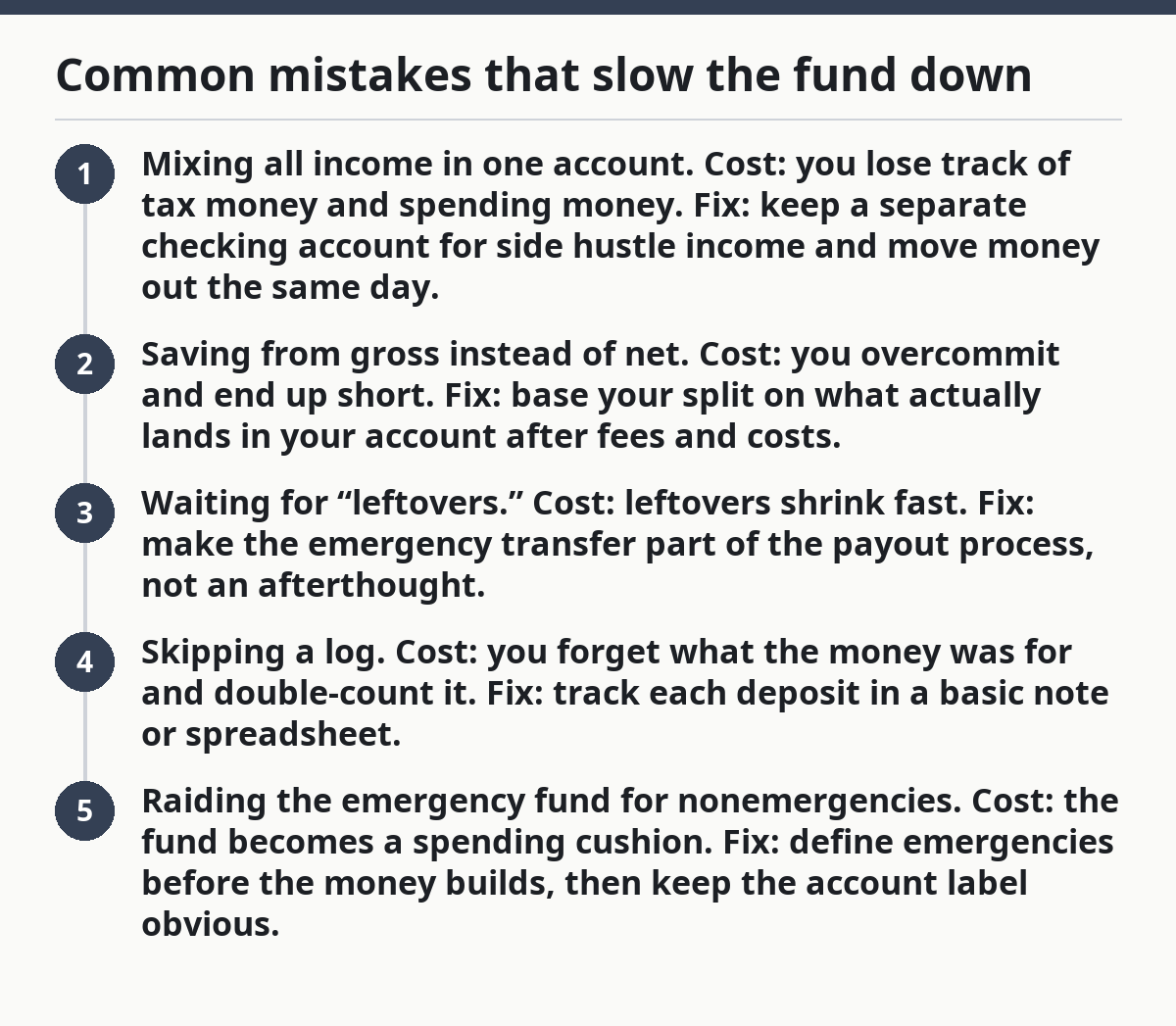
Common mistakes that slow the fund down
The biggest mistakes are mixing funds, saving from gross income, and waiting to transfer until the money feels “extra.” Those habits make side hustle income look bigger than it really is and leave the emergency fund underfed.
Picture this: you have a good week, spend a little more, then promise to fix it next week. That cycle is how side hustle money disappears without building anything lasting.
Avoid these traps.
-
Mixing all income in one account.
Cost: you lose track of tax money and spending money. Fix: keep a separate checking account for side hustle income and move money out the same day. -
Saving from gross instead of net.
Cost: you overcommit and end up short. Fix: base your split on what actually lands in your account after fees and costs. -
Waiting for “leftovers.”
Cost: leftovers shrink fast. Fix: make the emergency transfer part of the payout process, not an afterthought. -
Skipping a log.
Cost: you forget what the money was for and double-count it. Fix: track each deposit in a basic note or spreadsheet. -
Raiding the emergency fund for nonemergencies.
Cost: the fund becomes a spending cushion. Fix: define emergencies before the money builds, then keep the account label obvious.
You do not need a fancy budget app to do this. You need a rule, a place for the money, and the nerve to move it before it disappears.
That is enough to start.
How much side hustle income should go to emergency savings?
A steady share of each payout should go to emergency savings, but the exact amount depends on your taxes, fees, and basic hustle costs. The best rule is one you can apply every time money lands, even when the income swings.
If the side hustle is unpredictable, a percentage split is usually easier than a promise to save “whatever is left.” Keep the rule simple enough that you can repeat it after a late-night delivery or a freelance invoice without doing math from scratch.
Should you save gross or net side hustle income for emergencies?
You should save from net side hustle income, not gross income. Gross is the amount before platform fees, processing costs, or other deductions; net is what actually reaches your account.
That matters because emergency savings need real cash, not a number on an invoice. If you save from gross, you’ll likely overstate what’s available and leave yourself short when tax time or business costs arrive. See the IRS estimated tax guidance for the tax side of that split and Consumer Financial Protection Bureau savings guidance for keeping savings separate.
How do you keep side hustle money from getting spent?
You keep side hustle money from getting spent by moving it out of easy reach fast. A separate checking account, a same-day transfer rule, and a 24-hour pause on nonessential spending do most of the work.
If the money sits in the same account you swipe for groceries and gas, it will get used. Give the savings a different place to live, label it clearly, and make spending it less convenient than saving it.
Drafted with AI; not yet reviewed by a person.