Last updated: November 19, 2026
Quick Answer: a temporary second job can help you build a starter emergency fund in 8 to 16 weeks if you set a target, pick predictable hours, and separate the savings immediately.
Key Takeaways
- Set your target amount and exit date before you start the extra work.
- Pick the most predictable hours, even if the job sounds less exciting.
- A short-term income plan can turn extra pay into savings instead of spending.
- Keep the fund separate so it is easier to track and harder to use.
A temporary second job can fund an emergency cushion without changing your main career, if you treat it like a short project with an end date and consult a financial professional if your situation is complex. The best workable plan is to set a savings target, pick a second job with predictable hours, route every dollar into one savings account, and stop on a fixed date. The steps below show how to do that without burning out. For savings basics, see the Consumer Financial Protection Bureau and FDIC guidance on building emergency savings. CFPB, FDIC
Start with the amount and the stop date
Picture this: you already work one job, bills keep showing up, and you need a clear way to build cash without turning your life into a 7-day grind. You need two numbers first: the emergency-fund target and the date you’ll stop the extra work.
A small emergency fund can be a starter goal, not a forever goal. If you don’t have one yet, pick a dollar amount you can actually reach with a temporary second job in 8 to 16 weeks. That can be a starter buffer such as $1,000, a month of bare-bones expenses, or another amount that would keep one surprise bill from becoming a crisis. For examples of emergency-savings targets, see the CFPB and consumer guidance from the Federal Reserve. CFPB, Federal Reserve
Here’s the catch: if you don’t set a stop date, the second job starts to eat the time you needed to protect in the first place. Decide the end date before you take the first shift. Then back into the weekly savings amount from there.
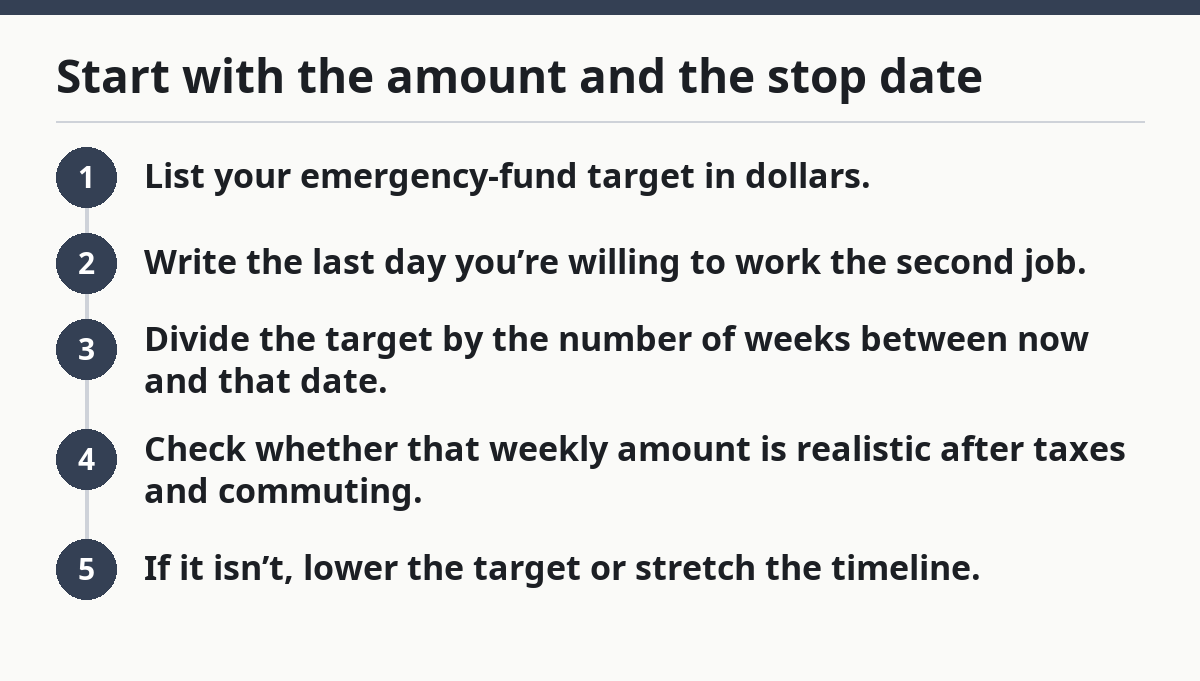
- List your emergency-fund target in dollars.
- Write the last day you’re willing to work the second job.
- Divide the target by the number of weeks between now and that date.
- Check whether that weekly amount is realistic after taxes and commuting.
- If it isn’t, lower the target or stretch the timeline.
When this step works, you’ll have a number on paper and a calendar date circled. That’s the moment the plan stops being vague. It becomes a project.
How do I choose a temporary second job that fits my schedule?
Choose the job that gives you the most predictable hours, not the one that sounds best on day one. A part-time job, seasonal work, or a short side job with a fixed shift pattern usually works better than anything that changes week to week.
Picture this: you’re comparing a retail shift job, weekend warehouse work, and an on-call gig. You need hours that stack cleanly around your main schedule, plus a commute you can repeat for a few months without resentment. If the second job needs constant texting, same-day changes, or late-night shifts that wreck sleep, it can cost more in burnout than it pays in cash.
Use this filter before you say yes:
- Predictable hours: look for set shifts, posted schedules, or a 2-week rota.
- Short commute: aim for a route you can repeat without losing an hour each day.
- Fast pay cycle: weekly or biweekly pay helps if your target is short-term.
- Low training load: fewer moving parts means faster first paycheck.
- Clean exit: the job should let you leave without drama when your target is met.
You do not need the “best” job in a career sense. You need the easiest job to finish. A temporary second job that pays a little less but fits your life is often the smarter choice.
What to avoid:
- gigs that need you to carry inventory, tools, or your own car unless the math still works;
- schedules that collide with sleep, child care, or a long commute;
- jobs with pay that arrives too late to help your target window.
If the role makes you dread the next week before you even start, keep looking.
Build a short-term income plan before the first shift
A short-term income plan turns your second job into a savings machine instead of extra spending money. The plan has one job: tell every dollar where to go before it lands.
Picture this: your first paycheck from the second job hits, and without a plan it gets split between takeout, clothes, and a “quick” Amazon order. That’s how temporary work turns permanent. The fix is to assign the money on paper before the first pay date.
Use a simple budget with three buckets:
- Emergency fund
- Required work costs
- Nothing else
Required work costs are the things that reduce your take-home pay: gas, transit fares, work shoes, a uniform, parking, and a basic meal if you’re out longer than usual. Put those in the budget first. Then move the rest to the emergency fund.
A clean test: if you can’t name every cost of the second job in under 2 minutes, you don’t yet know what the job really pays.
Use this sequence:
- Estimate gross pay from the second job.
- Subtract taxes if the pay isn’t already after tax.
- Subtract commuting, meals, clothing, and parking.
- Put the remaining amount into your emergency-fund target.
- Add a 10% cushion for surprise work costs if the job has them.
Use a separate savings account, not your everyday checking account. That split matters because it creates a delay before spending. If your bank lets you nickname accounts, label it “Emergency Fund — Temporary Job.” Simple labels work. Unclear labels usually do not.
How to keep the money ring-fenced so it doesn’t disappear
Keep the money ring-fenced by making it hard to spend and easy to track. A separate savings account that receives transfers the same day you get paid is often the cleanest setup.
Picture this: payday arrives, your regular checking balance looks bigger than usual, and a friend asks you to split dinner. If the emergency money sits in the same account as rent and groceries, your brain can treat it as available. That is why many personal finance guides recommend separating savings from everyday spending. CFPB, FDIC
Set up these barriers:
- Direct deposit from the second job into the savings account if possible.
- Automatic transfer of a fixed amount on each payday.
- No debit card attached to the savings account, if your bank allows it.
- Balance alerts so you see every transfer.
- A written rule that this account is for emergencies only.
A separate account works best when it has no frictionless spending path. If the money takes 3 taps and a card swipe to spend, it’s too easy to raid.
A good sign that the system is working: the savings balance rises right after every shift cycle, and your checking account still handles normal life without dipping into the fund. If the fund keeps getting borrowed from, the setup is wrong, not your willpower.
For a larger personal finance framework, this page sits inside the hub on Emergency Fund Funding Tactics. The temporary second job is just one route in that larger map. You may also want to see the related pages on budgeting basics, sinking funds, and side hustles for beginners.
Prevent burnout before the second job becomes the first job
Prevent burnout by protecting sleep, one day off, and a hard cap on shifts. A temporary second job only helps if you can finish it and return to normal life with your health and main income intact.
Picture this: you grab every available shift for 6 straight weeks, then miss work at your main job because you’re exhausted. That is a bad trade. Your emergency fund cannot come from a plan that weakens the income you already have.
Set three limits:
- Maximum workdays per week: decide the number before you start.
- One recovery block: keep at least one real off-block each week, even if it’s only half a day.
- Stop-loss rule: if sleep, mood, or performance drops for 2 weeks, cut hours.
The truth is, the fastest plan is not always the one with the most shifts. It’s the one you can repeat without dragging your life into the ground. A part-time job with steady hours often beats a chaotic side job that pays more on paper but leaves you wrecked.
Common mistakes here cost real money:
- Taking late shifts that make your main job sloppy.
- Saying yes to overtime after you’ve already hit your weekly savings target.
- Skipping meals to “save” money, then overspending later because you’re drained.
- Using every free hour for work and then crashing for a full weekend.
What to do instead: choose a ceiling, not a wish. For example, cap yourself at 10 to 15 hours a week if that still leaves room for sleep and the main job. If a commute eats another hour or two, lower the shift count. You’re building a fund, not proving toughness.
Stop the second job on purpose, not by accident
Stop the second job on purpose the week you hit your target or the date you set, whichever comes first. A temporary second job only stays temporary if you end it like a project with a closing date.
Picture this: the fund hits its goal, but you keep taking shifts “just in case.” That usually turns into vague drift, not smart planning. The extra money starts covering lifestyle creep, and the emergency fund stops being a target.
Use this closeout process:
- Confirm the savings balance matches your goal.
- Leave a small buffer in checking for the final paycheck timing.
- Tell the manager or scheduler your last available week.
- Move any final pay into the emergency account.
- Freeze the new habit by removing the shift app or calendar alerts.
If you picked 8 weeks, end it at 8 weeks unless the fund is short. If you picked a dollar target, stop when the account reaches that number and the final work costs are covered. Don’t keep extending the plan because it feels productive. That’s how temporary income becomes a permanent burden.
A solid ending leaves you with three things: the savings balance you wanted, a clean calendar, and no open-ended obligation to keep working nights or weekends. That is the point of the whole move.
Use a temporary second job for the right reasons
Use a temporary second job when you need a clear, time-limited way to build a starter emergency fund and you can spare the hours without damaging your main income. It is not the right move if your main job already leaves you exhausted, your schedule is unstable, or the second job would force you into debt for commuting or child care.
Picture this: you can handle another shift for a few months, but not for a year. That’s fine. This method is built for that exact situation. The goal is a short sprint with a defined finish, not a lifestyle change.
A temporary second job works best when:
- you need a fast start on savings;
- you want to keep the emergency fund separate from monthly budgeting;
- you can predict your next 8 to 16 weeks;
- you have a clear exit date and a clean savings account.
It works poorly when:
- the second job requires expensive tools, long travel, or irregular nights;
- your main job already depends on good sleep and recovery;
- you’re using it to avoid making a budget at all.
If you want the money to stay put, keep the rule simple: every payday from the second job goes to the fund until the target is met. No detours. No “I’ll just keep a little back.” The plan works because it is narrow.
FAQ
Is a temporary second job worth it for savings?
Yes, if the job has predictable hours and your take-home pay still leaves a real amount for the emergency fund. It’s usually worth it when you can reach a clear savings target in a few months without hurting your main job or health. If the commute, stress, or childcare cost eats most of the money, the trade-off gets worse fast.
How long should I keep a second job to save up?
Keep it only as long as it takes to hit the amount you wrote down at the start. For many people, that means a set period like 8 to 16 weeks, but the right length is the one that matches your target and schedule. The stop date should come from the budget, not from how long you can tolerate the grind.
How do I avoid spending second-job income?
Put the money in a separate savings account the same day you get paid. Keep that account out of your normal checking flow, remove spending access if you can, and assign every dollar to the emergency fund before the shift even starts. If the money sits in the account you use for groceries and bills, it will be much easier to spend.
Drafted with AI; not yet reviewed by a person.