Last updated: November 19, 2026
Quick Answer
A good starting emergency fund goal for commission pay is 3 months of essential expenses, based on your income floor, not your best month. If your pay is highly uneven, you may need more. This article explains how to set an emergency fund goal for commission pay, including how bonus pay fits and how to keep the target realistic.
A commission-heavy job makes emergency savings harder to size because your pay can swing by hundreds or thousands from one month to the next. Set the goal from your income floor, not your best month. The sections below show how to calculate that floor, where bonus pay fits, and how to choose a target that won’t collapse the first slow quarter hits.
Key Takeaways
- Use your base salary or lowest steady pay as the starting point.
- Add only the expenses that truly must be covered in a rough patch.
- Treat commission and bonus pay as fuel for the fund, not the number that sets the goal; when in doubt, consult a qualified financial professional. For emergency-savings guidance, see the Consumer Financial Protection Bureau and FDIC resources.
- If your income jumps around a lot, a 3-month target based on your floor is safer than a target based on your average.
- Big bonuses are useful, but a bonus should not be the reason your plan exists.
What is the right emergency fund goal for commission income?
The right goal for commission income is an emergency fund based on your income floor, not your average sales month. If your paycheck can swing sharply from one month to the next, the amount you can safely count on is the base salary or the lowest realistic month you can live on.
Picture this: you’re looking at last quarter’s pay stubs, and one month looks great while the next one barely covers rent. That’s exactly why a commission income emergency fund plan has to start with the floor, not the peak. A bonus-heavy role can make the average look strong and still leave you short when deals slip.
Here’s the catch: the goal is not “save as much as possible.” The goal is to cover the time between a bad income spell and the next stable paycheck. For many people, that means building a target around 3 months of essential expenses if the base pay is reliable, and more if the commission portion carries most of the household bill load. I’m not naming a one-size-fits-all number, because this page is about setting the goal, not pretending every pay structure behaves the same.
Use this rule:
- Stable base salary plus modest commission: start with the base salary and essential monthly costs.
- Low base salary plus heavy commission: use the lower pay floor and aim higher.
- Bonus pay that arrives once or twice a year: do not count it as monthly income unless it is truly fixed and predictable.
The honest test is simple. If a slow month would force you to use debt for groceries, gas, or rent, your current emergency fund goal is too low.
How do I set the number step by step?
You set the number by finding your floor, listing essential costs, and multiplying that by the months of coverage you need. That is the cleanest way to build a variable compensation emergency fund plan without letting your best month distort the math.
Picture this: you’re at your kitchen table with three pay stubs, a bank app, and a lease bill in front of you. You do not need a fancy spreadsheet. You need a clear number that still works if commission dries up for 30 days or longer.
Start with these steps:
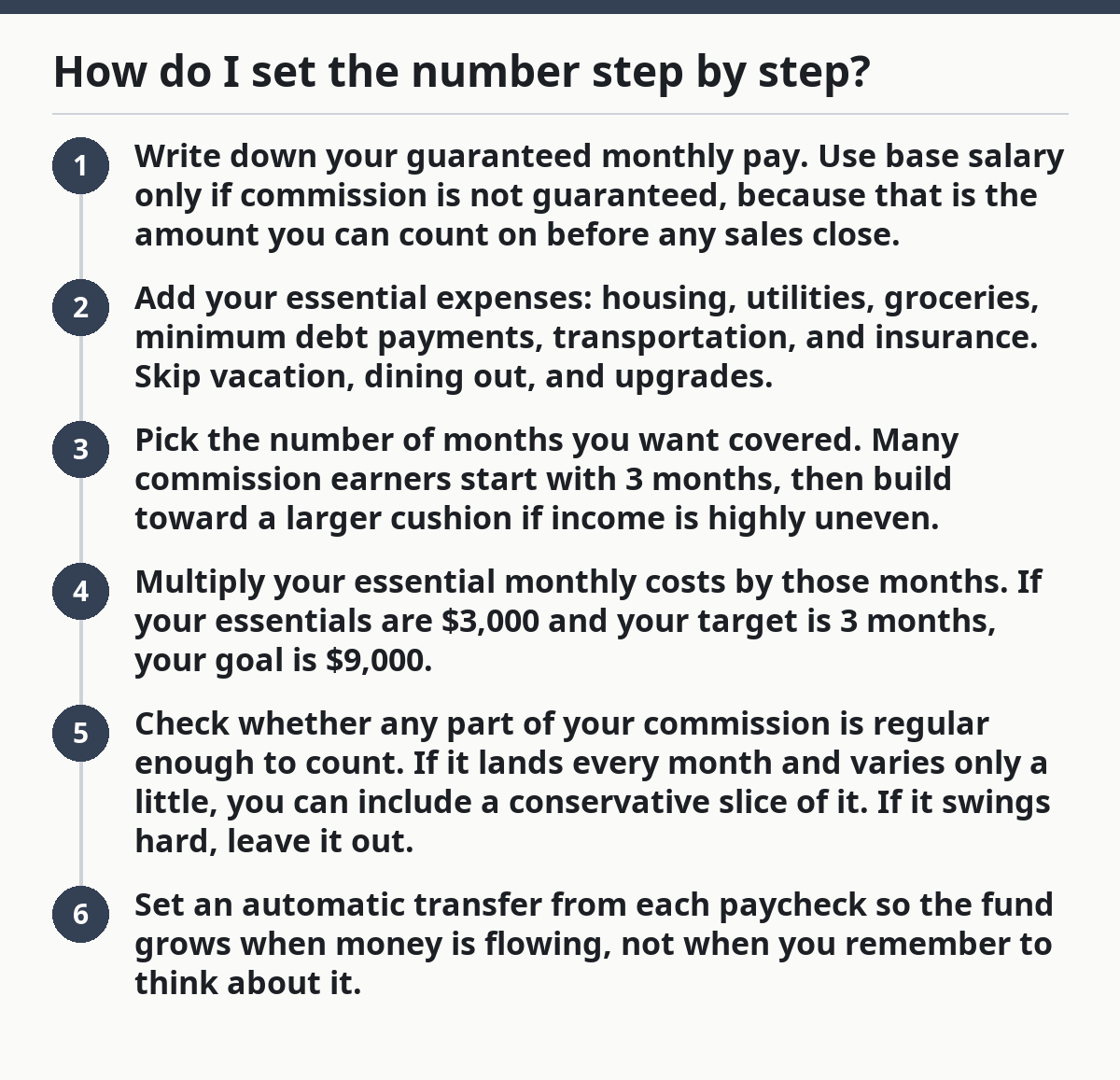
- Write down your guaranteed monthly pay. Use base salary only if commission is not guaranteed, because that is the amount you can count on before any sales close.
- Add your essential expenses: housing, utilities, groceries, minimum debt payments, transportation, and insurance. Skip vacation, dining out, and upgrades.
- Pick the number of months you want covered. Many commission earners start with 3 months, then build toward a larger cushion if income is highly uneven.
- Multiply your essential monthly costs by those months. If your essentials are $3,000 and your target is 3 months, your goal is $9,000.
- Check whether any part of your commission is regular enough to count. If it lands every month and varies only a little, you can include a conservative slice of it. If it swings hard, leave it out.
- Set an automatic transfer from each paycheck so the fund grows when money is flowing, not when you remember to think about it.
A useful check is the 90-day test. Ask, “If my next 3 months are thin, what bill still has to get paid?” That answer tells you whether your number is realistic or wishful.
The truth is, the step that matters most is the first one. If you start with average income, the goal will feel comfortable and fail when commissions lag. Start with the floor and the math gets honest fast.
Should I base it on base pay only?
Yes, base pay should usually be the anchor if your commission is irregular or unpredictable. When the commission side can disappear for a month, your emergency fund has to survive on the pay that is most likely to show up.
Picture this: your base salary covers half the month, and the rest depends on whether three deals close before Friday. That job needs a different savings target than a straight salary job. In that case, base pay only is not pessimistic. It is realistic.
Use base pay only when:
- Commission varies a lot from month to month.
- Payout timing is slow, such as 30 to 60 days after a sale.
- You cannot count on a minimum commission amount.
- Your fixed bills already strain your base salary.
You can blend in some commission only if the pattern is steady enough to trust. For example, if you earn a small, recurring commission every month and the amount has held for 12 months or more, you might count a conservative portion of it. But the number should stay cautious. Avoid treating the strongest few months from a good year as if they were normal.
Here’s the trade-off: a base-pay-only target may look larger than you want, but it protects you from the exact problem commission workers face. A “full income” target can be too fragile because it assumes sales keep rolling. A floor-based target assumes they might not.
If you want one clean sentence to remember, use this: base pay is the floor, not the forecast. That distinction keeps the goal from being built on hope.
For a broader planning view, the Emergency Fund Goal Planning hub can help connect this target to the rest of your savings plan.
How should bonus pay change the target?
Bonus pay should usually help you build the fund faster, not lower the target itself. If a bonus is not guaranteed, it should not become the foundation of the emergency fund goal.
Picture this: your annual bonus lands in March, and it feels like a windfall. That is the perfect time to push money into savings, pay down urgent debt, or finish the fund. It is not a good reason to raise your lifestyle and shrink your safety net at the same time.
Use this bonus rule:
- If the bonus is discretionary, count it as extra.
- If it is formula-based but still depends on company results, count only part of it, or none of it, in your target.
- If it has a fixed schedule and a dependable formula, you can treat it as a planning tool, not a monthly guarantee.
The clean way to use bonus pay is to pre-decide where it goes before it hits your checking account. Split it into 2 or 3 buckets if that helps:
- emergency fund top-up,
- bills or taxes due soon,
- debt that is draining your cash flow.
That split matters because bonus money disappears fast when it sits unassigned. A $5,000 bonus can vanish into credit card balances, car repairs, and a weekend trip before it does any real protection work.
As a result, bonus pay can shorten the time it takes to reach the goal without changing the logic of the goal. The target stays tied to your floor. The bonus just gets you there sooner.
What mistakes make commission earners under-save?
Commission earners under-save when they let strong months set the standard for weak months. That mistake makes the emergency fund look finished long before it can handle a real income dip.
Picture this: you’ve had two big commission checks, so you assume the pattern will hold. Then a client delays a signing, a quarter starts slow, and the cash cushion is gone in 2 weeks. That is the most common failure pattern.
The biggest mistakes are:
- Using average pay instead of floor pay. Cost: the target looks safe but breaks in a slow month. Fix: base the goal on guaranteed income only.
- Counting expected bonuses as guaranteed. Cost: you save less than you need. Fix: treat bonuses as extra, not required.
- Including nonessential spending in the target. Cost: the number gets inflated and the plan feels impossible. Fix: use essential costs only.
- Stopping at one month because a good quarter felt secure. Cost: one slow period wipes out the cushion. Fix: aim for at least 3 months of essentials as a starting point.
- Waiting for the “right” month to start. Cost: the fund never starts. Fix: set a small automatic transfer now, even if it’s modest.
Because commission income can be uneven, a commission-based pay structure needs a cold-eyed plan. Not a dramatic one. Not a perfect one. A workable one.
If your pay swings hard, the goal should feel a little conservative. That is not failure. It is the point. Emergency money is there to cover uncertainty, and commission income brings more of it than a fixed salary does.
How do I know the goal is high enough?
Your goal is high enough when a thin month would not force you to borrow for essentials or miss a core bill. That is the real test, and it matters more than any neat round number.
Picture this: you lose a full commission cycle, but your rent, utilities, groceries, gas, and minimum debt payments still get covered. If that would work, your target is doing its job. If it would not, the target is too low.
A quick self-check:
- Could you cover essentials for 30 days without commission?
- Could you do it for 60 days if two pay periods run light?
- Would a slow quarter still leave cash in the account?
If the answer is no to any of those, keep building. You do not need to guess whether the goal is finished; you can test it against a bad month on paper.
One more thing: a commission job can change. Sales territory shifts, quota changes, and payout timing changes too. Recheck the goal at least once a year, or after any major change in base pay, plan design, or bonus structure. A target that fit last year’s comp plan may be wrong now.
The goal is not to impress anyone with a big number. It is to stay steady when compensation is not.
FAQ
How do I budget if my pay changes every month?
Use your lowest reliable pay as the baseline and build the rest of the budget around that amount. Keep fixed bills separate from flexible spending so you can see what must be covered even in a weak month. A 3-month review of pay stubs often shows the real floor better than one month does.
Should I base my emergency fund on base pay only?
Usually, yes, if your commission is uneven or hard to predict. Base pay gives you a safer floor because it is the money most likely to arrive on time. If part of your commission is truly steady, you can count a cautious portion of it, but do not let it drive the whole target.
How do bonuses affect my savings target?
Bonuses should speed up the savings plan, not replace it. If a bonus is uncertain or variable, treat it as extra money that can fill the fund faster once it arrives. A bonus can shrink the time to reach your goal, but it should not lower the goal unless it is dependable enough to count as regular income.
Drafted with AI; not yet reviewed by a person.