Last updated: November 19, 2026
Key Takeaways
- Use the most dependable income as your baseline, not every dollar from a strong month.
- Rank each stream by stability, predictability, and repeatability to pick the anchor.
- Add side income only after separating it from your minimum survival number.
- Set the goal by choosing the anchor, mapping the bill floor, and selecting a replacement window you can fund.
An emergency fund for multiple income streams should start with your most stable income, not your highest one. Use the income you can count on first, then size the fund around the gap that would hurt if it disappeared. This guide on Emergency Fund Goal Planning for Multiple Income Streams explains which paycheck to anchor to, how to treat side income, and how to set a goal that fits multiple jobs, freelance income, W-2 pay, and side income. For general saving guidance, see the Consumer Financial Protection Bureau and the FDIC.
What is the right emergency fund baseline for multiple income streams?
The right baseline is the most stable income you rely on for bills, not every dollar you earn in a busy month. Picture this: you’ve got a W-2 job, two freelance clients, and a side gig, but one client vanishes for 60 days. Your fund should protect the part of your budget that still has to get paid.
Here’s the catch: if you average all income sources together, you can set a target that looks fine on paper and fails in real life. A safer baseline is the income stream with the fewest moving parts and the cleanest pay history. For many people, that is the W-2 paycheck. For others, it may be one long-term retainer or a contract that has held steady for 12 months.
The goal is not to guess at your best month. It’s to build around the month that would feel tight if one stream stopped. That means a lower, steadier number usually beats a higher, shaky one.
- Primary income: the stream that covers rent, food, insurance, and debt minimums.
- Secondary income: money that helps you save faster, but should not carry the emergency-fund target by itself.
- Replacement target: the number you need if a stream disappears for 1 to 3 months.
A simple test helps. If one income source vanished tomorrow, which bills would still be paid without stress? That answer is your baseline, not the largest deposit in your bank app.
How do I choose the income stream to anchor my target?
You choose the anchor by ranking each stream for stability, predictability, and repeatability. Picture this: you open your banking app and see three deposits from three different places, but only one of them lands on the 1st and 15th every month. That one usually belongs at the center of the plan.
The truth is, many people mix “most money” with “most dependable.” Those are not the same. A freelance client that pays $4,000 one month and $0 the next is not a better anchor than a $3,000 W-2 paycheck that arrives like clockwork. The first may be useful. The second is safer.
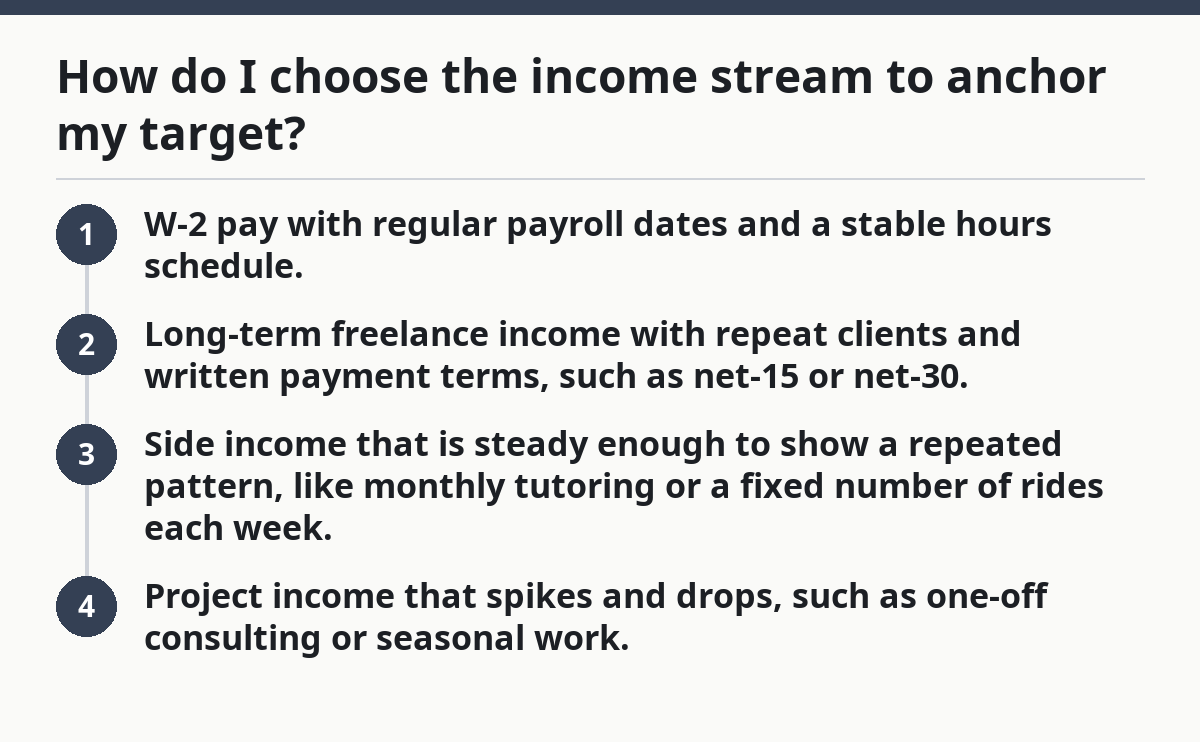
Use this ranking to decide what gets counted first:
- W-2 pay with regular payroll dates and a stable hours schedule.
- Long-term freelance income with repeat clients and written payment terms, such as net-15 or net-30.
- Side income that is steady enough to show a repeated pattern, like monthly tutoring or a fixed number of rides each week.
- Project income that spikes and drops, such as one-off consulting or seasonal work.
A practical rule, with a professional review if your finances are complex, is this: if an income source would take longer than 30 days to replace, do not treat it like your base. If it would be painful but possible to replace in a week or two, it may sit above your floor, not under it. Sources such as the Consumer Financial Protection Bureau and the FDIC can help, but a financial professional can also help you decide how to apply the rule.
- Anchor to the stream that has the lowest surprise risk.
- Ignore one-time spikes.
- Favor deposits with a 12-month track record over a hot streak.
- Pick the stream that would still exist after a slow month.
This is the part most generic guides miss: your fund should match your weakest reliable leg, not your strongest month.
How do I count side income in my emergency savings plan?
Count side income only after you separate it from your minimum survival number. Picture this: your weekend income pays for extras, but your rent is still due even if those shifts dry up next month. That means side income can speed up savings, yet it should not hold the whole plan up.
Side income belongs in your emergency plan in one of three ways. It can be ignored for safety, counted at a discount, or used as a temporary booster while you build the fund. The right choice depends on how steady it is. If the money arrives in a pattern you can prove over several months, you may count part of it. If it comes in bursts, keep it out of the core target.
A clean method is to separate the plan into two layers:
- Core fund: built from the stable income only.
- Stretch layer: funded by side income, freelance overflow, or extra hours.
That keeps your target honest. It also stops you from calling a $2,000 side hustle month “normal” when the next month is $300.
One useful filter is the 3-month lookback. If the side income has held up for at least 3 months in a row, it may be worth including at a reduced level. If the money depends on season, energy, or one client, consult a professional before leaving it in the baseline, and treat it as bonus savings.
What not to do: do not count side income twice. If you use it to raise your living standard and also use it to support your emergency target, you will overstate your safety.
- Count steady side income only if it repeats predictably.
- Keep irregular side income out of the base target.
- Use extra earnings to reach the target faster, not to justify a larger lifestyle.
- Recheck the pattern every quarter.
The step-by-step way to set a multi-income emergency fund goal
The right goal comes from a short process: choose the anchor, map the bill floor, and set a replacement window you can actually fund. Picture this: you sit down with bank statements, three pay sources, and a rent bill due in 10 days. You do not need a fancy calculator. You need a clean order of operations.
- List every income stream and label each one as stable, moderate, or shaky. Use your last 6 to 12 months of deposits if you have them.
- Pick the anchor income with the strongest payment pattern. For many people, that is W-2 pay.
- Write down your bare monthly bills: rent or mortgage, utilities, groceries, transit, insurance, and minimum debt payments.
- Subtract the income that is truly steady from those bills. The gap is the part your emergency fund needs to protect.
- Choose a replacement window. Many people aim for 1 to 3 months of the gap when they have multiple income streams, because some replacement is faster than a full rebuild.
- Set the dollar target by multiplying the monthly gap by the number of months you want to cover.
- Round the number up to a clean figure you can remember, such as the next $500 or $1,000. A clean target is easier to save toward.
- Review every 6 months or after any change in job hours, contract size, or client count.
Example: if your bills are $4,000 and your stable income covers $3,000, your gap is $1,000 a month. A 3-month target would be $3,000. If your freelance income is steady enough to count halfway, your real gap may be lower. That is why the baseline matters more than the headline income.
This method works even when your money comes from different places, because it focuses on the bill gap, not the glamour number.
What mistakes make multi-income emergency funds too small?
The most common mistake is counting the wrong income as stable, which makes the target look complete when it isn’t. Picture this: you set your goal based on last month’s best freelance check, then a client pauses work for 6 weeks. The fund was never as strong as it looked.
Another mistake is trying to replace every dollar from every stream. That sounds thorough, but it can create a target so large that you never finish it. For people with multiple income streams, the safer move is usually to protect the fixed bills first and let the fund grow from there. A fund that exists beats a perfect target that never gets funded.
A third mistake is using gross income when the bills are paid from net income. If taxes, platform fees, or business costs come off the top, your emergency fund should reflect the money you actually use, not the invoice total. That detail matters most for freelance income and side income.
Then there is the “I’ll just top it up later” trap. If one income source falls off, later may not arrive on schedule. A better move is to set a floor you can defend right now.
-
Mistake: counting unstable income at full value.
Cost: the fund comes up short.
Do instead: discount shaky income or leave it out. -
Mistake: basing the target on gross pay.
Cost: taxes and fees shrink the real cushion.
Do instead: use take-home figures. -
Mistake: waiting for a perfect month.
Cost: no target gets set.
Do instead: pick the cleanest 3- to 12-month pattern you have. -
Mistake: letting every extra dollar raise your lifestyle.
Cost: savings stalls.
Do instead: send new income to the emergency fund until the target is met.
This is also where a generic “3 to 6 months of expenses” answer can mislead you. That rule can be a starting point, but it is not a plan for someone juggling multiple jobs, freelance income, W-2 pay, and side income.
What does a stable income baseline look like in real life?
A stable baseline looks like the income you could lose least safely, then replace most slowly. Picture this: your calendar is full, but one source of income is a contract that ends next month and another is a salary with benefits. The salary usually belongs in the baseline; the contract probably does not.
A baseline is not a guess. It is a line drawn from pay history, contract terms, and your real bill list. If your W-2 pay has shown up on the same payroll cycle for 12 months, it is usually easier to trust than a side gig that swings from $200 to $2,000. If a freelance retainer has renewed for 6 straight months, it may deserve a place in the base, but probably not at full value if the client can cancel with short notice.
The smartest baseline often includes only one or two income streams. That can feel conservative. It is. And that is the point. A conservative baseline keeps the target within reach and avoids the trap of treating a busy season as a permanent one.
Here’s a simple standard for deciding what counts:
- Very stable: fixed payroll, recurring contract, or predictable retainer.
- Somewhat stable: recurring side work with uneven volume.
- Unstable: one-off gigs, seasonal spikes, and money that depends on demand you do not control.
If you need a fast way to choose, use the income source that has the longest clean history and the lowest chance of disappearing in the next 30 days. That gives you a floor you can actually build on.
For broader saving rules and target-setting ideas, the Emergency Fund Goal Planning hub is the next stop, and the Consumer Financial Protection Bureau and FDIC offer related guidance.
Which income should I use for my emergency fund target?
Use the most stable income stream as the anchor for your emergency fund target. If your pay is split across W-2 work, freelance income, and side income, the stream with the fewest surprises should lead the plan. The goal is to protect the bills that would still be due if the weaker income disappeared for a while.
Do I count side income in my emergency savings plan?
Count side income only if it is steady enough to trust as part of your baseline. If it comes in bursts or depends on seasonal demand, keep it out of the core target and treat it as bonus savings. That keeps the plan honest and prevents a strong month from distorting your goal.
How do I choose a stable income baseline?
Choose the baseline by looking at payment timing, consistency, and how hard the income would be to replace. A W-2 paycheck with regular payroll dates often belongs at the center, while freelance or side income may sit outside the base unless it has a long, predictable record. Use the cleanest 6 to 12 months of history you have.
Drafted with AI; not yet reviewed by a person.