Last updated: November 19, 2026
Key Takeaways
- Access and availability mean how fast you can turn emergency savings into usable cash without fees, delays, or penalties.
- The right speed depends on the emergency, but “next week” is too slow for most situations.
- The biggest barriers are transfer delays, account restrictions, bank holds, withdrawal limits, and penalties.
- A common setup for quick access is keeping most of the fund in savings and a smaller backup amount in checking or cash.
An emergency fund only works if you can get the money fast enough to solve the problem. In Emergency Fund Access and Availability — The Complete Guide, the real question is not just how much you save, but where the cash sits, how quickly you can move it, and what gets in the way when the bill is due today.
What “access and availability” actually mean

Access and availability mean how fast you can turn your emergency savings into usable cash without losing value to fees, delays, or penalties. A fund in a high-yield savings account with same-day transfer is very different from money tied up in a CD, a retirement account, or a joint account you cannot control.
For most people, the ideal emergency fund is liquid, principal-safe, and reachable in hours or at most 1 to 2 business days. That usually points to a savings account, money market account, or cash management account at a bank or credit union, not an investment account. If the money can drop in value, be locked for 12 months, or trigger taxes and penalties, it is not truly an emergency fund in the practical sense.
A setup that works well in practice is the one you can use under stress. A perfect rate means little if you have to wait until Monday morning, call customer service, or sell shares during a market slide.
How fast should emergency money be available?
Emergency money should be available within 24 hours for a true household emergency, and ideally within the same day for smaller shocks like a tow bill, a prescription, or a deposit on a repair. The right speed depends on the kind of expense, but “next week” is too slow for most emergencies.
A useful way to think about speed is in layers:
- Immediate cash: physical cash kept at home for power outages, card failures, or a weekend problem. This is limited and should be modest, often a few hundred dollars rather than a full fund.
- Same-day digital access: savings or checking at the same institution, where internal transfers can post instantly or near-instantly.
- 1 to 2 business days: external transfers, ACH moves, or withdrawals from many online banks.
- Several days or longer: CDs, brokerage accounts with settlement delays, retirement accounts with paperwork, or anything with penalties.
For emergencies, speed matters more than squeezing out an extra fraction of a percent in yield. A fund earning a little more but trapped in a slow transfer system can fail at the exact moment it is needed.
Where should an emergency fund be kept?

An emergency fund should usually be kept in a high-yield savings account, a savings account at a local bank or credit union, or a money market deposit account that allows fast withdrawal. These options balance safety and availability better than most alternatives.
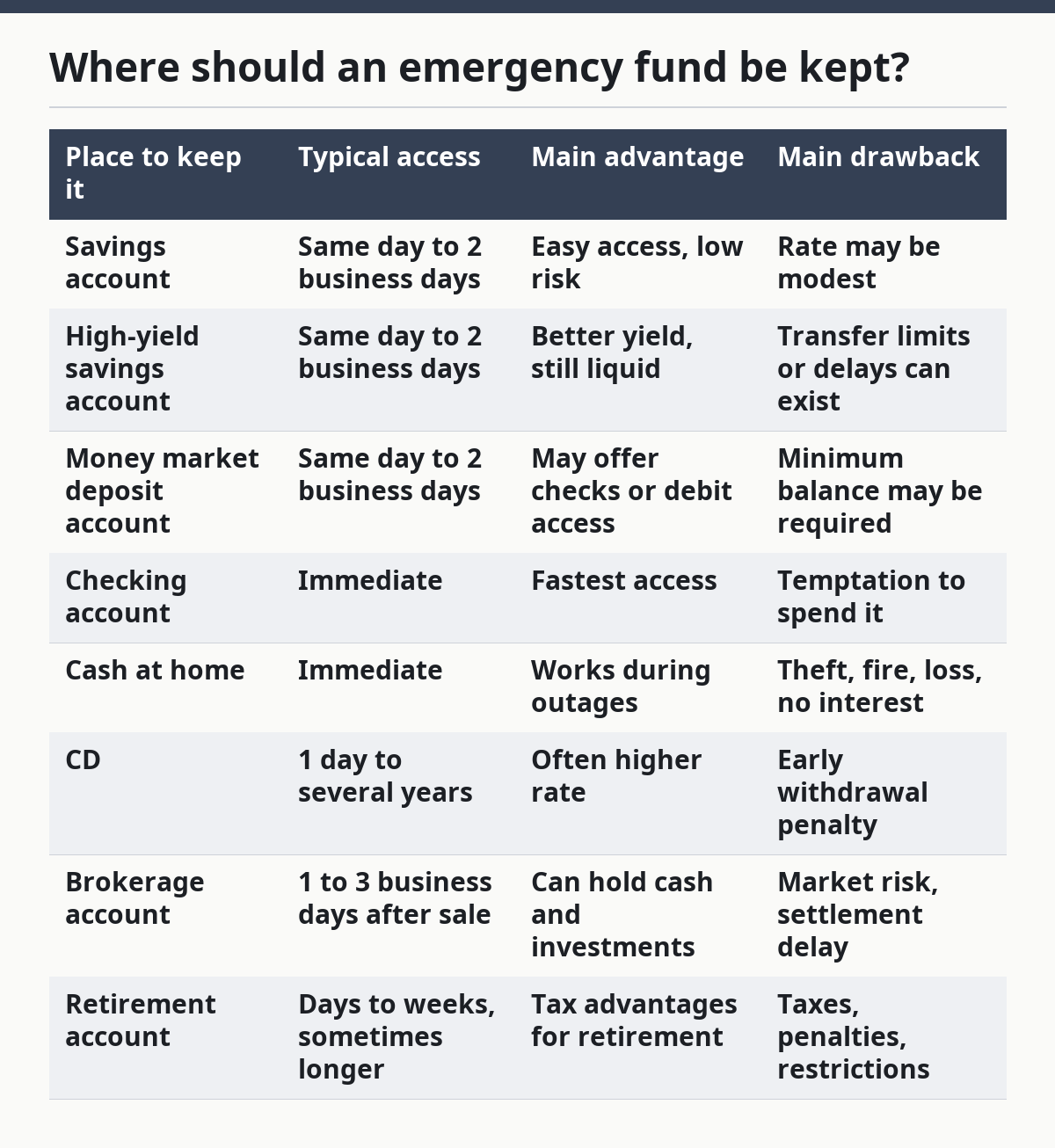
Here is how the common choices compare:
| Place to keep it | Typical access | Main advantage | Main drawback |
|---|---|---|---|
| Savings account | Same day to 2 business days | Easy access, low risk | Rate may be modest |
| High-yield savings account | Same day to 2 business days | Better yield, still liquid | Transfer limits or delays can exist |
| Money market deposit account | Same day to 2 business days | May offer checks or debit access | Minimum balance may be required |
| Checking account | Immediate | Fastest access | Temptation to spend it |
| Cash at home | Immediate | Works during outages | Theft, fire, loss, no interest |
| CD | 1 day to several years | Often higher rate | Early withdrawal penalty |
| Brokerage account | 1 to 3 business days after sale | Can hold cash and investments | Market risk, settlement delay |
| Retirement account | Days to weeks, sometimes longer | Tax advantages for retirement | Taxes, penalties, restrictions |
A plain savings account is often the safest default because it keeps the money separate from daily spending. A checking account is convenient, but it blurs the line between “emergency” and “extra money.” That makes it easier to spend the fund on non-emergencies.
A money market mutual fund is not the same thing as a money market deposit account. The former is an investment product and can, in rare cases, carry risk or settlement timing issues. The latter is a deposit account at a bank or credit union and is generally simpler for emergency use.
What can block access when you need the money?
The biggest barriers are transfer delays, account restrictions, bank holds, withdrawal limits, and penalties. A reader can have plenty of savings on paper and still be unable to reach it at 9 p.m. on a Friday.
The most common friction points are:
- ACH delays: Many external transfers take 1 to 3 business days.
- Cutoff times: A transfer started after the bank’s daily cutoff may not begin until the next business day.
- Daily limits: Some banks cap instant transfers, ATM withdrawals, or external sends.
- New-account holds: Recently opened accounts can face extra verification or transfer delays.
- Early withdrawal penalties: CDs often charge a penalty for taking money out early.
- Retirement account rules: Traditional IRAs and 401(k)s may trigger taxes, penalties, or plan restrictions if accessed early.
- Fraud controls: Banks may freeze suspicious activity, especially when a large transfer is unusual.
A generic article often says “keep it liquid” and stops there. That leaves out the part that breaks people in real life: the bank might call your transfer suspicious, your debit card may have a low daily limit, or your online bank may not process a transfer until the next business day.
The fix is to test access before you need it. Try moving a small amount, such as $25 or $50, from the emergency fund to your checking account. Note how long it takes and whether the bank imposes any hold. That single drill tells you more than a glossy rate page.
Which emergency fund setup is best for quick access?
A two-part system is often a strong option for quick access: most of the fund in a savings account and a smaller backup amount in checking or cash. This gives you speed without turning the whole fund into spending money.
A practical structure looks like this:
- Primary reserve in a high-yield savings account or credit union savings account.
- Secondary buffer in checking for immediate expenses.
- Optional small cash stash for outages, travel, or weekend problems.
This split works because not every emergency needs the full fund at once. A blown tire, a copay, or a broken appliance often needs a few hundred dollars first, not the entire balance. Keeping a modest buffer in checking means you can pay immediately while the main reserve stays protected.
This setup is not ideal for someone who overspends from checking. If a reader knows the money will disappear into groceries, subscriptions, or impulse purchases, then the checking buffer should stay tiny and the real reserve should live in a separate account with no debit card attached.
There is also a trade-off between convenience and discipline. The easier the money is to reach, the easier it is to spend on things that are urgent but not emergencies. That is why many people do better with a bank transfer step, even if it adds a day.
How much should be instantly available?
At least a small portion should be instantly available, and for many households that means $300 to $1,000 in checking or cash, with the rest in a separate savings account. That number is not a universal rule, but it covers many short-notice expenses without exposing the whole fund to everyday spending.
The right amount depends on the household’s reality:
- Renters with stable income may only need a modest same-day buffer.
- Drivers or commuters may want more immediate access because car trouble does not wait.
- Families with children may want quicker access for medical copays, school costs, or urgent travel.
- Self-employed workers often need a larger buffer because income can be uneven.
If the fund is all in one account, the temptation is to treat it like extra checking. If the fund is all in cash at home, it becomes vulnerable to theft or loss. A layered setup usually gives the best balance.
The exact number is less important than the rule: the first tier of the fund should be usable without waiting for a transfer. The second tier can be slower, because not every problem is a same-minute problem.
When should you use cash, checking, or a savings transfer?
Use cash for outages or tiny emergencies, checking for same-day bills, and savings transfers for larger expenses that can wait until the next business day. Matching the tool to the bill keeps the fund available when it matters.
A simple decision guide helps:
- Use cash when the card network is down, there is no internet access, or you need small amounts quickly.
- Use checking when a payment must clear now, like a tow truck, pharmacy purchase, or repair deposit.
- Use savings transfer when the bill is larger and can wait a day or two, such as part of a medical bill or appliance replacement.
Card payments can be useful, but they are not the same as emergency fund access. A credit card can cover the expense temporarily, then the emergency fund can pay the card balance. That can be smart if the card gives you a few extra days of breathing room or consumer protections. It is risky if the card balance grows because the reimbursement from savings is delayed or forgotten.
The best habit is to ask one question before spending: “How fast do I need the money to clear?” That answer determines whether the emergency fund should be in cash, checking, or savings.
What about CDs, investment accounts, and retirement money?
CDs, investment accounts, and retirement accounts are usually poor choices for the main emergency fund because they reduce access or add risk. They can work as backup money, but they are not the first line of defense.
A certificate of deposit can offer a fixed rate, but the penalty for early withdrawal may erase the benefit if you need the cash early. A brokerage account can be liquid after the sale settles, but the market value can fall just when you need the money most. A retirement account can be even more complicated, because early withdrawals may trigger taxes and penalties, and a 401(k) loan or hardship withdrawal depends on the plan’s rules.
That does not mean these accounts are useless. It means they are not the best place for the money that has to work under pressure. If a reader has only one account, the priority should be to move at least part of the emergency fund into something more accessible, then rebuild the balance over time.
This is where many generic articles get sloppy. They treat “any money you can get later” as if it were emergency-ready. It is not. Emergency access means immediate control, not just theoretical ownership.
What fees and tax issues can reduce availability?
Fees and taxes can cut into the fund’s usefulness even when the money is reachable. A fund that loses value to penalties or withdrawal charges is less available than it looks on the screen.
Common costs include:
- ATM fees if the bank does not reimburse out-of-network withdrawals
- Early withdrawal penalties on CDs
- Wire transfer fees if a bank charges for expedited movement
- Overdraft fees if the transfer timing causes a checking shortfall
- Taxes and penalties on certain retirement withdrawals
The tax side is especially important with retirement accounts. Traditional IRAs, 401(k)s, and similar accounts may create income-tax consequences when money comes out, and early withdrawals can trigger additional penalties depending on age and account type. Because those rules vary by account and situation, a reader should check with a tax professional before relying on retirement money for emergencies.
Cash in a savings account avoids most of those issues. That is one reason emergency funds are usually kept boring on purpose. Boring is good when the goal is access.
How to make sure the fund is actually reachable
The fund is reachable only if you can move it, identify it, and use it under stress. The fastest way to check is to run a small test transfer and review the account settings before an emergency happens.
Here is a practical access checklist:
- Make sure the account is titled in your name or in a form you can control.
- Confirm that you know the username, password, and two-factor authentication method.
- Check daily transfer and withdrawal limits.
- Know the bank’s cutoff time for transfers.
- Verify how long external transfers take, usually 1 to 3 business days.
- Keep a small balance in checking for immediate use.
- Store one backup payment method in a safe place.
- Review whether the account has a debit card, ATM access, or only online transfers.
If a reader shares financial accounts with a spouse, partner, or family member, access should be discussed before an emergency happens. Shared money can be useful, but only if both people know who can move it and under what circumstances.
The test transfer matters because it exposes hidden friction. An account that looks perfect on a dashboard may still have verification delays, transfer caps, or manual review on large withdrawals. A $25 trial withdrawal is cheaper than discovering that problem during a broken water heater or a last-minute flight.
Who this is not for
This setup is not for someone who needs high returns, who is comfortable taking market risk with emergency money, or who can tolerate a week-long delay in a crisis. It is also not ideal for anyone who cannot resist spending from checking, because too much convenience can drain the fund.
If a reader already has several months of expenses in a stable, accessible account, the issue is probably not where to keep the money but how to structure the layers. If a reader has no emergency fund at all, the first goal is not perfect optimization. The first goal is to get a starter buffer of cash where it can be used quickly.
That is the practical line: emergency money should be safe, reachable, and simple. Anything that makes those three goals harder should be treated with caution.
The bottom line
The best emergency fund is one you can use in a few hours without penalties, panic, or paperwork. For most people, that means a savings account or money market deposit account for the main balance, a small checking buffer for same-day needs, and a little cash for outages and weekends.
The wrong place for emergency money is anywhere that adds delay, market risk, or withdrawal penalties. If a bill cannot wait, the fund has to be close enough to act like cash, even if it earns a little less.
FAQs
How much of my emergency fund should be immediately available?
Enough to cover the kinds of expenses that show up without warning, usually a few hundred dollars to start. Many households keep a small amount in checking or cash and the rest in savings so the whole fund is not exposed to daily spending.
Is a high-yield savings account good for emergency access?
Yes, as long as the transfer speed fits your needs. Most high-yield savings accounts still move money through bank rails that can take 1 to 3 business days, so they are great for the main reserve but not always ideal for instant payment.
Should I keep my emergency fund in cash at home?
Only a small amount, if any. Cash is immediate, which is useful during outages or card failures, but it can be lost, stolen, or damaged, and it earns nothing. For most people, cash works best as a backup, not the full fund.
Can I use a credit card instead of emergency savings?
A credit card can bridge the gap, but it is not the emergency fund itself. It adds debt, interest risk, and a second bill to manage, so it works best as a temporary tool while you move money from savings to pay it off quickly.
Is it safe to keep emergency money in a retirement account?
Usually not as the main plan. Retirement money may be hard to access, and early withdrawals can trigger taxes and penalties depending on the account type and your situation. If that is your only option, it is worth speaking with a tax or financial professional before taking money out.
Drafted with AI; not yet reviewed by a person.