How to Name a Successor for Your Emergency Savings Account

Last updated: November 19, 2026
Quick Answer: In 3 steps, use your bank or credit union’s own beneficiary or payable-on-death form to name a successor for your emergency savings account, then confirm the institution records the change. This is a money and estate issue, not just a paperwork issue, and the result depends on the account title, the beneficiary designation, and local rules. For more on account control, see the emergency fund ownership guide and account access authorization page.
This is general information, not financial advice. A qualified adviser should be consulted for your own situation, since account rules and estate laws vary by country and can change over time.
Key takeaways
- A successor for an emergency savings account is usually set through the financial institution’s own form, not by casual note-taking.
- The account title matters: payable on death, beneficiary designation, and joint ownership do not work the same way.
- If the account owner dies or loses capacity, the bank will ask for records, forms, and proof before changing control.
- A will can still matter for the estate, but it does not always control the account at the bank.
- If the paperwork is unclear, incomplete, or conflicts with other documents, the bank may freeze the account until the estate paperwork is sorted out.
Who should do this, and who should stop here?

This applies to someone who already has an emergency savings account and wants a named person or process for account transition after death or incapacity. It assumes the reader can identify the financial institution, the exact account title, and any current beneficiary designation or payable on death label on the account.
However, this is not the right DIY step if the account is already part of a larger estate plan with trusts, business ownership, or court orders on the funds. It is also the wrong place to improvise if the account is shared, the owner is in poor health, or there is already a dispute between family members.
A successor access plan is a narrow tool: it answers who the bank should deal with first and what paperwork proves it. It does not replace a full estate plan, and it does not settle every question about taxes, debts, or inheritance. For that reason, a common mistake is treating a bank form like a full legal document; if the situation is unclear, consult a qualified professional and check the institution’s instructions or a source such as the FDIC deposit account guidance.
The practical goal is simple: make the account easier to recognize and transfer when the owner cannot act. That means the name on the account, the bank’s own records, and the estate paperwork must point in the same direction. If those pieces conflict, the bank may wait for an executor, court document, or other proof before touching the money.
How do I name a successor on the account?
You name a successor on the account by using the financial institution’s beneficiary or payable on death form and making sure the bank records match your choice. The exact label varies, but the bank or credit union is the place where the instruction becomes real. For a related overview, see the payable-on-death account guide.
- Review the account title: Read the current statement or online profile and verify whether the account is individual, joint, payable on death, or already tied to a beneficiary designation; if the title is unclear, ask the financial institution for the exact registration type, and a mismatch is the first sign the successor plan may fail.
- Request the bank form: Ask for the institution’s beneficiary, payable on death, or ownership-change form and confirm whether it must be signed in person, online, or with a wet signature; if the bank cannot produce the form or says the account type cannot accept one, the plan needs a different structure.
- List the successor correctly: Write the legal name, not a nickname, and add any identifying details the form asks for, such as relationship or contact details; verify the spelling against an ID or estate document, because a name that does not match can delay the account transition.
- Name alternates if the form allows it: Add a contingent beneficiary or backup successor only where the bank’s form provides that option, and keep the sequence clear; if the form has no backup line, do not improvise in the margin, since handwritten additions may be rejected.
- Sign and date the form: Complete every signature box and date field exactly as required by the institution, and keep a copy; if the date is missing or the signature block is incomplete, the bank may treat the form as invalid.
- Submit the form to the institution: Return it through the bank’s stated channel and verify that the account record changed, not just that the paper was received; a problem exists if the account profile still shows the old status after processing time has passed.
- Store supporting estate paperwork: Keep the will, executor contact details, and any related estate paperwork together with the account record so the successor can find them after death or incapacity; if these documents are scattered, the transfer can stall even when the bank form is correct.
Therefore, the safest version of this process is deliberately plain. It uses the bank’s own form, keeps the title consistent, and avoids side notes that no teller or estate officer can verify later. That matters because the account may need to move through a short but exact sequence: institution records, death or incapacity proof, and then the transfer or payout process.
What does the bank mean by beneficiary, POD, and successor?

A beneficiary designation names who gets the account or its balance under the institution’s rules, while payable on death, or POD, is the common label for that instruction on a deposit account. “Successor” is often informal bank language, so the form may use beneficiary, POD, or transfer-on-death language instead. For background, the CFPB’s account guidance explains how account features can vary by institution.
That vocabulary matters because the wrong label can send the reader to the wrong form. A POD designation usually tells the bank who receives the money after death, but it does not necessarily give someone the right to use the account while the owner is alive. A successor access plan may also need a separate power of attorney or incapacity document if the goal is management before death.
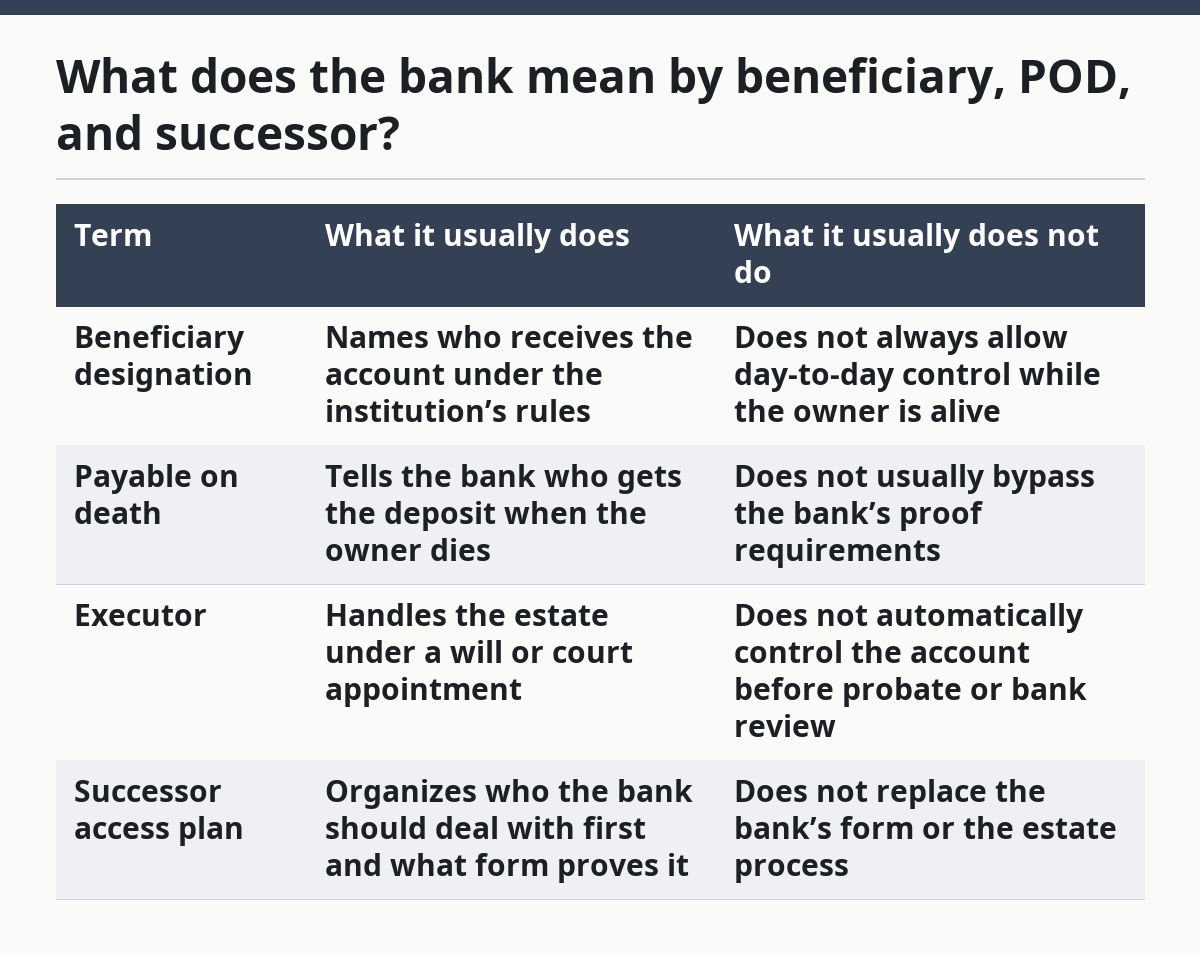
Here is the simplest comparison:
| Term | What it usually does | What it usually does not do |
|---|---|---|
| Beneficiary designation | Names who receives the account under the institution’s rules | Does not always allow day-to-day control while the owner is alive |
| Payable on death | Tells the bank who gets the deposit when the owner dies | Does not usually bypass the bank’s proof requirements |
| Executor | Handles the estate under a will or court appointment | Does not automatically control the account before probate or bank review |
| Successor access plan | Organizes who the bank should deal with first and what form proves it | Does not replace the bank’s form or the estate process |
The trap is assuming these terms are interchangeable. They are not. A will may name an executor, but the bank may still ask for its own form before releasing money. A beneficiary designation may move the funds outside the estate, but the estate paperwork can still matter if the account title, the death certificate, or the bank records are incomplete.
For a broader account-ownership view, this page fits under the site’s emergency fund ownership and access authorization hub, which covers the larger framework around account control. You can also review the bank account beneficiary checklist.
What should I check before I file the form?
You should check the account title, the beneficiary designation, and the bank’s signature rules before filing anything. Those three details decide whether the successor plan will work cleanly or sit in a file drawer until someone fixes it.
Start with the exact account type. A savings account at one financial institution may allow POD instructions, while another may use a different form or internal policy. Then check whether the account is individual or joint, because joint ownership can change the path entirely. If the account already has a beneficiary designation, replacing it may require a fresh form rather than a note to customer service.
Next, check the estate side. The executor named in the will may need the account records later, even if the bank pays the balance to a beneficiary outside probate. That is why it helps to keep the bank form, the will, and any estate paperwork together. If they disagree, the bank may pause until the conflict is resolved.
Finally, check whether the institution wants witness signatures, notarization, or both. Some forms are simple; others are not. If the bank says the form must be witnessed and that step is skipped, the plan can fail on a technicality. That is not a minor error in this subject. It can decide who has access to the money and when. For step-by-step review, see the estate planning checklist.
When does the standard approach not apply?
The standard approach does not apply when the account is already tied to a court order, a trust, a business entity, or a dispute. In those cases, a simple POD or beneficiary form may be the wrong tool, and the bank may require a different path.
The account is joint: Joint ownership can override a simple successor form — check the account agreement before naming anyone else, because the surviving owner may already control the funds.
The account is part of a trust: Trust ownership changes who has authority — use the trust document and the institution’s trust paperwork, not a standard POD assumption.
The owner has lost capacity: Incapacity can block normal changes — a bank may require a power of attorney or other proof, and a late change may not be accepted.
The estate is already open: Once an executor is involved, the bank may need probate or estate records — do not assume a fresh form alone will settle access.
There is a family dispute: A disagreement can freeze the account — the bank may hold funds until it sees court instructions or consistent estate paperwork.
These are not rare corner cases in the money world. They are exactly the situations where a simple successor access plan can be too small for the problem. If any of them apply, the reader should slow down and confirm what the institution will accept before changing the form.
What mistakes cause the most trouble?
The most common mistake is naming someone on a will and assuming the bank will treat that as the account instruction. That can leave the family with a document that looks right but does not change the bank’s records. The fix is to use the financial institution’s own form and verify that the account profile changed.
Another mistake is using a nickname, a married name that is no longer current, or an incomplete legal name. The consequence is delay or rejection when the successor presents identification. The fix is to match the form to legal documents exactly.
A third mistake is forgetting that POD and beneficiary wording can sit next to, but not replace, executor and estate paperwork. The consequence is confusion after death, especially if the account balance is needed fast. The fix is to keep the account form, the will, and the executor contact details together.
A fourth mistake is leaving the form unsigned or undated because the rest of the page looks complete. The consequence is a rejected instruction. The fix is to treat the signature and date as required fields, not optional ones.
A fifth mistake is failing to check whether the institution wants witness or notarization steps. The consequence is avoidable rejection. The fix is to ask for the exact process before submitting anything. For more on recordkeeping, see the financial records checklist.
What happens after death or incapacity?
After death or incapacity, the bank usually freezes or limits the account until it receives the proof it asks for and applies the account’s transfer rules. That proof often includes a death certificate for death, or legal documents for incapacity, along with any beneficiary or executor records.
If the account has a valid beneficiary designation or POD instruction, the money may move outside the estate process for that account, depending on the institution and local law. If the account does not have that instruction, the executor may need to handle it through the estate. Either way, the bank is likely to ask for documentation before releasing funds. According to the FDIC and CFPB, account access rules can vary by account type and institution, so the form matters as much as the family plan.
The practical point is that the successor plan is not only about naming a person. It is also about reducing confusion on the day the account must change hands. A clear form can shorten the back-and-forth between the bank and the estate. A vague form can do the opposite and leave the funds stuck until someone produces the right paperwork.
How do I know the plan is actually complete?
The plan is complete when the bank can point to its own record and the estate documents do not conflict with it. That means the account title, beneficiary designation, and executor references all make sense together.
A good result has three signs. First, the institution confirms the form was accepted and recorded. Second, the successor name matches the legal name on file. Third, the family or executor knows where the paperwork lives if death or incapacity happens. If any one of those is missing, the plan is only half done.
It also helps to review the form after major life changes, even if no number on the account changed. A marriage, divorce, move, or new financial institution can create a mismatch between the bank record and the estate papers. A review does not mean the account must change every time. It means the instructions still point to the same person and the same institution.
For the technical and legal background, the FDIC’s materials on deposit account ownership and the Consumer Financial Protection Bureau’s account guidance are useful starting points, but they do not replace the bank’s own form or a qualified adviser’s review of the reader’s situation. The FDIC deposit insurance resource and the CFPB bank account page are reliable starting points.
What happens to emergency savings if I die?
What happens next depends on how the account is titled and whether it has a valid beneficiary designation or POD instruction. If it does, the financial institution may transfer the money according to its records after it receives proof of death. If it does not, the account may go into the estate and be handled by the executor.
Can I name someone to take over an emergency savings account?
Yes, but the bank or credit union usually decides the form and the label. The document may call that person a beneficiary, POD recipient, or successor, and the account rules control what that person can do. A will alone usually does not change the bank’s records.
Is a beneficiary the same as a successor on a bank account?
Not always. A beneficiary is the person named to receive the account or its balance under the institution’s rules, while “successor” may be informal language for that role or for a related access step. The bank’s exact wording matters, so the account form is the document to trust first.
Drafted with AI; not yet reviewed by a person.