How To Keep Emergency Fund Access Legal When A Family Member Uses Your Account

Last updated: November 19, 2026
How to Keep Emergency Fund Access Legal When a Family Member Uses Your Account
Quick Answer: In most cases, a family member can use your emergency fund legally only through 1 of 3 bank-recognized setups: joint ownership, authorized signer status, or power of attorney. The bank’s records, not a private promise, control the access.
How to Keep Emergency Fund Access Legal When a Family Member Uses Your Account starts with the account agreement, not with a family conversation. The cleanest legal path is to match the access method to the account: joint owner, authorized signer, or power of attorney, and to follow the bank’s account agreement and identity checks. Rules vary by jurisdiction, so this is general information, not legal advice; a qualified lawyer should be consulted for your situation.
Key takeaways
- A family member can sometimes use your emergency fund legally, but only if the account structure allows it.
- A note on a phone or a verbal promise is not the same as bank-authorized access.
- The bank’s account agreement controls how money can be moved, who can sign, and what proof is required.
- Joint ownership, authorized signer status, and power of attorney are not interchangeable.
- If the account is in your name only, assume the family member needs formal permission from the bank before touching it.
- In practice, the bank must be able to verify the authority at the counter, online, or by phone.
What counts as legal access?
Legal access means the family member has authority the bank will recognize, not just your permission at home. In practice, that usually comes from the account title, a signed bank form, or a power of attorney, which is a document that lets one person act for another in specified financial matters.
For example, a generic “my sister can use it if I text her” setup is weak because it may not bind the bank. The bank will usually look at the account agreement, the signature card, identity documents, and any supporting paperwork before it allows a withdrawal, transfer, or online action. In the U.S., consumer banking rules and bank policy shape those steps; in other countries, the labels differ but the same basic idea holds. See the Consumer Financial Protection Bureau’s bank account guidance and the FDIC on ownership and deposit insurance.
This page is for a person who already has an emergency fund and wants a family member to have access in a way the bank can recognize. It is not for setting up a broader family budget, caregiver plan, or fraud alert plan, which belong on a different page in this site’s emergency fund ownership and access authorization cluster.
Which access method fits your account?

Because the right access method depends on whether you want shared ownership, limited transaction power, or backup authority if you cannot act yourself, the main options are joint owner, authorized signer, and power of attorney, and they do different jobs.
| Access method | What it usually allows | Main strength | Main risk |
|---|---|---|---|
| Joint owner | Both names can usually move money if the bank treats the account as joint | Fast access | Shared control; the other person may be able to act without asking |
| Authorized signer | The bank gives signing authority without ownership | Narrower than joint ownership | Not every bank offers it for every account type |
| Power of attorney | An agent acts for the owner under a legal document | Useful when the owner cannot act | Banks may need their own form and may review the document |
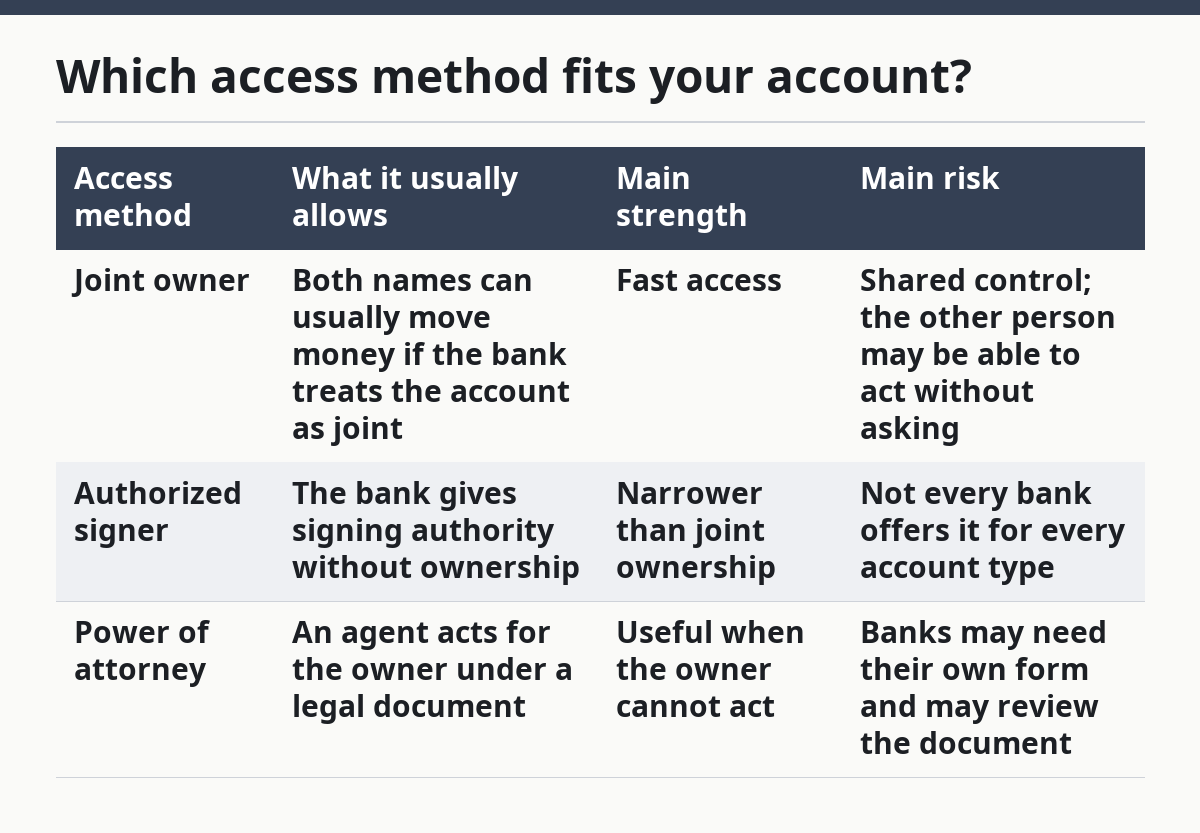
However, a joint owner is not just a helper; the person usually has ownership rights that can be broader than many families expect. An authorized signer has bank-recognized transaction power but not ownership in the same sense. A power of attorney can be very useful, but some banks still require their own forms, a notarized copy, or updated identity checks before they honor it. When the choice is unclear, consult a lawyer or a bank professional before signing.
If the goal is to let a spouse, adult child, or parent pay a bill in an emergency, limited authority is often less risky than joint ownership. If the goal is to make sure someone can manage the account if you are hospitalized, power of attorney may fit better. The wrong choice can create disputes over withdrawals, taxes, or who actually owns the money.
How do you keep the arrangement legal?
You keep the arrangement legal by matching the access method to the bank’s paperwork, identity checks, and ownership rules. The steps below describe the usual process, but the details depend on the bank and jurisdiction.
- Review the account agreement for the exact account type before anyone acts; verify the account title, withdrawal rules, and any limits on phone, online, or branch activity; a problem is any rule that says only one named owner can transact.
- Ask the bank for its form for a joint owner, authorized signer, or power of attorney; verify the form name, whether it must be notarized, and whether the bank requires original documents; a problem is being told to “just bring ID” when the bank actually needs written authorization.
- Choose the access method that matches the task; verify whether the family member needs ownership, signing power, or only emergency backup authority; a problem is giving full ownership when limited authority would do.
- Complete the bank paperwork with the exact legal names used on identification; verify spellings, middle initials, and any required signatures; a problem is inconsistent names that can trigger a rejection at the teller line or online.
- Provide identity documents for every person the bank requires; verify what counts as acceptable ID, such as government-issued photo identification, and whether the bank needs in-person presentation; a problem is assuming an old copy or photo of an ID will be enough.
- Store a copy of the signed account agreement and any authorization form in a safe place; verify that the family member knows where the paper copy or secure digital copy is kept; a problem is having the authority but no way to prove it when the branch asks. If the arrangement is complex, consult a lawyer or bank specialist and keep a source copy of the bank’s instructions with the records.
- Test the access path with a small, routine transaction before an emergency arrives; verify that the bank processes the transfer, withdrawal, or bill payment under the chosen authority; a problem is discovering the bank rejects the setup only when the money is urgently needed.
- Update the bank promptly after a name change, address change, death, divorce, or revocation; verify that old authority is removed or refreshed as needed; a problem is leaving outdated permissions in place after the relationship changes.
Therefore, the key legal point is that your private permission does not override the bank’s controls. If the bank does not recognize the arrangement, the family member may be blocked even if everyone in the household agrees. If the bank does recognize it, the family member may be able to act more broadly than you intended, so the paperwork should be narrow and clear.
The Consumer Financial Protection Bureau explains the basics of account access and authority for U.S. consumers, and the FDIC explains how account ownership affects deposit insurance. Those two topics matter because access rights and ownership rights are not the same thing.
What should you check before anyone uses the money?
You should check the account title, the bank policy, and the identity rules before any family member touches the funds. Those three checks decide whether the bank will treat the request as valid or as an unauthorized transaction, but a bank officer or lawyer should confirm the setup when the account is unusual.
First, look at whose name is on the account. If the account is single-owned, a family member usually cannot move money just because you told them to. If the account is joint, both owners may have broad access, but that can create shared control you did not intend.
Second, read the bank policy on third-party access. Some banks allow an authorized signer only for certain account types. Some will accept a power of attorney only after internal review. Some require the person to appear in person with original documents, while others allow online setup but still reserve the right to ask for more proof.
Third, check how the bank handles identity verification. A bank can ask for a driver’s license, passport, or other government-issued ID, and it can refuse access if the details do not match the account records. If the family member’s legal name changed after marriage or divorce, the mismatch can slow or stop the process.
When should you stop and get legal help?
You should stop and get qualified legal help when the arrangement could affect ownership, estate rights, or authority after incapacity or death. That is not a paperwork problem; it is a legal-rights problem.
The account will be shared with someone other than the family member who needs access: Shared ownership can change who controls the money — get advice before adding anyone to the title.
You want access to continue after you become unable to act: A power of attorney may help, but banks can reject incomplete or outdated forms — have a lawyer review the document setup.
The family member will use the account across state lines or national borders: The bank may follow one rule while local law follows another — confirm the governing rules before relying on the arrangement.
The account holds more than a simple emergency reserve: Mixed funds can create tax, ownership, or probate issues — separate the emergency fund before adding access.
There is conflict, divorce, guardianship, or a risk of financial abuse: The wrong access method can create a path for misuse — pause and get legal guidance before granting authority.
The bank says it needs a court order, not just a signed form: The institution is signaling a hard limit — do not guess at the workaround.
What mistakes cause bank problems?
The most common mistake is treating a family favor like a bank instruction. That can lead to a rejected withdrawal, frozen transfer, or a dispute over whether the transaction was authorized, so the safer move is to confirm the setup with the bank or a lawyer before anyone relies on it.
Another mistake is using a joint account when the real goal is backup access. Joint ownership can give the other person broad rights, including the ability to move money without asking again. If the goal is narrower, that structure is often too strong.
A third mistake is relying on a verbal agreement or a text message. Those may help explain intent, but they usually do not replace the account agreement or the bank’s own forms. A fourth mistake is skipping identity checks, which can stall the transaction at the very moment the cash is needed.
A fifth mistake is ignoring revocation. If the relationship changes, the old access method may stay live until the bank receives fresh instructions. The safer alternative is to review the paperwork after a major life event and remove authority the same way it was added.
What if the standard setup does not fit?
The standard setup does not fit when the account is in a trust, a business name, a custodial form, or a special estate structure. Those accounts often follow different signatures rules and may not allow the same family access as a plain personal savings account.
It also does not fit when the family member cannot meet the bank’s identity standards. If the person cannot present the required ID, the bank may refuse the transaction even if the paperwork is otherwise correct. In that case, the fix is not a casual exception; it is getting the bank’s required documents in order.
If the bank will not allow the access you want, the clean answer is usually to change the account structure or use another account that the bank can administer under its normal rules. For many people, the simplest legal setup is the one the bank already knows how to process.
How do you avoid account problems when a relative helps with emergency money?
You avoid account problems by making the bank, not the family conversation, the source of truth. That means matching the access method to the account agreement, keeping the paperwork current, and making sure identity checks can be passed when needed.
A good result looks boring: the bank accepts the authority, the family member can act when needed, and the account owner still understands who can do what. A bad result is an arrangement that only works if a teller is lenient or a branch manager makes an exception.
Ultimately, if the bank cannot verify the authority from its own records and documents, the access is not legally clean enough for emergency use.
Can a family member withdraw from my emergency fund?
Yes, a family member can withdraw from your emergency fund only if the bank recognizes that person’s authority. That usually means the person is a joint owner, an authorized signer, or an agent under a valid power of attorney. A family promise alone usually is not enough, and the bank may still ask for ID and paperwork.
Do I need paperwork for family access to savings?
Yes, you usually need paperwork if you want the access to be bank-recognized. The exact form may be a joint account agreement, an authorized signer form, or a power of attorney, depending on the bank and jurisdiction. A note, email, or text message may explain your intent, but it often does not replace the bank’s required documents.
How do I avoid account problems when a relative helps with emergency money?
Because the same issue comes up in different forms, the practical answer is to check the account agreement, use the bank’s own authorization form, and match the family member’s name to their ID. It also helps to know whether the bank requires notarization or in-person verification. If the arrangement is meant to cover incapacity or a dispute, a lawyer should review it before anyone relies on it.
Drafted with AI; not yet reviewed by a person.