Last updated: November 19, 2026
Quick Answer: a tiered emergency fund gives you 2 layers, with Tier 1 for same-day access and Tier 2 for backup savings that can wait 1–3 business days. Tier 1 vs Tier 2 Emergency Fund: How to Separate Fast Access Cash From Backup Savings is the question this article answers.
A tiered emergency fund separates money you may need today from money that can sit untouched longer. Tier 1 is the fast-access cash; Tier 2 is the backup reserve you do not want to touch unless the problem is bigger or longer than expected.
If you already keep your cash in a checking account, a high-yield savings account, or a money market account, this structure tells you what belongs in each place and why. The point is not to chase return. The point is to know which dollars are meant for same-day use and which dollars are there to keep you from going back into debt.
As someone writing about personal finance structure, I care most about liquidity, timing, and behavior: what can be moved in minutes, what can wait 1–3 business days, and what protects you when the first layer runs low.
Key takeaways
- Tier 1 is for urgent, predictable cash needs; Tier 2 is for larger or longer disruptions.
- A tiered emergency fund works best when the first layer is easy to reach and the second layer is harder to dip into.
- Checking accounts can offer the fastest access, but they can also make spending easier; savings-style accounts add a small speed bump.
- A money market account can function as either layer if it gives you check writing or debit access, but the access rules vary by bank.
- The right split is not about yield first; it is about how quickly you may need the money and how tempted you are to spend it.
What tier 1 and tier 2 actually mean

Tier 1 is the portion of your emergency fund you expect to use fast, often through a checking account or a savings account that can be moved with a few taps. Tier 2 is the backup savings layer, usually kept in a high-yield savings account or money market account that is still liquid but less convenient to raid.
That distinction matters because emergencies do not all arrive with the same clock attached. A tire blowout, prescription refill, or utility bill due tomorrow belongs in Tier 1 because same-day access is the point. A job loss, extended medical gap, or multi-month income dip belongs in Tier 2 because the money needs to last longer than one transaction.
The most common mistake is treating every emergency dollar as equally available. That can lead to two problems. First, the whole fund ends up in the account you spend from every day. Second, you lose the psychological separation that keeps short-term cash from being swallowed by non-emergencies. If your situation is unusual, consult a financial professional, and see the CFPB’s emergency savings guidance at https://www.consumerfinance.gov/consumer-tools/savings-account/.
A tiered emergency fund is not a new product. It is a cash management structure. The structure is especially useful if you already have a checking account for bills and a separate savings or money market account for reserve cash. It gives each dollar a job, instead of asking one account to do everything.
If you want the broader framework, the hub on emergency fund structure should sit above this page. This article focuses on the split itself, not the full system.
Why a tiered emergency fund usually beats one big pile of cash
A tiered emergency fund wins for most people because it makes the first decision easier: use the fast bucket for small shocks and leave the backup bucket alone. That is a practical advantage, not a theory.
The single-account approach looks tidy, but it often fails in two ways. Either the money sits in checking and feels too available, or it sits in a savings account and becomes slightly slower to move right when you need it. Neither outcome is ideal. Both are clumsy.
A two-tier structure solves the timing problem. Tier 1 covers the kind of expense that cannot wait through a weekend. Tier 2 gives you depth if the problem is not a one-off event but a real disruption. That separation matters even more if your income is irregular, because the account balance has to serve both immediate bills and a longer runway.
There is a drawback. A tiered system is one more thing to maintain, and people sometimes overcomplicate it by opening too many accounts. The right version is simple: one place for immediate access, one place for reserve cash. That is enough.
For most readers, the best answer is not “move everything into the highest-yield account you can find.” It is “put the near-term buffer where you can get it quickly, and park the rest where it is less tempting to spend.” That is why this structure is often better than a single emergency account, even if the yield difference is modest.
Tier 1: the fast-access cash you actually need first

Tier 1 is best kept small enough to be reachable and large enough to cover the emergencies that arrive without warning. That usually means money tied to a checking account or another setup that allows same-day access without a transfer delay.
The strength of Tier 1 is speed. A checking account is built for movement: debit card access, bill pay, ATM withdrawals, and transfers that can post quickly. A money market account can also work here if the bank gives you debit or check access, though some institutions limit withdrawals or require extra steps. The exact rules depend on the account agreement, so the access method matters more than the label.
The weakness is temptation. Money that lives beside your spending account can be easy to blur into ordinary cash flow. A checking account is also not a great place for a large idle balance if your goal is discipline, because the line between emergency money and spending money gets thin fast.
Tier 1 is right for someone who needs to handle common shocks without friction: a car repair estimate, a copay, a broken appliance, a deposit due before a landlord deadline. It is also right for people who are uncomfortable with the idea of transferring money during a stressful moment. If the question is “Can I pay for this today?” Tier 1 should answer yes.
Tier 1 is not the place for the whole emergency fund unless your total reserve is very small or your cash flow is unusually stable and predictable. A full fund sitting in checking often creates sloppy behavior. It feels available for everything, which is the opposite of what a reserve should do.
Tier 2: the backup savings that protects the rest
Tier 2 is the deeper reserve that stays out of the way until the problem is larger than a one-off expense. It is usually better in a high-yield savings account or a money market account, because the point is still liquidity, just not instant convenience.
Tier 2 wins when the emergency is not about speed but about staying power. Job loss, reduced work hours, an uninsured medical stretch, or a move caused by a lease break all fit this layer better than Tier 1. You do not need it in the next hour; you need it to be there six weeks from now.
The strength of Tier 2 is behavioral distance. A separate account creates a clear line: this is reserve money, not spending money. If the account is at a different institution, the extra transfer step can help prevent casual raids. That matters more than people expect.
The weakness is that the money is not always spendable right away. Even transfers that are usually quick can be delayed by bank cutoffs, weekends, or verification checks. That is why Tier 2 should not be the first dollar you expect to spend in a fast-moving emergency.
A high-yield savings account is often the most straightforward home for Tier 2 because it is designed for storage, not transactions. A money market account can also work if it offers easy transfers and you understand the withdrawal limits. The better choice is the one that keeps reserve cash available without making it feel spendable every day.
Tier 2 is not for someone who is likely to need funds before the next morning. It is for the cash that should stay in reserve until the situation is clearly bigger than an ordinary hiccup.
The honest side-by-side
Tier 1 wins on access; Tier 2 wins on discipline and depth. The table below shows where each layer fits best.
| Criteria | Tier 1 | Tier 2 | Winner for condition |
|---|---|---|---|
| Speed of access | Same-day or near-instant if kept in checking | Usually fast, but often one extra transfer step | Tier 1 for urgent bills |
| Best home | Checking account or very liquid money market account | High-yield savings account or money market account | Tier 1 for immediate use |
| Spending temptation | Higher because it sits next to everyday cash | Lower because it is farther from daily spending | Tier 2 for behavior control |
| Best use | Small, urgent, short-notice expenses | Larger, longer, or less predictable disruptions | Tier 2 for income loss |
| Ease of replenishing | Easy, but easy to ignore | Slightly slower, which can help discipline | Tier 2 for reserve protection |
| Risk of overuse | Higher | Lower | Tier 2 for people who raid savings |
| Best if your emergency happens on a weekend | Better | Worse | Tier 1 for same-day access |
| Best if you have unstable income | Useful but not enough alone | Better as the deeper cushion | Tier 2 for long runways |
| Banking friction | Minimal | Moderate, depending on transfer rules | Tier 1 for low-friction access |
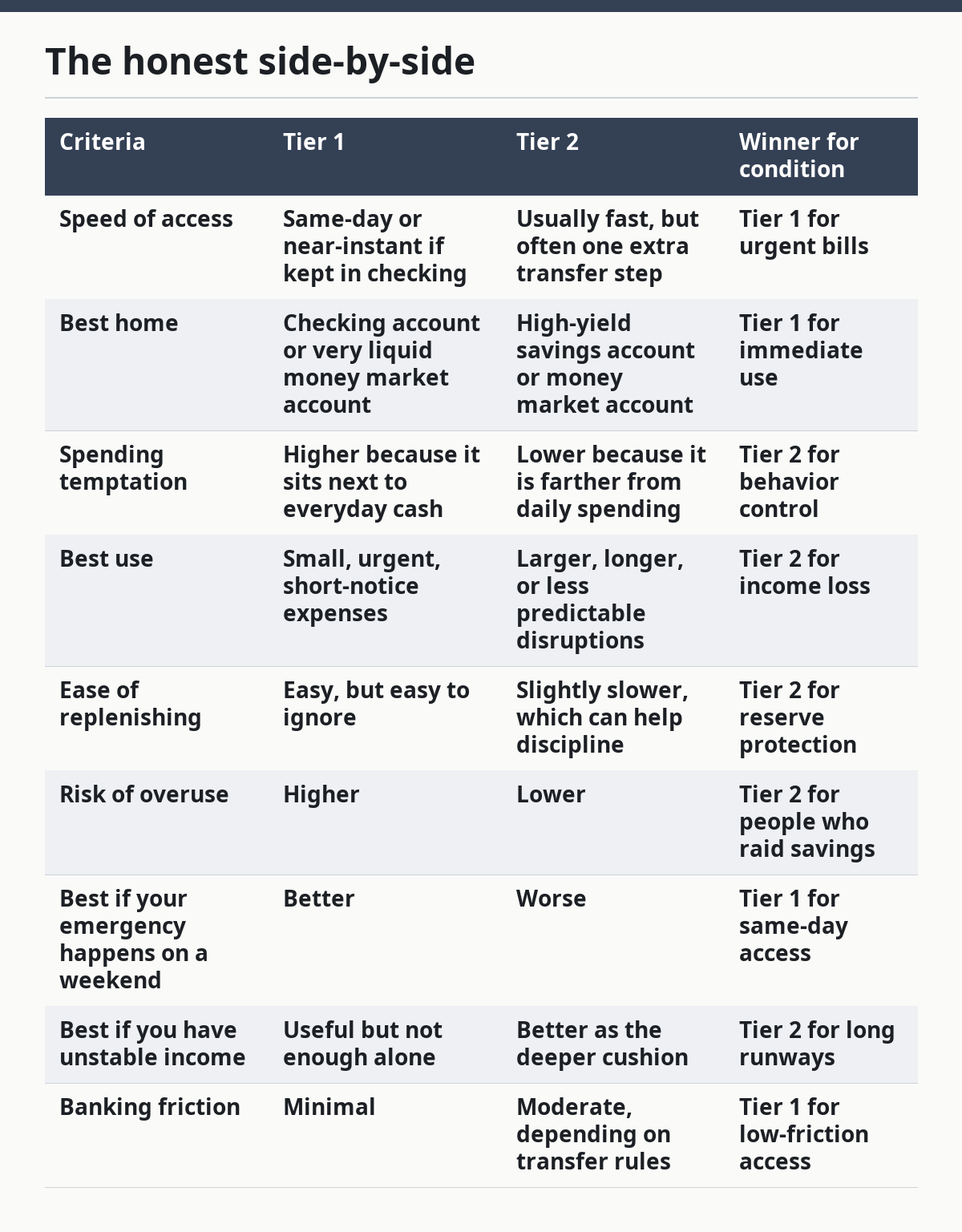
The table points to the real decision: if the money may need to leave immediately, Tier 1 owns it. If the money is there to keep you solvent after the first shock, Tier 2 owns it. Mixing those jobs in one balance makes both jobs worse.
When the usual rule flips
The standard split flips in a few specific cases.
First, if your total emergency fund is still very small, the whole balance may need to function as Tier 1 until the reserve grows. A $500 buffer is not a full tiered system; it is a survival cushion. In that stage, convenience beats elegance.
Second, if your income is highly variable and you are waiting on irregular payments, Tier 2 may deserve a larger share than usual. A freelancer with lumpy cash flow often needs reserve depth more than transactional convenience. The deeper cushion matters because the emergency may be a shortfall, not a one-time bill.
Third, if your bank setup makes transfers slow or fragile, the distinction between Tier 1 and Tier 2 becomes more important, not less. A backup reserve that cannot be reached when the app is down is not really a backup. In that case, the tier split should be built around actual access routes, not just account names.
Fourth, if you already keep a high checking balance for bill-paying reasons, you may not need a large Tier 1 at all. Some households naturally hold enough cash in checking to cover immediate needs for a short period. The danger is duplication: too much cash sitting in the wrong layer, doing the job of two layers at once.
These exceptions do not kill the tiered model. They tell you how to size it. The structure still works; the proportions change.
The verdict: which layer gets the money first?
Choose Tier 1 if you need money that can be used the same day, with minimal friction, for bills or repairs that cannot wait. Choose Tier 2 if the cash is meant to hold you through a longer disruption and should be harder to spend by accident. Neither if you are still carrying high-interest debt and the reserve has not yet reached a basic emergency cushion; in that case, talk to a financial professional about the order of priorities.
That is the clean rule. Tier 1 gets the money you might need today. Tier 2 gets the money that protects tomorrow.
If the choice is a checking account versus a high-yield savings account, the answer is not about which earns more in a vacuum. It is about which layer the money belongs in. The more immediate the need, the closer the cash should sit to checking. The more you need the balance to stay untouched, the farther away it should live.
The strongest version of this system is simple: one account for fast access, one for backup savings, and a clear rule for which emergencies drain which layer first. For bank account basics, see the FDIC’s consumer guidance at https://www.fdic.gov/resources/consumers/consumer-news/2024-02.html and the CFPB’s savings account guidance at https://www.consumerfinance.gov/consumer-tools/savings-account/.
What to do if you are starting from zero
Start with Tier 1, then build Tier 2 behind it. The reason is simple: an emergency fund that cannot be reached quickly does not help much in the first 24 hours.
The first job is to create a small cash cushion in a checking account or equivalent easy-access place. After that, move additional savings into a separate reserve account, usually a high-yield savings account or a money market account, so the backup layer is not mixed into daily spending.
Do not overbuild the structure before the first dollars are saved. Two accounts are enough. Three or four often become clutter. The point is not to engineer a perfect system; it is to make sure the next emergency does not force a credit card decision.
For a more complete framework, the emergency fund structure hub should be the next stop. This page is only about dividing the cash into the right layers.
What is a tiered emergency fund?
A tiered emergency fund is a two-layer cash reserve. Tier 1 covers immediate expenses, and Tier 2 holds the rest of the backup savings for larger or longer problems.
How much should stay in Tier 1?
Tier 1 should hold enough to cover the kinds of expenses you may need to pay right away, but not so much that it becomes everyday spending money. The exact amount depends on how stable your income is and how fast you can move money from savings, so a financial professional can help if your situation is unusual.
When should I use Tier 2 money?
Use Tier 2 when the emergency is bigger than a one-off bill or when Tier 1 would not cover the full shock. That includes job loss, reduced income, or a multi-month disruption where the reserve has to do more than solve one urgent payment.
Drafted with AI; not yet reviewed by a person.