
Last updated: November 19, 2026
In short: set a job transition emergency fund goal by covering your fixed expenses for the months you may be unemployed, then subtract any severance pay, unemployment benefits, and other cash that will actually arrive on time. If you want a quick starting point for How to Set an Emergency Fund Goal If You Are Between Jobs, begin with one month of bare-bones expenses and adjust for the likely gap before your next paycheck. The right goal is the amount that keeps rent, food, utilities, insurance, and minimum debt payments covered until your next paycheck, not a generic 3-to-6-month rule.
Key Takeaways
- Build the number from essential costs, a realistic runway, and cash that is already confirmed.
- Keep the budget limited to housing, food, insurance, transport, and job search basics.
- Severance and unemployment can reduce the target when the timing is clear and reliable.
- If the search lasts longer, revise the goal upward in stages rather than treating it as a miss.
If you are between jobs, your job transition emergency fund is not trying to protect you forever. It is trying to buy time for your job search without forcing bad choices, and that is why the page topic is How to Set an Emergency Fund Goal If You Are Between Jobs. A useful target is a simple runway calculation: how many months you need, what your bare-bones budget costs, and when money will land in your account. A person can make that number in 20 minutes with a notebook and a bank app.
Start with the right job transition emergency fund goal

Your job transition emergency fund goal should be the amount needed to keep life moving until income restarts, and that usually means a shorter, sharper target than a long-term household fund. If you are between jobs, the first question is not “What should I save someday?” It is “How many weeks or months do I need to stay afloat while I’m searching?”
The most useful way to think about this goal is as a cash runway. Runway is the time your cash can cover your essential bills at a stripped-down level. If your job search timeline is likely to be 6 weeks, your goal should look different from someone who expects 5 months before a new offer turns into a first paycheck.
Therefore, this approach works best for people who have a real chance of re-employment and who can trim spending fast. It is not the right framework if your income loss is tied to a longer disruption, repeated layoffs, or a large family expense that cannot be cut. In those cases, the transition fund may need to be built into a broader household plan, not a temporary bridge.
A simple target formula is:
Goal = monthly bare-bones expenses × months of runway needed − money already guaranteed to arrive
That last part matters. If a severance check is contractually due in two weeks, it should be counted. If unemployment benefits are still pending and timing is unclear, count them cautiously. If a freelance side job might pay, do not count it until the invoice is accepted and the payment date is clear. In the context of How to Set an Emergency Fund Goal If You Are Between Jobs, this is a practical starting formula rather than a fixed rule.
This is also where the hub page on the larger question belongs: if you want the broader framework for how much emergency fund do I need, use that as the long-term baseline and keep this page focused on the between-jobs version.
How do I figure out the number?
You figure out the number by listing essential monthly costs, choosing a realistic runway, and subtracting cash that is already committed to arrive. This is often the quickest way to build a goal that matches unemployment instead of guessing from a rule of thumb.
Use this order:
- List fixed expenses for one month. Start with rent or mortgage, groceries, utilities, insurance, phone, transit, minimum debt payments, and any child-care or medication you cannot pause. For example, if you pay $1,850 for housing and $620 for the rest of the essentials, your base month is $2,470.
- Cut the budget to the minimum you can sustain for 30 to 90 days. Pause subscriptions, travel, dining out, and nonurgent shopping. The goal is a bare-bones budget, not your normal lifestyle. A $2,470 month often becomes something lower once the extras are removed.
- Choose a runway in months. Match it to your job search timeline. If your field commonly moves fast and you already have interviews, 1 to 2 months may be enough. If hiring is slow or the market is tight, 3 to 6 months may be more realistic.
- Subtract cash that is truly on the way. Count severance pay if the amount and timing are known. Count unemployment benefits only to the extent you are confident about approval and start date. If $1,500 is guaranteed to arrive next week, your goal can be reduced by that amount.
- Set a floor and a stretch target. The floor is the amount that keeps you housed and insured. The stretch target includes a small buffer for surprises, such as a higher utility bill or a medical insurance payment that changes after job loss.
A worked example helps. Say your bare-bones budget is $2,400 a month, and you want 3 months of runway. That makes $7,200. If you know you will receive $2,000 in severance and $600 in unemployment benefits in the first month, your initial goal can drop to $4,600 for the first stretch, then rise again if benefits are delayed or your search takes longer than planned.
As a result, this method is better than guessing because it ties the number to reality. It is also more honest than using your old spending level, which usually overshoots the amount you need and can make the goal feel impossible.
What should go in a bare-bones budget?

A bare-bones budget should include only the bills that keep you housed, fed, insured, and able to keep looking for work. If a cost does not protect those four things, it does not belong in the emergency fund target.
Keep the list tight:
- Housing: rent, mortgage, lot rent, HOA fees
- Utilities: electricity, gas, water, trash, internet if needed for the job search
- Food: groceries and basic household supplies
- Transportation: gas, public transit, insurance, minimum car payment if you must keep the car
- Medical insurance: premiums, prescriptions, therapy copays, and any care you cannot skip
- Minimum debt payments: the smallest amount needed to stay current
- Job search costs: printing, transit to interviews, a reasonable outfit replacement, or a background check fee if it is part of the process
A common mistake is to leave in too many “small” items. A $12 streaming plan or a $60 meal budget may not look like much, but together they distort the target and make the fund look safer than it is. The point of the bare-bones budget is not comfort. It is survival plus enough stability to keep applying for jobs.
Another mistake is cutting too deep on medical insurance or transportation. If losing your car means missing interviews, the budget is too thin. If skipping medication creates a health problem, the budget is too thin. A strong emergency fund goal protects your ability to work again, not just your bank balance.
This section is where practical judgment matters. I would not recommend using a “zero-based” monthly budget that hides true fixed expenses behind optimistic estimates. If your health plan premium is due on the 1st and your rent on the 3rd, those dates matter. A budget that ignores timing can fail even when the total looks adequate.
How severance pay and unemployment benefits change the goal
Severance pay and unemployment benefits can lower your target, but only if you know when the cash will arrive and how much of it you can truly rely on. If the money is delayed, partial, or uncertain, it should not be counted at full value.
Treat severance pay as a bridge, not a windfall. If your employer says you will get two weeks of severance and it will arrive on a specific date, that amount belongs in the calculation. If the package is still under review, count it cautiously or not at all until it is confirmed in writing.
Unemployment benefits are different because they often arrive after an application and approval process. That timing gap matters. A benefit that starts in week 4 does not help with week 1 rent unless you already have cash to cover the gap. For that reason, the emergency fund goal should still cover the waiting period before benefits begin.
A practical way to adjust the number is to separate your runway into two phases:
- Gap phase: the weeks before severance or benefits hit
- Support phase: the months after regular support begins
If your monthly bare-bones budget is $2,200 and you have a 4-week gap before benefits start, you need at least one month of expenses for the gap alone. If benefits then cover part of your budget, the emergency fund target can be lower than if you had no support at all. The exact amount depends on the timing, not just the total benefit.
Do not make the mistake of counting gross benefit amounts without checking what they actually replace. If your benefits cover only part of your old wage, your emergency fund still has to cover the difference. And if a severance payment delays benefit eligibility in your state or situation, you need to budget for that lag too. This is one of those times when a benefits office, HR packet, or state unemployment site is worth reading closely before setting the final goal.
What if the job search takes longer than expected?
If the job search runs long, your emergency fund goal should expand in steps instead of being treated as a failure. A 2-month target that stretches to 4 months is not proof that the plan was wrong; it is a sign that the runway estimate was too optimistic or the market changed.
The cleanest way to handle this is to set three numbers:
- Minimum goal: the smallest amount that covers immediate bills
- Base goal: the amount needed for the most likely job search timeline
- Extended goal: the amount that keeps you safe if hiring slows down
For example, if your bare-bones budget is $2,300 a month, the minimum might be 1 month, the base 3 months, and the extended 5 months. That gives you $2,300, $6,900, and $11,500 as reference points before subtracting any known severance or benefits.
This is useful because it stops the all-or-nothing trap. If you only aim for the extended goal, you may freeze and do nothing. If you only aim for the minimum, you may come up short the first time a bill lands late or an interview cycle drags on.
A long search also creates a hidden cost: decision fatigue. When money gets tight, people accept worse jobs too early or skip needed expenses like transportation or medical care. A better target gives you room to say no to the first bad fit and wait for a better offer. That is the real value of an emergency fund between jobs. It protects the quality of the next job, not just this month’s budget.
Common mistakes that shrink the runway
The biggest mistake is using old spending instead of essential spending, and it can blow up the target by hundreds of dollars a month. If your normal budget includes vacations, restaurant meals, premium subscriptions, and impulse shopping, the number will look bigger than your actual survival need. The fix is to calculate the emergency version of your life, not the comfortable version.
A second mistake is ignoring timing. A person may say, “I have $4,000 in severance and $1,200 in unemployment coming,” then discover that the $1,200 arrives after rent is due. The cash exists, but the runway still gets tight. The fix is to map every payment to a date on a simple calendar.
A third mistake is forgetting medical insurance. Job loss can change premiums, subsidies, or payroll deductions, and that change can show up fast. If your coverage shifts, your emergency fund needs room for the new monthly cost and any out-of-pocket medical expense that does not vanish with your job.
A fourth mistake is setting the target once and never revisiting it. If the search lasts 2 weeks, the original estimate may be enough. If it lasts 4 months, the number needs another look. Recheck the goal after any major change: a new severance date, a benefits approval, a rent increase, or a change in the number of interviews you are getting.
There is one case where a lean goal is not wise: if you have unstable housing, a health condition that requires regular treatment, or a family obligation that cannot be paused, a minimal runway can be too thin. In that case, the safer move is to set a larger target and speak with a financial professional about the trade-off between urgency and protection.
The fastest way to set the goal today
Set the goal today by choosing one month of bare-bones expenses, then adjusting it for the most likely time until your next paycheck. If you need a simple starting point, use this rule: cover the gap plus one extra month if your job search is uncertain.
This is the shortest practical version:
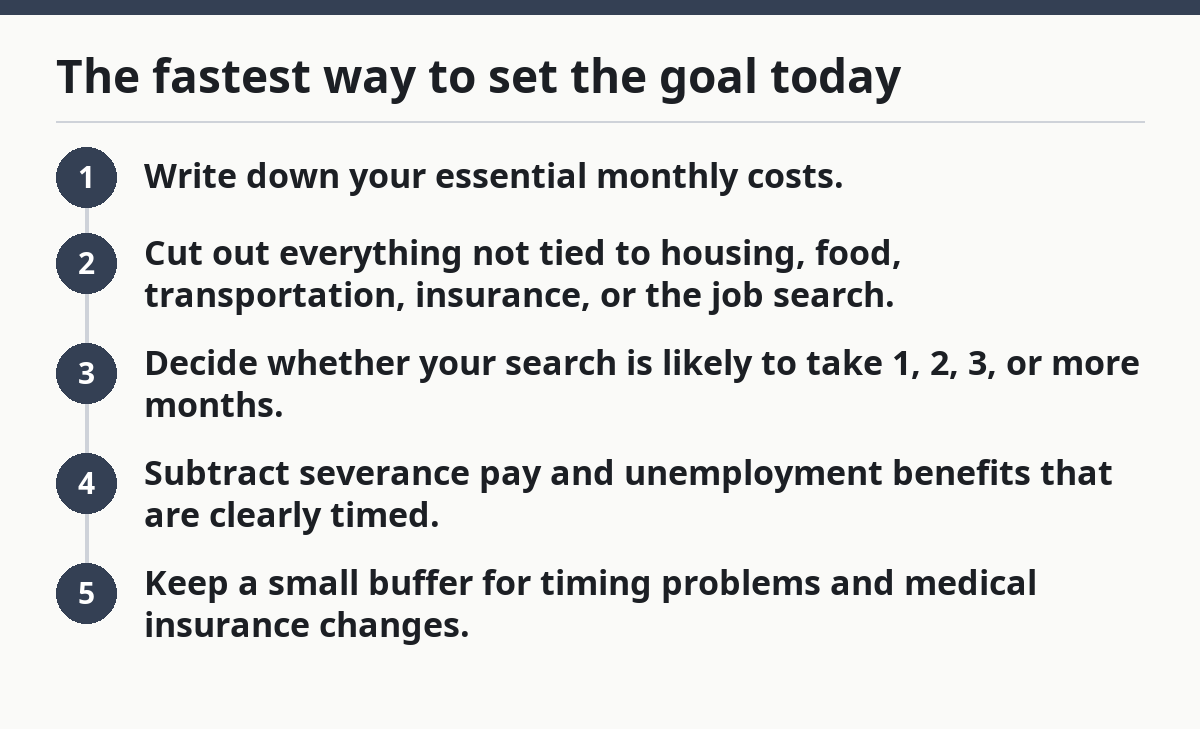
- Write down your essential monthly costs.
- Cut out everything not tied to housing, food, transportation, insurance, or the job search.
- Decide whether your search is likely to take 1, 2, 3, or more months.
- Subtract severance pay and unemployment benefits that are clearly timed.
- Keep a small buffer for timing problems and medical insurance changes.
If you want the broader long-term framework, the hub page on how much emergency fund do I need can handle the full household picture. This page is for the transition period, where the right answer depends on timing, not theory.
The best goal is one you can explain in a sentence: “I need enough to cover 3 months of fixed expenses, minus my severance, until unemployment benefits start.” That sentence is specific, testable, and easy to revise when the job search changes.
How much emergency cash should you keep while job hunting?
Keep enough emergency cash to cover your bare-bones budget for the full time you might be unemployed, plus the gap before severance or unemployment benefits arrive. A 1-month fund can be enough only if your search is likely to end quickly and your support payments start on time. If the market is slow, a 3-month target is a safer starting point.
Should severance count toward your emergency fund?
Yes, if the severance amount and payment date are known, you can count it in the calculation. The catch is timing: severance that lands after rent, insurance, or debt payments are due does not help with the gap before those bills hit. If the package is uncertain, count it conservatively until it is confirmed in writing.
How do you budget emergency savings during unemployment?
Budget emergency savings during unemployment by using a bare-bones monthly number and tracking when each payment arrives. For more context, the Consumer Financial Protection Bureau explains how to prioritize essentials and plan for irregular income, and the U.S. Department of Labor provides state-by-state unemployment resources that help you estimate timing and eligibility.
Drafted with AI; not yet reviewed by a person.