Last updated: November 19, 2026
Cutting monthly spending for an emergency fund means finding $50, $150, or whatever amount your budget can sustain every month and keeping it there. The most reliable path is usually a cleaner monthly budget that frees up cash flow from recurring bills, subscriptions, utilities, and groceries. This article explains how to cut monthly spending for an emergency fund without breaking your household budget.
Key Takeaways
- Start with recurring spending, because that is where the same dollar can be freed every month.
- The monthly budget is the tool here, not a strict punishment plan.
- Subscriptions, utilities, and groceries usually give the quickest repeatable savings.
- A small cut you can keep for 6 months beats a large cut that collapses in 2 weeks.
- If a bill is already at the minimum or a cut would create late fees, skip it and move to the next line.
What should I cut first in my monthly budget?
Cut the expenses that repeat every month and are easiest to change within 30 days. That usually means subscriptions, utility costs, and grocery spending before you touch rent, insurance, or debt payments.
Start with your monthly budget on one page or in one spreadsheet. List every recurring item and mark each one as either fixed, flexible, or optional. Fixed means you cannot change it this month without breaking something important. Flexible means you can reduce it within the next billing cycle. Optional means you can cancel it now and not miss it much.
If you need a rule for priority, use this order:
- Subscriptions you forgot about or barely use.
- Utility settings you can lower in 1 billing cycle.
- Grocery habits that leak money week after week.
- Recurring fees and convenience charges.
- Any remaining discretionary spending.
This order works because it attacks spending that resets every month. A one-time refund or a random side hustle check can vanish; a lower internet tier or a canceled streaming service keeps paying you back. That is why monthly budget changes matter more than one-off fixes.
A common mistake is going after the hardest bill first because it feels dramatic. That often saves little and burns time. Another mistake is slashing groceries so hard that you rebound and overspend the next week. Aim for cuts you can keep for at least 3 months. If a cut does not produce a lower card charge or bank withdrawal on the next statement, it did not really work.
For a broader framework, this page supports the hub on emergency fund funding tactics, but this article stays focused on monthly spending, not windfalls or fast-track tricks.
How do I find money in my budget quickly?
Find money in your budget quickly by reviewing the last 30 days of spending, not by guessing from memory. A practical method is to look at one checking account, one credit card, and any automatic drafts you already know about.
Do this in order:
- Pull the last full month of transactions from your bank or budgeting app.
- Circle every recurring charge that appears 2 times a month or every month.
- Put each item into one of 3 buckets: keep, reduce, cancel.
- Add the monthly amount for everything in the reduce and cancel buckets.
- Move that number into a separate emergency-fund transfer the day after payday.
You want to see 3 things when this step works: fewer subscriptions on the next statement, a lower average utility bill, or a grocery total that drops without making meals fall apart. If you only see “I think I spent less,” the cut is too vague to trust.
This is also where cash flow review matters. Cash flow is the gap between what comes in and what goes out each month. If your pay lands on the 1st and 15th, but most bills hit in the first week, you may feel broke even with a decent income. Move due dates when possible, or schedule the emergency-fund transfer for the day after your larger paycheck. The point is to make the savings happen before the money gets scattered.
A lot of generic advice says to “track expenses” and stops there. That leaves the reader staring at a report instead of a decision. The useful part is to assign each line a direction. Keep. Reduce. Cancel. No other label is as actionable. If you can find even $25 a month from 4 different places, that is a real monthly capacity increase, not a vague promise.
For source quality on budget methods, a solid reference is the Consumer Financial Protection Bureau’s budgeting guidance, which explains how to track spending and plan around bills. The U.S. Department of Labor also has plain-language material on managing expenses. Use them as frameworks, not as a script.
Which subscriptions and recurring bills should I cut first?
Cut subscriptions and recurring bills that do not protect your housing, work, health, or transportation. That means streaming services, premium app plans, gym memberships you do not use, box subscriptions, and auto-renewing add-ons you forgot existed.
The easiest win is to audit every auto-renewal in one sitting. Open your card statements and app store subscriptions, then list anything billed monthly or annually. Annual plans count too: a $120 annual charge is really $10 a month in your budget, and it still reduces your monthly capacity.
Then sort each item into 3 groups:
- Cancel now: unused or low-value services.
- Pause or downgrade: services you use, but not enough to justify the current tier.
- Keep: anything tied to work, school, or household functioning.
If you cancel a service and it still shows up next month, the cancellation did not stick. Watch the following statement for at least 1 full billing cycle. That is the proof that the monthly budget actually changed.
The trade-off here is convenience. Canceling one-click delivery, cloud storage, or entertainment plans can create friction. That friction is the point if the service was draining money without pulling its weight. What this is not for: bills that become more expensive when cut, such as losing a discount on a bundled service or triggering a penalty for ending a contract early. In those cases, wait until the penalty window closes or reduce a different category.
If a recurring bill is technically “necessary” but still too high, call the provider and ask for a lower tier, a non-promotional rate, or a payment plan that smooths cash flow. Keep the conversation focused on lowering the monthly amount, not on getting a vague concession. A successful result is a smaller line item on the next statement, not a promise.
How do I lower utility costs without making the house uncomfortable?
Lower utility costs by changing usage patterns before you start buying equipment. That usually means adjusting thermostat settings, reducing water waste, and cutting energy use in rooms you do not occupy all day.
Focus on the bills that recur every month:
- Electricity
- Gas
- Water
- Internet, if your plan is above what you actually use
Start with one bill at a time. If your electricity bill is the worst offender, look at the 3 biggest drivers: HVAC, laundry, and lighting. In many homes, simply setting the thermostat a few degrees higher in summer or lower in winter can change the bill from one cycle to the next. The exact savings vary, so do not guess a dollar amount in advance. The visible win is that next month’s bill stops climbing.
Use the same method for water:
- Fix obvious leaks.
- Shorten shower time by a few minutes.
- Run full loads in the washer and dishwasher.
- Check whether any outdoor watering is automatic and excessive.
Internet is a quieter but common leak. Many households pay for more speed than they need. If the plan is 500 Mbps and video calls, streaming, and normal browsing still work on a lower tier, a downgrade may free enough cash for the emergency fund without affecting daily life.
The mistake here is cutting comfort too hard, too fast, and then reversing the cut. A house that is too hot, too cold, or too restrictive will push you back to old habits. Keep the change small enough that you can live with it for at least one billing cycle, which is usually about 30 days. That is how utility savings become part of the monthly budget instead of a temporary experiment.
How should I cut grocery spending without wrecking meals?
Cut grocery spending by buying fewer convenience items, planning meals around what is already in the house, and reducing waste from food that spoils before you use it. This is one of the better places to free monthly cash because the spending repeats every week.
Use a 2-week food cycle instead of making 14 different meals. Pick a short list of breakfasts, lunches, and dinners that rely on overlapping ingredients. For example, rice, eggs, beans, pasta, oats, yogurt, frozen vegetables, and one or two proteins can cover many meals without a long grocery list. The exact foods matter less than the pattern: fewer ingredients, fewer impulse purchases, fewer trips.
Then set 3 guardrails:
- Shop with a list and eat before you go.
- Do one “use-it-up” meal every week.
- Replace brand loyalty with price comparison on staple items.
Your goal is not perfection. It is a grocery total that comes down and stays down for 4 consecutive weeks. If the bill drops one week and jumps the next because you ran out of planned meals, the plan is too rigid. Flexible meal planning beats a harsh list you abandon by Thursday.
A common error is trying to save by cutting all fresh food. That often leads to takeout, and takeout is usually where the monthly budget leaks back out. A better move is to buy fewer snack foods, fewer drinks, and fewer ready-made extras while keeping enough real food to cook. If store-brand pasta and frozen vegetables give you the same dinner for less, that is a real cut. If the cut makes your meals so unpleasant that you overspend on delivery, it failed.
If grocery spending is still too high after a month, review how often you shop. A weekly trip can create more impulse spending than a 2-week trip with a tighter list. The right cadence depends on your household, but the pattern should still be the same: fewer visits, less waste, lower total.
How do I turn those cuts into emergency-fund money every month?
Turn those cuts into emergency-fund money by automating the transfer the same day your income hits, but only if that transfer fits your situation; if you are unsure, consider a budget review with a qualified financial professional or counselor. Savings that stay mixed into checking tend to get spent.
Set up a separate savings account for the emergency fund if you have not already. Keep it out of the daily checking account so it is less tempting to absorb back into normal spending. Then choose a transfer amount based on the monthly savings you found:
- Subscriptions canceled: move that amount.
- Utility reduction: move the average monthly difference.
- Grocery cut: move the planned weekly reduction multiplied by 4.
The important part is timing. If payday is Friday, schedule the transfer for Friday afternoon or Saturday morning. If you wait until the end of the month, the money will be eaten by small expenses. That is not a character flaw; it is how cash flow works.
A realistic test is simple: after 2 billing cycles, check whether the emergency-fund transfer is still happening without forcing overdrafts or card balances higher elsewhere. If it is, the cut is sustainable. If it is not, you cut too deeply or in the wrong category. Reduce the transfer by a smaller amount and keep the rest of the plan intact.
This is the point where honesty matters. Not every budget can support a meaningful emergency-fund transfer right away. If the monthly budget is already tight, the goal is to free a repeatable amount, not to manufacture a perfect number. A $40 monthly transfer that survives for 12 months is more useful than a $200 promise that dies after 1 paycheck. For a step-by-step map of other funding routes, the hub on emergency fund funding tactics belongs next, but this page’s job is to keep the monthly spending cut alive.
What mistakes make monthly cuts fail?
Monthly cuts fail when they target the wrong expenses, ignore the next statement, or set savings too high to survive the month. The biggest mistake is cutting in a way that creates late fees, overdrafts, or rebound spending.
Watch for these failure points:
- Cutting only one category and hoping it is enough.
- Cancelling a service that actually prevents bigger spending elsewhere.
- Setting a savings target before checking the monthly budget.
- Ignoring annual charges that still damage monthly cash flow.
- Changing too many habits at once and quitting after 2 weeks.
What to do instead is simpler: test one or two cuts per billing cycle, then verify that the next bill is lower or the charge disappears. If a cut raises another expense, such as more takeout after you slash groceries, put the money back in the original category and cut a different one.
This is also where “who this is not for” matters. If your financial issue is an income gap, chronic late fees, or debt that is already in collections, monthly spending cuts may not create enough room on their own. In that case, budget trimming still helps, but it should be paired with broader financial help from a qualified professional or counselor. I would not treat spending cuts as the only fix when the monthly budget is already underwater.
The best rule is practical: if a cut cannot survive 30 days, it was too aggressive. The emergency fund needs continuity more than drama.
What expenses should I cut first?
Cut recurring expenses you can change this month, starting with subscriptions, flexible utility usage, and grocery waste. Those categories usually free cash faster than large fixed bills, and they are easier to reverse if the cut proves too harsh.
How do I find money in my budget quickly?
Review the last 30 days of transactions and sort each recurring charge into keep, reduce, or cancel. That gives you a direct list of monthly savings opportunities instead of a vague spending report. A 20-minute review can reveal unused subscriptions, high utility settings, or grocery habits that are inflating cash flow.
How much should I reduce spending by?
Reduce spending by an amount you can keep for at least 3 months, even if it is only $25 or $50 a month at first. The right number is the one that fits your monthly budget without causing overdrafts, debt, or rebound spending. A smaller cut that survives is better than a larger one that fails after one bill cycle.
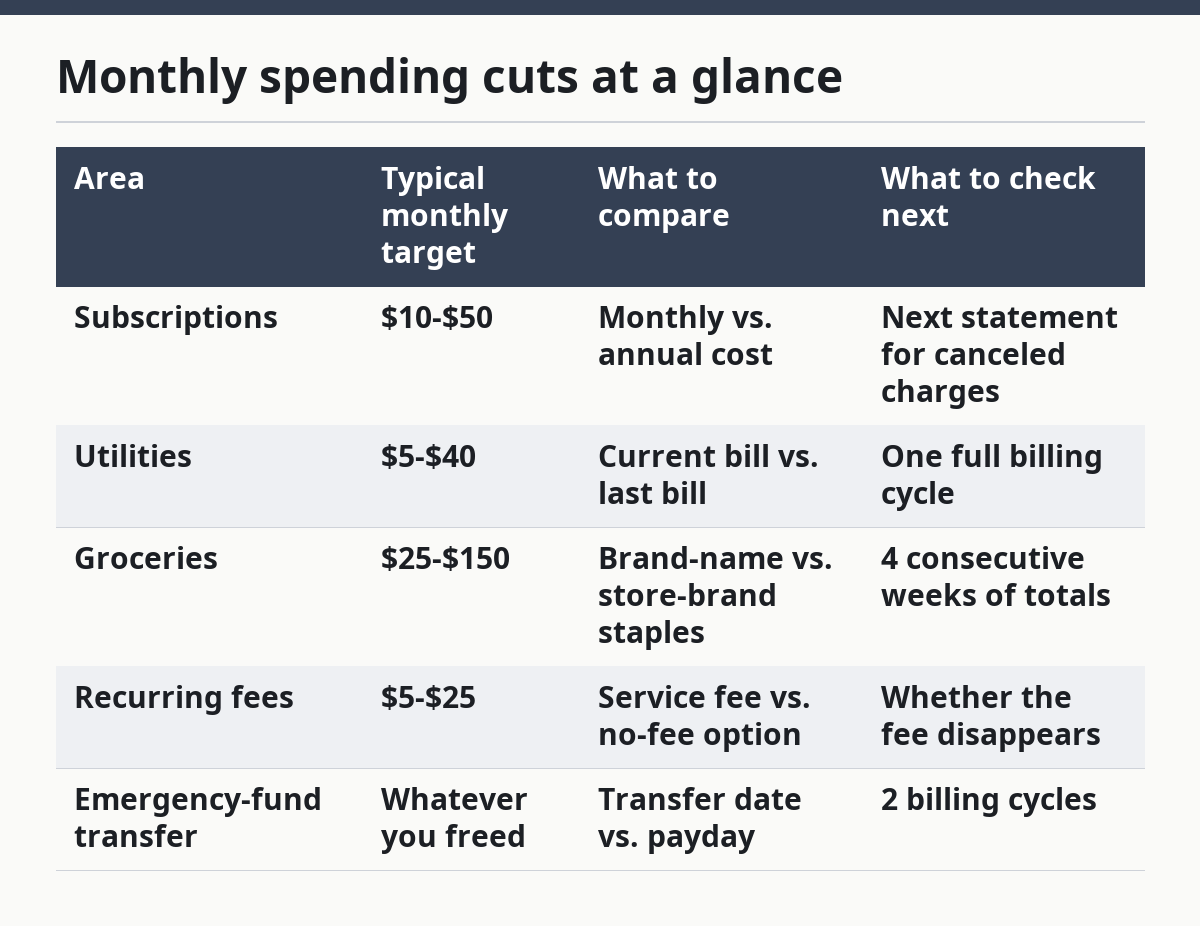
Monthly spending cuts at a glance
| Area | Typical monthly target | What to compare | What to check next |
|---|---|---|---|
| Subscriptions | $10-$50 | Monthly vs. annual cost | Next statement for canceled charges |
| Utilities | $5-$40 | Current bill vs. last bill | One full billing cycle |
| Groceries | $25-$150 | Brand-name vs. store-brand staples | 4 consecutive weeks of totals |
| Recurring fees | $5-$25 | Service fee vs. no-fee option | Whether the fee disappears |
| Emergency-fund transfer | Whatever you freed | Transfer date vs. payday | 2 billing cycles |
For related budget guidance, see how to build an emergency fund, budgeting basics, and how to reduce monthly bills. Authoritative external sources on budgeting and household expenses include the Consumer Financial Protection Bureau and the U.S. Department of Labor, which explain how to track spending and manage bills.
Drafted with AI; not yet reviewed by a person.