Last updated: November 19, 2026
Quick answer: for most households, a practical emergency fund strategy starts with $500 to $1,000, then grows toward 3 to 6 months of essential expenses. In this guide, Emergency Fund Strategy and Goal Setting means building a cash reserve for real shocks, not for planned spending, so one bad month does not turn into debt.
An emergency fund should cover the real shocks that break a budget: a job loss, a car repair, a medical bill, a roof leak, or a move you did not plan. The goal is not to hit some magic number first; the goal is to build enough cash that one bad month does not become debt.
What an emergency fund is for—and what it is not
An emergency fund is money kept in cash or cash-like savings for true interruptions, not for planned spending. A kitchen remodel, holiday travel, annual insurance premiums, or a new phone should come from a separate sinking fund, because mixing those goals makes the emergency fund look bigger than it is.
That distinction matters because people often set the wrong target. If the money is likely to be spent in the next 6 to 12 months, it is not an emergency fund. If you would still need the money after a layoff, a deductible, or an urgent home repair, it belongs here.
The cleanest rule is this: an emergency is sudden, necessary, and hard to avoid. That is why this fund works best in a savings account, not in stocks, crypto, or any place where a bad week can also become a bad market. If the money has to be there on Monday morning, it should not depend on whether the market is up or down.
A good emergency fund also has one job. It should make you less fragile. It should not be the account you constantly borrow from for small temptations. If you keep raiding it for non-emergencies, the number on the screen stops being protection and starts being wishful thinking.
How much emergency fund do you actually need?
The right target is usually 3 to 6 months of essential expenses, but many people do best by starting with a smaller first milestone of $500 to $1,000. That two-stage approach is often more realistic than trying to save six full months from zero.
“Essential expenses” means rent or mortgage, utilities, food, transportation, insurance, minimum debt payments, and child care you cannot cut quickly. It does not mean dining out, subscriptions, or discretionary shopping. If your essential monthly spend is $3,000, then a 3-month fund is $9,000 and a 6-month fund is $18,000.
The right range depends on risk, not just discipline. A single earner with variable income needs more cushion than two steady paychecks. Someone with a stable government job and low fixed costs may be fine at the lower end. A freelancer, commission earner, or contract worker should usually lean toward the higher end, because income risk is part of the emergency equation.
A few common situations change the math:
- Stable dual-income household: 3 months of essentials may be enough if both incomes are truly reliable.
- Single income household: 4 to 6 months is safer because there is no second paycheck to soften the hit.
- Variable income or gig work: 6 months or more is often the better target.
- High-deductible health plan or older home: add a buffer above the base target, because the first shock may be expensive.
- Heavy debt load: the fund may need to be larger before aggressive debt payoff makes sense, because one emergency can push the whole budget off the road.
A generic article often skips the trade-off here: more cash in savings means less money invested or used to pay debt faster. That is not a flaw; it is the cost of liquidity. If you are not sure which side to favor, start by protecting against the event most likely to force high-interest borrowing. That is usually the emergency fund’s real purpose.
For more on why emergency savings matter, Consumer Financial Protection Bureau guidance on building an emergency fund is a useful reference, and FDIC consumer materials explain why insured savings accounts are the standard place to keep cash reserves.
How do I set a realistic emergency fund goal?
Set the goal in layers so it stays doable. A practical ladder is $500, then $1,000, then one month of essentials, then three months, then six months if your income or life situation calls for it.
This matters because people fail when the target feels abstract. “Save $15,000” is a hard sell. “Build $1,000 by splitting every paycheck for 5 months” feels concrete. Once the first milestone is in place, the second stage becomes less intimidating because the habit already exists.
A useful way to size the goal is to work backward from your monthly survival number:
- List only the bills that must be paid to keep life running.
- Add up one full month.
- Multiply by 3 if your income is stable.
- Multiply by 6 if your income is uneven or your household has one main earner.
- Add a separate buffer if your deductible, car repair exposure, or housing risk is unusually high.
Example: if essentials total $2,400 a month, then a 3-month target is $7,200 and a 6-month target is $14,400. If that feels impossible, do not abandon the plan. Shrink the time horizon first. Hitting $2,400 in cash is far more useful than endlessly talking about $14,400 while saving nothing.
The goal should also match the account’s purpose. If your fund is meant to cover a job loss, a 3-month target may be the first meaningful line. If it is meant to cover a layoff in a shaky industry, a 6-month or 9-month target may be more appropriate. The correct number is not the one that sounds financially sophisticated; it is the one that buys enough time to recover.
One note for people carrying credit card debt: if the balance is high and the interest rate is punishing, the decision is not always “save first” or “pay debt first.” A starter fund of $500 to $1,000 often makes sense before attacking the debt more aggressively, because otherwise every small emergency goes straight back onto the card.
Where should emergency money be kept?
Emergency money should be kept in an account that is safe, liquid, and boring. A high-yield savings account can be a good fit because it keeps the cash accessible while earning a modest return compared with a checking account.
The ideal account has three qualities:
- Immediate access: you can transfer money quickly when needed.
- Low risk: the balance is not exposed to market swings.
- Separation: it is not the same card or account you use for day-to-day spending.
That last point is underrated. If the money sits in your main checking account, it will be too easy to blur the line between emergency cash and routine spending. If it sits in a brokerage account, the temptation is different: you may be forced to sell at the wrong time.
For U.S. savers, a bank or credit union account that is FDIC- or NCUA-insured up to the legal limit is the standard safety rail. That does not mean every account is equally useful. Some banks impose transfer delays, minimum balances, or paperwork that slows access. If the money is supposed to solve a same-week problem, slow access is a real cost.
Treasury bills and money market funds can play a role for larger emergency funds, but they are not always the simplest choice for money you may need on short notice. Treasury bills mature on fixed dates, which is fine if your cash need matches the timing and you understand the mechanics. A money market fund is still an investment product, not a bank deposit, and while these funds are usually conservative, they are not the same thing as a savings account.
A plain savings account may look less impressive, but this is one place where boring wins. The fund exists to be there when life is inconvenient. The goal is availability, not excitement.
Emergency fund strategy for different situations
An emergency fund strategy depends on your income pattern, family structure, and the kinds of shocks you are most likely to face. A one-size rule misses too much.
For salaried workers with stable jobs, the priority is consistency. Automate transfers on payday and build toward 3 months of essentials first. If your employer is stable and you have low fixed costs, this can be enough for a while.
For freelancers, contractors, and commission-based earners, the fund has a second job: income smoothing. In that case, 6 months is a more realistic floor, and some people need more. The mistake here is assuming a strong month cancels out a weak one. Cash flow swings should be planned for, not treated as surprises.
For families with children, the fund should account for practical disruptions: child care gaps, school expenses that appear suddenly, and the fact that one parent may need to miss work more often. A 3-month target can be too thin if there is no backup care or if one income carries the household.
For renters, the risk profile is often different from homeowners. There may be fewer home repair costs, but a job loss can still trigger a lease problem, a move, or a need to cover a deposit. The fund should reflect those relocation costs, not just monthly rent.
For homeowners, the emergency fund should sit alongside, not instead of, a home-maintenance reserve. A water heater, furnace, or roof issue can erase a thin fund quickly. If the home is older, the emergency target should be more conservative.
For people with high-deductible health plans, the fund needs to respect the deductible and out-of-pocket exposure. Even a “small” medical event can cost more than a typical household expects. The exact amount depends on the plan, but the principle is simple: if you would hesitate to use care because you cannot cover the bill, the cash buffer is too small.
For people in retirement, the goal often shifts from “replace income” to “avoid selling investments at the wrong time.” Retirees still need cash for surprise expenses, but the structure may include a cash bucket for near-term spending and a separate reserve for true emergencies. Taxes, required distributions, and portfolio withdrawals can interact in ways that are easy to miss, so professional guidance can help.
A local-cost style table for emergency fund targets
The table below translates the strategy into practical targets based on monthly essentials. The numbers are examples, not guarantees, because every household’s fixed costs are different.
| Monthly essential expenses | Starter goal | 3-month target | 6-month target |
|---|---|---|---|
| $1,500 | $500 to $1,000 | $4,500 | $9,000 |
| $2,500 | $500 to $1,000 | $7,500 | $15,000 |
| $3,500 | $500 to $1,000 | $10,500 | $21,000 |
| $5,000 | $500 to $1,000 | $15,000 | $30,000 |
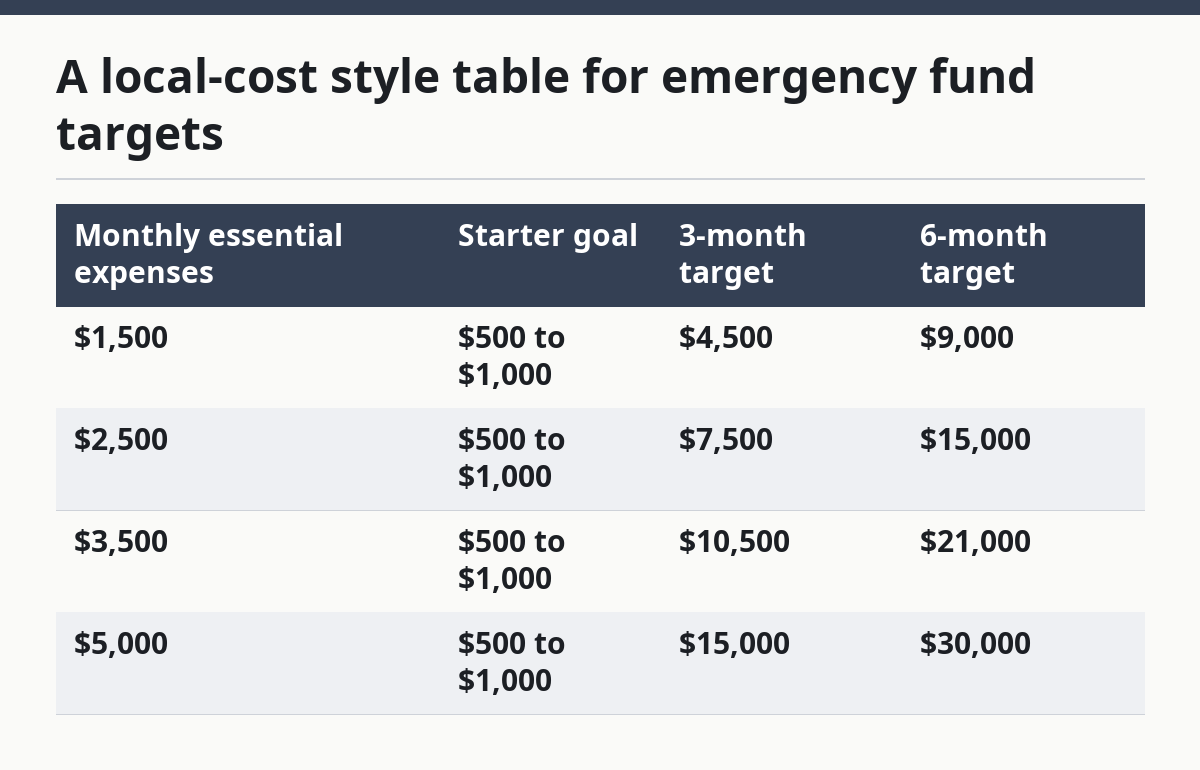
This table hides one important detail: the starter goal should come first even if the long-term number is much larger. A household with $5,000 in monthly essentials does not become safer by waiting until it can save $30,000. It becomes safer by building the first $1,000, then the first month, then the full reserve.
Another useful way to think about the table is that the emergency fund gets more valuable as your expenses rise, but not necessarily more urgent in proportion to income. A high earner with heavy fixed costs can still be fragile if cash flow is tight. A modest earner with low fixed costs may need less to stay stable.
How fast should you build it?
You should build it at a pace you can keep for 6 to 12 months, not at a pace that makes you quit in week three. A slow, automatic plan beats an aggressive plan you abandon.
The most useful method is a fixed transfer tied to payday. If you are paid biweekly, that means 26 pay periods a year. Even a modest transfer every two weeks adds up over time because the system runs without a fresh decision each payday.
A practical approach looks like this:
- Set the first target at $500 or $1,000.
- Automate a transfer the day after payday.
- Increase the transfer when a debt is paid off or an expense drops.
- Put windfalls, tax refunds, bonuses, or side income into the fund until the target is hit.
- Stop only when the fund reaches the number tied to your actual risk.
The trade-off is clear: a faster build slows down other goals. If you are balancing debt repayment, retirement investing, and a cash cushion, the right order depends on interest rates and risk. A 24% credit card balance deserves different treatment than a 4% auto loan. But even then, a tiny emergency fund can save you from repeating the same debt cycle every month.
A lot of people overestimate the pain of automation and underestimate the relief it creates. Once the transfer is on autopilot, the decision disappears from your daily life. That is the point.
Red flags that your goal is wrong
Your emergency fund goal is probably wrong if any of these are true: you can’t define “essential expenses,” you keep spending from the fund on planned purchases, or you still need credit cards for ordinary monthly life.
A few warning signs deserve attention:
- You included discretionary spending in the target. A fund built on dinners out and streaming subscriptions is not a survival fund.
- You keep moving money back and forth. That usually means the fund is doing the job of a checking account.
- You chose a huge goal but never started. A perfect target that delays action is worse than a smaller real cushion.
- You have no account separation. If the money is visually mixed with spending cash, the boundaries blur.
- You are ignoring job risk. A stable paycheck today is not a promise about the next 12 months.
There is also a hidden red flag: using the emergency fund as proof that you are “done” with financial planning. It is not the finish line. It is one part of a wider plan that includes retirement savings, insurance, debt control, and regular budgeting.
This is where a generic article often gets sloppy. It tells readers to “save six months” without asking what the fund is supposed to defend against. That is how people end up with too little cash for a layoff or too much cash sitting idle while high-interest debt grows.
When should you use it—and when should you not?
You should use the fund when the expense is sudden, necessary, and outside your normal monthly plan. You should not use it for convenience, impulse, or predictable annual bills that can be scheduled in advance.
Use it for:
- unemployment or reduced hours
- urgent medical bills
- emergency travel for family crises
- essential car repair
- critical home repair
- unavoidable moving costs after a disruption
Do not use it for:
- vacations
- holiday spending
- replacing something because you want a newer version
- annual insurance premiums if you had months to prepare
- routine maintenance you could have budgeted for
- “opportunities” that are really investments with no guaranteed return
If you do have to use the fund, the next step is a refill plan. That part matters as much as the original savings. A used emergency fund is not a failure; a used fund with no refill plan is how the next crisis becomes more expensive.
A refill plan should be specific. For example, if you spent $1,200 on a car repair, decide whether you will restore the account by adding $100 per paycheck for 12 pay periods, or by temporarily reducing another goal. The number matters less than the fact that the plan exists and starts immediately.
The best emergency fund strategy is the one you can keep
The most effective emergency fund strategy is a two-part target: a small starter cushion now and a larger safety reserve later. That approach works because it solves the urgent problem first without pretending every household can save six months overnight.
The most common mistake is treating the emergency fund like a single static number. It is better to treat it as a living goal that changes with income, family size, debt, housing, and health coverage. A renter with one paycheck and a high deductible does not need the same amount as a dual-income household with low fixed costs and stable employment.
The second mistake is keeping the target too vague. “As much as possible” is not a plan. A real plan names a dollar amount, a deadline, and the account where the money lives.
A final caution: if your finances are already stretched, do not let the emergency fund become a source of guilt. Start small. Even $250 can interrupt a debt spiral. Even one month of expenses can buy time to think clearly. That is what the fund is for: time, options, and fewer desperate decisions.
Key takeaways
- A true emergency fund covers sudden, necessary costs, not planned spending.
- The most useful starting goal is often $500 to $1,000, then a bigger target later.
- Three months of essential expenses fits many stable households; six months fits more variable situations.
- Keep the money in a safe, liquid account, usually savings, not in market investments.
- The target should reflect income risk, family structure, debt pressure, and health coverage.
- If you use the fund, set a refill plan right away so the next emergency does not start from zero.
If you want the shortest useful version of the whole guide: define essentials, pick a starter amount, automate the transfers, and keep the money boring enough to be there when life turns expensive.
Drafted with AI; not yet reviewed by a person.