Last updated: November 19, 2026
Key Takeaways
- Emergency funds cover urgent, necessary expenses that can’t wait without causing harm.
- Set the target from essential monthly costs, not gross income.
- The right amount depends more on risk than on ideology.
- Keep emergency money safe, liquid, and separate from day-to-day spending.
An emergency fund is the money that keeps a bad month from becoming a financial crisis. In short: if you want one rule that actually works, keep cash set aside for true emergencies only, and aim for 3 to 6 months of essential expenses unless your job, income, or family situation makes a different target smarter.
That answer is simple on purpose, because the hard part is not knowing that you need a fund. The hard part is deciding how much to keep, where to keep it, and when “enough” really means enough. A nurse with a stable salary and employer coverage does not need the same target as a rideshare driver, a freelancer, or a parent supporting a household on one income.
This guide covers the real math behind an emergency fund, how to set a target that fits your life, what to do if you are starting from zero, and where people usually go wrong. For a broader consumer framing, the Consumer Financial Protection Bureau’s savings guidance and the FDIC’s deposit insurance page are useful references.
What an emergency fund is for
An emergency fund is for necessary, unplanned expenses that cannot wait 30 days without causing damage. That usually means a job loss, a medical bill, a car repair, a broken appliance that affects basic living, or a short gap in income. It is not for planned travel, holiday shopping, a new phone, or a “good deal” that appears out of nowhere.
The simplest test is this: if the expense is expected, even if the timing is fuzzy, it belongs in a sinking fund or a regular budget line, not an emergency account. A roof replacement in 10 years is planned maintenance. A burst pipe on a Tuesday night is an emergency.
The point of the fund is not to earn the highest return. It is to be there when your checking account would otherwise force you into a credit card balance, payday loan, 401(k) withdrawal, or expensive personal loan. Those alternatives can cost far more than the cash earns sitting in a high-yield savings account.
A useful emergency fund should also be boring. That means a separate account, easy access, and no debit card tied to daily spending if you know temptation is a problem. A fund that is too easy to spend on nonemergencies is not really a fund at all.
If you want an outside reference for the structure of safe, liquid cash holdings, the Consumer Financial Protection Bureau’s savings guidance is a solid place to start, and the FDIC’s deposit insurance page explains the basic protection on bank deposits.
How much should your emergency fund be?
The right emergency fund target is usually 3 to 6 months of essential expenses, but many people should use a smaller or larger number depending on job stability, household size, and access to other support. The target is not based on gross income; it is based on the minimum amount of money your life requires each month.
That distinction matters. A person earning $90,000 a year with modest monthly bills may need less cash than someone earning $55,000 a year with a large mortgage, child care, and two cars. The income number looks impressive, but it does not tell you what has to be paid next month.
Start with essential expenses only:
- housing
- utilities
- groceries
- minimum debt payments
- transportation
- insurance
- medication or basic medical costs
- child care if it is required for work
- any other bill that must be paid to keep life functioning
Do not include restaurant meals, subscriptions you can pause, or discretionary shopping. If your budget is not already clear, use bank and card statements from the last 2 to 3 months and identify the non-negotiables.
A simple planning rule is:
Monthly essentials × months of coverage = target fund
Here are practical examples:
| Household type | Monthly essentials | 3-month target | 6-month target |
|---|---|---|---|
| Single renter with stable salary | $2,500 | $7,500 | $15,000 |
| Two-income household, one child | $4,200 | $12,600 | $25,200 |
| Freelancer with uneven income | $3,000 | $9,000 | $18,000 |
| Single parent, high fixed costs | $3,800 | $11,400 | $22,800 |
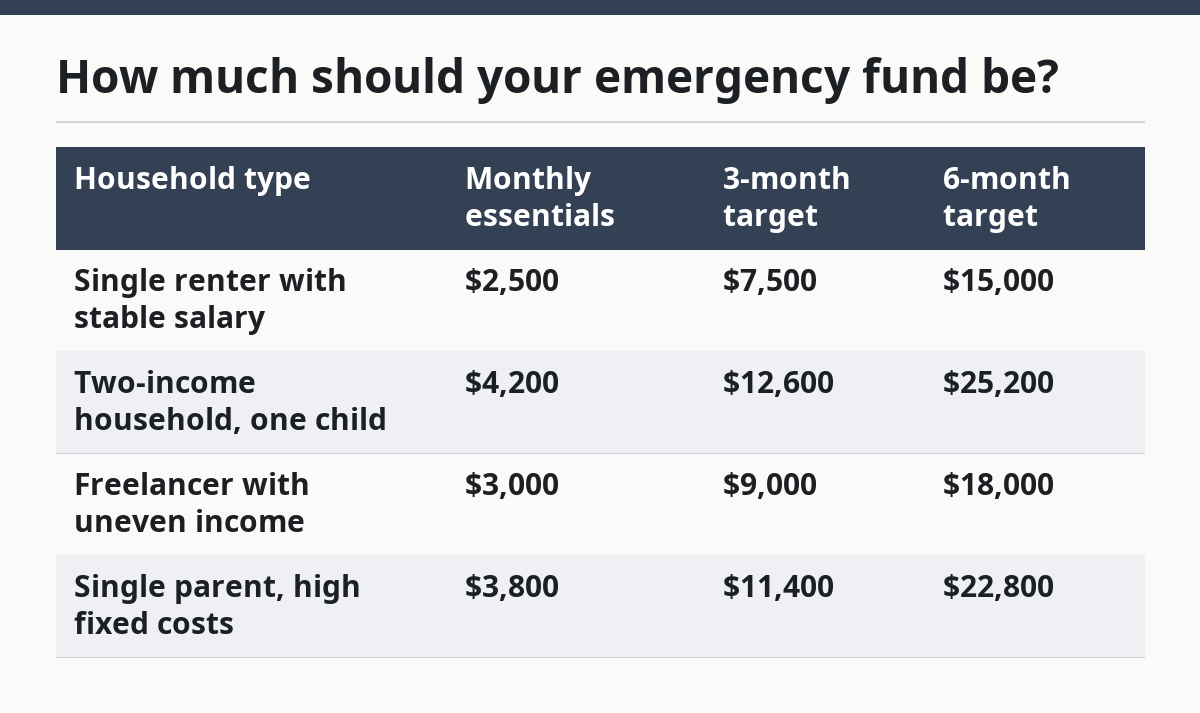
Those figures are examples, not rules. The value of the table is the method. Your actual target may land below or above those ranges.
For many people, 3 months is the minimum useful buffer. For job categories with unstable hours, seasonal income, commission pay, or freelance work, 6 months is usually a better starting point. If your household has one income and several dependents, the lower end can feel thin very quickly. If you have two stable incomes, little debt, and strong family support nearby, 3 months may be enough to start.
However, a larger fund is not always the better choice if it keeps you from paying off high-interest debt. If you are carrying a very expensive balance, a smaller starter fund paired with aggressive debt reduction may be the better balance. That trade-off is real, and anyone who tells you otherwise is ignoring the cost of interest.
How to choose the right savings target for your situation

The right target depends less on financial ideology and more on risk. Your savings target should match the size of the hit you are likely to take if something goes wrong.
Use these factors to adjust your number:
1. Income stability
A salaried employee with predictable hours can usually aim closer to 3 months. A contractor, bartender, realtor, gig worker, or seasonal employee often needs 6 months or more because income swings are part of the job.
2. Number of earners
A one-income household has less margin than a two-income household. If one paycheck covers most essentials, loss of that paycheck is a bigger event than it is in a dual-income home.
3. Dependents
Children, older relatives, and anyone who depends on you for care push the target higher. Child care alone can make a “small” disruption expensive.
4. Benefits and safety nets
Employer severance, sick pay, disability coverage, family help, and liquid taxable investments can reduce the amount of cash you need. Those supports should be counted carefully, not assumed.
5. Housing and transportation risk
A renter with a fixed lease has different risk than a homeowner who may face repair costs. A family with one old car and a long commute should plan for more repair risk than someone living near transit.
6. Health and insurance
High deductibles and recurring prescriptions push the target upward. Health insurance does not eliminate out-of-pocket costs. A deductible of $2,500 or $5,000 can leave a real gap that needs cash, not optimism.
For many readers, the most practical target is not “perfect.” It is staged:
- first $1,000 to $2,000
- then 1 month of essentials
- then 3 months
- then 6 months if needed
That staged approach works because it protects you quickly. A small cushion can stop one flat tire from becoming a credit card spiral. Once that first layer is in place, the later stages get easier.
Where should emergency fund money be kept?
Emergency fund money should be kept in a place that is safe, liquid, and separate from daily spending. A high-yield savings account at an FDIC-insured bank or NCUA-insured credit union is the standard choice for most people.
A checking account is usually too tempting. A brokerage account can be too volatile. A certificate of deposit can lock up money you may need before the term ends. A cash envelope at home is risky because of theft, fire, and simple loss. A mattress is not a strategy.
The best account usually has three features:
- easy transfers
- no market risk
- no penalty for withdrawal
A high-yield savings account often wins because it keeps the cash accessible while paying more interest than a basic checking account. The exact rate changes, and chasing the highest teaser rate is less useful than choosing a reputable institution with reliable transfers and no hidden fees.
If your bank offers automatic transfers, that feature is worth using. Even $25 or $50 per paycheck adds up faster than a vague promise to “save more next month.” Automation also removes the daily decision fatigue that causes many plans to fail.
If your emergency fund will sit above the deposit insurance limits at one institution, check how that coverage works before you leave large balances in a single account. The FDIC and NCUA both publish clear explanations of deposit protection. That matters more than the interest rate when the balance gets large.
How to build an emergency fund from zero
The fastest way to build an emergency fund is to make the first target small enough to reach, then increase it in stages. A first target of $500, $1,000, or one month of essentials is more practical than aiming straight for 6 months and quitting in frustration.
Here is a workable sequence:
Step 1: Pick a starter target
Choose a number you can reach in 1 to 3 months. For many people, $500 to $1,500 is enough to handle a tire replacement, urgent co-pay, or a short interruption in pay.
Step 2: Open a separate account
Use a distinct savings account so the money is not mixed with the bill-paying balance. Separation reduces the chance that you treat it like spending money.
Step 3: Fund it automatically
Move money on payday. Even $20 per paycheck is a beginning. If you are paid weekly, that can become $1,040 a year without asking yourself twelve times whether you “feel like” saving.
Step 4: Use one-time money well
Tax refunds, bonuses, rebates, cash gifts, and side income can speed up the process. A single $500 tax refund can nearly finish a starter fund if you are starting small. The key is to assign the money before it disappears into general spending.
Step 5: Raise the target after the first milestone
When the starter fund is complete, increase the target to one month of essentials. After that, move toward 3 months. The psychological win of finishing a stage matters. People stick with plans they can see ending.
A mistake many people make is trying to save the “perfect” amount while still carrying every other financial burden unchanged. That plan often fails because it asks too much of a budget with no slack. It is better to create a small buffer first, then build the larger reserve.
What if you also have debt?
You should usually keep at least a small emergency fund even if you have debt, because a zero-cash household often replaces one problem with a more expensive one. If an unexpected $700 car repair forces a credit card charge at a high interest rate, the debt problem gets worse, not better.
The honest trade-off is between cash safety and debt cost. If you are paying very high interest on unsecured debt, stopping at a starter emergency fund and putting the rest toward the balance may make sense. That is not a failure. It is a choice about which risk is more expensive right now.
A common middle path looks like this:
- build $500 to $1,000 first
- keep making minimum debt payments
- direct extra money toward high-interest balances
- increase the emergency fund once the worst debt is under control
This approach is especially useful if your monthly budget is tight and surprises happen often. It gives you enough cash to avoid new borrowing without turning the emergency fund into a slow replacement for debt payoff.
One warning: do not drain the fund every time you feel behind. If you use it for a true emergency, the right next step is to rebuild it as soon as possible. A fund that never gets replenished is just temporary spending.
Common emergency fund mistakes
The most common mistakes are too little cash, the wrong account, and a vague definition of “emergency.”
Mistake 1: Making the target random
A round number sounds tidy, but your target should be tied to monthly essentials. $10,000 might be too little for one household and too much for another. The right answer depends on actual bills.
Mistake 2: Counting investments as emergency money
Stocks can drop 20% or more in a bad stretch, which is exactly when you do not want to sell. Money needed soon should not depend on market timing.
Mistake 3: Mixing emergency money with everyday spending
If the account is also your bill-paying account, the balance will drift. Separate accounts reduce that drift.
Mistake 4: Saving only after everything else
If you wait until the month feels “comfortable,” the fund often never grows. Emergency saving works best as a fixed transfer, not a leftover.
Mistake 5: Using the fund for predictable but annoying expenses
Holiday travel, school clothes, annual insurance premiums, and routine car maintenance are not surprises if you know they are coming. Put those into separate sinking funds or budget categories.
Mistake 6: Keeping too much in cash without a reason
A very large cash balance can be sensible for unstable income, but cash has an opportunity cost. Once the emergency target is met, extra money may belong in retirement savings, debt payoff, or other goals. The right amount is enough for risk, not enough to ignore the rest of your plan.
When should you use the fund, and when should you not?
Use the fund when the expense is urgent, necessary, and not already built into your budget. Do not use it for wants dressed up as needs.
A good test is to ask three questions:
- Is this expense unexpected?
- Is it necessary for health, work, housing, or basic living?
- Can I wait without causing a bigger financial problem?
If the answer is yes to all three, the fund is probably the right tool.
Examples that usually qualify:
- job loss or a major drop in hours
- medical bill after insurance
- emergency travel for a family crisis
- essential car repair
- furnace, water heater, or plumbing failure
- rent or mortgage gap caused by short-term disruption
Examples that usually do not:
- vacation upgrades
- a better phone when the old one still works
- moving because a neighborhood is less exciting than you hoped
- annual memberships you forgot about
- shopping sales
If you are unsure, pause for 24 hours before using the fund for anything that is not clearly urgent. That delay is enough to separate panic from necessity in many cases.
How to know when your emergency fund is enough
Your emergency fund is enough when it can cover the likely disruption you are actually preparing for, not every possible disaster. For many people, that means 3 to 6 months of essentials, plus separate plans for predictable costs.
You may be ready to stop increasing it if:
- your income is stable
- your essential expenses are clear
- you have no high-priority debt emergency
- your account can cover a realistic loss of income or major repair
- you have a plan for medical deductibles, car maintenance, and annual bills
You may need more if:
- your work is seasonal or commission-based
- your household depends on one paycheck
- your rent or mortgage is high relative to income
- you have children, health issues, or a high deductible
- replacing income would take longer than 3 months
There is no magic finish line that works for everyone. The point is not to maximize the account forever. The point is to create enough breathing room that one problem does not turn into three.
The bottom line
An emergency fund is a buffer, not a trophy. The practical target for many households is 3 to 6 months of essential expenses, but the right number depends on how steady your income is, how many people depend on it, and how expensive a bad month would be.
If you are starting from zero, do not wait for the perfect amount. Build a small starter fund first, keep it in a separate savings account, and raise the target in stages. If you carry expensive debt, a smaller fund plus debt payoff may make more sense than trying to do everything at once.
The best emergency fund is the one that is there when life gets messy.
Drafted with AI; not yet reviewed by a person.