Last updated: November 19, 2026
Quick Answer: For most people, the best emergency fund account selection is a no-fee high-yield savings account, with $500 to $1,000 kept immediately accessible in checking. The right emergency fund account selection depends on how fast you may need the money, but that split gives you a practical starting point without overcomplicating the setup.
The topic of Emergency fund account selection — The Complete Guide is simple in principle and more varied in practice: the best place for an emergency fund is a high-yield savings account, a money market account, or a short-term Treasury ladder at a bank or brokerage that lets you get cash fast without putting principal at risk. The wrong place is anything that can drop in value right when you need the money: stocks, crypto, long-term bonds, or a certificate of deposit with a punishing early-withdrawal penalty.
Key takeaways
- Cash you may need within days should be easy to reach, not exposed to market swings.
- FDIC- or NCUA-insured accounts keep principal protected up to the standard insurance limits, which matters more than squeezing out one extra percentage point.
- The best choice depends on your timing: same-day access points toward checking or a savings account with instant transfers, while money you can leave untouched for months can sit in a higher-yield option.
- Rates change often, so the account that wins today may not win next quarter.
- A good emergency fund setup is boring on purpose: simple access, clear transfer rules, and no fees that eat the interest.
- If your income is unstable or your bills are lumpy, liquidity matters more than yield.
What the right emergency fund account has to do
The right emergency fund account has to preserve principal, keep the cash within reach, and avoid fees that punish you for using it. That sounds plain, but many products fail one of those three jobs.
An emergency fund is not an investment portfolio. It is a buffer for job loss, a medical bill, a car repair, a furnace replacement, or a flight home. Those events do not wait for a 3-day transfer, and they do not reward a person for taking market risk. If the money might be needed in less than 12 months, safety and access beat return.
A solid emergency fund account usually has four traits:
- Low or no balance minimums. A minimum of $1,000 may be fine for a regular savings account, but a person building from zero usually does better with an option that has little or no meaningful entry barrier.
- Fast transfers. Same-day internal transfers, instant transfer rails, or a linked debit card can matter when a car repair shop wants payment before closing.
- No monthly maintenance fee. A $5 or $10 fee can quietly eat a meaningful share of interest on a small balance, so fee-free accounts are usually easier to live with.
- Insurance or principal protection. FDIC- or NCUA-insured deposits are the simplest answer for most people. U.S. Treasury bills are backed by the full faith and credit of the U.S. government, which is different from bank deposit insurance but still highly secure; if you want help choosing among insurance, Treasury holdings, and bank products, consult a qualified financial professional and review TreasuryDirect, FDIC, or NCUA materials before opening anything.
The classic mistake is chasing yield before solving access. A person who needs $3,200 for a roof leak does not care that a slightly better rate was available in a place that takes three business days to open the cash.
That does not mean yield is irrelevant. If two accounts have equal access and equal safety, the one with the better rate wins. It just should not be the first filter.
Which account type fits your emergency fund?
The best fit is usually a high-yield savings account, but the right answer changes with the size of the fund and how fast you might need it. A good rule is to choose the least complicated product that still gives you the access you need.
High-yield savings account
A high-yield savings account is the default choice for most people. It is simple, liquid, and usually insured if held at a bank or credit union with deposit insurance.
Why it works:
- Easy to open
- Easy to understand
- Usually no market risk
- Often has a decent APY compared with standard savings, though rates move
Trade-offs:
- Rate can change at any time
- Some banks cap the highest rate with balance tiers or promotional terms
- Transfers may take 1 to 3 business days if you move money to an external checking account
This is the best pick for someone who wants a plain answer and no fuss. It is also the best fit for a first emergency fund of $500, $1,000, or $5,000 where the main job is to stop the money from getting spent, not to optimize every basis point.
Money market account
A money market account can be a good choice if it gives check-writing, a debit card, or faster access than a plain savings account. It often sits in the middle between checking and savings.
Why it works:
- May offer flexible withdrawals
- Often insured at a bank or credit union
- Some accounts provide better access features than standard savings
Trade-offs:
- Not the same thing as a money market mutual fund
- May require a higher minimum balance
- May have tiered rates that drop at lower balances
This option is useful for someone who wants a cash reserve with spending tools attached. It is not automatically better than a savings account just because the name sounds more sophisticated. The feature list matters more than the label.
Cash management account at a brokerage
A cash management account can be useful when you want a money hub linked to investing, but it is only right if you understand how the cash is held and how quickly you can get it out.
Why it works:
- One place to keep cash and investments organized
- Often includes debit card access, bill pay, and electronic transfers
- May sweep unused cash into insured program banks or money market funds, depending on the provider
Trade-offs:
- “Cash management” is a broad category, not a standard product with identical protections
- The details on sweep programs and transfer timing matter
- Some versions are more feature-rich than they are emergency-friendly
This is a decent option for a person who already keeps their financial life at a brokerage and wants fewer moving parts. It is not the best choice if the setup is hard to explain in one sentence.
Treasury bills or Treasury-only funds
Short-term Treasury bills can be a strong option for the portion of an emergency fund that can sit untouched for a few weeks or months. Treasury bills are backed by the U.S. government, and they usually mature in 4, 8, 13, 17, 26, or 52 weeks, depending on the issue.
Why it works:
- Very strong credit quality
- Can be attractive for cash that does not need to be instantly available
- Interest from Treasury securities is generally exempt from state and local income taxes, though federal tax still applies
Trade-offs:
- Not as simple as a savings account
- Selling before maturity can expose you to price changes if you use a fund instead of holding a bill to maturity
- Direct purchase and settlement timing matter
This is better for a disciplined saver with a larger buffer and a brokerage account already in place. It is less suitable for someone whose emergency fund keeps getting tapped for unpredictable expenses.
Certificate of deposit
A certificate of deposit can work only for a slice of emergency cash you are very unlikely to touch before maturity. The problem is access.
Why it works:
- Rate may be higher than a standard savings account
- Principal is generally insured if held at an insured institution
- Term is fixed, which can help people who want to lock away temptation
Trade-offs:
- Early-withdrawal penalty can wipe out interest or more
- Maturity dates may not line up with actual emergencies
- Not ideal for the first layer of your safety net
A CD is not a full emergency fund solution for most people. It is a parking spot for money you are calling “emergency” only because it is not part of the everyday spending pool.
Checking account
A checking account is the right home for only the first small layer of true emergency cash. It offers the fastest access, but it usually pays little or nothing.
Why it works:
- Immediate spending access
- Debit card, checks, and bill pay
- Good for the first $500 to $1,000 of fast-access cash
Trade-offs:
- Usually low yield
- Easy to spend by accident
- Can invite balance drift if you keep too much there
This is the right place for a “break glass now” amount, not the whole reserve.
How to compare accounts without getting fooled by the rate
The right comparison starts with access, insurance, fees, and transfer rules, then moves to yield. A 4.50% APY account with slow transfers and a $10 monthly fee can be worse than a 3.80% APY account with no fee and same-day transfers.
Therefore, it helps to use a practical comparison framework:
| Feature | High-yield savings | Money market account | Brokerage cash account | Treasury bill | Checking |
|---|---|---|---|---|---|
| Principal risk | Low if insured | Low if insured | Varies by setup | Very low if held to maturity | Low if insured |
| Access speed | 1 to 3 business days typical | 1 to 3 business days, sometimes faster | Often fast | Depends on settlement or sale timing | Immediate |
| Typical yield | Moderate to higher | Moderate | Varies | Often competitive for short terms | Low |
| Fees to watch | Monthly fee, excess withdrawal fees | Monthly fee, minimum balance | Transfer or service fees | Broker fees, bid-ask spread if using a fund | Overdraft, monthly fee |
| Best use | Main emergency reserve | Cash with some flexibility | Integrated cash hub | Money not needed right away | First-need cash |
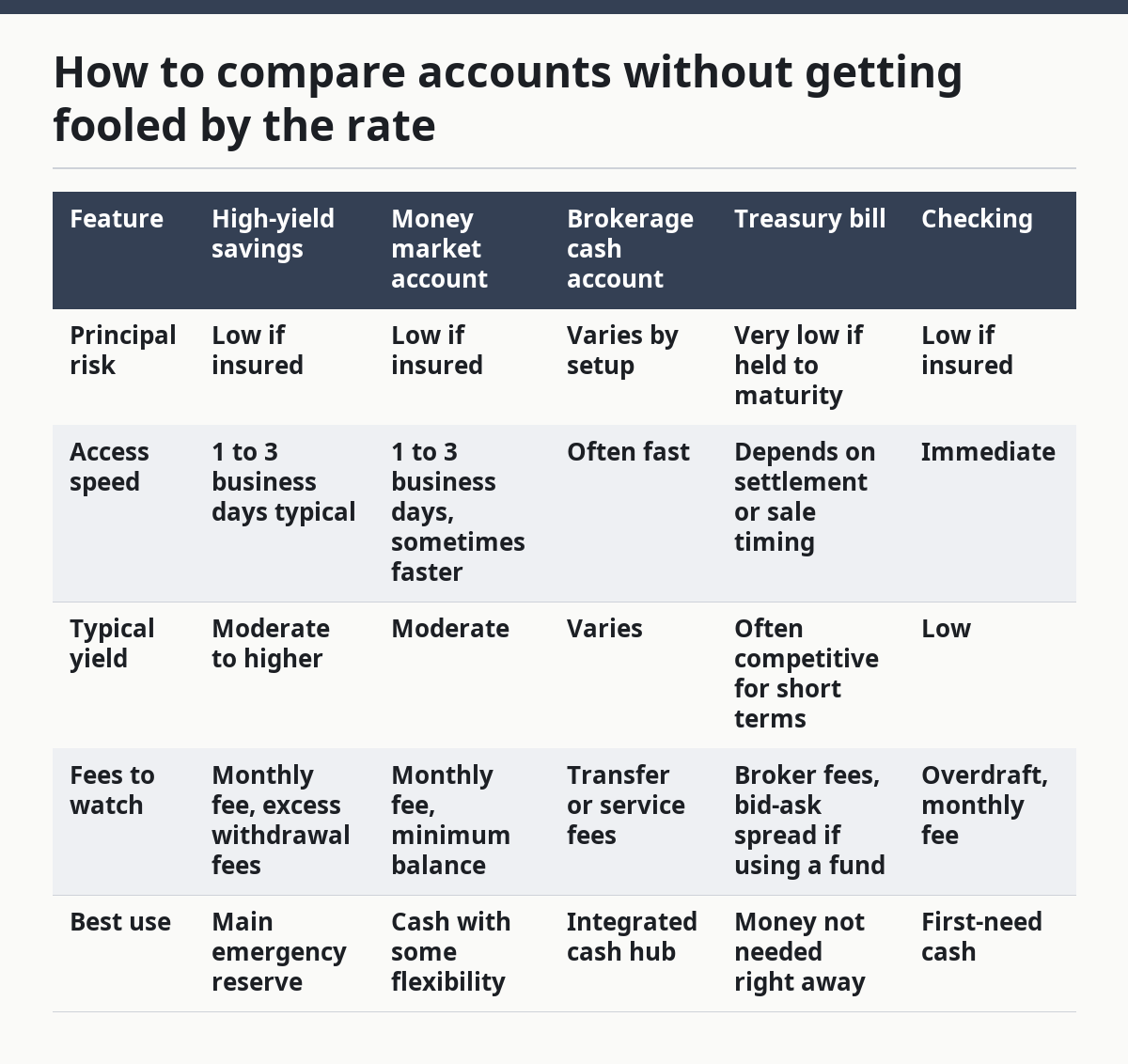
The table hides an important truth: the rate is the least stable part of the decision. A bank can change a rate with little warning, and promotional APYs often expire. The things that stay painful are the fees and the slow transfers.
A person comparing options should ask five questions before opening anything:
- Is the cash insured by the FDIC or NCUA, or otherwise protected by a government guarantee?
- Is there a monthly fee, and what balance removes it?
- How long does an external transfer really take?
- Is there a debit card, check-writing, or same-day withdrawal option?
- What happens if the balance falls below a threshold?
If two products are close, choose the one with the cleaner rules. Clean rules reduce mistakes.
How much of your emergency fund belongs in each place?
The safest setup is often split across two places: a small amount in checking and the rest in a liquid savings-type account. That gives speed and slightly better yield without turning the fund into a puzzle.
A sensible split looks like this:
- First $500 to $1,000: checking account or an instantly accessible savings account
- Next 1 to 3 months of expenses: high-yield savings account or money market account
- Extra cushion beyond that: Treasury bills, a Treasury-focused account, or a second insured savings account if you want to stay simple
The exact split depends on your life.
If your job is stable and your expenses are predictable, a single high-yield savings account may be enough. If you are self-employed, have irregular pay, or support dependents, you may want a faster-access layer in checking and the rest in a higher-yield spot.
The goal is not perfection. It is reducing the chance that a real emergency becomes a cash-flow crisis.
One useful rule: keep at least one month of bare-bones expenses in something you can get to immediately. That means rent, groceries, gas, utilities, insurance premiums, prescriptions, and minimum debt payments. A second layer can be slightly less liquid if it earns more.
Fees, minimums, and transfer speed matter more than people think
Because fees can quietly turn a decent account into a bad one, minimums can do the same if they force you to park more cash than you have.
The most common traps are plain:
- Monthly maintenance fee: A $5 fee on a small balance can be brutal.
- Minimum balance requirement: Some accounts need $500, $1,000, or more to avoid fees or earn the advertised APY.
- Excess transaction limits: Deposit accounts no longer face the old federal Regulation D transfer cap in the same way they once did, but banks and credit unions still set their own transfer policies and may charge or restrict activity.
- Transfer delays: An “instant” transfer may not be available every time, and external transfers often still take 1 to 3 business days.
- Early withdrawal penalty: This is the CD problem, and it is real.
A high-yield account with a 0.00% monthly fee and a modest minimum is usually better than a flashy rate with hidden friction. If the money has to sit untouched for a while, the few extra dollars of yield should not come at the expense of being trapped or nickeled-and-dimed.
Transfer speed deserves special attention. If a bank says “instant,” check whether that means:
- only to an account at the same institution,
- only to a linked debit card,
- only during business hours,
- only up to a small dollar cap.
The details matter when the emergency is happening at 6:40 p.m. on a Friday.
Which emergency fund account is best for your situation?
The best emergency fund account is the one that matches your access needs, not the one with the prettiest headline rate. A high-yield savings account is the best default; a money market account is the best alternative when you want more payment flexibility; a Treasury bill is better for cash that can wait.
A good fit by scenario:
- New saver with under $2,000 set aside: A basic FDIC- or NCUA-insured savings account with no monthly fee is usually enough. The priority is getting started.
- Worker with variable income: Split the fund between checking and a high-yield savings account so some cash is instantly spendable.
- Self-employed person with uneven cash flow: A money market account or brokerage cash account can help if bill payment and transfer options are useful.
- Household with a larger reserve already built: Keep the first layer liquid and move the extra layer into a short-term Treasury position or another insured account with better yield.
- Person who tends to spend what they can see: Put the reserve in a separate institution so the balance is not staring at you every time you log in.
Who this is not for: someone trying to maximize return on a six- or twelve-month spending plan. If the money might be needed soon, the emergency fund is not the place to hunt for the last extra bit of yield.
There is also a behavioral test. If the account makes you think about moving the cash into something riskier, it is probably too complicated. The best emergency fund account is one you can explain to a partner or family member in under 30 seconds.
How to choose between a bank, credit union, and brokerage
The institution matters almost as much as the product. Banks, credit unions, and brokerages can all hold cash, but they solve different problems.
Bank
A bank is the simplest choice for most people. Deposits are typically FDIC-insured up to the standard limits, and online banks often pay better rates than big branch networks.
Choose a bank if you want:
- clear deposit insurance
- easy electronic transfers
- a familiar setup
- fewer moving parts
Watch for:
- low branch rates
- fees attached to checking-linked savings
- promotional rates that fade after a few months
Credit union
A credit union can be excellent if it offers a good savings rate and you like the member service model. Deposits are typically NCUA-insured, which serves a similar role to FDIC insurance for member shares.
Choose a credit union if you want:
- local access
- possible fee-friendly terms
- strong basic savings products
Watch for:
- membership requirements
- fewer digital features at some institutions
- transfer systems that are less polished than large online banks
Brokerage
A brokerage makes sense if your cash reserve is closely tied to investing and you want to manage everything in one login. A brokerage cash sweep may put uninvested cash in banks or money market funds, but the exact setup varies.
Choose a brokerage if you want:
- unified cash and investment management
- bill pay plus trading plus cash access
- the option to move into Treasury bills without opening another platform
Watch for:
- complexity
- unclear sweep arrangements
- the risk of mixing emergency cash with market exposure
The best institution is often the one you already understand well. A familiar system with slightly lower yield can beat a better-paying platform if you are unlikely to make mistakes in the familiar one.
Red flags that mean the account is wrong
The wrong emergency fund account usually advertises convenience but hides friction. If you see these signs, keep looking.
1. The rate comes with a maze of conditions
If the APY depends on payroll deposits, debit card swipes, direct deposit counts, or daily balance gymnastics, the product may be more trouble than it is worth. The rate should not require a spreadsheet to preserve.
2. The money is not clearly insured or protected
If you cannot quickly tell whether the balance is FDIC- or NCUA-insured, pause. For a plain emergency reserve, that lack of clarity is a problem.
3. The transfer time is vague
“Fast access” is not enough. You want a specific timeline, such as same-day internal transfers or 1 to 3 business days for external ones. Vague language is often a warning sign.
4. The fee is small but unavoidable
A $3 or $5 monthly fee can seem trivial until the balance is still small. On a $600 reserve, a fee is not small. It is a drag on the whole point of the account.
5. The product pushes you toward risk
If the institution nudges you into a market fund, a callable note, a bundled investment feature, or any setup that can lose value, that is not an emergency fund home. It may be a good product for another purpose, but not this one.
6. The setup makes withdrawals awkward
If you need a phone call, a paper form, a cutoff time before noon, or a multi-day approval process just to move cash, it is the wrong tool for a real emergency.
A practical setup that works for most people
A practical emergency fund setup is boring, separated, and easy to explain. The cash should live in 2 places at most for most households.
A strong setup often looks like this:
- Layer 1: $500 to $1,000 in checking for immediate hits
- Layer 2: the rest in a no-fee high-yield savings account at a different institution
- Optional Layer 3: any extra cushion in Treasury bills or another insured cash product if the reserve is larger than your near-term need
That setup gives you:
- immediate access for day-one problems,
- reduced temptation to spend the whole reserve,
- a better rate on the bulk of the cash,
- and less stress when a bill arrives out of nowhere.
The key is not maximizing the APY on every dollar. It is making sure the reserve is there when a real problem shows up.
If you want the shortest version: choose a high-yield savings account for most of the fund, keep a small amount in checking, and only use more complex products if you already have the basics covered. For a reserve you may need in 24 hours, simplicity is a feature, not a compromise.
For current deposit insurance rules, the FDIC’s deposit insurance resources and the NCUA’s share insurance pages are the best places to confirm coverage details before opening anything. For Treasury securities, the U.S. Department of the Treasury’s TreasuryDirect site explains purchase and holding mechanics.
Drafted with AI; not yet reviewed by a person.