
Last updated: November 19, 2026
Quick answer: for a 3-Month vs 6-Month Emergency Fund: Which Target Fits You? decision, a 3-month emergency fund fits a stable job, predictable bills, and a person who can replace income quickly; a 6-month emergency fund fits variable income, a single-income household, dependents, or a higher health-risk situation.
Key Takeaways
- A 3-month fund is the practical default for steady income and fairly fixed expenses.
- Three months works when interruption risk is real but still manageable.
- Six months fits variable income or a family that cannot cut back easily.
- A side-by-side comparison matters only if it changes your choice.
I write about personal finance decisions the way a planner does: by matching the cushion to the real risk, not to a slogan. If you want the broader framework behind this 3-Month vs 6-Month Emergency Fund: Which Target Fits You? choice, the hub on emergency fund basics and savings targets can sit beside this page.
The real difference is not size, it is how much income interruption you can absorb
A 3-month emergency fund is the better default for people whose income arrives on a schedule and whose expenses are fairly steady. A 6-month emergency fund is the better buffer when a disruption could last long enough to strain rent, food, insurance, and debt payments without warning.
The point is not simply “bigger is better.” The point is whether three months of fixed expenses gives you enough runway to handle a layoff, a delayed client payment, a medical issue, or a temporary job search without needing to raid retirement or use high-interest debt. For many salaried workers in a stable job, three months is enough to turn a bad month into an inconvenience. For a freelancer, commission earner, contractor, or household with one paycheck supporting everyone, six months is closer to a true safety net.
A generic article often misses this: the target should rise with income volatility, not just with fear. Someone with a dual-income household, strong benefits, and low monthly obligations may be over-saving if they force themselves to hold six months before doing anything else with their money. Someone with irregular income may be underprotected at three months even if that number sounds “responsible.”
If I had to reduce it to one line: three months is a starting point for predictable lives; six months is the sturdier choice for uncertain ones.
3-month emergency fund: who should actually use it

A 3-month emergency fund wins when the risk of interruption is real but manageable. It suits a stable job, a dual-income household, and a person whose monthly costs would not spike if one income paused for a short time.
The strength here is speed to readiness. Three months is less intimidating to build, so it is easier to stop the cycle of “I’ll start later.” That matters because a half-finished cushion does not help much during a layoff notice or a car repair. A smaller target can also be the right fit if you are still paying down expensive debt and need a balance between protection and progress.
The weakness is obvious: it can run out quickly if a problem lasts longer than expected. Three months can be thin if your field has long hiring cycles, if your employer has shaky finances, or if you are the only income in the home. It is also thin if health risk is higher, because even with insurance, a medical setback can create more than one kind of cost at once: lost work time, copays, travel, and child-care changes.
The profile that matches this target is specific. I would point to someone with:
- steady salary income
- low-to-moderate monthly obligations
- a second household income, or no dependents
- good job prospects in the same field
- a short path to another paycheck if things go wrong
The person who should not stop at three months is just as specific: a freelancer with uneven client work, a single parent, a household that relies on one earner, or anyone whose job search could stretch beyond a quarter.
For finance context beyond this comparison, the Consumer Financial Protection Bureau’s emergency savings material and the U.S. Department of Labor’s budgeting guidance are both useful reference points. The CFPB’s consumer resources and the Department of Labor’s budgeting guidance both support the idea of matching savings to needs, not a fixed slogan.
6-month emergency fund: where the extra runway pays off
A 6-month emergency fund wins when your income is less predictable or your family cannot easily cut back. It is the stronger choice for variable income, a single income household, and anyone carrying more dependency risk.
The obvious advantage is time. Six months can cover a longer job hunt, slower freelance collections, a reduced workload after illness, or a temporary industry downturn. That extra runway matters because a financial setback is often not one event but a chain of them. One missed paycheck can lead to late fees; a second can force hard choices; a third can turn a temporary problem into debt.
The downside is that it takes longer to build. It can delay other priorities, too. A person trying to save for a home, pay off high-interest debt, or invest for retirement may feel stuck if every extra dollar is locked into the emergency bucket. There is also a behavioral cost: some people see a larger target and assume they must reach it before they can do anything else, which can freeze the whole plan.
This target is right for people who face one or more of these conditions, and it is wise to consult a financial professional if you are unsure:
- variable income from contracting, freelancing, commission, or seasonal work
- a single-income household
- children or other dependents who make interruptions more expensive
- a health situation that could reduce working hours
- a job market where replacement income would likely take time
The biggest mistake is treating six months as a moral upgrade. It is not. It is simply a better match for people whose risk of income disruption is higher. If your income is highly stable and your expenses are low, six months may be more cushion than you need at the start, especially if that extra money is sitting idle while more urgent financial problems go unresolved. If you want outside guidance, the CFPB and Labor Department both have consumer-facing budgeting resources.
The honest side-by-side

A head-to-head comparison is useful only if it changes the decision, and if you want personalized guidance it is worth consulting a financial professional. Here is the short version.
| Criteria | 3-month emergency fund | 6-month emergency fund | Winner for the condition |
|---|---|---|---|
| Income stability | Better for steady wages | Better for uneven cash flow | 6 months if income varies |
| Household structure | Works well in dual-income homes | Safer for single-income homes | 6 months for one earner |
| Dependents | May be enough with low obligations | Better when others rely on you | 6 months with dependents |
| Job-search runway | Shorter but often sufficient | Longer and less stressful | 6 months in slower fields |
| Build time | Faster to reach | Slower to reach | 3 months for quick momentum |
| Behavioral fit | Less intimidating to start | Easier to underfund for too long | 3 months for beginners |
| Medical uncertainty | Limited cushion for disruption | Better if health risk could affect work | 6 months if health risk is higher |
| Opportunity cost | Frees money sooner for other goals | Keeps more cash idle | 3 months if debt or investing matters now |
| Repair value | Handles small shocks well | Handles larger or longer shocks | 6 months for bigger unknowns |
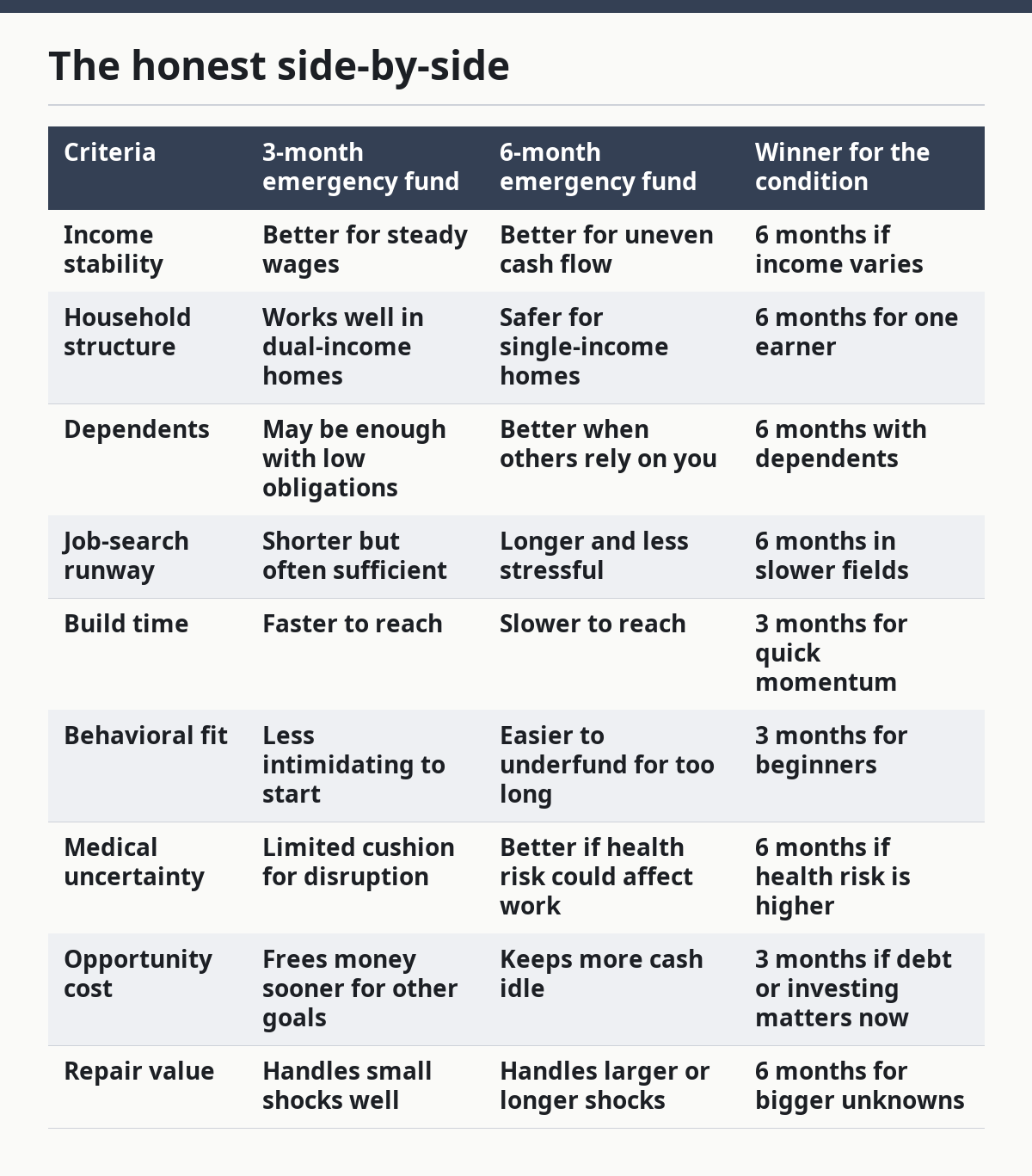
The table points to the same pattern again and again: choose the smaller target when your risk is low and your need for momentum is high; choose the larger target when a bad stretch could last longer than a quarter.
What changes the answer fastest
A 6-month emergency fund becomes the better answer faster than most people expect when there is a single paycheck, variable income, or dependents in the picture. A 3-month target becomes enough faster than most people expect when there are two incomes, low fixed expenses, and strong job mobility.
A stable job does not guarantee safety, but it does lower the odds that a disruption becomes a long one. A family household with children may need more runway even if both adults work, because child care, school schedules, and illness can create secondary costs. A single-income household has less room to absorb even a brief income gap, so the same household budget that looks comfortable on paper may be fragile in practice.
Health risk deserves its own mention. If a medical condition could reduce work capacity, create recurring appointments, or slow a return to full hours, a larger target is wiser. Not because every health issue becomes a crisis, but because the cost of interruption can stack up quickly.
This is where many generic comparisons go wrong: they treat the target as a number to memorize, and a financial professional can help if the decision is not clear. It is really a response to volatility. The more volatility in income, work, or family load, the closer the target should move toward six months.
When to reconsider the choice entirely
The 3-month versus 6-month debate is the wrong debate if one of four things is true.
First, if you have no cash cushion at all, the first milestone is not three or six months. It is one month of essential expenses. A person starting from zero needs a usable buffer before a perfect one.
Second, if high-interest debt is consuming your budget, locking every extra dollar into a six-month goal can backfire. In that case, a smaller cash reserve plus a debt plan may be the better balance, though a financial professional can help set the right order.
Third, if your income is so unpredictable that even six months would feel thin, the real fix may be income smoothing, side work, or a lower-cost living setup, not just a larger fund.
Fourth, if you are relying on a line of credit as a backup plan, that is not the same thing as cash. Credit can be cut, rates can change, and repayment can add pressure right when your income is under strain.
These are the cases where the question stops being “three or six?” and becomes “what actually protects my household from a bad month turning into a bad year?”
The verdict: which one to choose and why
Choose a 3-month emergency fund if you have a stable job, predictable expenses, and a dual-income household or otherwise low dependency risk. Choose a 6-month emergency fund if you have variable income, a single income household, dependents, or a health issue that could interrupt work. Neither if you are still at zero and need a first cash buffer before aiming higher.
That is the cleanest call. Three months is the practical starting point for a stable life. Six months is the stronger target when life itself is less stable.
Who should have a 3 month emergency fund
A 3-month emergency fund is best for someone with steady pay, low monthly obligations, and a decent chance of replacing income quickly. It fits a dual-income household especially well, because one paycheck can often keep the lights on while the other recovers. It is also a good early target if you are building momentum and need a goal you can actually reach.
The trade-off is obvious: it gives less room for a longer disruption. If your work is seasonal, your health is uncertain, or your family depends on one earner, three months is usually too thin.
Who should have a 6 month emergency fund
A 6-month emergency fund is best for someone with variable income, one paycheck supporting the household, or dependents who raise the cost of any disruption. It also makes sense when a medical setback could slow work or when your field takes longer to rehire. The benefit is time; the drawback is that it takes longer to build and can crowd out other goals if you make it the only priority.
Can I start with 1 month?
Yes, and that is often the right first move if you currently have no cushion. One month is not the final target; it is the bridge between being exposed and being protected. If your budget is tight, a first milestone of one month can stop a small problem from becoming a crisis while you work toward three months and, if your situation calls for it, six.
The catch is that one month is still a thin buffer, so it should be treated as a stepping stone, not a stopping point.
Drafted with AI; not yet reviewed by a person.