
Emergency Fund Structure and Organization — The Complete Guide

Last updated: November 19, 2026
Quick answer: a practical emergency fund structure for most households is two to three layers, with a small checking buffer, a primary savings reserve, and an optional backup layer for larger shocks. This guide to Emergency Fund Structure and Organization — The Complete Guide explains how to organize that money so it stays available, separate, and usable when you actually need it.
An emergency fund works best when it is easy to reach, hard to raid, and large enough to cover real life. The structure matters as much as the dollar amount: a single pile in a checking account invites spending, while a deliberately organized setup helps you use the money only for true emergencies.
Key takeaways
- A good emergency fund is organized by purpose, not just size.
- Keep the first layer liquid and boring; keep longer-term backup money slightly separate.
- The right structure depends on income stability, housing risk, family size, and access to credit.
- A fund that is too fragmented becomes hard to manage; a fund that is too exposed gets spent.
- The goal is not maximum return. The goal is fast access with low risk of loss.
What an emergency fund should actually cover

An emergency fund should cover the expenses that would force you into debt, missed bills, or a fire sale of investments. That usually means rent or mortgage, utilities, food, insurance premiums, prescriptions, transportation, and urgent repairs that cannot wait 30 days.
A practical emergency fund does not try to cover every inconvenient purchase. A broken phone screen, a holiday trip, or a planned car upgrade is not an emergency. If you blur those lines, the fund becomes a spending account with a noble name.
A simple rule works well: if the expense is unplanned, necessary, and time-sensitive, it belongs in the emergency category. If it can wait for a normal paycheck or a planned sinking fund, it does not.
For many households, the target is not one magic number but a range. A worker with stable salary income and no dependents may need 3 months of essential expenses. A freelancer, commission earner, single-income household, or family with medical risk may need 6 months or more. That is a planning rule, not a guarantee, and financial circumstances vary enough that a licensed financial professional can help tailor the target.
How should I structure my emergency fund?
The structure is often most useful as a two- or three-layer system: immediate cash for instant access, backup cash in a separate savings account, and a small buffer in checking so the emergency fund is not your everyday spending money.
This structure solves the main problem: money that is too easy to reach gets spent, and money that is too hard to reach may not be available when you need it. The goal is to create friction for casual spending without creating friction for true emergencies.
A common setup is often described like this:
- Layer 1: checking buffer — a modest amount for overdrafts and timing problems
- Layer 2: primary emergency savings — the bulk of the fund in a high-yield savings account or similar liquid account
- Layer 3: backup reserve — an additional stash for larger disruptions, sometimes in a second bank or a separate savings subaccount
The exact amounts depend on monthly expenses and income volatility. Someone paid every two weeks may need a larger checking buffer than someone with a predictable monthly salary. Someone with a $4,000 monthly baseline does not need the same structure as someone living on $1,800.
The point is to separate roles. Checking handles today. Emergency savings handles shocks. Backup reserve handles extended trouble.
Where should the money go first?
The first emergency layer should go in an account that is safe, liquid, and boring, usually an FDIC-insured or NCUA-insured savings account with easy transfers. That choice matters more than chasing a slightly higher return.
The trade-off is simple. A savings account pays less than stocks or even some money market funds, but it is much less likely to be down when you need it. An emergency fund is not an investment portfolio. If the market drops 20% the same week your furnace dies, the “higher return” stopped being helpful.
A common order of operations is:
- Build a starter reserve of $500 to $1,000 if you are beginning from zero.
- Expand that to one month of essential expenses.
- Grow it to 3 to 6 months, depending on job stability and household risk.
- Add a second buffer only if your life needs it, such as irregular income or caregiving responsibilities.
If your emergency fund is large, keeping all of it in one account can be a mistake. A single account is easy to raid. Splitting the fund into layers creates mental and practical boundaries.
Emergency fund structure by account type
The right account mix is the one that keeps your emergency money available within 1 to 3 business days while still reducing temptation. That usually means one checking account, one high-yield savings account, and, for some people, one separate savings account at a different institution.
Here is a practical breakdown:
| Account type | Best use | Typical role | Main drawback |
|---|---|---|---|
| Checking account | Immediate spending and bill timing | Small buffer only | Too easy to spend |
| High-yield savings account | Main emergency reserve | Primary holding place | Transfer delay of 1-3 business days is common |
| Separate savings account | Backup reserve or second layer | Adds friction | More accounts to monitor |
| Money market account | Liquid reserve with some check-writing features | Useful if you want flexibility | Terms vary by institution |
| Treasury bills or short-term bonds | Only for money you likely will not need soon | Not ideal for the core fund | Price risk and settlement timing can complicate access |
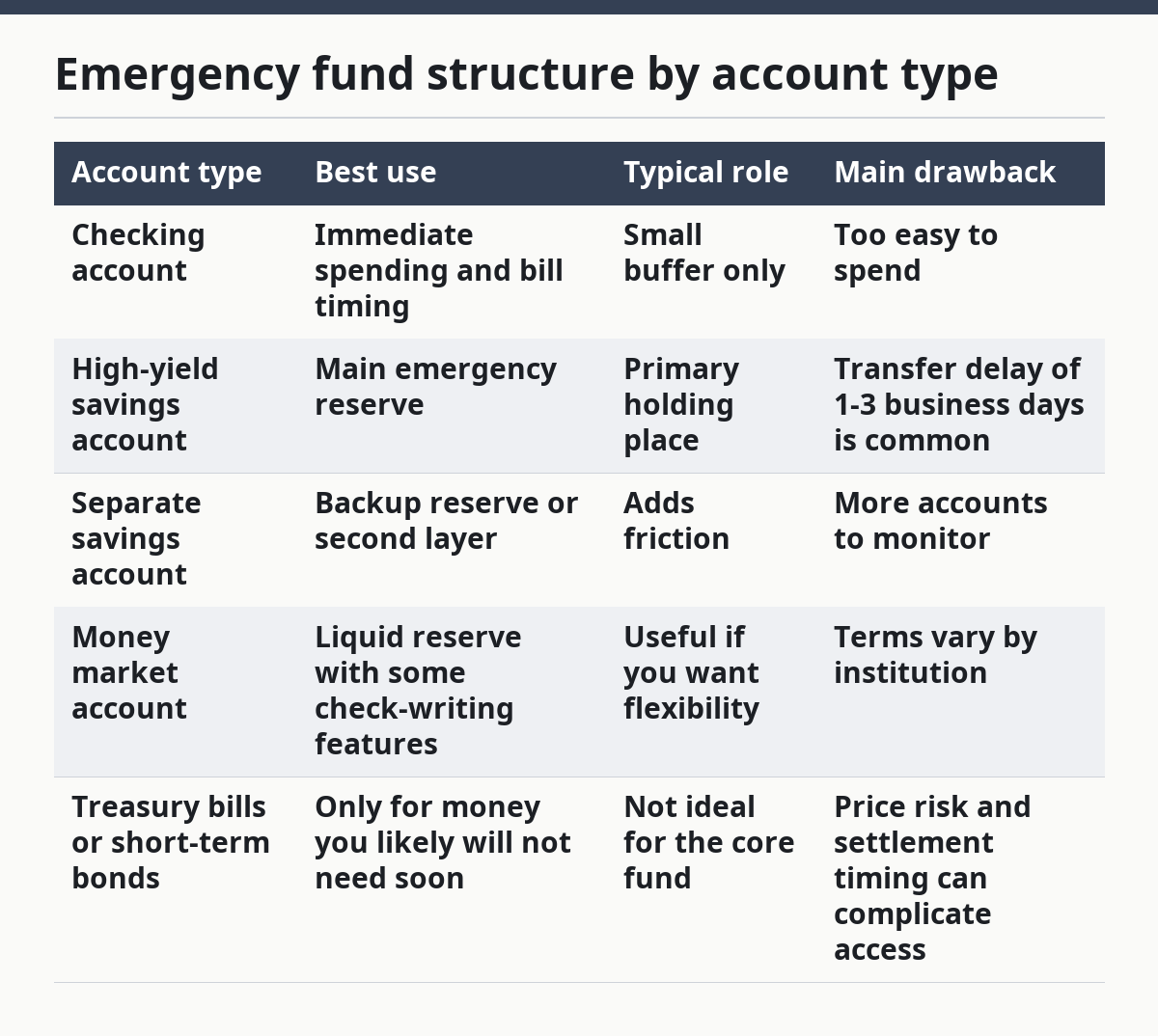
The core fund belongs in cash-like accounts, not in volatile assets. Even a short-term bond fund can dip in value. That may be tolerable for a long-term reserve, but it is a bad fit for rent money.
A useful structure for many households is to keep one month of expenses in a savings account tied to the main bank and the rest in a second institution. That way, an impulsive swipe is harder, but access is still fast enough for urgent repairs or a medical bill.
How much should each layer hold?
Each layer should hold enough to do its job, but not so much that the whole system becomes clumsy. A checking buffer that is too small leads to overdrafts; a checking buffer that is too large invites leakage into regular spending.
A commonly used framework is this:
- Checking buffer: 1 to 2 weeks of routine expenses, or a flat amount such as $500 to $2,000
- Primary emergency savings: 1 to 3 months of essential expenses
- Backup reserve: enough to reach your full target of 3 to 6 months, or more if you are self-employed
For example, if your essential monthly expenses are $3,000, a 3-month target is $9,000. You might keep $1,000 in checking, $6,000 in one savings account, and $2,000 in a second savings account. That arrangement gives you speed, separation, and enough granularity to avoid draining the whole fund at once.
The exact split changes when life changes. If you have a baby, a layoff risk, a chronic health issue, or a home that needs predictable repairs, the emergency fund should usually move upward. If you pay off high-interest debt and your expenses drop, the target can come down somewhat.
How do I keep the fund organized without overcomplicating it?
You keep it organized by giving each dollar a job and using labels that match real-life risks. The fund should be simple enough to maintain in 5 minutes a month, not so complex that you need a spreadsheet every time you buy groceries.
A clean organization system often includes:
- One label for immediate emergencies
- One label for job loss or income interruption
- One label for home, car, or health shocks
- One small checking buffer for payment timing
Many banks let you create savings subaccounts or “buckets.” If yours does, that can help. A subaccount for “car repair” or “medical deductible” is not the same as a separate spending account, but it makes the purpose of the money visible. Visibility reduces the odds that a vague balance gets treated like extra cash, although you should still review the setup with a qualified financial professional if you are unsure how to keep it aligned with your budget. For additional guidance, see the Consumer Financial Protection Bureau and FDIC resources on savings separation and account safety. Consumer Financial Protection Bureau and FDIC.
That said, too many buckets can backfire. If you split a $7,000 fund into six tiny piles, you may forget what each one is for. A better system is usually three categories max unless your finances are unusually complex.
A monthly routine helps:
- Check the total balance.
- Compare it to your target range.
- Refill any layer you used.
- Move extra cash only if the target is already full.
- Review whether your target still matches your current expenses.
This takes far less time than rebuilding the fund after a crisis.
How should the emergency fund change for real life risks?
The emergency fund should scale to the risks that are most likely to hit your household, not to a generic internet rule. A renter with steady pay, no dependents, and low fixed costs has a different profile than a homeowner with two cars and one irregular income.
Some common adjustments:
- Freelancers and contractors: aim higher, often 6 months or more, because income can drop without warning.
- Homeowners: keep a separate repair buffer inside or alongside the emergency fund, since HVAC, plumbing, roof, and appliance issues can arrive in clusters.
- Parents: account for childcare, medical visits, school costs, and the fact that one work disruption can affect two adults.
- Single-income households: usually need more cash cushion than dual-income households with stable jobs.
- People with high-deductible health plans: often need a specific layer for deductibles and out-of-pocket maximums.
This is where one-size-fits-all advice breaks down. A person with $2,200 in monthly rent and no debt may still need a larger fund than someone with lower expenses if their income is irregular. The fund should reflect the cash flow risk, not just the monthly bill total.
If your life includes both predictable and unpredictable risks, a split can help. Keep a core emergency fund for general disruption, then set aside a separate sinking fund for home maintenance, car upkeep, or annual insurance deductibles. That prevents “emergency fund” from becoming a dumping ground for every future expense, and you should consult a financial professional if you are not sure how to divide those categories in a way that fits your situation. For related guidance, see the CFPB and FINRA on budgeting and emergency planning. FINRA.
What are the biggest mistakes in emergency fund organization?
The biggest mistakes are mixing spending money with emergency money, parking the fund in risky assets, and keeping no system for replenishment. A fund can exist on paper and still fail in practice if it is hard to find, hard to access, or too easy to spend.
Here are the ones that cause the most trouble:
- Keeping everything in one checking account. This makes the balance look available for daily life.
- Putting the fund in stocks or aggressive mutual funds. A market drop can cut the fund right when you need it.
- Using a fund that is too small. A $500 reserve is useful, but it is not enough for many real emergencies.
- Creating too many accounts. Complexity causes neglect.
- Not restoring the fund after use. The next crisis arrives before you have rebuilt it.
- Treating planned purchases as emergencies. That slowly drains the balance and destroys trust in the system.
A good emergency fund should be boring enough that you forget about it until needed. If you check it daily or debate every transfer, the structure is too fragile.
The trade-off is worth stating plainly: a highly organized emergency fund may earn less than a more aggressive short-term investment. That is normal. The value of the fund is stability and access, not maximum yield. For a conservative overview of liquidity and safety, the FDIC and SEC both explain why principal protection matters for near-term cash needs. SEC.
When should I use the fund, and when should I leave it alone?
You should use the fund when the expense is necessary, urgent, and not already covered by another bucket. You should leave it alone when the expense is expected, optional, or can be handled by normal cash flow.
A few examples make the line clearer:
- Use it: job loss, urgent car repair, medical bill, emergency travel for family, major home repair that prevents damage
- Do not use it: vacation, holiday shopping, routine clothing, a planned phone upgrade, a furniture sale
- Probably not it: annual insurance premiums, regular maintenance, school supplies, unless your budget is unusually tight and you have no other reserve
The fastest way to make a fund useless is to use it for “almost emergencies.” That logic feels harmless in the moment, but it steals from your future self. If you find yourself dipping into the fund often, the problem is usually not discipline alone. The target may be too low, the budget too tight, or the categories too vague.
For some households, the right answer is to pair the emergency fund with sinking funds. A sinking fund covers known future costs like a car registration, holiday gifts, or annual insurance premiums. The emergency fund stays reserved for the unknown.
How to rebuild the fund after you use it
You rebuild the fund by restarting automatic transfers immediately and trimming nonessential spending until the balance returns to target. Waiting until “next month” usually stretches into several months.
A practical rebuild plan might look like this:
- Freeze the category that caused the drain, if possible.
- Set a weekly or per-paycheck transfer amount.
- Divert windfalls, tax refunds, bonuses, or side income until the fund recovers.
- Reduce discretionary spending for 1 to 3 months.
- Restore the buffer before increasing other goals.
If you had to use the fund once, that is not failure. It is proof the fund worked. The important part is the next move. A drained emergency account is vulnerable. Even a small automatic transfer of $25, $50, or $100 per paycheck can keep the rebuilding process moving without relying on motivation.
If the fund is repeatedly used for the same category, the structure needs revision. Repeated car repairs may mean the vehicle is beyond your current budget. Repeated overdrafts may mean the checking buffer is too small. Repeated medical withdrawals may mean the health-care layer needs to be larger or more specific.
What should a simple emergency fund setup look like today?
A simple setup for many people is one checking account, one high-yield savings account, and one backup savings account, with clear targets for each. That arrangement balances access, protection, and mental clarity.
Here is a straightforward version:
- Keep $500 to $2,000 in checking for bill timing.
- Keep one month of essential expenses in a primary savings account.
- Keep the rest of the fund in a second savings account or a separate subaccount.
- Review the total once a month.
- Refill the fund before adding extra savings to lower-priority goals.
If you want the shortest version possible: make the money easy to find when disaster hits, but slightly annoying to reach on a whim.
That balance is the heart of emergency fund structure. A good fund is not just money in a bank. It is a system that protects you from yourself, protects you from timing problems, and protects you from the financial shock that turns a bad week into a long-term mess.
FAQ
How many accounts should an emergency fund have?
Two accounts are enough for many people, and three can work well if your cash flow is irregular. One account should handle immediate access, and the other should hold the main reserve. More than three often adds confusion unless your finances are unusually complex.
Is a high-yield savings account the best place for an emergency fund?
It is often the best default place because it is liquid, relatively safe, and easy to separate from spending money. It is not the highest-return option, but that is not the goal here. The goal is to keep the money intact and available within a few days.
Should I keep part of my emergency fund in cash at home?
A small amount of physical cash can help during a power outage, banking outage, or local system disruption, but it should usually be modest. Cash at home carries theft and loss risk, so it is better as a backup than as the main reserve. For most households, a few hundred dollars is more practical than a large stash.
Can I invest my emergency fund if I have a long time horizon?
Only the portion you are confident you will not need quickly should be invested, and even then the risk must be understood clearly. The core emergency fund should stay liquid and stable. If you are unsure, speak with a qualified financial professional before moving cash into anything that can lose principal.
What is the most important part of organizing an emergency fund?
The most important part is separating emergency money from everyday money. If you can tell at a glance what each dollar is for, you are far more likely to keep the fund intact until a true emergency happens. Without that separation, the fund tends to disappear into ordinary spending.
Drafted with AI; not yet reviewed by a person.