Emergency Fund Storage and Liquidity Choices — The Complete Guide

Last updated: November 19, 2026
Quick answer: for most people, keep the first $1,000 to $2,000 of an emergency fund in checking or instant-access savings, and keep the rest in an insured high-yield savings account. This guide to Emergency Fund Storage and Liquidity Choices — The Complete Guide shows how to balance speed, safety, and yield without making the money hard to reach.
Your emergency fund should be easy to reach, safe from market swings, and separate from day-to-day spending. Cash in a high-yield savings account or similar liquid account is the right default for most people. The sections below will settle where to keep it, what to avoid, and how to split it if you need both speed and yield.
Key Takeaways
- Put the first layer of your emergency fund where you can get it in 1 business day or less.
- Keep spending money and emergency money in different accounts so you don’t raid the fund by accident.
- Yield matters, but access and principal safety matter more.
- A CD or Treasury ladder can work for part of the fund, not the whole thing.
- The wrong place for an emergency fund is anything that can fall hard when you need cash fast.
What “liquid” really means for an emergency fund
Picture this: your furnace dies on a Sunday, the vet wants a deposit today, or a layoff notice lands on a Friday afternoon. You need money that shows up fast, without a fire sale. Liquidity means how quickly you can turn cash into usable dollars and how much friction stands in the way.
A true emergency fund has three jobs: stay safe, stay available, and stay yours. That usually means no market risk, low withdrawal friction, and plain-vanilla access through an ATM, ACH transfer, or bank transfer. A fund that earns a little more but takes 5 days to touch is less useful than it looks.
The basic rule: the more likely you are to need the money within 24 hours, the more cash-like it should be.
Common liquidity levels:
- Immediate: checking account, debit card, ATM access
- Fast: high-yield savings, money market deposit accounts, many online bank savings accounts
- Delayed but predictable: CDs, Treasury bills, bond ladders
- Slow or risky: brokerage investments, crypto, individual stocks, most bond funds
Where should I store my emergency fund?
You should store most emergency money in an account that is FDIC- or NCUA-insured, easy to move, and separate from your spending account. That usually means a savings account, a money market deposit account, or a short-term Treasury setup for part of the balance.
The right place depends mainly on how soon you may need the money. If you might need to pay for a tow truck, rent gap, or emergency travel, a savings account wins over a higher-yield option that takes more steps to sell or settle. If the money is only there as backup for a known future event, you can be a little less liquid.
Good storage choices:
-
High-yield savings account
- Best all-around choice for most people.
- Usually easy to link to checking.
- Interest rates move with the market, so the yield can change.
-
Money market deposit account
- Often works much like savings.
- May offer check-writing or debit access.
- Some accounts require a higher minimum balance.
-
Regular savings at a brick-and-mortar bank
- Good if you value branch access and simple transfers.
- Often pays less than online accounts.
- Still fine if the balance is modest and access matters more than yield.
-
Treasury bills or a Treasury ladder
- Useful for part of a larger emergency reserve.
- Backed by the U.S. government, but not instant cash.
- Better for money you probably won’t need this week.
-
Brokerage cash sweep or money market fund
- Can be useful in a brokerage-based cash system.
- Money market funds are not the same as insured bank deposits.
- Settlement timing matters, so this is not ideal as your only emergency layer.
Which account type is safest for principal?
An insured deposit account is the cleanest answer if you want the least drama. FDIC and NCUA insurance protect eligible deposits up to federal limits, while market-based holdings can lose value.
That does not mean every insured account is equal. Some banks make transfers clumsy, charge excess withdrawal fees, or bury the emergency fund inside the same app as your spending account. Safety is not just about the balance sheet. It is also about whether you can reach the cash without mistakes.
What to favor:
- Deposit insurance from a bank or credit union
- Simple transfer paths to checking
- No penalty for moving money in an emergency
- Clear statements and separate account labels
What to avoid:
- Accounts tied to a platform you also use for trading
- Funds exposed to stock or bond price changes
- Products that require market hours to sell
- Accounts with confusing withdrawal rules
A boring account is a feature here. Boring is good.
How much access do you need, really?
You need enough access to cover the gap between the emergency and the money landing in your hands. Same-day access is ideal for the first layer, and next-business-day access is good enough for the rest of many funds.
A practical split looks like this:
- Layer 1: 1 to 2 weeks of bare-bones expenses in checking or a same-day-access savings account
- Layer 2: the rest in a high-yield savings account or money market deposit account
- Layer 3: optional backup cash in short-term Treasuries or CDs, only if you can wait a few days
This is where people get tripped up. A 4% yield sounds nice until you need to break a CD and lose interest, or wait for a Treasury sale to settle. The extra basis points are not worth much if the money misses the moment.
A useful test:
- Can I get this money on a Friday night?
- Can I get it during a bank holiday?
- Can I transfer it without logging into a trading platform?
- Will I pay a penalty, fee, or price loss to use it?
If the answer is “yes” to the first two and “no” to the last two, the storage choice is probably working.
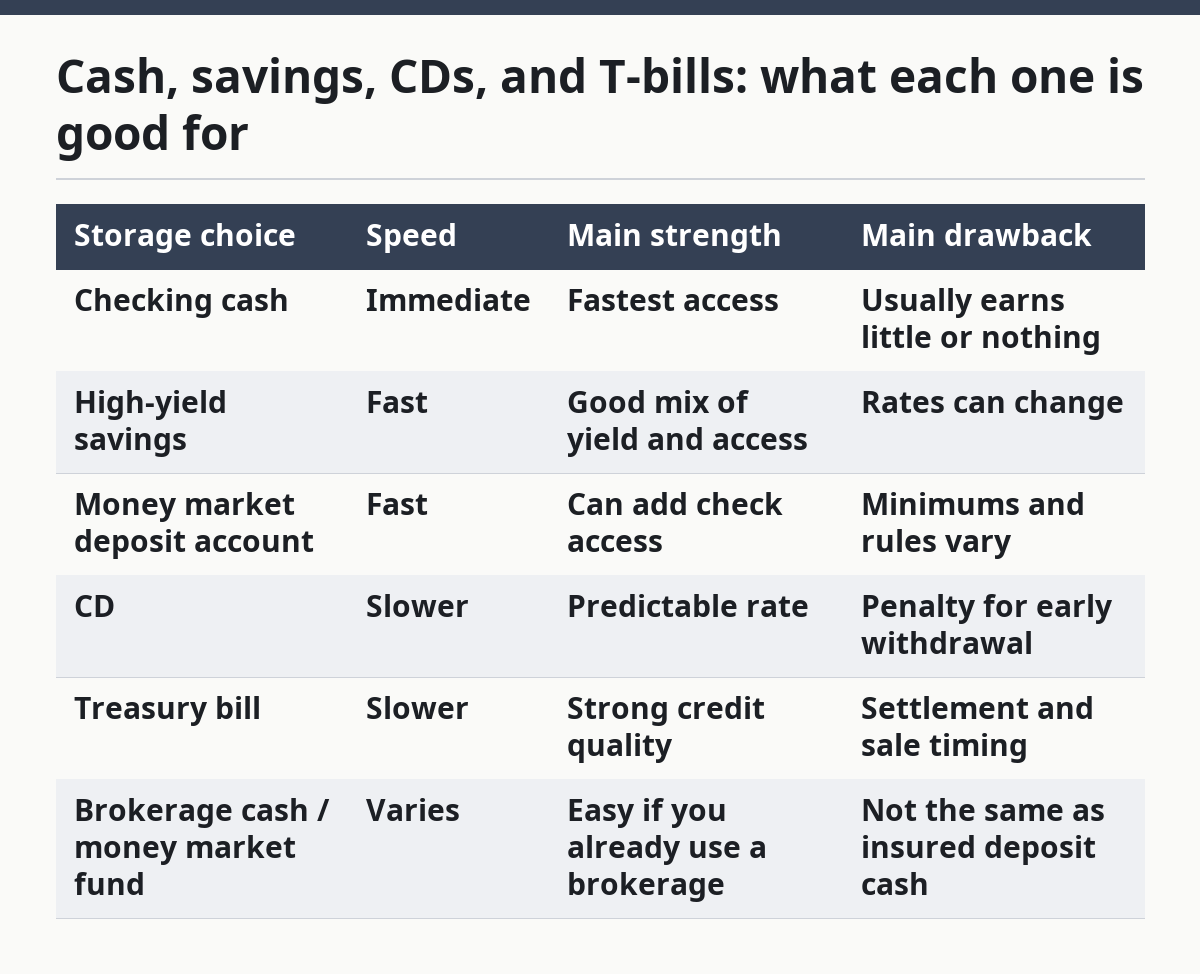
Cash, savings, CDs, and T-bills: what each one is good for
Picture this: you’ve built a $10,000 emergency fund, and now you’re deciding whether all of it should sit in one savings account. It doesn’t have to. The right answer is often a split. Cash handles speed, savings handles flexibility, and CDs or Treasuries handle money you may not need soon.
Here’s the catch: each choice trades convenience for yield. The Federal Reserve’s Regulation D history and the FDIC’s deposit insurance rules both reflect that trade-off between access and account design, while TreasuryDirect explains how Treasury bills settle and mature.
| Storage choice | Speed | Main strength | Main drawback |
|---|---|---|---|
| Checking cash | Immediate | Fastest access | Usually earns little or nothing |
| High-yield savings | Fast | Good mix of yield and access | Rates can change |
| Money market deposit account | Fast | Can add check access | Minimums and rules vary |
| CD | Slower | Predictable rate | Penalty for early withdrawal |
| Treasury bill | Slower | Strong credit quality | Settlement and sale timing |
| Brokerage cash / money market fund | Varies | Easy if you already use a brokerage | Not the same as insured deposit cash |
Use cash for: immediate bills, cash-only needs, and the first move in a real emergency.
Use savings for: the bulk of the fund, especially if you want a clean balance between yield and access.
Use CDs or T-bills for: money beyond the first layer, when you can wait and want a bit more return.
Avoid stocks for: emergency money. If the market drops 20% right when you need cash, that fund did not do its job.
How to split an emergency fund without making it messy
You can split the fund into 2 or 3 buckets and still keep it simple. The cleanest setup is one fast bucket and one slower bucket, with clear labels and a fixed purpose for each.
A simple framework:
-
Spend-now bucket
- 1 month or less of expenses
- In checking or instant-access savings
- For car repairs, deposits, travel, and bills due now
-
Backup bucket
- The rest of your 3- to 6-month reserve
- In high-yield savings or a money market deposit account
- For layoffs, medical gaps, or longer interruptions
-
Optional reserve bucket
- Only for larger households or stronger cash flow
- In CDs or short-term Treasuries
- For money you expect to leave alone unless life goes sideways
The point is not to squeeze every dollar for yield. The point is to stop one emergency from turning into a second one. A fund that is too spread out becomes hard to use. A fund that sits all in one checking account may be too easy to spend.
What should I avoid storing an emergency fund in?
You should avoid putting emergency money in places where price swings, lockups, or delays can hurt you. The wrong storage choice turns a safety net into a gamble.
Avoid these:
- Individual stocks
- Broad stock index funds
- Crypto
- Long-term bonds or bond funds
- Prepaid cards with fees or limits
- Accounts with high withdrawal penalties
- Anything you need market hours to sell
Why this matters:
- Stocks can drop when you need the money most.
- Bond funds can fall when rates rise.
- Crypto can move fast in either direction.
- Some “cash-like” products still settle slowly or charge for early exits.
A generic investing rule says higher return often means higher risk. That rule is brutal in an emergency fund. You do not want return. You want certainty.
How do taxes, interest, and inflation change the decision?
They change it, but not enough to outrank access and safety. A little interest is nice; losing access is worse.
Interest-bearing savings accounts, money market deposit accounts, CDs, and Treasury bills can all generate taxable interest. The tax treatment depends on the account type and your situation, so consult a tax professional if the balance is large or the interest income matters to your return. The IRS explains how interest income is generally reported, and TreasuryDirect explains how Treasury securities are taxed at the federal level.
The bigger issue is inflation. Cash sitting still loses purchasing power over time, which is why keeping far more than you need in plain checking can be wasteful. Still, an emergency fund is not an investment account. It is insurance for life interruptions.
A simple way to think about it:
- Short-term need: favor liquidity
- Medium-term need: favor a bit of yield
- Long-term money: invest elsewhere, not in the emergency reserve
That split keeps the emergency fund from doing two jobs badly.
How do I choose between a savings account and a money market account?
You choose based on access features, minimums, and how the account behaves in a crisis. If both are insured and easy to move, the better one is the one you will actually keep funded.
A savings account usually wins if you want:
- Simple setup
- Easy transfers
- No check-writing temptation
- A clean place to park the fund and ignore it
A money market deposit account can win if you want:
- Check-writing or debit features
- A little more flexibility
- A place that feels closer to checking without being checking
What to check before opening either one:
- Is it insured by FDIC or NCUA?
- Can you transfer money to checking the same day or next business day?
- Are there monthly fees or balance minimums?
- Is there a cap on withdrawals or transfers?
- Does the bank block ACH pulls or card access during account review?
Who this is not for: someone who wants to trade a few hours of access for a tiny yield bump. If that sounds like you, a plain savings account is a better fit than a more complex setup.
Red flags that mean your emergency fund setup is too clever
Your setup is too clever if it depends on fine print, market timing, or memory. If you need a spreadsheet to figure out whether you can pay rent today, the system is broken.
Red flags:
- The money is spread across too many institutions
- You cannot explain how to get the cash in 1 minute
- The highest-yield account has the worst access
- You use the same app for bills, spending, and the emergency reserve
- You need to sell something before you can spend it
- The account has a penalty that would sting in a real emergency
A useful setup should survive stress. That means:
- One clear primary home
- One backup transfer path
- One debit or transfer method you have actually checked
- No need to guess during a rough day
If you are hesitating because the account “probably” works, that is a warning sign. Emergency money should not require faith.
A practical setup for most people
Picture this: you have one paycheck coming in, one checking account for bills, and no interest in managing a money maze. You want a setup that works in under 15 minutes once it is open. The simplest durable answer is checking plus high-yield savings, with a small cash layer if you need immediate spending room.
A plain setup:
- Keep monthly bills and spending in checking
- Keep the main emergency fund in a high-yield savings account
- Keep a small instant-access buffer in checking if you worry about timing
- Use CDs or Treasuries only for money you can leave untouched for a while
That setup is not flashy. It is effective.
A good default by urgency
- Need cash today: checking + linked savings
- Need cash this week: high-yield savings
- Need cash next month or later: CD or Treasury bill can enter the picture
- Need growth more than access: this is not emergency money anymore
Two authoritative sources worth checking
For insured deposits, the FDIC explains how deposit insurance works and what it covers. The National Credit Union Administration gives the parallel rules for credit union shares. For Treasury bills and other government securities, the U.S. Treasury and TreasuryDirect explain purchase and redemption details.
Useful references:
- FDIC: https://www.fdic.gov/
- NCUA: https://www.ncua.gov/
- TreasuryDirect: https://www.treasurydirect.gov/
- IRS interest income guidance: https://www.irs.gov/taxtopics/tc403
These are the right places to verify account protection, limits, and redemption rules before you park a large balance.
FAQ
Is a high-yield savings account good enough for an emergency fund?
Yes. For most people, a high-yield savings account is the cleanest home for the main emergency reserve because it gives you speed, safety, and better interest than many checking accounts. It is usually a better fit than investing the money, which can drop in value when you need it.
Should I keep some emergency cash in checking?
Yes, if you need immediate spending room. A small buffer in checking helps with same-day bills, card holds, and timing gaps, but too much there can tempt you to spend it. Many people keep one to two weeks of bare-bones expenses in checking and the rest in savings.
Are CDs a bad place for emergency money?
No, but they are not ideal for the full fund. CDs can work for money you are unlikely to need soon, especially if you want a fixed rate, but early withdrawal can cost you interest. That makes them better as a secondary bucket than as the only emergency home.
Can I put my emergency fund in Treasury bills?
Yes, for part of it. Treasury bills are useful if you want a government-backed short-term parking place and you can live with settlement timing or a small delay. They are less useful if you need cash on short notice and do not want to sell anything first.
Is a money market fund the same as a money market account?
No. A money market deposit account is usually an insured bank product, while a money market mutual fund is an investment product with different risks and rules. That difference matters when the goal is emergency access, not return chasing.
Drafted with AI; not yet reviewed by a person.