
How to Set Emergency Fund Access Limits for a Joint Account Holder

Last updated: November 20, 2026
Set the access limit at the bank, not with a handshake. If a joint account holder already has full access to emergency savings, the practical way to reduce damage is to use bank controls, card limits, transfer limits, and written approval rules so the account still works in a crisis.
Key takeaways
- A joint account holder usually has broad rights unless the bank offers controls that narrow them.
- The best setup uses more than one barrier: a debit card limit, a transfer limit, and a clear approval rule.
- The goal is not to block real emergencies; it is to stop casual or rushed withdrawals from emptying the fund.
- If the bank cannot set the limits you want, the account agreement may be the ceiling.
- A joint account can still be useful, but it is not the right tool if one person needs private control over every dollar.
What access limit means here

An access limit is the rule that narrows what a joint account holder can do with emergency savings through the bank’s own controls. It can mean a lower debit card limit, a transfer limit, a permission level change, or a rule that only certain transactions go through without a second approval.
That matters because a joint account is not just a shared ledger. In many banks, both owners can withdraw, transfer, and spend unless the account setup says otherwise. The Federal Deposit Insurance Corporation explains joint ownership rules on its consumer pages, and the Consumer Financial Protection Bureau has plain-language bank account guidance at consumerfinance.gov/consumer-tools/bank-accounts/.
A good access limit is specific. “Please be careful” is not a control. A 24-hour transfer hold, a $0 card limit, or a rule that online transfers need two approvals is a control. If the bank cannot name the setting, it is probably not a real limit.
This page is about a joint account holder who already has access. It is not about whether joint ownership is a good idea in the first place. That question belongs on the hub page for emergency fund ownership and access authorization.
How do I set an access limit?
You set an access limit by asking the bank to change the account’s card, transfer, and permission settings one by one. Start with the bank’s shared account controls, then narrow the debit card limit, then narrow the transfer limit, and then write down the approval rule that matches the bank’s setup.
- Review the account agreement for joint-account rules, debit card terms, and transfer terms. Look for the words “joint owner,” “authorized signer,” “external transfer,” and “overdraft protection.” This tells you which controls the bank can change and which ones it cannot.
- Call or message the bank and ask for shared account controls on the specific joint account. Say that you want an emergency fund access limit, not a general spending reminder.
- Set the debit card limit to the lowest amount that still lets the account work for real emergencies. If the card is not needed, ask whether the bank can disable it entirely for one or both holders.
- Set the transfer limit on online, mobile, and telephone transfers. Ask for the limit to cover only the amount you would truly need for an urgent bill, not routine spending.
- Choose the approval rule for withdrawals above a set amount. That rule can be “one person may move funds under the limit, both must approve above it” if the bank supports dual authorization.
- Check overdraft protection and unlink it if it creates an easy drain from another joint or linked account. Overdraft coverage can make a small mistake travel farther than planned.
- Confirm the change in writing through email, message center, or a secure note. Keep the confirmation with the account records so there is no argument later about what the limit was.
The bank may not offer every setting on every account type. If it cannot set a specific limit, ask what it can do instead, because the account agreement is the real ceiling.
Which bank controls matter most?
The most useful controls are the ones that stop fast money movement: debit card limit, transfer limit, and overdraft protection. Those three do more work than a vague promise to “check first.”
| Bank control | What it limits | What it helps with | Main drawback |
|---|---|---|---|
| Debit card limit | Purchases and cash access tied to the card | Stops quick spending at stores, ATMs, and online purchases | A lower limit can block a true emergency if the amount is too tight |
| Transfer limit | Online, mobile, and phone transfers | Keeps one owner from moving a large balance in one step | A determined user may still make many smaller transfers if the bank allows them |
| Overdraft protection | Automatic pull from linked funds | Stops surprise spillover into another account | Can move the problem to another account and hide the drain |
| Permission level | Who can approve or initiate a transaction | Creates a second check for large withdrawals | Not all banks offer two-person approval on consumer accounts |
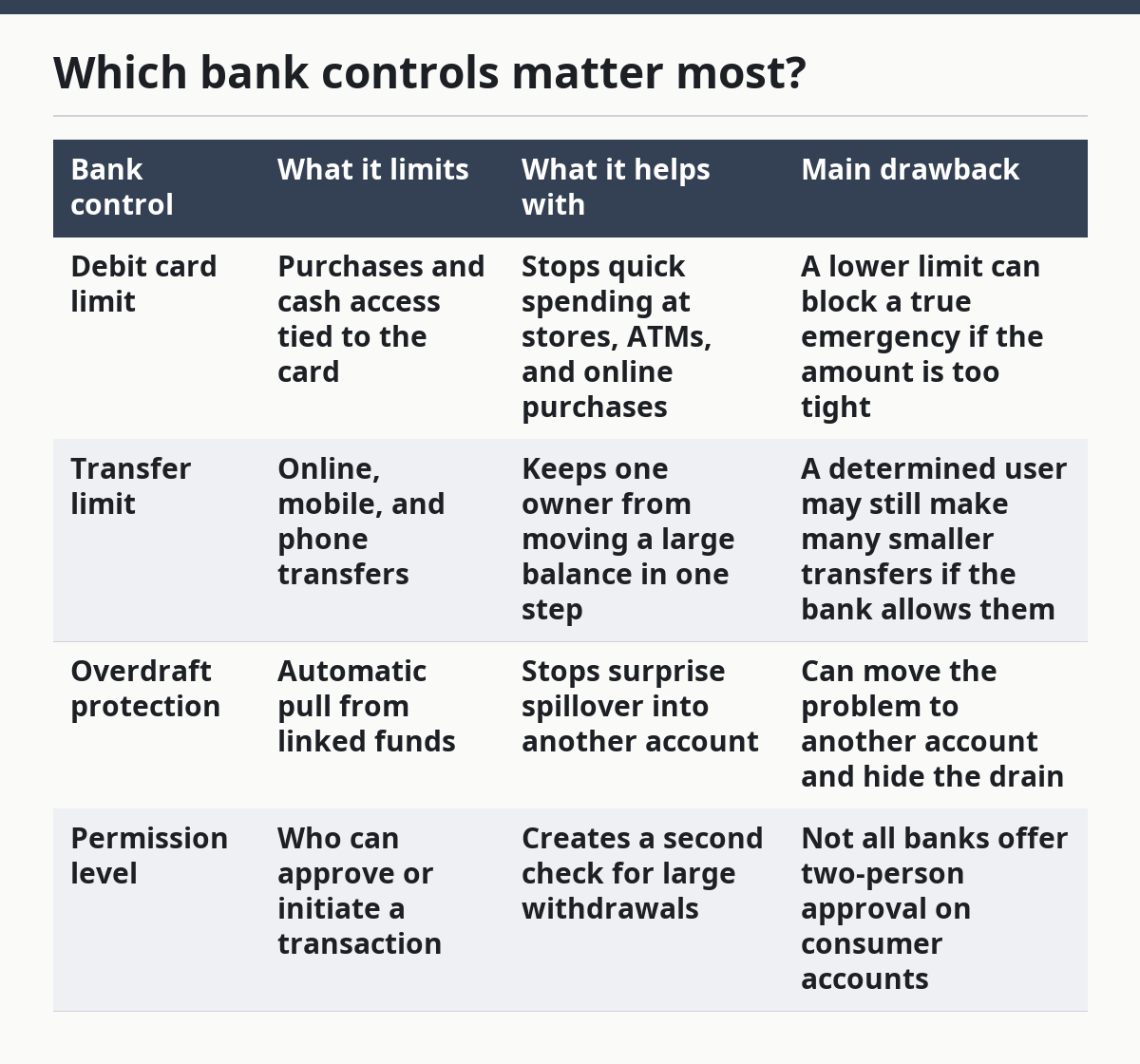
A debit card limit works best when the emergency fund should not be used for everyday taps and swipes. A transfer limit works best when the real risk is a fast move into another account, because transfers can be harder to spot in the moment. Overdraft protection is often the least understood control, and that is why it deserves a check every time.
If the bank offers only one of these, start there. If it offers all three, use all three. A single limit is easier to bypass than a layered setup.
How low should the limit be?
The limit should be low enough to stop casual use and high enough to cover a real emergency without a same-day scramble. In practice, that means the limit should match the size of a likely urgent expense, not the size of the whole account.
That is a judgment call, not a math trick. A small cap can be wise if the fund is meant to cover a bill, a repair, or a short gap in income. A very low cap can backfire if it blocks the exact event the emergency fund is meant to handle.
A useful rule is to ask, “What amount would I trust without a second conversation?” Put that amount into the bank’s limit field. If the bank needs a whole-dollar cap, use that instead of a loose verbal promise. If the bank allows a daily or per-transaction cap, choose the smaller number only if it still covers the job.
The wrong setup is one that feels strict but fails in real life. A $50 card limit on an account meant to cover a major car repair may make the fund unusable. A very high transfer limit on a savings account meant for true emergencies may leave too much room for impulsive spending.
The right limit is boring. It should be easy to remember, easy to explain, and hard to abuse.
What should the approval rule say?
The approval rule should say who may move money, when they may do it alone, and when the second owner must sign off. That rule needs plain language, not a casual text thread that nobody can find later.
Use one short rule, such as: “Either owner may withdraw up to the set limit. Any amount above that limit needs both owners to approve in writing.” If the bank allows only one-owner transactions, the rule should still match the bank’s settings, even if the approval part is handled outside the system.
Put the rule in three parts:
- Who can act: one owner or both owners.
- What amount triggers review: the set limit.
- What counts as approval: bank message, signed form, or other written record the bank accepts.
This is where many people make a costly mistake. They set a number but never define the step that comes after the number. When that happens, one person can claim the transaction was “obviously” allowed, and the other can claim it was not. A clean written rule avoids that argument.
If the bank offers permission levels, use the one that matches the rule. If it does not, keep the approval rule in the account records and the household finance records so the limit has a paper trail.
What goes wrong with joint access limits?
The biggest failure is assuming the limit exists everywhere when it only exists in one channel. A card cap may not limit a transfer. A transfer cap may not stop an ATM withdrawal. A verbal agreement may not stop anything.
Another common failure is forgetting overdraft protection. If the emergency fund is linked to another account, a joint holder may still create movement you did not expect. That can make a small purchase turn into a larger cash flow problem.
A third failure is setting the limit too late. If the account already saw a large withdrawal, the limit only helps from that point forward. It cannot undo a past transfer or purchase. That is why the bank confirmation matters as much as the setting itself.
The last failure is picking a limit that fits the person’s habits instead of the fund’s job. If the account is the main bill-paying account, a strict cap may create constant friction. If the account is supposed to be quiet emergency money, a loose cap defeats the point. The account’s role should decide the rule, not the other way around.
When the bank cannot support the limit you want, that is a sign to rethink the account structure, not to pretend the limit exists. A control that lives only in memory is not much of a control.
What should I do before I lock it in?
Before you lock it in, compare the control options and choose the one that matches the account’s job. The best choice depends on whether you need everyday access, rare emergency access, or a hard stop on large withdrawals.
| Goal | Best control | When it fits | When it fails |
|---|---|---|---|
| Stop impulse spending | Debit card limit | The account should not be used for daily purchases | It may not stop transfers |
| Stop large transfers | Transfer limit | The biggest risk is fast movement of cash | It may not stop card use |
| Keep overdraft from spreading | Disable or review overdraft protection | The emergency fund is linked to other accounts | It can still leave the primary account exposed |
| Require a second check | Dual approval or written approval rule | Both owners are available and responsive | It slows down true urgent access |
A good setup usually combines two controls, not one. A debit card limit without a transfer limit leaves a gap. A transfer limit without an approval rule leaves a different gap. If the bank supports it, use the fullest mix that still lets the account serve its emergency purpose.
This is also the point to check the account agreement and the bank’s consumer help pages. The CFPB bank account resources are a good place to start, and the FDIC’s consumer pages help with ownership and deposit insurance questions. Those sources will not set your limit for you, but they help you understand what the bank is allowed to do.
Can I limit what a joint account holder can do with emergency savings?
Yes, but only through bank controls, not by wishful thinking. A joint account holder often has broad access unless the account agreement or the bank’s settings narrow it, so the first step is to ask for debit card limits, transfer limits, and any permission levels the bank supports. If the bank cannot change those settings, the practical limit may be smaller than you want.
How do I set spending limits on a joint account?
Ask the bank to set a debit card limit and, if possible, a transfer limit on the same account. Then make the approval rule match those limits so a purchase or transfer above the cap needs both owners to sign off in the way the bank accepts. A clear written record matters as much as the number.
What are the risks of joint access to emergency savings?
The biggest risks are fast withdrawals, accidental overdrafts, and confusion about who approved what. A joint holder may move money through a card, an online transfer, or a linked overdraft route, and each path can behave differently. That is why a single verbal agreement is weak protection. A bank-side limit and a written rule give the emergency fund a better chance of staying intact.
Drafted with AI; not yet reviewed by a person.