How to Set Emergency Fund Access for a Person Who Helps You

Last updated: November 20, 2026
Quick Answer: set up emergency fund access for 1 helper, 1 task, and 1 end date. In this guide to How to Set Emergency Fund Access for a Person Who Helps You in a Crisis, the goal is temporary access, written instructions, a contact protocol, and a backup way to pay if mobile banking is down.
Key takeaways
- Keep the plan narrow: one helper, one purpose, one emergency path.
- Use bank tools that fit the job, such as mobile banking, checkwriting, or payment authorization.
- Write down what the helper can do, what they cannot do, and who they should call first.
- Build in an end point so the access does not stay open after the crisis.
- Keep the instructions short enough that someone can follow them under stress.
What a crisis helper access plan does

A crisis helper access plan for How to Set Emergency Fund Access for a Person Who Helps You in a Crisis gives a trusted person just enough access to use your emergency fund when you cannot act yourself. It is not the same as shared ownership, and it should not give that helper full control of the account for an open-ended time. The goal is to make a same-day transfer, payment, or check possible when a crisis is already in motion.
The cleanest version has three parts: the helper’s name, the exact task they may handle, and the time limit. That time limit can be short, such as one day or one emergency event, because the point is to solve a problem, not to redesign your bank setup. If you need a long-term arrangement for a caregiver, family member, or partner, that is a different plan and should stay on its own page.
This plan is for a person who may need help in a crisis because of illness, injury, travel trouble, or sudden unavailability. It is not right for someone who only wants casual money sharing, and it is not a substitute for full account ownership. If your helper would need to make repeated financial decisions, this setup is too thin.
A helpful way to think about it is this: the helper gets a lane, not the whole road. They can move money, pay a bill, or write a check only within the narrow job you assign. That keeps the account safer if the helper is stressed, rushed, or standing at a bank branch with a phone that has 12% battery left. For broader account-sharing basics, see joint bank account rules and emergency fund planning.
Who should you choose as the helper?
Choose the person who can stay calm, follow directions, and reach your bank contact quickly. That person might be a friend, sibling, neighbor, or another trusted helper who already knows how you handle urgent tasks. Rather than assuming the “best” person is the one who knows you best socially, pick the person who can act within minutes when needed.
Use a short test before you name anyone. Ask yourself whether this person can read a 1-page instruction sheet, make one phone call, and keep receipts or screenshots in order. If the answer is no, the person may still care about you, but they may not be the right helper for your emergency fund.
A bad fit is someone who likes to improvise with money, ignores written rules, or gets overwhelmed when a bank asks for extra steps. It is also a bad fit if the person is likely to become part of the emergency itself. The helper should reduce stress, not add a second problem.
A narrow setup can be safer in practice, but only if the helper can still complete the task. The setup should be narrow enough that one helper can finish it alone, while still broad enough to cover the emergency without extra back-and-forth. If you already have a person who would make a better long-term account contact, that belongs in a different authorization plan, not this temporary one.
According to the CFPB, financial authority should match the role and be documented clearly. If you are unsure whether a setup is appropriate, consult your bank or another qualified professional before you add access.
How do I set temporary access for someone helping in a crisis?

Set temporary access by matching the tool to the task, then writing the limit beside it. The point is to give the helper one route into the money, not every route. A good plan uses the least amount of access needed for the shortest useful time.
- List the exact emergency task, such as transfer, bill payment, or cash withdrawal, and write the amount or limit beside it.
- Choose the bank tool that fits the task: mobile banking for fast transfer, checkwriting for a paper payment, or payment authorization for a one-time bill.
- Write the helper’s permissions on one page, including what they may do, what they may not do, and when access ends.
- Store the bank contact, account details, and backup notes in a place the helper can reach fast.
- Test the handoff with a 5-minute dry run so the helper knows where the numbers, app, and instructions are kept.
- Remove the access after the crisis ends, then confirm the plan is closed on the same day if possible.
If your bank offers mobile banking with alerts, that can make temporary access easier because the helper can confirm activity without waiting for paper statements. If the emergency is a payment to a landlord, hospital, or utility, checkwriting or payment authorization may fit better than a transfer. Pick one primary path first; too many choices slow people down when time matters. For a second reference point on account access, see bank account ownership basics and power of attorney details.
Because of that, the narrowest useful setup is often the safest. A broad permission to “help with money” creates confusion, while a specific instruction like “use mobile banking to move funds to this one account” gives the helper a clean task. If the task needs more than one bank action, break it into steps and number them.
What should the written instructions include?
The written instructions should include the helper’s role, the bank contact, the exact action, and the end point. A single page is better than a long packet, because the helper may need to act while tired, upset, or standing outside a hospital room. Clear beats clever here.
Include the following items in plain language:
- The emergency fund account name and which bank holds it
- The helper’s name and phone number
- The exact permission, such as “use mobile banking to transfer funds” or “write one check”
- Any dollar limit or one-time limit
- The bank contact and branch contact, if you use one
- The code words or identity checks the helper may need
- The date or event that ends the permission
- Where to put receipts, screenshots, or call notes
Keep the instructions short enough to fit on 1 page if printed. If you need more than that, the plan is probably trying to do too much. A helper should not need to hunt through a folder of 12 pages to learn which button to press.
This is also where you write down what the helper must not do. For example: no cash withdrawals above the stated amount, no adding new payees, and no changing account settings. That kind of limit matters because bank tools can do more than the emergency requires.
A plain written note also helps if mobile banking fails and the helper has to call the bank contact. The note should give enough detail that the call can move quickly, not drift into guesswork. The bank may still ask questions, but the helper should not be starting from zero. For consumer guidance on access and documentation, the CFPB and FDIC both emphasize clear authority and records.
Which bank tools make this easier?
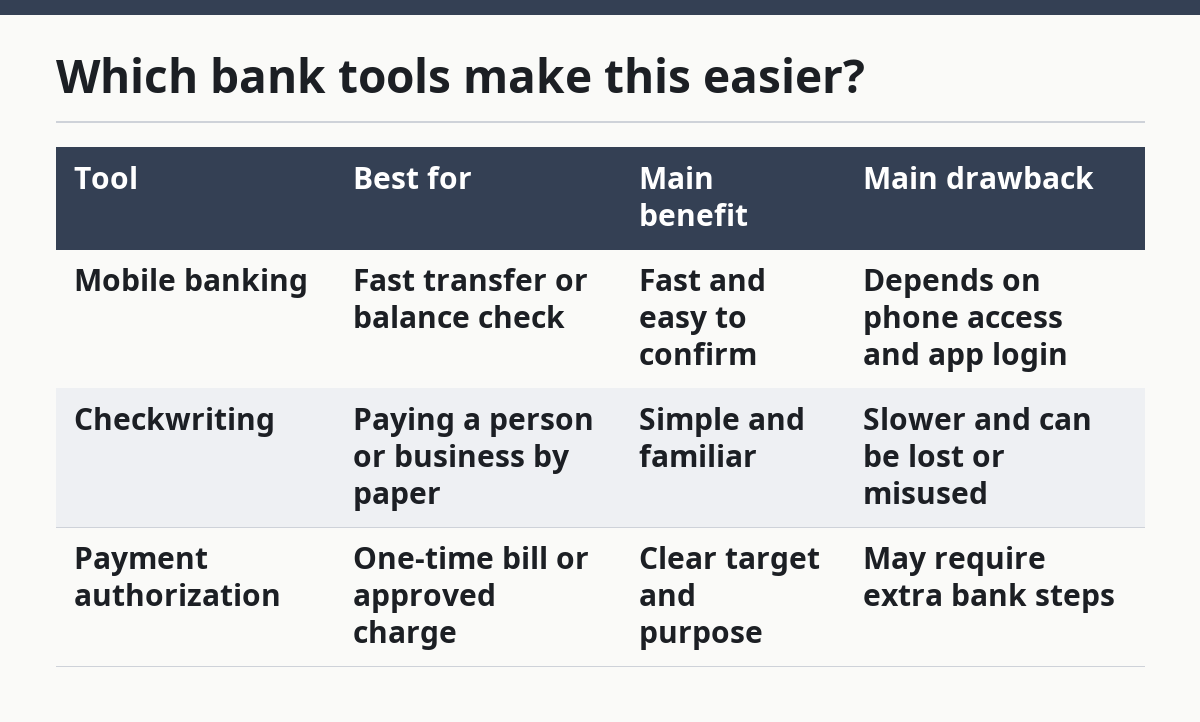
The best bank tool is the one that matches the job and still keeps control narrow. Mobile banking is usually best for a quick transfer, checkwriting works well for a one-off payment, and payment authorization can fit a specific bill or charge. Each tool has a trade-off.
| Tool | Best for | Main benefit | Main drawback |
|---|---|---|---|
| Mobile banking | Fast transfer or balance check | Fast and easy to confirm | Depends on phone access and app login |
| Checkwriting | Paying a person or business by paper | Simple and familiar | Slower and can be lost or misused |
| Payment authorization | One-time bill or approved charge | Clear target and purpose | May require extra bank steps |
Mobile banking is often the most practical if the helper needs to move money the same day. The weak point is access: if the phone is locked, the app is outdated, or the signal is poor, the helper may stall. That is why the instructions should include a backup path, not just the app.
Checkwriting is more limited, which can be a good thing. A signed check gives the helper a narrow tool that does not expose the whole account. The drawback is that it can be slow if the bill must clear quickly, so it works best when the emergency has a little room for timing.
Payment authorization is useful when the emergency is tied to one charge or one bill. It keeps the helper from roaming around the account making unrelated moves. If your bank supports it, this is often the cleanest option for a single purpose.
What can go wrong if the plan is too broad?
A broad plan can turn a short emergency fix into a money mess. If the helper has wide access, they may make the wrong transfer, pay the wrong bill, or keep access longer than intended. That can cost time, trust, and extra calls to the bank.
The biggest mistake is leaving the ending off the plan. Without a clear stop point, temporary access becomes permanent by accident. Put an end date, end event, or same-day removal step in writing, then follow it.
Another mistake is using too many people. More helpers can sound safer, but it often means more confusion, more missed messages, and more chances that two people do the same job twice. One trusted helper is usually better for a crisis access plan.
A third mistake is failing to name the bank contact. If the helper has to spend 20 minutes searching for a phone number while the emergency is still unfolding, the plan is not doing its job. Keep the contact details where they can be found in less than a minute.
This setup is not for someone who wants a general money-sharing arrangement or a standing family budget tool. It is also not for a helper who expects full discretion over the account. If the need has become routine, the plan should be rebuilt from scratch instead of stretched past its purpose.
How do I keep the plan safe after the crisis?
Keep the plan safe after the crisis by shutting off access, collecting any records, and reviewing what worked. The emergency is over only when the account permissions are closed, not when the first payment goes through. A same-day cleanup is the goal.
Start by removing temporary access from mobile banking, payment authorization, or any other tool you used. Then check whether the helper still has any active way into the account, such as saved login details or a checkbook in hand. If you used a bank contact, note the date and time you called.
Next, collect the paper trail. That can mean screenshots, a receipt, a check image, or a short note about what was paid and why. A 2-line record is better than nothing, and it makes later review much easier.
Finally, look at the weak point in the plan. Maybe the bank contact was hard to find, or maybe the helper needed clearer payment instructions. Fix that one problem before the next emergency, because a crisis helper access plan only works well when the next person can use it in under a minute.
If the crisis changed your money needs for the long term, stop and build a different arrangement instead of stretching this one. Temporary access is a tool for a narrow job, not a permanent way to run your account. For broader emergency fund ownership and access authorization, the hub on this topic covers the bigger framework.
Who should I let help me access emergency savings?
Let help come from one person who can follow written instructions and act fast. Pick someone who is calm under pressure, knows how to call a bank contact, and will not treat temporary access like a blank check. If you need repeated help or shared control, this plan is too small and should be changed. If you are unsure whether this arrangement fits your bank’s rules, consult the bank or another qualified professional before you proceed.
How do I set temporary access for someone helping in a crisis?
Set temporary access by giving one helper one narrow task for a short period. Put the rule in writing, choose the bank tool that fits the task, and add a stop point such as the end of the day or the end of the emergency. Then remove the access as soon as the crisis is over.
What instructions should I give a helper for my emergency fund?
Give the helper the bank name, the exact action to take, any limit, the bank contact, and where to put records. Keep it to 1 page if possible, and write down what the helper is not allowed to do. Clear instructions save time when the helper is under stress and the phone battery is low.
Drafted with AI; not yet reviewed by a person.