
Last updated: November 20, 2026
Key Takeaways
- An estate access plan sets out who can act on accounts before death, at death, and after death.
- Match each account to one access tool, then record the names where your executor and agent can find them.
- The best setup is the one that fits how you want the money used during life and after death.
- Your will should direct the estate, but it should not be treated as the password to your emergency fund.
Your emergency fund can be useless if nobody can reach it when you’re dead or incapacitated. The fix is an estate access plan that pairs account ownership, beneficiary forms, a power of attorney, and your will. The steps below show who can get money, what they can get, and what belongs in each document.
What an estate access plan does for your emergency fund
An estate access plan tells a bank who may act on your accounts before death, at death, and after death. It keeps a $500 checking cushion from getting trapped behind probate paperwork when bills are due, and it stops family members from guessing.
Picture this: you’re in the hospital, your phone is locked, and rent is due in 3 days. A clear estate access plan names the person who can pay from the right account, under the right document, without waiting for a court file.
Start with the account itself. A beneficiary form only controls what happens after death on accounts that allow one. A power of attorney helps during life. A will speaks to the estate, but it usually does not override a bank beneficiary form.
- Beneficiary designation: handles death-time transfer on accounts that allow it.
- Power of attorney: helps someone act while you’re alive but unable to handle money.
- Will: directs the estate, not the bank account in front of it.
- Account ownership: decides whether the money is jointly owned, individually owned, or frozen in probate.
The better part is that you do not need a perfect legal package to start. You need the right tools matched to the right account, then the names kept current.
See the Consumer Financial Protection Bureau’s guidance on power of attorney basics and beneficiary designations for a general overview.
How do I set an emergency fund beneficiary and estate access plan?
Because of that, you set it by matching each account to one access tool, then writing the names down where your executor and agent can find them. This is a 4-part job, not a single form.
Picture this: you’ve got one savings account for emergencies, one checking account for bills, and an old joint account from years ago. Each one has a different access path, so a blanket plan will miss something.
Use this order:
- Review the account type — Check whether the emergency fund is individual, joint, payable-on-death, or trust-held. The result is knowing which rules already apply.
- Choose the beneficiary form — If the bank offers a beneficiary or payable-on-death option, name the person who should receive the balance at death. The result is a direct transfer path outside the will.
- Create a power of attorney — Sign a durable financial power of attorney so someone can pay urgent bills if you are alive but unable to act. The result is access during incapacity, not after death.
- Update your will — Put the emergency fund in the estate plan if any part of it will still fall under probate. The result is a backup instruction for assets the bank form does not control.
- File and label — Keep copies with your other estate papers and tell the executor where the account list is stored. The result is fewer delays when someone needs to act.
A common mistake is naming the wrong person in the wrong place. That can leave one account accessible and another locked. It can also force a bank to follow its form even when the will says something else.
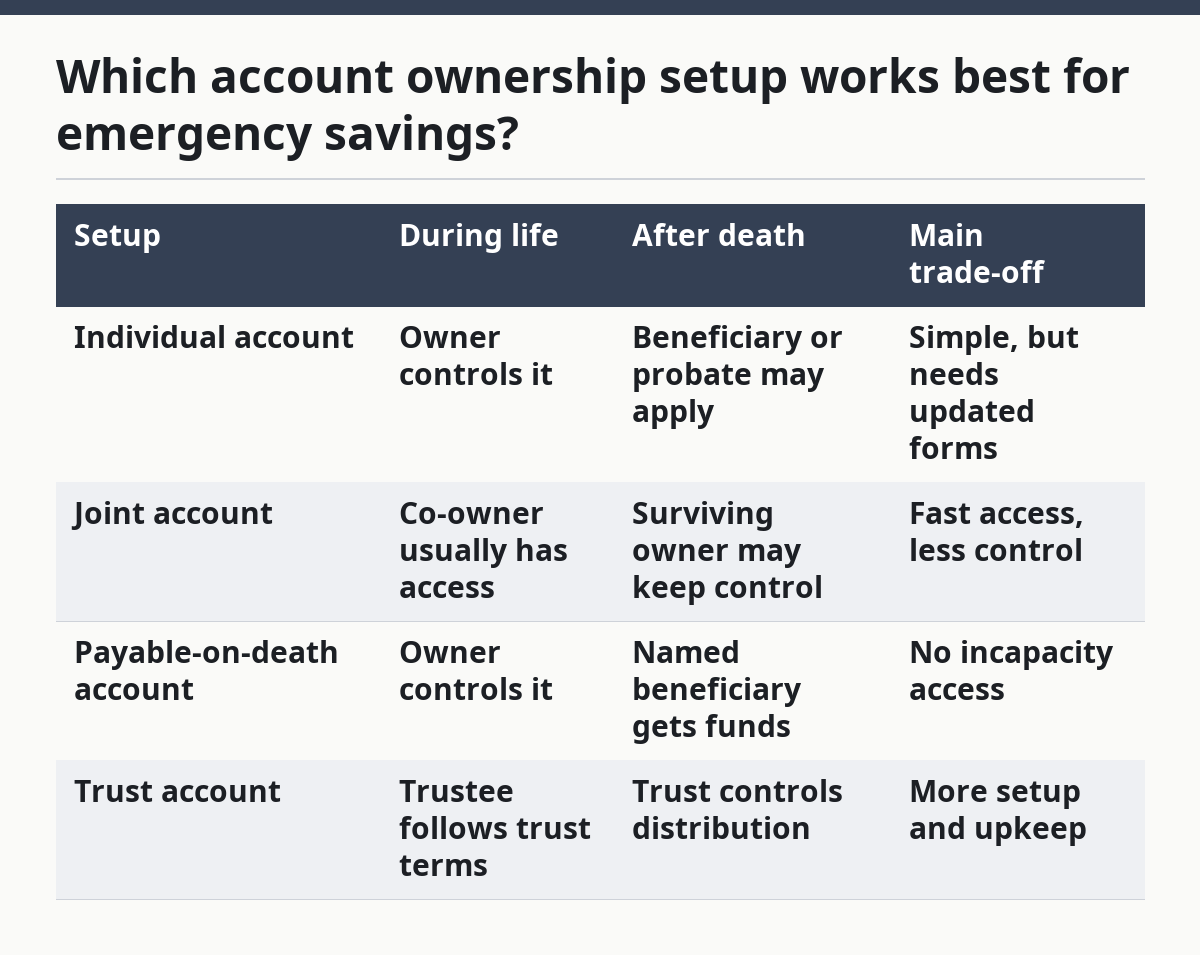
Which account ownership setup works best for emergency savings?
The cleanest setup is the one that matches how you want the money used during life and after death. For many people, an individual account with a beneficiary designation and a separate power of attorney gives the most control.
Picture this: you want emergency money to stay yours, but you also want a trusted person to pay the utility bill if you’re unconscious. A single joint account can solve one problem and create another, because the other owner may have full access right away.
Here’s how the common setups behave:
- Individual account: You control it while alive. After death, the account follows the beneficiary form if the bank allows one; otherwise it may go through probate.
- Joint account: The other owner usually has access immediately. That can help with bills, but it also gives that person present-day control over the money.
- Payable-on-death account: The named beneficiary gets the funds after death. It does not give them spending power while you are alive.
- Trust account: The trust terms control the money. This can work well when the account needs layered instructions, but it adds setup work.
If your emergency fund is small, maybe $1,000 to $5,000, simplicity matters. A plain individual account with a current beneficiary form is often easier to maintain than a more complex setup with multiple co-owners.
The trade-off is real. Joint ownership can avoid probate, but it also hands over control too early. A beneficiary form avoids that risk, but it does nothing for incapacity.
A comparison can help:
| Setup | During life | After death | Main trade-off |
|---|---|---|---|
| Individual account | Owner controls it | Beneficiary or probate may apply | Simple, but needs updated forms |
| Joint account | Co-owner usually has access | Surviving owner may keep control | Fast access, less control |
| Payable-on-death account | Owner controls it | Named beneficiary gets funds | No incapacity access |
| Trust account | Trustee follows trust terms | Trust controls distribution | More setup and upkeep |
For bank account rules, see FDIC account ownership information and Nolo’s overview of payable-on-death accounts.
What belongs in the will, and what does not?
Your will should direct the estate, but it should not be treated as the password to your emergency fund. The bank follows its own account records first, and the will comes into play only for assets that still belong to the estate.
Picture this: you wrote a will that says “my savings go to my sibling,” but the bank already has a payable-on-death beneficiary on file. The bank will generally follow its form, not the will. A mismatch like that creates avoidable confusion.
Use the will for these jobs:
- Name the executor who will gather estate assets.
- Identify backup heirs for anything that lands in the estate.
- Point to personal property that does not have a separate title or beneficiary form.
- Explain what should happen if a named beneficiary has died before you.
Do not rely on the will for access to accounts that have their own transfer rules. If the emergency fund is in an account with a beneficiary form, the will usually does not change that form. If the account is in probate, the will helps the court and executor see your intent, but it still may not open money quickly.
This delay matters. Probate can take weeks or months, and bills do not wait. That is why the will is a backup, not the main access plan, for emergency savings.
For more on the bigger picture, the hub article on emergency fund access rules fits here as the parent guide.
See also how probate works and Nolo’s explanation of wills versus beneficiary forms.
How do I keep a beneficiary form from causing the wrong result?
You keep the form current, consistent, and visible to the people who will need it. A stale form can send money to the wrong place.
Picture this: you named an ex-spouse on a bank form in 2018, then changed your will in 2024. If the beneficiary form was never updated, the bank may still follow the old name. That is how simple paperwork becomes a family fight.
Check these items at least once a year and after major life events:
- Marriage or divorce
- Birth or adoption
- Death of a named beneficiary
- Opening a new account
- Moving banks
- Signing a new power of attorney
Keep the beneficiary name exact. Use the full legal name, not a nickname. If the form asks for a contingent beneficiary, add one so the money does not bounce into probate if the first choice cannot take it.
Also make sure the title on the account matches the form. A beneficiary designation on one account does not fix another account at the same bank. A lot of people miss that.
The biggest mistake is assuming the bank will “figure it out.” It will not. It follows the paper on file.
What should the person handling the estate actually have?
Because the person handling the estate needs enough information to find the money, not unlimited access to everything, give them account names, institution names, and the location of the key documents.
Picture this: your executor has your will, but not the bank list. Your agent under power of attorney has authority, but no clue which account pays the insurance bill. The fix is a short, plain record that lives with the estate papers.
Keep these items together in a secure place:
- A list of all emergency fund accounts
- The account type for each one
- The beneficiary name on each account
- The name of the person named in your financial power of attorney
- A copy of your will
- Contact details for the bank or credit union
- Any trust paperwork if a trust owns the account
Do not put passwords in the will. The will becomes public in many places after death, and account credentials should stay separate. Use the bank’s own access process and your institution’s secure document rules, and ask a lawyer or financial professional if you are unsure.
If you want the right person to move fast, tell them where the documents are stored now, not later. A locked drawer, a fire-safe box, or a secure digital vault can all work if someone knows how to open it.
What happens if I do nothing?
If you do nothing, your emergency fund follows default account rules, and those rules may not match the person you want to help. That can mean probate delay, frozen cash, or a joint owner gaining control you never meant to give.
Picture this: an individual savings account has no beneficiary, no power of attorney, and no clear estate instructions. If you become incapacitated, a bank may not let a relative withdraw money just because they know the PIN. If you die, the account may have to pass through the estate.
That can create three problems:
- Bills go unpaid while the estate is opened.
- The wrong person has no authority, even if they are acting in good faith.
- The account ends up tied up with other estate assets.
The fix is not complicated, but it is specific. A beneficiary handles death. A power of attorney handles incapacity. A will backs up the estate. Ownership decides the starting point.
If your money is in a plain checking or savings account, that 30-minute paperwork review can save weeks of delay later. That is the whole point.
FAQ
Who can access an emergency fund if I die or become incapacitated?
Access depends on the account and the document that controls it. If you are incapacitated, a person named in a valid financial power of attorney may be able to act for you. If you die, the beneficiary form, joint ownership, or estate process usually controls, not the PIN or family agreement.
Does a beneficiary designation control emergency savings access?
A beneficiary designation controls where the money goes after death, if the account type allows that designation. It does not usually give the beneficiary spending access while you are alive, and it does not replace a power of attorney for incapacity. The bank follows the account record first.
How do I make savings accessible to the right person?
Use the right tool for the right time: beneficiary for death, power of attorney for incapacity, and account ownership for day-to-day control. Then keep the forms current and store copies with your estate papers. If the setup is unclear, a bank or estate professional can help interpret the account’s rules.
Do I need both a will and a beneficiary form?
Yes, in many cases you do. The beneficiary form can move the account outside probate, while the will covers the rest of the estate and names the executor. If the two conflict, the account form may still control the money on that account, so both documents need to be reviewed together.
Drafted with AI; not yet reviewed by a person.