
Last updated: November 20, 2026
Quick answer: for many freelancers, a practical emergency fund goal starts at 3 to 6 months of core spending, plus a cushion for delayed invoices.
Delayed invoices change the math on your emergency fund goal because money you’ve billed is not money you can spend yet.
Here’s the basic point: How to Set an Emergency Fund Goal for a Freelancer With Delayed Invoices is really about sizing that buffer without guessing.
Start with the cash gap, not the invoice total
Picture this: the work is done, three invoices are out, and the bank balance looks healthy on paper but thin in reality. That gap is the issue, not your income number. Because the cash gap is the real problem, the target should follow the months you could miss if client payments slow down, then include a separate cushion for delayed invoices.
The math feels rude, but it is honest.
A freelancer with accounts receivable has to ask a different question than a salaried worker: “How long can I cover life if none of those invoices clear on time?”
Usually, the answer begins with 3 to 6 months of core spending, then gets adjusted for how slow your clients really are.
Use this simple frame:
- Personal essentials: rent, food, utilities, minimum debt payments, insurance.
- Business expenses: software, internet, phone, fuel, subcontractors, bookkeeping.
- Invoice lag: the time between billing and cash hitting your account.
- Client risk: how much of your income comes from one or two clients.
If your invoices usually land in 14 to 30 days, do not pretend that money is already in hand. Treat it as pending, not available; and if you want to be precise about whether a late payment should be counted, consult a qualified financial professional. That one shift stops a goal that sounds big from collapsing the first time a client pays late.
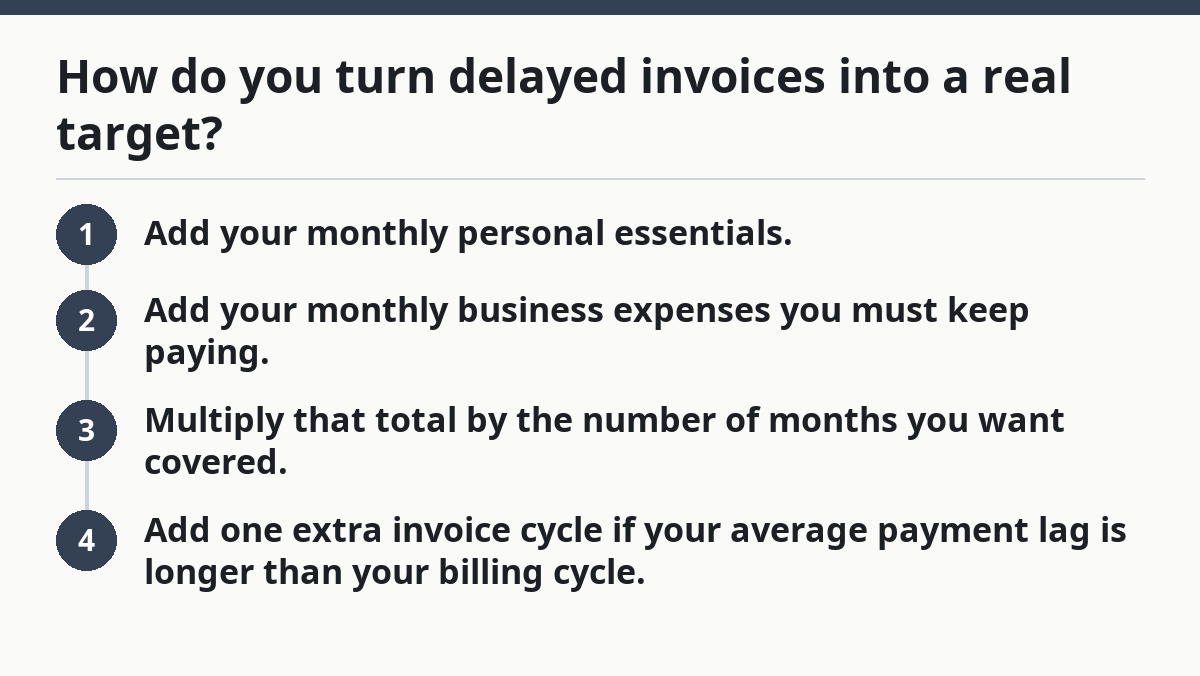
How do you turn delayed invoices into a real target?

You add a payment-lag buffer on top of your living-cost buffer.
That buffer should cover the invoices already sent plus the time you often wait for the next payment to clear.
Because timing matters, picture this: you’ve billed on the 1st, the client approves on the 15th, and payment arrives near the end of the month. If that rhythm is normal, the fund has to survive the delay without forcing you to miss rent or put business costs on a card.
Use a plain formula:
- Add your monthly personal essentials.
- Add your monthly business expenses you must keep paying.
- Multiply that total by the number of months you want covered.
- Add one extra invoice cycle if your average payment lag is longer than your billing cycle.
That extra cycle matters. If you invoice on the 1st but money often arrives 30 to 45 days later, a “one month” cash buffer can act like a three-week gap, not a true month of safety.
Accounts receivable are not emergency savings. They are expected cash that may arrive late, come in partial amounts, or get stuck in dispute.
For additional context on cash-flow risk, see the U.S. Small Business Administration’s guidance on cash flow management.
What numbers should you use for business expenses and personal bills?
Use the bills that would still hit your account even if no client paid for 30 days.
That list gives you a clean floor for your goal and keeps the fund tied to real outflows, not wishful thinking.
Open your budget and the “small” costs show up fast: six subscriptions, a phone bill, gas for client visits, and a quarterly software charge hiding in the corner. Those are not optional in practice; if the business depends on them, they belong in the target.
A practical way to build the number:
- List fixed personal costs first.
- Add fixed business costs next.
- Separate true emergencies from routine bills.
- Ignore revenue you hope will arrive later this week.
A clean list often reveals a surprise. Email tools, cloud storage, payment processing fees, contractor help—those little charges can push the monthly floor much higher than expected.
Not even close to pocket change.
If your business has lean months and busy months, use the lowest normal month for this step, not the highest one. That keeps the emergency fund from being built on a peak that won’t repeat.
For a more detailed framework, the hub on emergency fund goal setting can sit next to this page without repeating the freelancer-specific math here.
How much should client concentration change the goal?

Client concentration should push your goal higher when one client supplies a large share of your income.
Lose one account, and cash flow can take a hard hit; the fund needs to act like a wider safety net, not a narrow buffer.
One client can make the whole thing wobble. Suppose they supply 60% of your work and delay payment by 20 days. The problem is not just late cash; one approval cycle can throw off the whole month.
A freelancer with only a few clients should plan as if one dispute or one slow approver can freeze a big chunk of expected income.
Use three practical risk checks:
- One-client risk: if one client drives a big share of income, increase the fund goal.
- Invoice timing risk: if you bill after delivery instead of up front, delays hit harder.
- Approval risk: if clients have long review chains, payment lag stretches.
A reader with five steady clients can often use a lower buffer than a reader whose work depends on one buyer and one accounts-payable team. That is why the same “3 months” rule can be wrong in two different directions.
The number should follow your client mix, not a generic chart.
You do not need a perfect forecast; you only need a goal that assumes at least one payment goes sideways once in a while. That is realistic.
And it is cheaper than panic.
Use invoice timing to set the final cushion
Once you know the base amount, match the fund to your slowest normal payment path.
That means looking at when you bill, when clients approve, and when money actually lands in your account.
Because the timing thread matters here, picture this: you send invoices at the end of the month, but your biggest client only starts processing them on the 10th of the next month. That lag changes the emergency fund math more than any spreadsheet trick.
If your billing cycle is uneven, use the longest common delay you see in practice, not the best case.
Try this timing check:
- Track three recent invoices.
- Note the day you sent each one.
- Note the day cash landed.
- Use the slowest normal cycle as your buffer guide.
A short delay of 7 days is annoying. A 30-day delay can break a thin cash plan. A 60-day delay can force you to borrow if you treated pending invoices like cash, so if that is a possibility in your business, consult a qualified financial professional before relying on those receivables.
The fund goal should protect you from the second and third case.
If your invoices are often paid late, your goal should sit higher than a freelancer whose clients pay within two weeks. That is not pessimism; it is bookkeeping with a pulse.
What should you leave out of the goal?
Leave out invoices that are already overdue, disputed, or likely to be cut.
Those amounts are not reliable enough to count as support for an emergency fund target.
Because those balances are uncertain, picture this: one invoice is being reviewed, another is over 45 days late, and a third may get reduced after revisions. If you count all three as good cash, your goal becomes a fantasy number.
That is a quick way to feel “prepared” and still run short.
Do not include:
- Unapproved work that can still be challenged.
- Highly delayed invoices that have crossed normal payment terms.
- Wishful retainer renewals that are not signed yet.
- Tax money unless it is already separated for that purpose.
A freelancer with delayed invoices often wants to count everything on the dashboard because it looks close to money. That’s the trap.
Accounts receivable are a plan, not a payout.
If you want a cleaner number, split your cash into two buckets: emergency savings and receivables you expect to collect. Keep them mentally separate even if they sit in the same bank account for a while. That makes the goal honest.
Honest goals hold up better.
How do you know if your goal is too low or too high?
Your goal is too low if one late payment would force you to miss essentials or move business bills to debt.
It is too high if you are starving your working capital and can’t cover normal operations while you build it.
Because the balance matters, picture this: you have a huge emergency fund target, but every month you drain your operating cash to feed it. That can create a second problem while solving the first.
A freelancer needs both emergency cash and day-to-day business liquidity.
Use this quick check:
- If a 30-day delay would hurt, raise the goal.
- If you can handle 2 or 3 slow invoices without stress, the goal may be enough.
- If the target stops you from paying yourself at all, it may be too aggressive at once.
This is where a general emergency-fund article can mislead you. A salaried worker may only worry about job loss. You have job risk, approval risk, and payment lag all mixed together.
Different problem. Different buffer.
The right number is the one that keeps your life stable while your receivables catch up. If the goal does that, it is doing its job.
For the broader framework, the hub on emergency fund goal setting can sit next to this page without repeating the freelancer-specific math here.
Key Takeaways
- Base the fund on real monthly outflows, not on invoices you hope will clear soon.
- Add a separate cushion for the slowest normal payment cycle you see.
- Count overdue or disputed invoices carefully; do not treat them like cash.
- Raise the target if one client supplies too much of your income.
- Keep emergency savings separate from operating cash, even when both matter.
How much should I save if I’m a freelancer with delayed invoices?
Save enough to cover your essential personal bills, required business costs, and the time your invoices usually take to pay.
For many freelancers, that means a base buffer of 3 to 6 months of core spending, then an extra cushion for the payment lag. If your clients pay slowly or unevenly, aim higher than a freelancer with fast-paying accounts.
Should delayed invoices be treated as income or savings?
Delayed invoices should be treated as expected income, not savings.
They are money you have earned but not yet received, so they do not protect you the way cash does. If a client pays late or asks for changes, that invoice can slip outside your plan.
How do payment delays affect emergency fund size?
Payment delays make the emergency fund bigger because they create a cash gap between work completed and cash received.
The longer the delay, the more cash you need on hand to cover bills without borrowing. A freelancer with a 30-day lag needs a different target than one who gets paid in 7 days.
Drafted with AI; not yet reviewed by a person.