How to Set an Emergency Fund Replenishment Deadline After a Withdrawal

Last updated: November 20, 2026
Quick answer: set the emergency fund replenishment deadline for your next paycheck or, if the withdrawal was large, the paycheck after that. In the article on how to set an emergency fund replenishment deadline after a withdrawal, the safest rule is to pick the date the same day you use the money and write it on your calendar immediately, so “I’ll refill it later” becomes a concrete plan.
Key takeaways
- Pick a deadline on the calendar the day you use the money.
- Tie the deadline to a paycheck, not to a vague feeling of readiness.
- If the withdrawal was large, split the refill into chunks that fit your pay cycle.
- Pause one or more short-term goals if needed so the emergency fund gets priority.
- Use an automatic transfer when possible, because manual refill plans are easy to miss.
What is a replenishment deadline?
A replenishment deadline is the date by which you plan to restore the money you took from your emergency fund. It is a time rule, not a budget goal, and it should be specific enough to write on your budget calendar in one line.
Because an emergency fund works best when it is ready for the next surprise, the deadline matters. A 30-day delay can be manageable, but if the account stays drained for 60 days, 90 days, or longer, the next bill can force you to borrow, tap credit cards, or delay other payments. A deadline gives the withdrawal a finish line.
Set the deadline around your cash flow, not around wishful thinking. If your paycheck lands every 2 weeks, the refill plan should usually line up with one or two paydays, unless the withdrawal was large enough to need more time.
How do I choose the deadline?
Choose the deadline by matching the size of the withdrawal to your paycheck timing and your savings rate. Start with the next paycheck, then decide whether the full refill fits there or needs a second paycheck.
Use this simple rule: the smaller the withdrawal, the sooner the deadline; the larger the withdrawal, the more you should spread it across your budget calendar. A refill deadline that fights your rent, food, or utility bills will fail fast, so the date has to fit the rest of your month.
Set your replenishment deadline in 5 steps
-
Review your checking account and budget calendar for the date of your next paycheck, then mark the withdrawal date and the first realistic refill date.
This shows the cash window you actually have, not the one you wish you had. -
Calculate your recovery target in the savings account by adding back only the amount you withdrew.
The result is a clear dollar target, which stops you from guessing whether “close enough” counts. -
Choose one deadline date that lands on or just after a paycheck, then write it next to the withdrawal on your budget calendar.
A single date is easier to follow than a range like “sometime next month.” -
Split the refill across paychecks if the full amount will strain your month, and assign a piece of the target to each payday.
This keeps the deadline realistic while still giving the fund a fixed end point. -
Set an automatic transfer from checking to savings for the chosen payday or the day after it.
The transfer turns the deadline into an action, so the refill happens without a fresh decision each time.
Because a deadline does not have to be aggressive to work, a 1-paycheck refill is not always the best choice. If a 1-paycheck refill would force you to miss bills, a 2-paycheck deadline is better than a failed 1-paycheck promise. The point is not speed for its own sake; the point is a date you can actually meet.
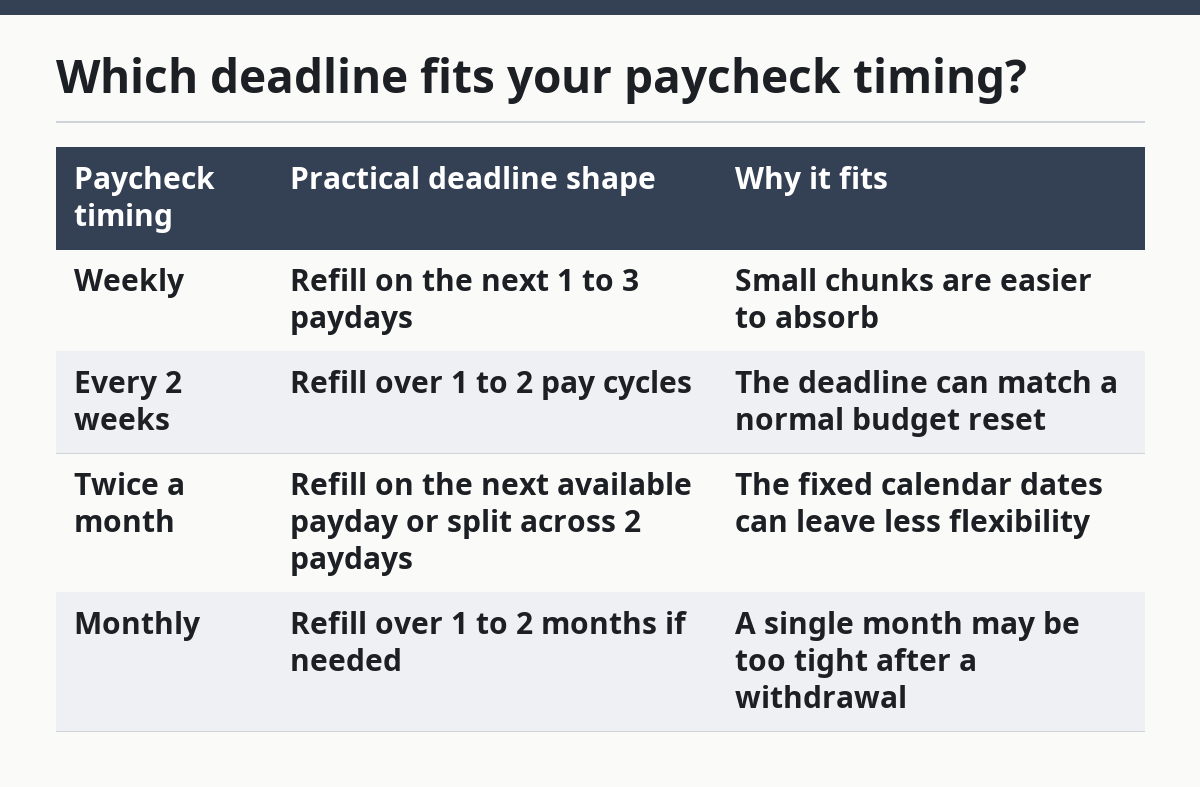
Which deadline fits your paycheck timing?
The right deadline fits the pay cycle you already live on. If you get paid weekly, the refill can usually be faster; if you get paid twice a month or once a month, the deadline may need more room.
| Paycheck timing | Practical deadline shape | Why it fits |
|---|---|---|
| Weekly | Refill on the next 1 to 3 paydays | Small chunks are easier to absorb |
| Every 2 weeks | Refill over 1 to 2 pay cycles | The deadline can match a normal budget reset |
| Twice a month | Refill on the next available payday or split across 2 paydays | The fixed calendar dates can leave less flexibility |
| Monthly | Refill over 1 to 2 months if needed | A single month may be too tight after a withdrawal |
If your savings rate is already thin, do not force a deadline that competes with essentials. A 15-minute plan that works beats a 1-night plan that falls apart by day 3. The deadline should fit the paycheck, not the other way around.
When should you use an automatic refill schedule?
Use an automatic refill schedule when you know the deadline is likely to slip. An automatic transfer is the cleanest way to protect the deadline because it moves money before you can reassign it to something else.
Set the transfer for the day after payday, or the same day if your account timing is stable. If your bank lets you schedule a transfer for a fixed dollar amount, that makes the refill easier to repeat. If the withdrawal was bigger than one paycheck can handle, schedule a second transfer for the next payday and keep both dates on the calendar.
An automatic schedule has one drawback: it can pull too much if your paycheck changes or a bill lands late. That is why the transfer amount should stay tied to a real budget, not to a rough guess. If the automatic plan threatens overdrafts, lower the amount and extend the deadline.
What should I pause until the fund is restored?
Pause at least one short-term goal if the refill deadline will otherwise slip. That may mean slowing extra savings, waiting on a nonessential purchase, or reducing an aggressive payment plan for a short stretch.
This is not the same as abandoning your other goals. It is a temporary order of operations: emergency fund first, then the rest. If the withdrawal came from an unplanned repair or medical bill, the emergency fund has already shown why it exists, and letting it stay depleted weakens the next month’s security.
The trade-off is real. Slowing another goal can feel annoying, especially if you already have a long list of priorities. Still, a 30-day or 60-day pause on another goal is often cheaper than leaving the emergency fund exposed for 6 months.
What mistakes make the deadline fail?
The most common mistake is setting a deadline without checking the paycheck calendar. That usually creates a date you cannot fund, and the result is a refill plan that dies in the first week. The fix is to anchor the deadline to a specific payday before you write the number down.
Another mistake is treating a windfall as optional refill money. A tax refund, bonus, or gift can restore the fund quickly, but if you spend it before the refill happens, the deadline slips again. If you are not sure how to prioritize that money, consult a financial professional and put the windfall on the emergency fund line first, then decide what is left.
A third mistake is making the deadline too strict after a large withdrawal. If the emergency fund lost several months of expenses, a 1-paycheck deadline can push you into overdrafts or force you to raid other accounts. A slower deadline that actually survives the month is better than a fast deadline that fails.
The last mistake is stopping the refill once the money is “close enough.” If the target was $1,000 and you stop at $800 because other bills appeared, the fund is still short. Use the full recovery target, even if that means one extra transfer.
How does this fit with the rest of your money plan?
It fits as a temporary priority inside your broader budget, not as a permanent rewrite of everything else. The deadline tells your cash flow what to do for a short time, then your normal savings rate can take back the next dollar.
For readers who want the full rule set around withdrawals and refills, the hub on emergency fund withdrawal and replenishment rules belongs here as the bigger map. This page handles the deadline piece only: when to refill, how to line it up with paychecks, and how to keep the fund from staying empty.
A good deadline respects the rest of your life. If the refill plan leaves you unable to cover groceries, rent, or a utility bill, the deadline is too aggressive. If the plan feels easy but drifts for months, it is too soft. The right one sits in the middle and has a date on it.
How soon should i refill an emergency fund?
Refill it as soon as your budget can support it without creating a new problem. For many people, that means the next paycheck or the one after that, but the right timing depends on the size of the withdrawal and the rest of the month’s bills. The deadline should be specific enough to put on your budget calendar the same day you take the money out.
Should I pause investing until my emergency fund is restored?
Often yes, if pausing investing is the cleanest way to restore the emergency fund on time. A short pause on investing can free up cash for a refill deadline that falls on the next paycheck or within 1 to 2 pay cycles. If the pause would damage a longer-term plan or trigger penalties, adjust the refill amount instead.
How do I rebuild emergency savings after I use it?
Start by setting the recovery target, then assign the refill to a paycheck date and automate it if possible. If the full amount will not fit in one paycheck, split it into smaller transfers and keep the deadline visible on your budget calendar. A fixed date, a clear target, and a temporary pause on one other goal are usually enough to get the fund back on track.
What should I use to track the deadline?
Use a budget calendar, a paycheck schedule, and a transfer date you can see in your banking app. That simple setup is usually enough to keep the deadline from slipping. If you want a cleaner rule, write the date next to the withdrawal amount so the refill is tied to a specific number and a specific payday.
For a plain explanation of why emergency cash should stay easy to access, the Consumer Financial Protection Bureau explains savings account basics here: CFPB savings accounts. For a related budgeting reference, see the guide on emergency fund withdrawal rules and the page on how much emergency savings you need.
Drafted with AI; not yet reviewed by a person.