Last updated: November 20, 2026
Key Takeaways
- Build your emergency fund around the bills that still arrive when tips slow down.
- Start with your lowest steady income month and match it to your must-pay expenses.
- Essential expenses are the bills you need to stay housed, fed, and able to work.
- Base pay should be the floor, with average tips as support, not the whole plan.
If your income swings with tips, your emergency fund goal for tipped workers should be built from base pay plus your real bare-bones monthly expenses, not from your best tip week. That keeps the target tied to money you can count on. The steps below show how to set the number without guessing.
What your emergency fund goal needs to cover
Your emergency fund goal should cover the bills that still show up when tips dry up. For a tipped worker, that means rent, utilities, groceries, transportation, insurance, minimum debt payments, and any child care or medicine you cannot skip. If a bill can wait 30 days, it does not need to shape the core goal.
The mistake is to aim for a full month of your usual spending, including restaurant meals, rideshares, and random splurges from good nights. That makes the target too high and can stall the whole plan. A tighter goal is better than no goal.
- Base pay matters most.
- Tips are extra, not guaranteed.
- Slow season can last weeks.
- Essential expenses set the floor.
If you want the broad framework behind this page, start with the hub on emergency fund goal setting. This article is the version for tipped work, where cash flow changes by the shift, not just the month.
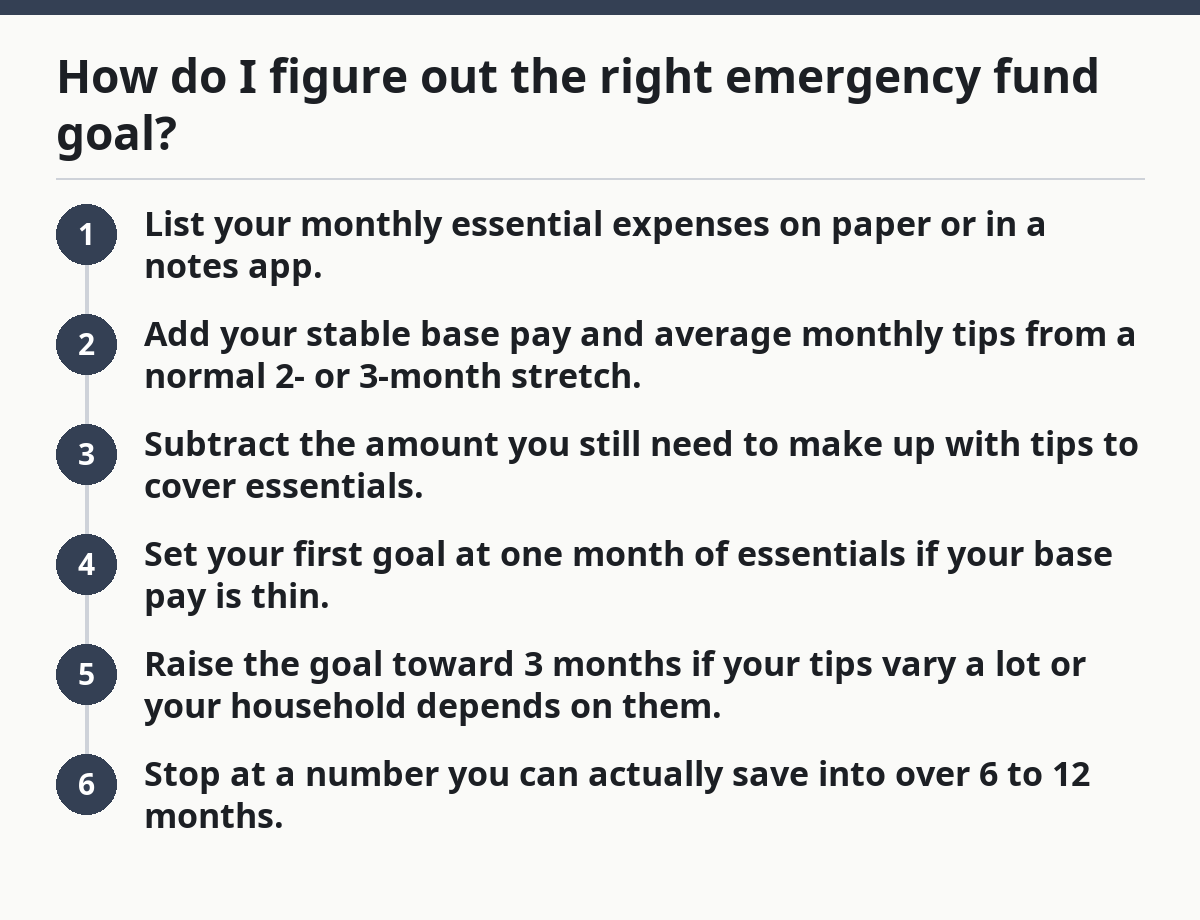
How do I figure out the right emergency fund goal?
You figure it out by using your lowest steady income month, then matching it to your non-negotiable expenses. For most tipped workers, a practical starting point is 1 to 3 months of essential expenses, then more if your tips swing hard or you have dependents.
Picture this: you work four busy dinner shifts, then a week of rain cuts traffic in half. Your bills do not shrink with the weather. That is why the goal has to come from the bottom of your cash flow, not the top.
- List your monthly essential expenses on paper or in a notes app.
- Add your stable base pay and average monthly tips from a normal 2- or 3-month stretch.
- Subtract the amount you still need to make up with tips to cover essentials.
- Set your first goal at one month of essentials if your base pay is thin.
- Raise the goal toward 3 months if your tips vary a lot or your household depends on them.
- Stop at a number you can actually save into over 6 to 12 months.
A simple example helps. If essentials run $2,000 a month and base pay covers $1,200, you are relying on tips for $800 just to break even. A first emergency fund goal of $2,000 gives you one month of breathing room. A stronger goal of $4,000 to $6,000 gives you a buffer for a slow season or a bad week that turns into a bad month.
Here’s the catch: if your tips are erratic, use your low-average month, not your best month. Best-month math lies to you.
Which bills count as essential expenses?
Essential expenses are the bills you must pay to stay housed, fed, and able to work. That usually means housing, utilities, groceries, gas or transit, phone service, insurance, child care, and minimum loan payments.
Picture this: you are tempted to include every normal expense because you want a bigger cushion. That can help if your income is very unstable, but it also makes the goal feel impossible. The right move is to separate what you need from what you like.
Use this sort of list:
- Rent or mortgage
- Electric, water, and heat
- Groceries
- Gas, transit, or parking
- Phone
- Health or car insurance
- Minimum debt payments
- Child care
- Basic work costs, if you cannot work without them
Do not include restaurant meals, subscriptions, clothing upgrades, or gifts in the first version of the goal. Those can come later, after the core fund is in place.
If a bill only matters in a crisis because you let it lapse, count it. If it is a nice-to-have, leave it out. That choice keeps the emergency fund goal realistic and tied to the way your life actually works.
Should I use average tips or only base pay?
You should use base pay as the floor and average tips as the cushion, not as the whole plan. For a tipped worker, base pay is the number that keeps the plan honest, while average tips tell you how much faster you can build the fund.
Picture this: your hourly wages cover part of the month, and tips cover the rest. On a good week, your tips make the math look easy. On a bad week, they vanish. That swing is exactly why a goal based only on tips can break down.
A practical rule:
- Count base pay as the money you can expect first.
- Count average tips only after you smooth them over 8 to 12 weeks.
- Use the lower end of that range if your work changes with weather, holidays, or foot traffic.
- Ignore one-off windfalls, like a huge party or a holiday rush, when setting the goal.
This is also where some people get tripped up by “I can always make it up next weekend.” Maybe you can. But an emergency fund is there for the weekend when you cannot. That is why the goal should survive a slow week, not just a normal one.
One more clean test: if your emergency fund has to protect you during a full month with weak tips, can the number still work? If not, raise the goal. If yes, you are in the right zone.
How fast should a tipped worker try to save it?
A tipped worker should save the fund in small, steady chunks that fit around slow and busy seasons. If the goal is large, trying to fill it all at once usually backfires. A monthly transfer that you can repeat beats a giant one-time push.
Picture this: the summer patio season is strong, then January arrives and every shift feels lighter. If you save only when income is high, the fund grows and shrinks with the calendar. That is not a plan. It is a mood.
Use a simple split:
- Save a fixed amount from every shift, such as $10, $20, or $50, depending on your cash flow.
- Move part of each tip-heavy week into savings the same day or the next day.
- Put any extra from a busy season toward the emergency fund before you spend it.
- Pause only if rent, utilities, or food would be affected.
If a small automated transfer helps and your base pay hits the same account every week, use it. If tips land in cash, separate them before they disappear into daily spending. Even a paper envelope system can work if you keep it locked to the goal.
A slow build is still a real build. A $500 starter fund that stays put is more useful than a $2,000 fund you keep raiding every time tips dip.
What mistakes make the goal fail?
The goal fails when the number is built on a good week, then treated like a promise. Tipped work punishes wishful math fast. A goal that ignores slow season, base pay, and real bills will be too high, too low, or both.
Picture this: you pick a target from your busiest month because it feels motivating. Then winter hits, tips slide, and you cannot save at the same pace. That is how people quit before the fund gets traction.
Common mistakes to avoid:
- Using peak tips only. That creates a target that does not match normal life.
- Counting every expense. That turns a safety fund into a giant, stalled project.
- Skipping base pay. That makes the goal too dependent on tips you cannot control.
- Treating the fund as spending money. That drains the account before it can help.
- Not revisiting the number. A goal from last year may miss current rent or gas costs.
If your expenses changed by $200 or more a month, revisit the goal. If your work schedule changed from five shifts to three, revisit it again. A good emergency fund goal is not carved in stone. It is a working number.
For a tipped worker, the real win is a fund that survives a rough month without turning into debt. That is the standard.
When should I change my emergency fund goal?
You should change your emergency fund goal when your essential expenses, base pay, or tip pattern changes enough to move the math. A new lease, a car payment, fewer shifts, or a move to a slower house or restaurant can all shift the target.
Picture this: your income was steady all spring, then a new manager cut your hours by 8 a week. The old goal may still be useful, but it may not be enough. That is the point where a one-time checkup saves you from guessing later.
Review the goal after these changes:
- A rent increase or new roommate
- A change in base pay
- A major shift in weekly hours
- A move into a slower season
- A new bill that affects your minimum monthly expenses
- A debt payment that ended, which may let you lower the target
Use the same rule each time: essential expenses first, then a buffer that matches how often your income swings. If the change is small, keep the goal and keep saving. If the change is big, reset the number and start again from the new floor.
This is why the best emergency fund goal is the one you can explain in one sentence: “I need enough to cover my essentials when tips are bad.” If you can say that clearly, you can size the fund clearly too.
Can I build this fund with cash tips and hourly wages?
Yes, you can build it with both cash tips and hourly wages, as long as you separate the money before it slips away. The method matters more than the format. Cash tips need a container, and hourly wages need a rule.
Picture this: a good Friday night leaves you with cash in your pocket, and your hourly wages hit on Tuesday. Without a system, both disappear into food, rides, and quick purchases. The fund never gets its turn.
A workable system:
- Put a set share of cash tips aside before you start spending.
- Send a fixed share of hourly wages to savings on payday.
- Keep the emergency fund in a separate account so it is not mixed with spending money.
- Refill the fund after you use it, starting with the next shift or paycheck.
If your tips are mostly cash, the physical act of setting some aside matters. If your tips come through a card app, move them immediately into the emergency fund bucket. The timing is the guardrail.
The point is not perfection. The point is a fund that grows from both sides of your income, even when one side is messy.
How do I budget emergency savings when tips vary?
You budget emergency savings by setting a fixed amount from each good shift and a smaller amount, or none, from the bad ones. That keeps the plan tied to cash flow instead of hope. A weekly review works better than a monthly promise when tips change day to day.
Should tipped workers count average tips or only base pay?
Tipped workers should count base pay first and average tips second. Base pay shows the floor you can lean on, while average tips help you judge how fast you can build the fund. If tips swing a lot, use a cautious average from several weeks, not your best stretch.
What if my tips are unpredictable month to month?
If your tips are unpredictable month to month, set the goal from your essential expenses and aim for the lower end first. A starter goal is easier to reach and easier to keep. Once that money stays in place, you can raise the target in the next round.
Drafted with AI; not yet reviewed by a person.