Last updated: November 20, 2026
Key Takeaways
- Savings accounts are usually the simplest emergency home for cash; cash management accounts add access features.
- Pick the account that lets you reach emergency cash fastest under stress.
- Savings accounts suit people who want the least drama.
- Cash management accounts suit people who value access more than simplicity.
A savings account or a cash management account can both hold emergency savings, but the better choice depends on how fast you need cash, how you want to access it, and what kind of insurance applies. The right pick is the one that keeps your emergency money easy to reach without adding transfer delays or coverage gaps. This article on How to Choose Between a Savings Account and a Cash Management Account for Emergency Savings explains that trade-off and points you to the right fit for your situation.
Our Top 3 Picks at a Glance
-
1 Best Overall: Savings account — best when you want simple bank transfers, plain FDIC coverage, and no extra account features to learn.
-
2 Best Budget Pick: Cash management account — best when you want one account that can pair cash storage with debit card or ATM access.
-
3 Best Heavy-Duty / Upgrade Pick: Savings account plus linked checking — best when you want the cleanest emergency setup and don’t need investment-style extras.
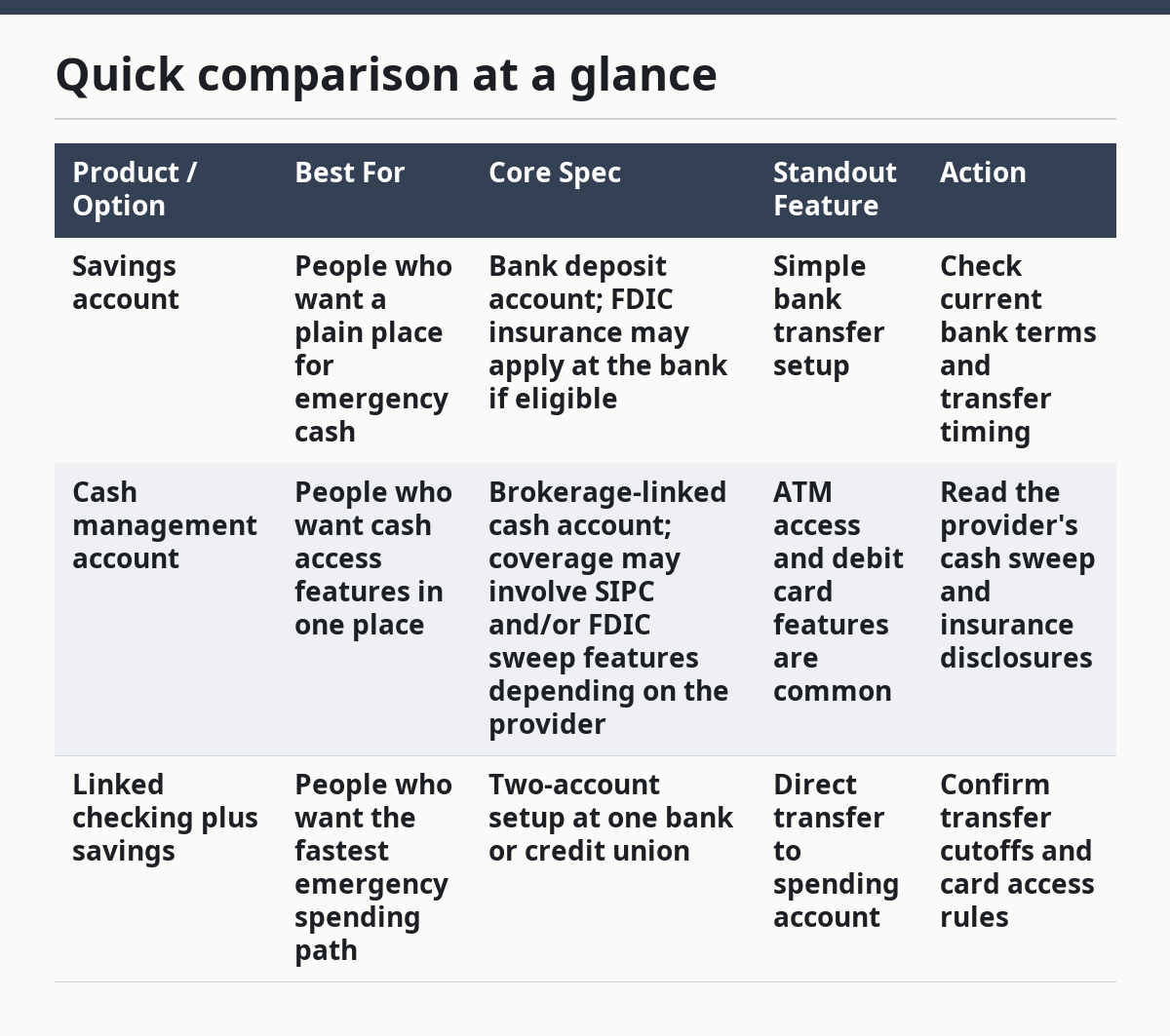
Quick comparison at a glance
| Product / Option | Best For | Core Spec | Standout Feature | Action |
|---|---|---|---|---|
| Savings account | People who want a plain place for emergency cash | Bank deposit account; FDIC insurance may apply at the bank if eligible | Simple bank transfer setup | Check current bank terms and transfer timing |
| Cash management account | People who want cash access features in one place | Brokerage-linked cash account; coverage may involve SIPC and/or FDIC sweep features depending on the provider | ATM access and debit card features are common | Read the provider’s cash sweep and insurance disclosures |
| Linked checking plus savings | People who want the fastest emergency spending path | Two-account setup at one bank or credit union | Direct transfer to spending account | Confirm transfer cutoffs and card access rules |
I write about deposit accounts and cash access rules for a living, so I read these products through one lens: how the money gets out when life goes sideways. This article is information, not financial advice, and a qualified adviser should be consulted for your own situation.
The real difference between a savings account and a cash management account
A savings account wins if you want the simplest emergency home for cash; a cash management account wins if you want extra access features. The gap is not about safety in the generic sense — it’s about structure, transfer paths, and what kind of coverage the provider uses.
Picture this: you’re trying to keep three months of expenses somewhere boring, but you also want to know how to get that money back into your checking account on a Friday night. That is where the two accounts split. A savings account is usually a bank deposit account. A cash management account is often tied to a brokerage or similar financial platform and may route your cash through bank partners or sweep programs.
Here’s the catch: the name “cash management account” does not tell you the coverage, transfer speed, or card access by itself. You have to read the provider’s disclosures. Some cash management accounts offer FDIC insurance through partner banks, while others use SIPC coverage for brokerage assets and may have separate protections for swept cash. The details change by provider and by country.
- A savings account is usually easier to understand.
- A cash management account can be easier to spend from.
- The insurance story is not identical.
- The transfer path matters more than the label.
For the official insurance basics, see the FDIC’s consumer coverage pages and the SIPC explanation of what it covers. Those two organizations describe very different protections, and the difference matters when you hold emergency money.
How should I choose between them for emergency savings?
Choose the account that makes a real emergency move fastest without confusing you under stress. If you want a plain place to park cash and move it by bank transfer, the savings account usually fits better. If you want ATM access, a debit card, or a single dashboard that mixes cash and brokerage features, the cash management account may fit better.
Picture this: your car needs a repair on a Saturday and the shop wants payment now, not after a two-business-day bank transfer. In that moment, the question is not which account sounds modern; it’s which one lets you reach money with the fewest steps. That is why access features matter more than branding.
The choice also depends on how you keep your emergency fund split. Many people keep the first layer of emergency cash in a savings account because it stays mentally separate from spending money. Others like a cash management account because it can feel closer to a high-access cash hub, especially if the provider offers ATM withdrawals or a linked debit card. The trade-off is that a more flexible account can also tempt you to spend the money for non-emergencies.
- If you freeze under logins and app menus, simpler wins.
- If you need card access, look hard at the cash management account.
- If you care most about a straightforward bank relationship, savings often wins.
- If you already use a brokerage and understand its cash sweep rules, a cash management account can make sense.
The best part? You do not need perfect features. You need the account that makes it hard to raid the fund and easy to use it for a true emergency.
A savings account: who should actually use this, and who shouldn’t?
A savings account wins for people who want the least drama. It is usually the cleaner choice for someone building an emergency fund for the first time, or for anyone who wants a basic bank transfer path with familiar FDIC insurance rules at an eligible bank.
Picture this: you’re setting aside rent, groceries, and a repair buffer in one place, and you do not want that money linked to investment menus or extra account tiers. A savings account is built for that kind of job. It is plain, but plain can be a strength when the goal is not growth — it’s access and separation.
The weakness is just as plain. Savings accounts often don’t come with a debit card, and many limit how directly you can spend from them. That means your emergency cash may need a bank transfer into checking before you can use it. Depending on the bank and the country, transfer timing can be same-day, next-day, or longer. That delay can matter if the bill is due now.
- Best fit: someone who wants a simple emergency stash.
- Weak fit: someone who needs direct spending access.
- Strength: easy to understand and widely available.
- Weakness: less useful if your emergency needs cash on the spot.
Who Should Skip This: someone who needs ATM access or a debit card tied directly to the emergency fund should look at a cash management account instead.
Buy this if: you want a plain emergency home for cash and your main move will be bank transfer to checking.
Skip this if: you need to pay an emergency bill directly with a card or withdraw cash from an ATM.
A cash management account: when does it win?
A cash management account wins when access features matter more than simplicity. If you want ATM access, debit card use, and a cash balance that lives alongside brokerage services, this account can make emergency spending easier.
Picture this: you’re away from home, a card is denied, and the nearest branch is not yours. A cash management account can be handy because many providers build in broader spending access than a basic savings account. That extra access can reduce the number of steps between “I need cash now” and “I have cash now.”
The drawback is that the account structure is less uniform. The name alone does not tell you whether the cash is held at a bank partner, covered through a sweep arrangement, or wrapped into a brokerage platform. That means you have to check the provider’s current disclosure pages for FDIC insurance details, SIPC coverage, transfer timing, and ATM rules. A generic article that says “cash management account” without those details is leaving out the part that actually matters.
- Best fit: someone who wants cash access features in one place.
- Weak fit: someone who wants the simplest possible deposit account.
- Strength: often better for card-based emergency use.
- Weakness: coverage and access rules can be more complicated.
The truth is, a cash management account is not automatically better just because it sounds more flexible. It is better only if the added features solve a real problem you have. If you never use a card from the emergency fund, the extra structure may be wasted.
The honest side-by-side
A savings account wins on simplicity; a cash management account wins on access. The table below is the cleanest way to see where each one fits when you are storing emergency savings.
Picture this: you’re comparing two places to keep money you hope never to touch, but one of them has better spending tools and the other has a simpler legal structure. This is where the details matter, because emergency money is about the route out, not the label on the app icon.
| Criteria | Option A | Option B | Winner for the condition |
|---|---|---|---|
| Ease of understanding | Savings account is usually straightforward | Cash management account can involve brokerage terms | Savings account for first-time savers |
| Direct spending access | Usually limited | Often includes debit card or ATM features | Cash management account for on-the-spot spending |
| Bank transfer use | Common, familiar path | May still rely on transfers, but through the provider’s system | Savings account for simple transfer habits |
| Coverage structure | Often FDIC at the bank if eligible | May use FDIC sweep coverage, SIPC, or both depending on provider | Savings account for clarity |
| ATM access | Usually not the main feature | Often a core feature | Cash management account for cash withdrawals |
| Risk of confusion under stress | Lower | Higher because of sweep and platform details | Savings account when you want fewer moving parts |
| Extra account features | Few | Often many | Cash management account for feature-rich users |
| Emergency fund discipline | Can help keep money out of sight | Can blur cash with spending tools | Savings account for discipline |
The winner for most people who just want a safe, reachable emergency stash is the savings account. The winner for people who specifically need cash access features is the cash management account. Those are different jobs.
What about FDIC insurance, SIPC coverage, and transfer timing?
The account that looks safer on the surface is not always the one with the cleaner coverage story. A savings account usually makes the insurance question simpler, while a cash management account can involve multiple layers, depending on the provider and the way cash is held.
Picture this: you’re reading account disclosures and every line seems to use a different term for where the money sits. That is the moment to slow down. Emergency savings are not a place to guess. If the provider says cash is swept to partner banks, read whether the bank deposits are FDIC insured up to applicable limits. If the provider says the account is brokerage-based, read what SIPC does and does not cover. Those two protections are not the same.
Transfer timing is part of this too. A bank transfer from a savings account to checking may take one business day or more, depending on the institution and the rails it uses. A cash management account may offer faster spending through a debit card or ATM, but that does not always mean instant transfer to another bank. Fast access is useful only if you need cash in the form the account provides.
- FDIC insurance generally relates to eligible bank deposits.
- SIPC coverage relates to brokerage customers and securities custody rules.
- Transfer timing can be a dealbreaker for emergency use.
- ATM access can matter more than headline language.
For a clean read on the rules, review the FDIC’s consumer insurance information and the SIPC’s coverage explanation before you rely on any provider’s marketing page.
When does the choice flip?
The verdict flips in three cases, and each one is tied to a concrete need. If you need card access, if you already use a brokerage-based cash hub, or if your emergency fund is meant to move in and out often, a cash management account can make more sense than a savings account.
Picture this: you’re not just storing money — you’re using it as a short-term holding pen between paychecks, bills, and travel. In that case, the extra access features can reduce friction. On the other hand, if the fund is there for rare disasters and you want the least tempting setup possible, the savings account has the edge.
Here are the cases that change the answer:
- You need ATM access during travel or after business hours.
- You already keep your cash inside one brokerage platform and understand its disclosures.
- You want a debit card tied to emergency money instead of moving funds into checking first.
- You prefer fewer account features because extra access makes you spend too easily.
That said, neither account is the right answer if your provider’s rules are unclear or if you cannot tell how your cash is covered. In that case, the account label is less important than the disclosure page.
The verdict: which one to choose and why
Choose savings account if you want the simplest emergency setup, plan to move money by bank transfer, and value clear FDIC-style deposit handling over extra features.
Drafted with AI; not yet reviewed by a person.