
Last updated: November 20, 2026
Key Takeaways
- Choose the account by matching ownership, access, and purpose before yield or branch convenience.
- Match the setup to the parent’s control, the child’s ownership, and the account’s limits.
- A custodial savings account gives the child ownership while the parent manages it until state law says otherwise.
- The most important bank features are easy parent access, low-friction deposits, and tight limits on casual spending.
A custodial savings account is usually the simplest answer for a minor child’s emergency fund because the parent can open and manage it while the child remains the minor owner. Pick the account that gives the parent control, keeps the money safe, and matches how soon the child may need it. The steps below settle when a custodial account fits, when a plain bank account is better, and what to check before you open either one.
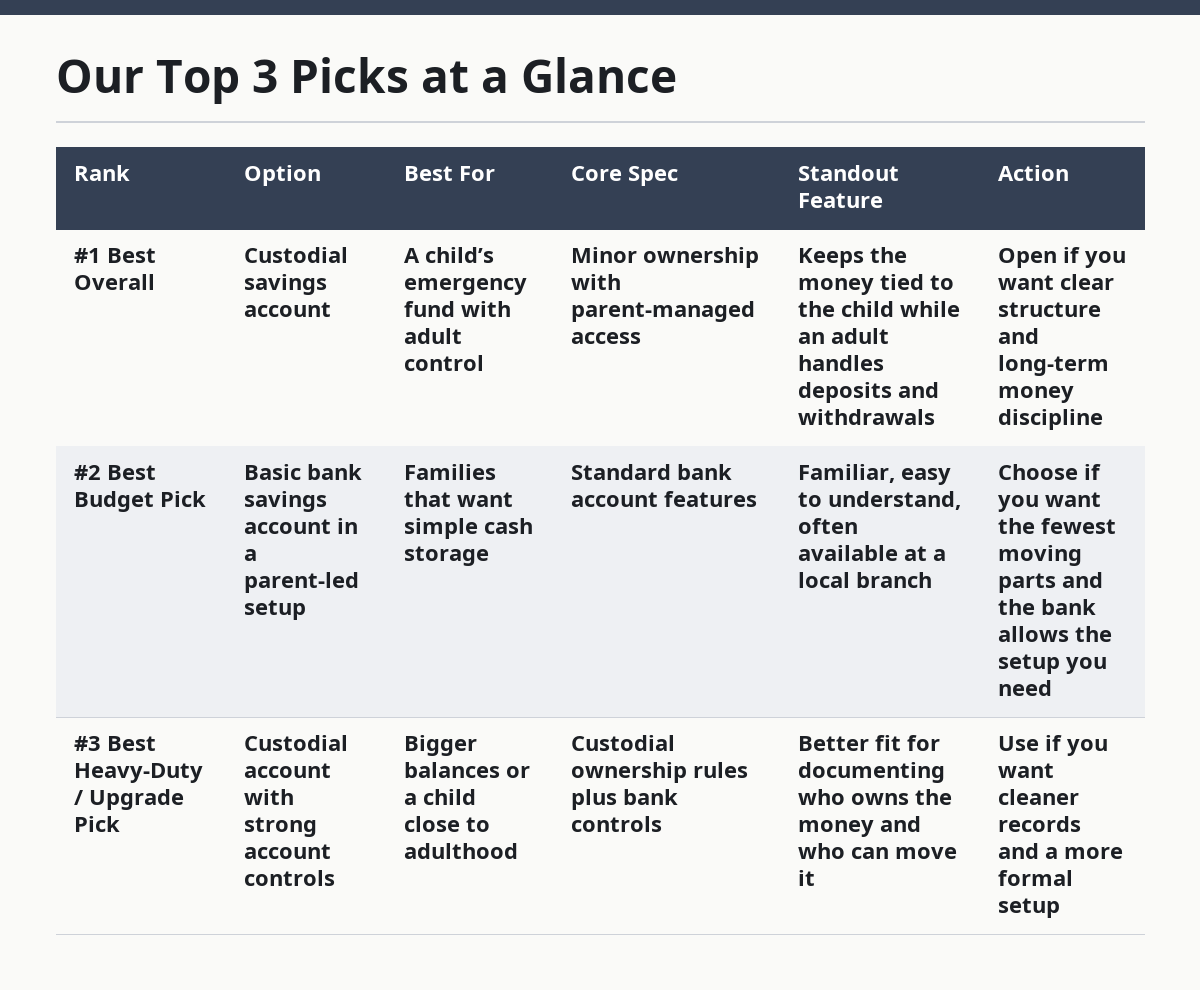
Our Top 3 Picks at a Glance
| Rank | Option | Best For | Core Spec | Standout Feature | Action |
|---|---|---|---|---|---|
| #1 Best Overall | Custodial savings account | A child’s emergency fund with adult control | Minor ownership with parent-managed access | Keeps the money tied to the child while an adult handles deposits and withdrawals | Open if you want clear structure and long-term money discipline |
| #2 Best Budget Pick | Basic bank savings account in a parent-led setup | Families that want simple cash storage | Standard bank account features | Familiar, easy to understand, often available at a local branch | Choose if you want the fewest moving parts and the bank allows the setup you need |
| #3 Best Heavy-Duty / Upgrade Pick | Custodial account with strong account controls | Bigger balances or a child close to adulthood | Custodial ownership rules plus bank controls | Better fit for documenting who owns the money and who can move it | Use if you want cleaner records and a more formal setup |
| Product / Option | Best For | Core Spec | Standout Feature | Action |
|---|---|---|---|---|
| Custodial savings account | Child-owned savings with parent oversight | Minor child is the owner; parent acts as custodian | Clear split between ownership and control | Open if the goal is a true child savings account for emergencies |
| Basic bank savings account | Simple cash storage with easy access | Standard bank account setup | Easy to explain and manage | Use if the bank can set up access the way you need |
| Custodial account with account alerts | More oversight and recordkeeping | Custodial structure plus alerts or transfer limits | Better paper trail for deposits and withdrawals | Choose if you want tighter control and cleaner tracking |
Picture this: you want a place for a child’s emergency money that is easy to reach, but not too easy to spend. The right choice is not just “a savings account” — it is the account type, the ownership setup, and the access rules.
Here’s the catch: if the parent and child names are not set up correctly, the money can end up in the wrong legal bucket.
How do I choose the right emergency fund account for a minor child?
Choose the account by matching ownership, access, and purpose before you look at yield or branch convenience. For a minor child’s emergency fund, that usually means a custodial savings account or another bank account that clearly lets the parent manage the money without pretending the child can run it alone.
Start with one question: who should legally own the money? In a custodial account, the minor child is the owner and the parent is the custodian. That split matters because it changes who controls the funds and how the money should be used. If you want the account to teach saving while still keeping adult control, this structure is the cleanest fit. For an account that is meant to stay with the child, a custodial savings account is often the clearest setup.
Now decide how the money may be spent. Emergency funds are not for toys, school trips, or routine wish-list buys. They are for real needs such as a replacement bus pass, a broken pair of glasses, or a short gap before the next paycheck from a teen job. The account should make that use easy to track.
- Choose the ownership type — decide whether the money should sit in a custodial account or a standard bank account, and expect the legal owner to match that setup.
- Check parent access — confirm the parent can deposit, view, and withdraw money without delays, paper forms, or guardian-only hurdles.
- Set the use rule — write down what counts as an emergency, so withdrawals have a clear purpose.
- Review the bank’s controls — look for alerts, transfer limits, and ATM or debit access, then expect fewer impulse withdrawals.
- Pick the storage style — choose savings if you want liquidity, or avoid tying the money up where it can’t be reached fast.
A simple savings account at a bank can work if the bank sets it up correctly. But if the title, control, and access do not line up, the wrong account becomes a paperwork headache fast.
What makes a custodial savings account different from a regular bank account?
A custodial savings account is different because the child owns the money while the parent controls it until the child reaches the age set by state law. That is the feature that makes it useful for a minor child’s emergency fund, and it is also the part that creates the most confusion.
A regular bank savings account is easier to picture, but it may not solve the ownership question on its own. Some banks let a parent open and manage an account for a minor in the child’s name. Others may require a custodial form, a joint setup, or a parent as the sole signer. The account label matters less than the legal structure behind it. For readers comparing options, custodial accounts for children explain the difference in more detail.
The truth is, a lot of generic advice misses this point and talks only about “putting money in a savings account.” That advice skips the real issue: who can move the money, who gets the tax record, and what happens when the child is older. A custodial account answers those questions better than a vague family savings pile.
Important things to compare:
- Ownership: the child owns the custodial account.
- Control: the parent manages deposits and withdrawals.
- Access timing: the child’s rights change at adulthood or the state’s transfer age.
- Paper trail: the bank should show who is custodian and who is minor owner.
This is also why a custodial account is a poor fit if you want to keep the money fully under adult ownership for a household emergency. The account belongs to the child, not the parent. That is the trade-off.
On the flip side, if you want the child’s emergency money to stay clearly separate from the parent’s own savings, custodial ownership can help. It creates a clean line on paper and in practice. For a parent-led alternative, see our page on parent-controlled savings accounts.
Which bank features matter most for a child emergency fund?
The most important bank features are easy parent access, low friction for deposits, and strong limits on casual spending. For a minor child’s savings, the bank should make emergency use simple without turning the account into a pocket-money machine.
Look at how the account is handled online and in branch. Can the parent move money with a few clicks? Can the child see the balance without being able to spend it? Does the bank support alerts for withdrawals over a set amount? Those details matter more than a shiny app screen.
Here’s a practical filter:
- Parent access: the parent should be able to get to the account without a six-step approval chain.
- Withdrawal rules: the bank should show exactly who can withdraw and under what terms.
- Savings format: a savings account is usually better than a checking account because it reduces impulse use.
- Branch support: if you want in-person help, a local branch can save time when forms or identity checks come up.
- Recordkeeping: statements should be clear enough for a parent to explain the money later.
A common mistake is choosing the account with the easiest debit card access. That feels convenient, but it often weakens the whole point of an emergency fund. If money can be spent as easily as it can be saved, the account starts acting like a spending account.
A better choice is a plain savings account with limited access and clear alerts. That gives you speed in a real emergency and friction everywhere else. The friction is the feature.
If the bank offers more than one minor-friendly setup, ask which one creates a true custodial relationship and which one is just a parent-controlled savings product. Those are not the same thing, even if they look close on the website. If you are comparing institutions, start with the bank’s official account terms and the Consumer Financial Protection Bureau guide to savings accounts.
How should a parent set up control without making the money hard to use?
A parent should set up control with one rule: easy for emergencies, hard for impulse spending. That balance is the whole point of a child’s emergency fund, and it works best when the account has a simple access rule from day one.
First, decide who can move the money. If the parent is the custodian, then the parent should be the only person with withdrawal authority. If the child is old enough to help track the balance, give the child visibility, not spending power. That teaches the purpose of the account without handing over the keys too early.
Then write down what counts as an emergency. Keep it short. A cracked laptop needed for school. A lost transit card. A same-week need tied to health, school, or basic transport. If the reason takes a week to justify, it probably does not belong in the account.
Use these setup habits:
- Keep the emergency fund in one account so it is easy to find.
- Label the account in a way that makes the purpose obvious.
- Review the balance every month so the parent knows whether the fund needs a refill.
- Keep statements and login access in one secure place, and check with a financial professional or your bank about the safest setup.
- Avoid overdraft features that can turn a savings account into a risk point.
Now, you might be wondering if the child should ever be added as a signer. Usually, no — not if the goal is parent control. A child signer can be useful in older teen setups, but it muddies the line for a true emergency fund and can make withdrawals too easy.
This is not the right setup if the money is meant to be fully under the child’s control for a college budget or a long-term gift. That is a different job. This page is about emergency storage, not long-term transfer planning.
What mistakes cost families the most?
The costliest mistake is choosing an account that makes the money hard to prove, hard to access, or easy to spend. That usually shows up later as confusion about ownership, a surprise withdrawal, or an account that no one can explain well.
A second mistake is using a checking account because it feels convenient. Checking is fine for spending. It is often a bad fit for emergency savings because it makes the money too mobile. The result is not just lower balance — it is blurred purpose.
A third mistake is skipping the parent-child conversation. The money may be small now, but the account teaches habits. If the child never hears why the account exists, every withdrawal looks optional. That can turn a useful fund into a silent spending pool.
Common errors and better moves:
- Wrong ownership form: fix by asking the bank whether the account is custodial or just minor-friendly.
- Too much access: fix by removing debit-style spending if the bank allows it.
- No emergency rule: fix by writing a short list of acceptable uses.
- No tracking: fix by checking the account on a set day each month.
- Choosing yield over access: fix by remembering that emergency money must be reachable, not just well positioned on paper.
A final mistake is forgetting what happens as the child grows up. The account may need to change later, especially as the minor approaches the age when control shifts. If that transition is ignored, a once-clean setup can become messy fast.
The best move is often boring and clear. Pick the right legal structure, keep the money liquid, and make the rules visible. That usually beats clever account gymnastics.
How do I know the account fits my child’s age and use case?
The account fits when the child’s age, the parent’s control, and the emergency purpose all point to the same setup. A younger child usually needs a pure custodial structure with full parent control, while an older teen may need more visibility and a clearer rule set, but not necessarily spending power.
For a young child, the account should be simple. Savings only. Parent-managed. No debit card if it can be avoided. That keeps the money from turning into pocket change. For a teen, the same account can still work, but the parent may want to explain the balance and the withdrawal rule more often.
Use this quick test:
- If the money is for surprise needs, choose a custodial savings account.
- If the money must stay under adult control, avoid setups that give the child spending authority.
- If the child is old enough to learn from the account, give them a view of the balance, not a free pass to spend it.
- If the emergency fund must stay separate from gifts or allowance, keep one dedicated account.
One more thing: if the family is really trying to manage a household emergency reserve, this is not the right page for that choice. The account for a minor child is a different job than the account for a parent’s reserve. The hub on emergency fund storage choices is the better place for that wider decision.
If the bank cannot explain the setup in plain language, walk away. A good account for a minor child’s savings should be simple enough to explain in one minute.
Can a child’s savings count as emergency savings?
Yes, if the money is set aside for real short-notice needs. A child’s savings can count as emergency savings when the parent has a clear rule for use and the account stays liquid enough to reach fast. It should not be mixed with allowance, wish-list money, or holiday savings.
Who controls a minor’s savings account?
The parent usually controls a minor’s savings account if the account is set up as custodial or under a bank’s minor-account rules. In a custodial account, the minor owns the money and the parent acts as custodian. The exact access rules depend on the bank and the state’s transfer age.
Drafted with AI; not yet reviewed by a person.