How to Use an Emergency Fund for a Medical Bill With Insurance Pending

Last updated: November 20, 2026
A medical bill with insurance pending demands a quick, careful call: use the emergency fund for what you may actually owe, not the full amount on the statement, while the claim is still open. Quick answer: use the emergency fund only for the amount you may owe, not the whole billed charge, while the claim is still open. The steps below show how to check the estimate, pay the provider, and handle any refund.
Key Takeaways
- Pay from emergency savings only after you compare the bill, the insurer’s estimate, and any explanation of benefits.
- Treat the provider’s first statement as a draft until the claim is processed, and check it against the insurer’s claim status or a billing professional’s guidance.
- Keep a record of every payment, claim number, and refund request.
- If the bill is large, unclear, or tied to an appeal, slow down and get the insurer and provider on the same page.
- This information is not financial advice; a qualified adviser can help with your own situation. For claims and benefits questions, consult the insurer, the provider’s billing office, or a qualified professional.
Who this applies to, and what you need first
This applies when you have a medical bill, a pending insurance claim, and emergency cash you may need before the insurer finishes processing. It assumes you already have the provider’s statement, your insurance card, and a rough idea of your deductible, copay, and coinsurance.
Picture a familiar mess: you’ve had care, the provider has sent a bill, and the insurer still has the claim under review. You want to avoid late fees, but you do not want to overpay before the explanation of benefits arrives. That timing gap is the whole problem.
If your bill is tied to an appeal, a denied claim, a coding dispute, or a hospital stay with several line items, the process still starts here, but the risk of paying the wrong amount is higher. In those cases, the provider’s billing office and the insurer’s member services line matter as much as the emergency fund itself. Sloppy timing gets expensive fast.
- Have the medical bill in hand.
- Have the claim number, if you have one.
- Know whether the service should hit your deductible, copay, or coinsurance.
- Know whether the insurer has sent an explanation of benefits yet.
The provider’s first statement is not always the final amount due. Claims can be reprocessed, adjusted, or denied after that first bill lands.
How do I use emergency savings for a medical bill with insurance pending?
Use it to cover the amount you can reasonably expect to owe, then adjust once the claim is finalized. If the account is urgent and the bill is due in 15 or 30 days, paying the likely share can keep the account current while the insurer finishes review.
Picture the tug-of-war: the provider wants payment now, but the insurer has not issued the explanation of benefits. Paper trail beats haste here. The goal is to pay a legitimate balance without treating an estimate like a final verdict; if the number is fuzzy, ask the insurer or a billing professional before paying more than you can verify.
- Verify the provider statement, the claim status, and the service date before moving any money. Check the bill for the patient name, date of service, account number, and the amount billed; then confirm the claim is marked pending, under review, or processing. If any of those fields don’t match, stop and call the billing office.
- Compare the bill with the plan terms you already have, including deductible, copay, and coinsurance. Use the plan summary or benefits sheet, not a guess. If the service usually requires a 20% coinsurance after the deductible, but you don’t know whether the deductible is met, the estimate is still incomplete.
- Request an estimated out-of-pocket amount from the provider or insurer if the number is missing. Ask for the probable patient responsibility in writing, even if it is only a range. If nobody will give one, that’s a sign the bill is too unsettled to pay in full from savings.
- Set aside only the estimated patient share from the emergency fund in a separate savings bucket or transfer line. Do not empty the fund for the entire billed charge unless the bill is clearly the full amount you owe. If the estimate changes by a large margin, you may have set aside too much or too little.
- Pay the medical provider only the amount that matches the estimate or the due amount on the statement if the claim is already reflected there. Use the account number exactly as printed. If the provider says the payment will be posted as a prepayment or credit, ask how refunds are handled.
- Document the payment, the date, the method, and the claim status in one place. Keep the bill, the explanation of benefits, and any portal screenshots together for at least the length of the billing cycle. If you can’t trace the payment later, refunds get messy.
- Reconcile the emergency fund after the explanation of benefits arrives. Compare what you paid with what the insurer says you owe, then match any difference to a credit balance, refund, or remaining balance. A mismatch means the claim, the coding, or the provider posting still needs review.
Honestly, the emergency fund is a bridge, not a verdict.
What should I check before I pay?
Check four things before you pay: whether the claim is truly pending, what the insurer expects you to owe, what the provider says is due, and whether the bill can change after processing. That last point matters most for a medical bill with insurance pending.
Picture the trap: the provider portal shows a balance, the insurer says the claim is still processing, and you want to wipe it out so it stops nagging you. One wrong click can leave you with a credit balance that takes weeks to unwind.
- Explanation of benefits: this is the insurer’s notice of how the claim was priced. It is not always a check or a final bill.
- Pending claim: the insurer has not finished processing the service, so the final amount may still change.
- Provider billing: the office that sent the bill may bill before the insurer posts its final share.
- Estimated out-of-pocket cost: the amount you think you may owe after deductible, copay, and coinsurance rules are applied.
When the medical provider and the insurer give different numbers, ask for the claim line items, not just the total. A hospital bill with several services can split into separate pieces, and one piece may process before another. That part often looks like a hairball on paper.
What if the bill changes after I pay it?
If the bill changes after you pay, the difference should become either a refund or a remaining balance. Depending on the provider’s billing policy and state rules, the office may post a credit, mail a refund check, or apply the overpayment to another account.
Picture this: you paid the estimated share from emergency savings, then the explanation of benefits arrives and the patient responsibility is lower by a real amount. The work shifts from paying to reconciling. Small differences happen when the insurer applies negotiated rates or changes a line item.
Do not assume an automatic refund. Some medical providers hold credits on account until you request them, and some need the insurer’s final adjudication before they release money.
- If the EOB shows you owe less, ask the billing office to apply the overpayment correctly.
- If the EOB shows you owe more, pay the remaining balance from the emergency fund only after confirming the math.
- If the EOB shows zero patient responsibility, request a refund in writing and save the confirmation.
- If the bill and EOB disagree on a code or service line, ask for the claim to be reviewed before sending more money.
This is where records matter. Keep the account number, claim number, payment date, and the names of anyone who touched the case.
When should I stop and get help with the bill?
Stop when the bill is too unsettled to estimate, because paying the wrong amount can take longer to fix than waiting for the claim. That is especially true when the balance is large or the service is being appealed.
Picture the awkward spot: your emergency fund could cover the bill, but the paperwork is still moving. In that moment, speed is not progress. The wrong payment can create a credit balance, a new dispute, or a collection notice that should not exist.
The claim was denied: the insurer has not agreed to pay yet — ask the provider and insurer why before paying more than a minimal amount.
The bill shows multiple service lines: one line may process differently from another — verify each line instead of paying the whole statement.
An appeal is pending: the patient responsibility may change after review — wait for the appeal result or ask for a written estimate.
The provider says the bill is final but the EOB has not arrived: the account may still change — request a billing hold or a detailed estimate.
You cannot match the bill to the service date or claim number: the payment may land on the wrong account — pause and ask for a corrected statement.
The amount is larger than one month of your emergency cash: the withdrawal may weaken the fund too much — split the issue into billing review and funding plan.
On the other hand, if the amount is small, the claim is clearly pending, and the estimate lines up with your deductible or coinsurance, paying the expected share can keep the account from aging.
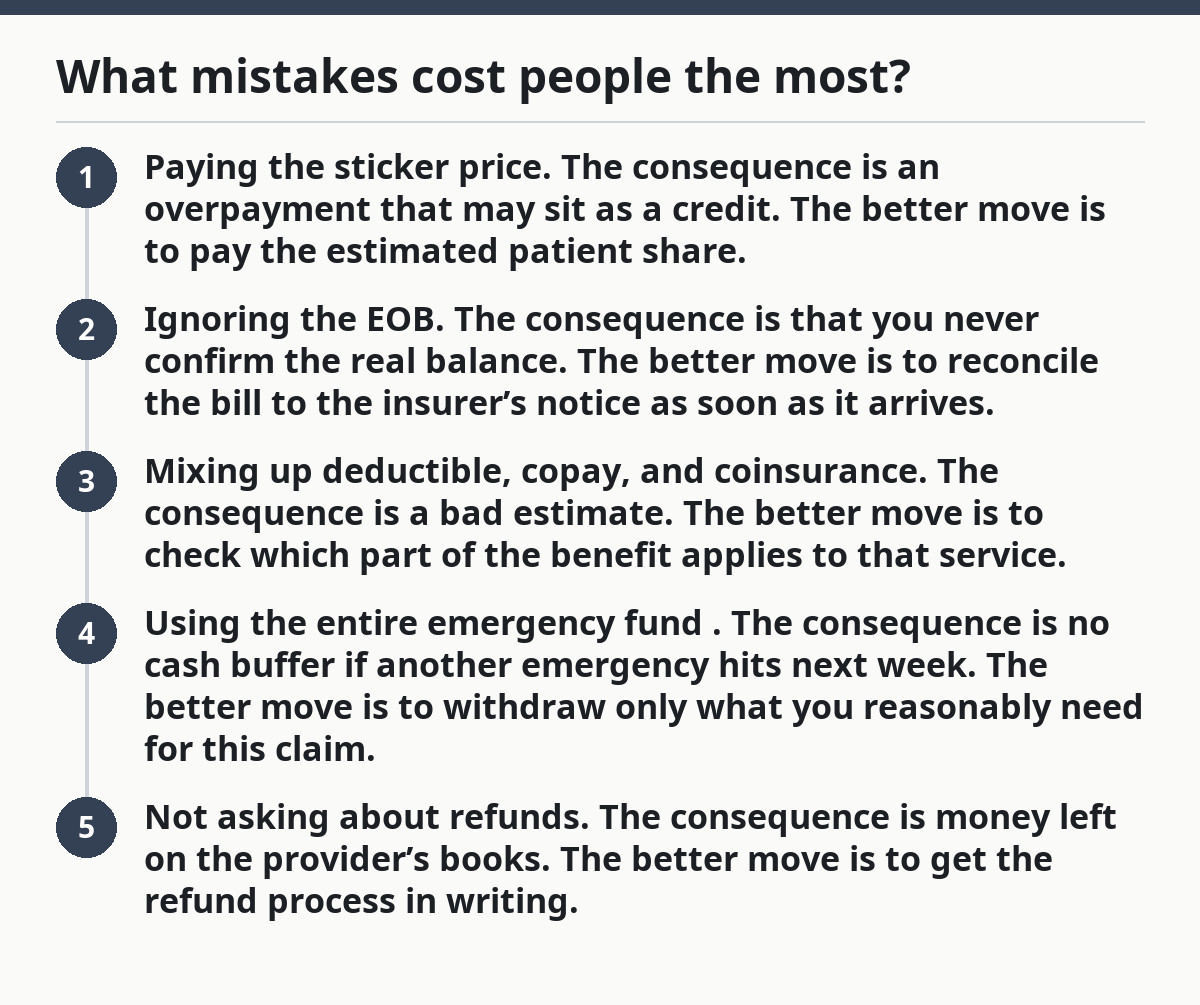
What mistakes cost people the most?
Paying the full billed amount before the claim is processed is the biggest mistake. It can pin cash down for weeks and force you to chase a refund later.
Picture the common blunder: you try to be responsible and clear the whole statement. Then the insurer prices the claim at a lower allowed amount, and the provider owes you money back. If you do not reconcile promptly, that overpayment can sit there like a brick.
- Paying the sticker price. The consequence is an overpayment that may sit as a credit. The better move is to pay the estimated patient share.
- Ignoring the EOB. The consequence is that you never confirm the real balance. The better move is to reconcile the bill to the insurer’s notice as soon as it arrives.
- Mixing up deductible, copay, and coinsurance. The consequence is a bad estimate. The better move is to check which part of the benefit applies to that service.
- Using the entire emergency fund. The consequence is no cash buffer if another emergency hits next week. The better move is to withdraw only what you reasonably need for this claim.
- Not asking about refunds. The consequence is money left on the provider’s books. The better move is to get the refund process in writing.
A provider refund fixes only part of the problem if the claim was overpaid. Keep the claim number and the paper trail.
How this fits the rest of your emergency fund plan
This situation follows the same withdrawal and replenishment rules you’d use for any emergency fund, but the medical bill adds a second clock: the insurer’s processing time. So the question is not just “Can I pay it?” but “How much of it is actually mine?”
Picture the point of the fund: it is for real shocks, not just invoices. A medical bill with pending insurance belongs in that bucket only if you can separate the likely patient responsibility from the billed charge.
The refund side matters just as much as the payment side. If you get money back after the claim settles, move it back into the emergency fund unless you already assigned it to another documented expense. That keeps the fund honest and makes the next medical bill easier to handle.
FAQ
Should I pay a medical bill from emergency savings before insurance settles?
Yes, if you are paying the estimated amount you may owe, not the full billed charge. The bill can still change until the explanation of benefits arrives, so the safest move is to match your payment to the best written estimate you can get from the provider or insurer.
What if my medical bill changes after I pay it?
Then the account should be adjusted to reflect the final claim result. If you overpaid, ask the provider how refunds are issued and whether the credit will be sent back or held on account. If you underpaid, confirm the remaining balance before sending more emergency cash.
How do I avoid overusing emergency savings for healthcare costs?
Only withdraw what matches the likely patient responsibility, and leave the rest of the fund alone. Compare the provider bill, the pending claim, and the explanation of benefits when it arrives. If the numbers still don’t line up, pause before you move more money.
Sources to check
For plan rules and claim handling, the U.S. Department of Labor’s employee benefits pages and your health insurer’s own member materials are useful starting points. For billing disputes and rights, your state insurance department can also help, since rules differ by country and often by state.
Drafted with AI; not yet reviewed by a person.