Last updated: November 19, 2026
Key Takeaways
- Set your fund goal by covering the longest likely gap in seasonal pay.
- Protect the bills that would create a crisis if income stopped.
- Base the target on lean months, then multiply by the months you need to bridge.
- Use peak-season income to fund the account faster, not to skip the fund.
A seasonal worker needs an emergency fund built for the off-season gap—not some random bill that happens to show up in a busy month. How to Set an Emergency Fund Goal for a Seasonal Worker starts with the cash needed to keep housing, food, transport, and minimum debt payments alive between paychecks and between seasons. This guide lays out the math without guesswork. For a general benchmark, the CFPB recommends building savings for emergencies, and the FDIC also emphasizes liquid cash reserves.
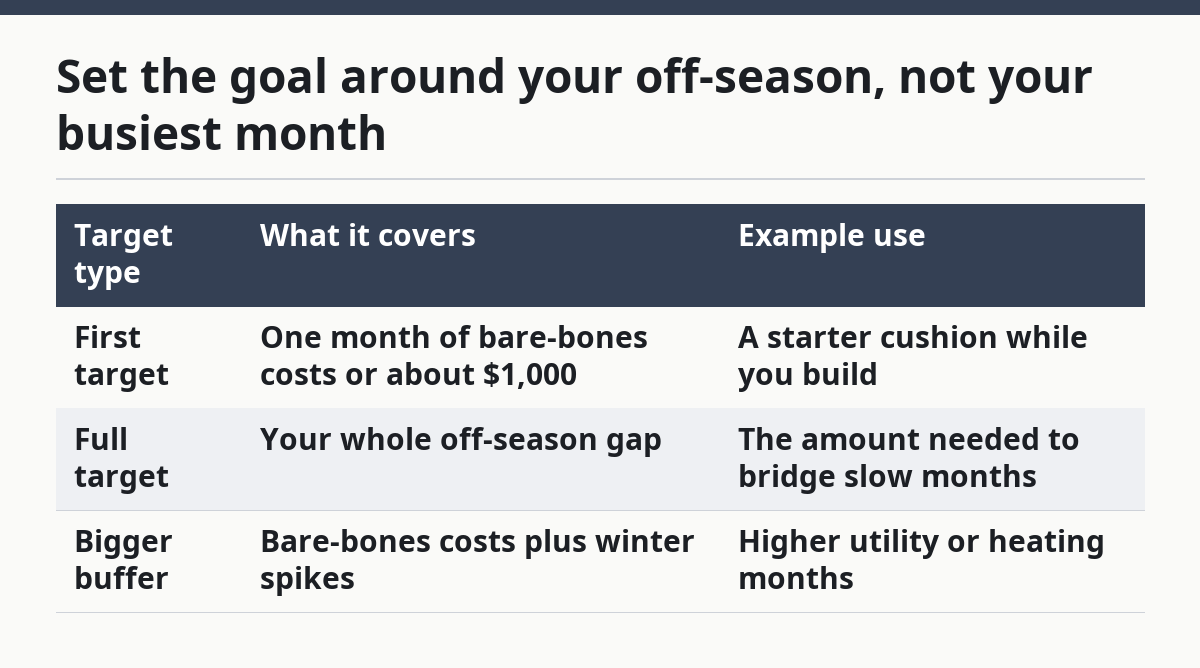
Set the goal around your off-season, not your busiest month
Picture the scene: you’re working flat out for 4 months, money is flowing, and then the season ends. If your next season is not guaranteed on a date, the smartest emergency fund goal for a seasonal income emergency fund plan starts with the longest stretch you might go without steady pay.
So the target should cover 2 to 6 months of bare-bones expenses, depending on how long your off-season usually lasts. More predictable work points to the short end. Uncertain return dates push the number higher.
Start with the monthly amount you must pay to keep life running. Use the figure that keeps the lights on, not the one that reflects a normal spending month.
| Target type | What it covers | Example use |
|---|---|---|
| First target | One month of bare-bones costs or about $1,000 | A starter cushion while you build |
| Full target | Your whole off-season gap | The amount needed to bridge slow months |
| Bigger buffer | Bare-bones costs plus winter spikes | Higher utility or heating months |
- Rent or mortgage
- Utilities
- Groceries
- Fuel or transit
- Insurance
- Minimum debt payments
- Medications or other fixed costs
Multiply that by the months you may need to bridge. If your off-season is 3 months and your lean monthly cost is $2,000, your goal starts at $6,000. If your work dries up for 5 months, the same plan points to $10,000.
But there’s a catch: a seasonal worker’s emergency fund should also reflect how reliable the next season is. A signed contract or a steady return call each year can justify a lower target. If hiring depends on weather, tourism, or grant funding, do not assume the next shift will show up on time. The calendar can turn mean in a hurry.
What should count as a real emergency fund goal?
A real emergency fund goal for seasonal work covers the bills that will hurt you fast if income stops. It does not include vacation money, holiday spending, or a future purchase fund.
The practical move is to separate true survival costs from everything else. That keeps the number honest and keeps you from building a fund that looks large but fails the first time work slows down.
Use this test: if the expense can wait 30 days without creating a crisis, it probably does not belong in the emergency fund number. If skipping it would trigger a late fee, shutoff, eviction notice, or debt spiral, it belongs. For financial-help decisions that affect housing, utilities, or debt, it is wise to review the situation with a qualified professional or nonprofit counselor. The CFPB’s budgeting guidance and HUD housing resources can help you think through urgent bills.
Common costs that belong:
- Housing
- Food
- Transportation to work
- Child care needed to keep working
- Minimum loan payments
- Health coverage premiums
- Basic phone service if jobs depend on it
Costs that usually do not belong:
- Eating out
- New clothes for convenience
- Annual subscriptions you can cancel
- Planned travel
- Home upgrades
Honestly, many seasonal workers underestimate this list because the busy months make everything feel affordable. Then the off-season hits and the fund is short by 1 or 2 full bills. That gap stings.
Build two totals: your bare minimum and your less painful minimum. The first keeps the household alive. The second leaves a little room for delay fees, gas spikes, or one higher utility bill. If those two totals are close, use the higher one.
How do I figure out the right number?
Use your lean months first, then multiply by the number of months you need to cover. That gives you a seasonal income emergency fund plan that matches actual cash flow instead of a generic rule.
Begin with 3 recent months that were slow, not the months when work was heavy. If your pay changes a lot, use 6 months. The goal is to find the amount that keeps you stable when income is weak.
Use this simple method
-
Write down your fixed monthly bills.
Include rent, minimum debt payments, insurance, utilities, and any other expense that does not disappear in the off-season. -
Estimate your lean living costs.
Add groceries, gas, transit, and other basic spending you still need in a slow month. -
Subtract the income you can count on.
Count only money you expect with high confidence, such as a side shift, part-time winter hours, or a known stipend. -
Multiply the gap by the number of months to cover.
If your shortfall is $1,500 and the off-season is 4 months, your target is $6,000. -
Add a small buffer if your bills jump in winter.
Utilities and heating can run higher for a 2- to 4-month stretch, so rounding up is often smarter than aiming for the exact penny total. -
Set a first target and a full target.
A first target can be about $1,000 or one month of bare-bones costs. The full target is the full off-season amount.
That two-step setup matters because a full goal can feel too far away. A smaller milestone keeps the plan moving while still aiming at the real need.
How should peak season income change the goal?
Peak season income should change how fast you fund the account, not whether you need one. In a seasonal job, the busy months are your chance to build the buffer that the slow months will chew through if you ignore them.
This is where income smoothing comes in. You are not trying to make income the same every month; you are trying to turn a high-earning stretch into a stable year. That often means saving a fixed share of each paycheck during the busy stretch.
Decide ahead of time what part of peak season pay goes to the fund. Even 10% to 20% of peak earnings can make a real difference when the season is long enough. If the season is short, the share may need to be higher.
Use peak season for three jobs:
- Cover current bills
- Refill any money spent from the fund
- Build next off-season money before the slowdown hits
The mistake is spending as though the busy months will last forever.
The cash is temporary.
A simple split helps:
- First, cover this month’s essentials.
- Second, put money into the emergency fund.
- Third, only then spend on extras.
If your income arrives in uneven chunks, save from each payment instead of waiting for a “big enough” month. A $300 deposit saved right away is more useful than a perfect plan that never starts. Waiting for ideal timing is a mug’s game.
For the Federal Reserve’s broader approach to emergency savings, see its Report on the Economic Well-Being of U.S. Households.
What mistakes make seasonal workers miss the target?
Seasonal workers miss the target when they build the fund around optimism instead of the off-season. Usually that means the number is too low, the timeline is too vague, or the money gets mixed into spending before the slow months arrive.
The most common mistake is counting peak-season spending as normal spending. Busy months often include more fuel, more meals out, more gifts, and more convenience buys. If those costs sneak into your emergency fund math, the target gets inflated in the wrong direction or, worse, you think you can save less than you really need.
Another mistake is assuming every off-season will be identical. One year may bring a short gap; the next year may bring a 6-month stretch with no work. If you know your field is weather-based, tourism-based, or contract-based, use the longer gap when you set the goal.
A third mistake is treating the emergency fund like a catchall account. That makes the balance look healthy while the real reserve disappears on non-urgent spending. Before using the fund for anything outside a true emergency, it is smart to check the need against your budget or a financial professional’s advice.
-
Wrong move: using the fund for planned car repairs.
Cost: the next real emergency lands with nothing behind it.
Better move: keep a separate sinking fund for known repairs. -
Wrong move: setting one number and never revisiting it.
Cost: rent rises or debt payments change, but the target stays frozen.
Better move: review the goal at the start of each season. -
Wrong move: saving only after the season ends.
Cost: the off-season starts before the account is ready.
Better move: save during the first weeks of peak pay.
If your income is too unstable to make even a rough target, this is still a planning problem, not a failure. It just means the goal should start with your minimum monthly survival costs and a shorter first milestone.
How often should I adjust the goal?
You should adjust the goal at least once a year, and sooner if your rent, debt payments, or season length changes. Seasonal work changes faster than a standard salary job, so a set-it-and-forget-it target goes stale quickly.
The right time to review is before the next busy season starts. That gives you a fresh look at what the off-season will probably require and how much of the fund you still need to rebuild.
Check these items:
- Rent or mortgage changes
- New debts or paid-off debts
- Higher transportation costs
- Child care changes
- Health insurance changes
- A longer or shorter off-season
- A new source of off-season income
If one of those changes moves your monthly bare-bones number by even a few hundred dollars, the emergency fund goal should move too. Over 4 or 5 months, that adds up fast.
You do not need a perfect forecast. You only need a goal that is close enough to protect you from the obvious gap. A seasonal income emergency fund plan works because it is tied to your real calendar, not a generic rule from someone with steady pay.
For a broader framework on setting the size of your reserve, see the hub on Emergency Fund Goal Planning.
How do I know if my goal is too small?
Your goal is too small if one lost month would force you to skip rent, miss minimum debt payments, or borrow just to buy groceries. That is the clearest sign the number does not match your life.
A seasonal worker should look for pressure points, not just the final balance. If the fund would cover 2 months of bills but your off-season usually lasts 4, the goal is too small. If one car repair would wipe out half the account, the goal may also be too thin.
Use these warning signs:
- You would need a credit card for basics in month 2 or 3
- You rely on overtime to cover ordinary bills
- You have no room for higher winter utilities
- You would tap the fund for non-emergencies right away
If the number feels impossible, split it into stages. A first goal of 1 month of survival costs is better than a fantasy target you never touch. Then move to 2 months, then the full off-season amount.
That staged plan is not a shortcut. It is a way to get a real reserve in place while you are still living through the same seasonal pattern that created the problem.
How do seasonal workers save for emergencies?
Seasonal workers save for emergencies by setting a target around the off-season gap, then moving money from peak-season pay into that fund before spending on extras. The safest version is to use a lean monthly budget, multiply it by the months you need to cover, and build the fund in stages if the full goal feels too large at once. A seasonal income emergency fund plan works best when it is tied to your real slow season.
Should I save more during busy months?
Yes, saving more during busy months is usually the point for a seasonal worker. Peak season is the time to fill the gap that the off-season will create, so saving a fixed share of each paycheck makes the plan work faster. If the season is short or the next season is uncertain, the save rate often needs to be higher than a steady-income saver would use.
How do I plan for months without work?
Map your fixed bills, lean spending, and the longest gap between paychecks or seasons. Then set the emergency fund goal to cover that gap, not just the average month. If your field has uneven hiring, give yourself extra room for one more month than you expect, because the cost of being short is usually debt or late fees.
Drafted with AI; not yet reviewed by a person.