Last updated: November 19, 2026
Key Takeaways
- Overtime works best when it has a purpose before it reaches checking.
- Choose an amount you can sustain without breaking your budget.
- Ask payroll about split deposit options before the paycheck is issued.
- Variable overtime can still build savings over time.
Overtime pay can fund your emergency cushion without changing your regular budget. In How to Use Overtime Pay to Build an Emergency Fund, the core answer is simple: send extra hours straight to savings, track the money on your paystub, and leave your base income alone. The steps below show how to set that up, what to do on a 2-week pay cycle, and how to keep the money out of day-to-day spending.
Start by separating overtime from your normal paycheck
Overtime pay works best when it has a job before it lands in your checking account. If you already cover rent, food, and bills with your hourly wages, the extra shift money can be treated as a separate transfer into savings; if your situation is more complicated, consider checking with a payroll professional or financial professional. That keeps the emergency fund growing without forcing you to rebuild your whole budget.
The cleanest move is to decide where each overtime dollar goes before the pay period ends. If your employer offers direct deposit splits, route the overtime portion to a savings account. If not, use a bank transfer the same day the paycheck clears. Either way, the goal is the same: the money should leave checking fast enough that you do not spend it by accident.
-
Check your paystub first. Find the regular hours, overtime hours, rate, and gross pay so you know what part of the check is extra.
When this works, the overtime line stands out clearly, and you can tell the difference between base pay and the surplus. -
Set one rule for the extra money. Pick a percentage or a full-dollar sweep for overtime pay only, not for every paycheck.
When this works, you know exactly where the surplus goes before payday even hits. -
Choose the receiving account. Use a separate savings account if possible, not the account you tap for groceries and gas.
When this works, the emergency fund balance grows without getting mixed into daily spending. -
Move the money within 24 hours. Use a bank transfer or payroll split as soon as the deposit posts.
When this works, the overtime cash is already out of reach when the weekend starts. -
Leave your regular budget untouched. Keep rent, utilities, and minimum debt payments on your normal income.
When this works, the overtime becomes surplus instead of a patch for everyday bills.
A practical way to do this is to split the paycheck or transfer the overtime portion within a day, then avoid spending it unless a real emergency hits. That is the core habit. Not fancy.
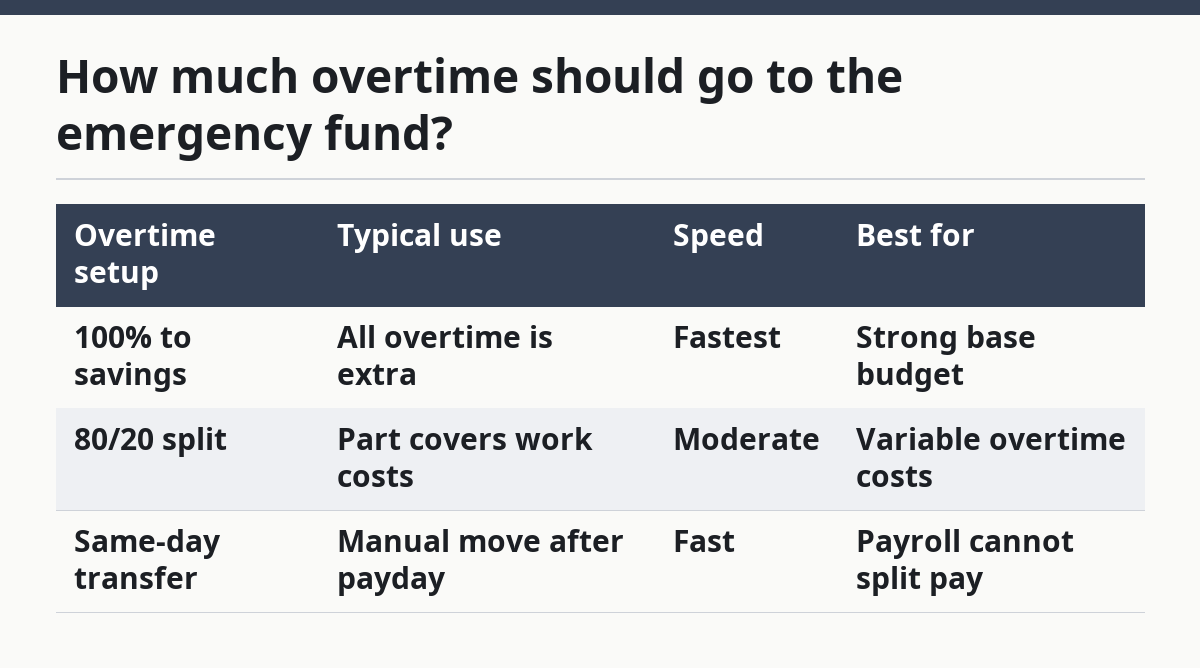
How much overtime should go to the emergency fund?
The amount should be enough to grow the fund without making the plan impossible to keep. Picture this: you get 6 extra hours in a week, but you still need fuel, childcare, and sleep. If you try to save every overtime dollar forever, you may quit the plan the first time your schedule gets hard.
A better approach is to use overtime as a planned surplus allocation. Decide in advance whether the full overtime amount goes to savings or whether a small slice stays available for extra work costs like meals, transit, or laundry. If your overtime pay is inconsistent, a fixed percentage is easier to repeat than a fixed dollar target.
A practical rule looks like this:
- 100% to savings if your base budget already covers normal expenses and overtime is truly extra.
- A split such as 80/20 if overtime creates real costs, like longer commutes or paid parking.
- A temporary full sweep after a stretch of heavy hours, then a pause if fatigue starts to affect the rest of your week.
Here’s the catch: overtime is still wage income, so it can disappear fast if you treat it like found money. Consult a payroll or tax professional if you are unsure how it should be handled, and check the IRS guidance on wages and withholding if you need help reading a paystub. The point is to assign it the same day you earn it. If the overtime is small, save it anyway. A $75 transfer still matters when the emergency fund starts at zero.
One useful check is this: if saving the overtime leaves you unable to cover your next normal payday, the plan is too aggressive. Lower the percentage, not the habit. The fund should grow in a way you can keep for the next 3 months, not just the next pay cycle.
| Overtime setup | Typical use | Speed | Best for |
|---|---|---|---|
| 100% to savings | All overtime is extra | Fastest | Strong base budget |
| 80/20 split | Part covers work costs | Moderate | Variable overtime costs |
| Same-day transfer | Manual move after payday | Fast | Payroll cannot split pay |
How do I set up direct deposit splits for overtime pay?
You set up direct deposit splits by telling payroll where the extra money should go before the paycheck is issued. Picture this: your hourly wages still land in checking for bills, while the overtime portion goes straight to savings with no extra step from you. That is the cleanest setup if your employer’s payroll system allows it.
Start by asking payroll whether direct deposit can be split by percentage or by flat amount. Some systems let you send a set percent of every deposit to a savings account. Others only allow a single account per paycheck. If your payroll setup can’t separate regular pay from overtime pay, use a bank transfer after payday instead.
A good setup usually has these pieces:
- One checking account for monthly bills and spending
- One savings account labeled for emergencies
- One payroll rule that sends overtime money away first
- One weekly review of the paystub so you can confirm the deposit matched the hours worked
The key check is simple: after payday, your checking balance should look like normal wages only, and the savings account should show the overtime deposit or transfer. If the overtime is landing in checking and getting spent, the payroll setup is not doing its job.
The truth is, not every employer can split by type of earnings. In that case, the fix is manual but still effective. Transfer the overtime amount after each deposit, or set an automatic transfer for the day after payday. A 1-day lag is still far better than waiting until the end of the month.
For payroll details, the IRS explanation of wages and withholding terms can help you read a paystub more clearly, and the Consumer Financial Protection Bureau has plain-language guidance on using separate accounts and automatic transfers. For employer setup details, your payroll provider’s help center can also show whether a direct deposit split is possible.
What if my work schedule changes every week?
You still can build the fund if the overtime amount changes from paycheck to paycheck. Picture this: one week brings 10 extra hours, the next brings none, and then a holiday shift appears at the last minute. The fix is not a perfect formula. It is a repeatable habit.
Use a simple trigger tied to each paycheck, not to your schedule. Every time overtime hits, move that amount to savings within 24 hours. If you only get small bursts of extra pay, add them together by pay period instead of trying to save per shift. That keeps the process easy enough to follow even when your work hours swing.
A schedule-based plan works well in three parts:
- Treat overtime as irregular income. Do not build your regular budget around it.
- Send each overtime deposit to savings on arrival. Small transfers count.
- Review the last 2 pay stubs before each month ends. That shows whether your extra hours are helping the fund or just filling the checking account.
If your overtime changes because of seasonal work, a project deadline, or staffing gaps, the real risk is spending the money before it has a job. A separate savings account solves that faster than willpower does. If you need the money for a short-term expense next week, keep that money out of the emergency fund and label it for the actual bill instead.
Not all schedule spikes should go to savings at full speed. If extra hours are cutting into sleep or childcare, save what you can and stop there. The emergency fund should protect your life, not wreck the week that funds it.
Should bonuses and overtime be handled the same way?
No, bonuses and overtime should not always be handled the same way because they do different jobs in your budget. Picture this: overtime pay comes from extra hours on your timecard, while a bonus may show up once a quarter and may be taxed differently on the paystub. Both can help the emergency fund, but they do not need the same rule.
For overtime pay, the best rule is usually automatic: save it when it lands. For a bonus, the better move is to divide it on purpose. You might send one part to the emergency fund, one part to a repair bill, and one part to a goal that keeps you from raiding savings later. That is still disciplined. It just reflects the size and timing of the money.
Use this quick filter:
- Overtime pay: treat as planned surplus and move it fast.
- Small bonus: send most or all to savings if the emergency fund is thin.
- Large bonus: split it if one expense is already waiting, like car repairs or insurance.
The best part? You do not need the same percentage forever. If your emergency fund is just starting, a bonus can fill the gap faster than overtime alone. Once the fund has a decent cushion, overtime can keep it growing while leaving your normal paycheck alone.
If you are using a bonus to fund the emergency account, make sure you are not mixing up short-term wants with true emergencies. A bonus can be a strong push. It should not become a reason to spend overtime on things that do not belong in the fund.
Common mistakes that slow the fund down
The biggest mistake is letting overtime drift into normal spending. Picture this: the extra shift pays for dinner out, a new gadget, and a larger streaming bill, and two weeks later the emergency fund is still empty. That is how overtime disappears without doing any real work.
The second mistake is waiting to see what is left at the end of the month. By then, the money has usually already been assigned to something else. A third mistake is saving only big overtime checks and ignoring the small ones. That turns a steady tool into an occasional rescue.
Here’s the fix for each one:
-
Mistake: using overtime like spending money.
Cost: the fund never grows.
Do instead: transfer it the day you get paid. -
Mistake: relying on memory.
Cost: missed transfers and messy checking balances.
Do instead: set a payroll split or an automatic bank transfer. -
Mistake: saving only when the overtime feels “worth it.”
Cost: slow progress and broken habits.
Do instead: save every overtime deposit, even a small one. -
Mistake: building the emergency fund from overtime alone.
Cost: progress stops whenever hours get cut.
Do instead: use overtime as a boost, not the only source.
The truth is, overtime is temporary income. That makes it powerful, but it also makes it shaky. If your schedule changes, the extra money can vanish next month. So the habit has to be simple enough to survive a lean pay period.
For a fuller system that pairs well with this approach, see the hub on Emergency Fund Funding Tactics and the CFPB’s guidance on automatic savings.
The cleanest overtime-to-savings setup
The cleanest setup is one separate savings account, one paystub check, and one transfer rule that happens every payday. Picture this: the overtime money lands, you confirm it on the paystub, and the bank transfer moves it before you can spend it. That is enough for most people.
A good finish looks like this:
- Your base pay still covers normal life
- Your overtime pay goes to savings first
- Your emergency fund grows in a separate account
- Your checking account stays predictable
If you want the shortest possible version, use this rule: overtime earns the right to leave checking immediately. That keeps your emergency fund from competing with groceries, gas, and weekend spending. It also makes the process automatic instead of emotional.
The point is not to save overtime perfectly. The point is to make overtime useful the moment it arrives. That’s how a few extra shifts turn into a real cushion.
Should overtime go to savings or debt?
Overtime should go to the place that protects your monthly budget first. If you have no emergency cushion, sending overtime to savings is usually the cleaner move because it keeps a small surprise expense from becoming a new debt. If a debt is costing you fees or late charges right now, that can change the order, so check the full budget picture.
How much overtime should I save?
Save the amount that fits your schedule and still leaves you able to work the next week. For many people, that means saving all of it or most of it and adjusting only when overtime creates real extra costs like transportation or meals. A stable habit matters more than a perfect percentage.
How do I keep overtime money separate?
Keep overtime money separate with a dedicated savings account and a transfer rule that happens on payday. If your payroll system allows direct deposit splits, use that first. If it does not, move the overtime amount out of checking within 24 hours so it does not get folded into normal spending.
Drafted with AI; not yet reviewed by a person.