Last updated: November 19, 2026
Your first emergency fund target from zero should be a small, reachable starter amount tied to one month of essential expenses, not your full fund. Pick a first milestone you can hit in 30 days to 3 months, then raise it later. The sections below will help you choose the number, the order, and the starting point.
Key takeaways
- Your first target should be small enough to reach, not so small that it feels pointless.
- A starter fund works best when it covers one month of essentials or a clear first milestone you can actually save to.
- If your budget is tight, begin with the lowest useful amount and build from there.
- The right target is the one you can fund without turning to credit cards or missing rent.
- A starter fund is a bridge, not the finish line.
What should my first emergency fund goal be?
Your first emergency fund goal should be one month of essential expenses or a smaller first milestone you can hit fast. If you are starting from zero, a small buffer can help with a repair or a medical copay before a bigger fund exists.
The key is to think in monthly essential expenses, not in vague “savings” terms. Essentials are the bills you must pay to keep life moving: housing, food, utilities, transportation, minimum debt payments, and basic insurance. The goal is to make the first target large enough to matter, but not so large that you quit before you begin.
A starter target often falls into one of these buckets:
- $500 for a very small first buffer
- $1,000 as a common starter milestone
- 1 month of essentials if your fixed costs are modest and you can reach that amount without dragging it out for a year
You do not have to pick the final number now. You only need a first stop that keeps you out of panic mode.
If the target feels impossible, it’s too big for a first month. If it feels meaningless, it’s too small to change behavior.
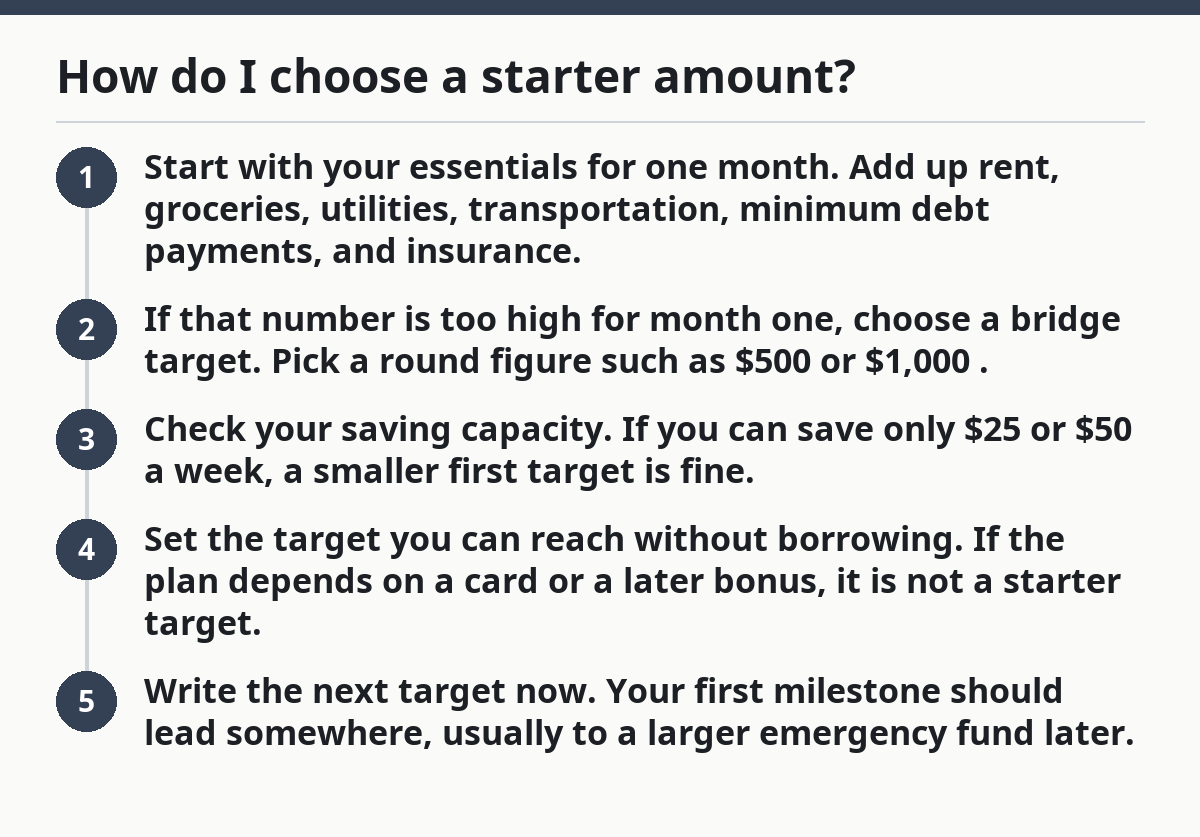
How do I choose a starter amount?
Your starter amount should be the smallest number that would stop a normal surprise from turning into debt. If you face a flat tire, a prescription copay, a broken phone charger, or a utility bill you didn’t expect, the first target should help with that kind of ordinary problem.
Here’s the catch: many generic articles jump straight to “3 to 6 months” and skip the part that matters when you are at zero. That advice can be true later and useless today. If you need to restart your savings habit, your first goal should be close enough to feel real in 30 days, not abstract enough to collect dust.
Use this order to choose the number:
- Start with your essentials for one month. Add up rent, groceries, utilities, transportation, minimum debt payments, and insurance.
- If that number is too high for month one, choose a bridge target. Pick a round figure such as $500 or $1,000.
- Check your saving capacity. If you can save only $25 or $50 a week, a smaller first target is fine.
- Set the target you can reach without borrowing. If the plan depends on a card or a later bonus, it is not a starter target.
- Write the next target now. Your first milestone should lead somewhere, usually to a larger emergency fund later.
A clean starter amount is one you can explain in one sentence: “I’m trying to save my first $1,000,” or “I’m building one month of essentials first.” That sentence matters because it keeps the goal concrete.
How do I pick the number if I’m starting from zero?
You pick the number by matching it to your cash flow, your bill pressure, and how fast you can save in real life. If you have no cushion, two or three bills hit on the same week, and every extra dollar already has a job, the right number is the one that creates motion, not guilt.
If you are at zero, the first month target should do one of two things: protect you from the most likely small shock, or give you a fast win that changes your habits. That is why people often use a simple range instead of a precise formula. It keeps the goal useful without pretending your situation is normal.
A practical way to choose:
- Very tight budget: start with $250 to $500
- Some room to save: aim for $500 to $1,000
- Steady income and low fixed costs: use one month of essentials
- Irregular income or unstable work: keep the first target smaller and easier to finish
If you want a simple test, ask this: “What amount would make a minor emergency annoying instead of damaging?” That answer is usually your starting number.
Don’t make the common mistake of picking a figure because it sounds responsible to other people. A starter emergency fund is not a status symbol. It is a tool for the month you are in now.
The first-month target that actually works
The first-month target that actually works is the one you can save in 4 to 12 weeks without blowing up the rest of your budget. If you set a target so large that every setback resets you to zero, you may end up with no progress to show after three months. That kind of goal trains quitting.
The truth is, your first-month target needs to fit your real savings rate. If you can set aside $25 a week, then a first goal of $100 or $200 may be the right opening move. If you can save $250 a month, then $500 may be reachable in two months, and $1,000 may be the better first milestone if you can sustain it.
A useful starter fund target should have these traits:
- It is specific: a dollar amount, not “some savings”
- It is short-range: something you can picture finishing soon
- It is useful: enough to cover a real small emergency
- It is repeatable: you can keep saving after the first target is hit
The wrong target has the opposite traits. It is vague, too large, and hard to connect to daily life.
If you need a name for the goal, call it your starter fund. That phrase tells you it is phase one, not the full job. It also makes it easier to keep going after you hit the first number.
A simple way to set your number in 10 minutes
You can set your first emergency fund target in 10 minutes by listing essentials, choosing a ceiling, and picking a dollar amount you can hit on purpose. If you sit down with a notebook, bank app, or phone notes, you can choose a number before the evening gets away from you. You do not need a perfect budget. You need a working target.
Use this procedure:
- Write down your monthly essentials: housing, food, utilities, transportation, minimum debt payments, and insurance.
- Circle the bills you cannot skip for 30 days. That tells you what survival looks like.
- Pick a starter ceiling: $500, $1,000, or one month of essentials, whichever fits your situation best.
- Check your monthly savings capacity. If you can save $50 a week, the target must respect that pace.
- Choose the number that feels hard but possible. If you hesitate for more than a minute, the target is probably too large.
- Write your next step under it, such as “After this, I move to a larger emergency fund.”
This method keeps the decision from drifting into perfect-planning mode. You are not solving the whole savings problem. You are choosing the first marker on the road.
The number can change later. Your starter target is a working draft, not a life sentence.
Common mistakes that make the first target fail
The wrong starter target usually fails because it ignores your actual budget, not because the idea of an emergency fund is bad. If you pick a number that sounds responsible, then miss it every month and start treating the whole plan like a lost cause, the target itself is creating the motivation problem.
Three mistakes show up over and over:
- Picking the full fund first. A target that belongs to a later stage can take months or years, which is too long when you are starting from zero.
- Choosing a random round number with no link to bills. If you pick $2,000 without knowing why, the goal can feel fake and hard to defend when money gets tight.
- Making the first target so tiny that it does nothing. A $50 goal may feel easy, but it may not change your day-to-day risk at all.
Here’s the better move: choose a target that reflects your closest real emergency. For many people, that is a $500 to $1,000 buffer or a small slice of essential expenses. For others, the first milestone is simply one month of key bills, because that matches their cash flow and life costs.
A starter fund also needs a landing spot. Put it in a separate savings account if you can. If the money sits next to spending cash, the target gets blurry fast.
How this fits with the larger emergency fund plan
Your first-month target is the opening stage of the bigger emergency fund plan, not the whole plan itself. If you reach your first milestone, breathe easier, and then wonder whether to stop or keep going, the answer is to keep the same habit and raise the bar one step at a time.
This page sits inside the larger Emergency Fund Goal Planning process because the first target only makes sense when it has a next target. The opening number should give you traction; the later numbers can build real protection. See also How Much Emergency Fund Should I Have? and How to Build an Emergency Fund Fast.
A good next-step pattern looks like this:
- Hit your starter target
- Keep saving the same amount each month
- Raise the target in stages
- Let your savings goal grow with your income and bills
That way, you are not trying to leap from zero to a polished final answer in one jump. You are building a habit that can survive a bad week, a car bill, or a month with extra expenses.
The real win is not the first number by itself. It is the fact that you now have a number, a place to start, and a plan that can survive ordinary life.
What should my first emergency fund goal be?
Your first emergency fund goal should be a starter amount that you can reach without strain, such as $500, $1,000, or one month of essentials. The right choice depends on your bills and how quickly you can save. If the number makes you freeze, it is too big for a first goal.
How do I choose a starter amount?
Choose the smallest amount that would keep a small surprise from turning into debt. A good starter amount matches your monthly essentials and your savings pace, not what sounds impressive. If you can save only a little each week, start with a smaller number and build from there. See How to Build an Emergency Fund Fast for practical ways to get moving.
Should I start small or wait for a full fund?
Start small if waiting would keep you at zero for months. A starter fund gives you a real buffer now, while a full fund can come later in stages. Waiting usually means staying exposed to the same problem for longer, and that costs more than a smaller first target. For budgeting basics, see Budgeting 101.
Drafted with AI; not yet reviewed by a person.