Last updated: November 19, 2026
Quick Answer: To save spare change for an emergency fund without friction, use one place, one trigger, and one transfer day. Spare change can become the start of an emergency fund if you set up a low-friction system that catches coins, round-ups, and tiny transfers before you can spend them. The goal is not big deposits; it is repeatable deposits. The steps below show a practical way to make that happen without adding hassle.
Key Takeaways
- Give spare change one landing place and one simple rule.
- Tie small savings to habits you already have, not to willpower.
- A cash jar makes progress visible, so coins feel real.
- A jar, tin, or envelope works.
The fastest setup for spare change
Spare change works best when you give it one simple landing place and one simple rule. Start with a cash jar, round-up tool, or bank transfer that runs on autopilot, then move the money into a savings account on a set schedule.
Here’s the catch: if saving requires thought every time, it usually stops. So the trick is to remove choices.
- Pick one home for your change. Use a jar at home, a round-up tool tied to a card, or a separate savings account at your bank. You should end this step with a place where spare money goes without debate.
- Set one trigger. Use “every coin I get,” “every card purchase rounds up,” or “every Friday I move $5.” The trigger should be so plain you can repeat it in one sentence.
- Make deposits automatic or bundled. Put coins in the jar daily, let the round-up tool collect tiny amounts, or move cash to savings once a week or once a month. You should see money piling up without a fresh decision each time.
- Keep the transfer small enough to ignore. If the amount feels like a loss, shrink it. A $1 or $5 transfer is easier to keep than a plan that feels tight.
- Move the balance into a real savings account. The point is not to let change sit in a drawer. You want it in an account that is separate from spending money so the cash stays available for emergencies.
If you do only those five things, you have a working system.
How do I use spare change without thinking about it every day?
You use spare change without friction by tying it to habits you already have, not to willpower. On most days, the best systems take less than 30 seconds and do not ask you to track every penny.
Picture this: you come home, empty your pockets, and drop coins into a jar by the door. Or you pay for coffee with a card, and your bank rounds the purchase up to the next dollar. In both cases, the money moves before your brain starts bargaining.
Use one of these simple setups:
- Cash jar method: keep a jar, bowl, or envelope where you already see it, like near keys or a charging station.
- Round-up tools: turn on a bank feature or app that rounds purchases and sends the difference to savings.
- Daily micro-savings: move a tiny fixed amount, such as $2 or $5, at the same time each day or week.
- Coin deposits: collect loose coins for a month, then deposit them together.
- Small recurring transfers: schedule a bank transfer on payday or every Friday so the money moves on its own.
None of these needs a big balance to work. A few cents here and there still count because the habit matters more than the size of the first deposit. For related guidance, see the Emergency Fund Funding Tactics hub page, and review Consumer.gov’s emergency fund advice and the CFPB’s saving basics.
How to save spare change for an emergency fund with a cash jar
A cash jar is the simplest way to save spare change because it turns loose coins into visible progress. Use a clear container and one rule: all coins go in, and nothing comes out unless you are taking the full amount to savings.
Picture this: you get home with coins in your pocket, and instead of tossing them in a junk drawer, you drop them into the jar. The next day you see the level rise by a little more, and that matters more than it sounds.
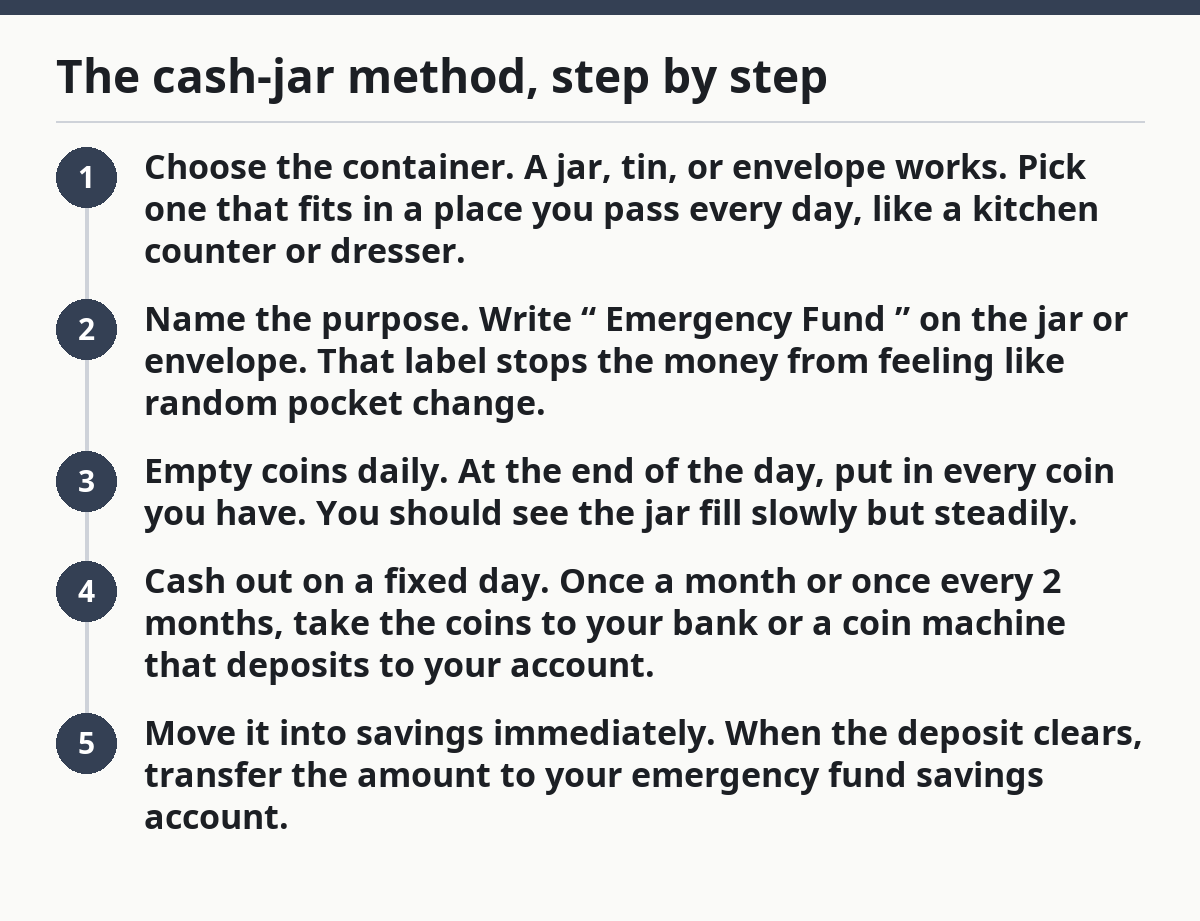
The cash-jar method, step by step
- Choose the container. A jar, tin, or envelope works. Pick one that fits in a place you pass every day, like a kitchen counter or dresser.
- Name the purpose. Write “Emergency Fund” on the jar or envelope. That label stops the money from feeling like random pocket change.
- Empty coins daily. At the end of the day, put in every coin you have. You should see the jar fill slowly but steadily.
- Cash out on a fixed day. Once a month or once every 2 months, take the coins to your bank or a coin machine that deposits to your account.
- Move it into savings immediately. When the deposit clears, transfer the amount to your emergency fund savings account.
A cash jar has two real drawbacks. First, coins in the house can be easy to raid if the jar is too casual. Second, some banks or coin machines handle loose coins differently, so you may need to sort or roll them first. The FDIC and Consumer.gov both recommend keeping emergency savings separate from regular spending money.
Who Should Skip This: someone who hates handling coins or never carries cash should use round-up tools or small recurring transfers instead.
Buy this if: you are a cash user who wants a low-tech habit and can commit to a monthly coin deposit.
Skip this if: you tend to spend loose cash without thinking or you need the money moved automatically.
Can round-up tools do the work for me?
Yes, round-up tools can do most of the work if your spending already runs through a debit card or linked account. They are one of the easiest ways to save spare change because the savings happen in the background. The Consumer Financial Protection Bureau and NerdWallet both note that automatic savings can help people build a habit.
Picture this: you buy groceries, coffee, or gas, and the bank rounds each purchase to the next dollar. A 42-cent round-up turns into a 58-cent transfer, and you barely feel it because the spending already happened.
Use round-up tools this way:
- Link one spending account only. Keep the setup simple so you can see what is being rounded.
- Check the rule. Some tools round every purchase to the next dollar; others use a higher target or a fixed transfer. Know the rule before you turn it on.
- Watch the first week. After a few purchases, confirm that the round-ups are going to the right savings account.
- Leave it alone. The tool works best when you stop micromanaging it.
- Empty the savings bucket into the emergency fund. If the round-up money lands in a sub-savings pot, move it to the main emergency fund on a schedule.
The trade-off is simple: round-up tools are easy, but they depend on card spending. If you use cash most of the time, they will not collect much. They can also feel invisible, which is good for friction, but bad if you never check the balance.
What if I only have a few coins at a time?
Use tiny recurring actions and coin deposits, not big goals, because small amounts are easier to repeat. A $1 coin or a handful of quarters can still be a start when it moves often.
Picture this: you find $1.37 in the car, a few quarters in a coat pocket, and some pennies in a bag. That is not a windfall, but it is enough to begin a pattern.
A simple pattern looks like this:
- Every day: put loose change in a jar or envelope.
- Every week: move $5 from checking to savings if you have it.
- Every payday: sweep whatever spare change is left in your spending account into savings.
- Every month: cash in coins and deposit them into the emergency fund.
The point is to set a floor, not a perfect amount. If you can only spare $2 a week, that is still a system. If you can only handle coin deposits once a month, that is still a system.
Common mistakes here are easy to spot:
- Making the amount too big: the plan dies when the transfer competes with groceries.
- Using no schedule: “whenever I remember” usually means never.
- Leaving the money in a drawer: loose cash gets spent.
- Mixing it with spending money: the balance looks available, so it disappears.
The fix is boring, and that is why it works. Pick one amount, one day, and one place for the money.
How do I get the money into a savings account without extra steps?
You get the money into a savings account without extra steps by using one transfer path and repeating it every time. A separate savings account is the end point, not the jar, not the app, and not the wallet.
The truth is, spare change only helps an emergency fund if it leaves your spending space. Otherwise it is just delayed spending money.
Use this path:
- Collect the money in one place. Jar, round-up tool, or checking account.
- Choose one transfer day. Friday, payday, or the first day of the month all work.
- Move the full amount. Do not leave “just in case” money sitting around.
- Keep the savings account separate. That makes it harder to spend by accident.
- Label the purpose. If your bank lets you name sub-accounts, call it “Emergency Fund.”
A separate savings account also gives the money a job. That matters because money with a job is less tempting to touch when a small want shows up.
If the transfer feels annoying, shorten the path. Use a bank transfer from checking to savings, not cash to a drawer to a wallet to a bank. Every extra step invites delay.
For a broader plan that fits this method into a full emergency fund strategy, the hub page on Emergency Fund Funding Tactics covers the bigger picture.
What usually breaks a spare-change system?
A spare-change system usually breaks when the steps are too clever, too hidden, or too easy to raid. The fix is to remove drag, not to add more rules.
Picture this: you start strong, then a week later the jar is forgotten, the round-up app is off, and the savings transfer never happened. Nothing is wrong with the idea. The setup just asked for too much attention.
Watch for these failure points:
- Too many containers: coins end up in pockets, car cup holders, and kitchen bowls.
- No deposit date: the money sits around because there is no deadline.
- No separation: emergency money and spending money blend together.
- No visible cue: if you never see the jar or the transfer reminder, the habit fades.
- Trying to save both change and a large amount at once: the larger plan crowds out the smaller one.
The fix is to simplify until the system feels almost too easy. One jar. One transfer day. One savings account. That is enough.
If you want the habit to stick for more than a month, give it a visual cue and a calendar cue. A jar by the door plus a monthly deposit date is often enough.
Does spare change really help?
Yes, spare change helps because it lowers the barrier to starting an emergency fund. Even tiny amounts add up when they move into savings often, and the habit can later support larger transfers.
How often should I deposit spare change?
Deposit spare change on a regular schedule, such as once a week, once a month, or whenever a jar fills up. A fixed day works better than waiting until you feel like it, because the habit stays automatic.
What is the easiest way to save small amounts?
The easiest way to save small amounts is to make the money move by itself, usually with round-up tools or a small recurring bank transfer. If you handle cash more often than cards, a jar is the simplest backup.
Drafted with AI; not yet reviewed by a person.