Last updated: November 19, 2026
Quick Answer
Put 100% of eligible refunds and rebates into savings until you reach your starter emergency fund target.
Refund and rebate money can start How to Save Your First Emergency Fund With Refunds before it gets eaten by rent, groceries, or a night out. In this guide, How to Save Your First Emergency Fund With Refunds means moving tax refunds, merchant refunds, and cash-back rebates into a separate savings account right away. Put each refund into savings the same day it lands. The steps below show how to move that money before normal spending grabs it.
Use refund money before it gets absorbed
Refund and rebate money works best when it never touches your checking balance for long. If you let a tax refund, merchant refund, or cash-back rebate sit for even a few days, it starts looking like spending money instead of emergency money.
Picture this: you get a $73 store refund, a $41 cash-back rebate, and a $220 tax refund over three weeks. That money is real, but it feels small when it lands in pieces. The trick is to give it one job and one home.
- Pick the savings account first. Use a separate savings account at your bank, not the same checking account you use for bills. When the transfer lands and the balance rises, the money has already moved out of daily spending.
- Turn on direct deposit if you can. If a tax refund can be sent to your savings account instead of checking, do it. When the deposit posts where you want it, there is no extra step to forget.
- Move merchant refunds the day they clear. Check your app, confirm the refund posted, then transfer that exact amount to savings. You should see the checking balance drop by the same number.
- Sweep rebate money on a set day. Pick one day each week, like Friday at 5 p.m., and move every small rebate sitting in checking. When the routine works, your checking balance stays cleaner and your savings balance climbs.
You do not need a big refund to start. A few small ones can build momentum fast.
How much of each refund should go to savings?
All of it should go to your first emergency fund until you hit your starter target. That is the cleanest rule for a beginner, because splitting a refund between spending and saving usually leaves both jobs half done.
The truth is, most people lose refund money in the same place they lose grocery leftovers: loose spending. A $30 rebate becomes a meal out. A $150 merchant refund becomes “extra cash.” Then the emergency fund stays at $0.
Use this simple split when money lands:
- $0 to spending if you are still trying to build your first emergency fund.
- 100% to savings for tax refunds, cash-back rebates, and store refunds until you reach your target.
- Hold back only taxes or fees owed if the refund is not actually yours in full.
For example, if your first emergency fund goal is $500 and you get a $240 tax refund, the full $240 goes into savings. If you later get a $58 rebate and a $36 store refund, both go in too. When the balance reaches your target, you can decide the next job for future refunds.
This rule is simple on purpose. A beginner does not need a perfect budget system to start. The money is already here; it just needs a destination.
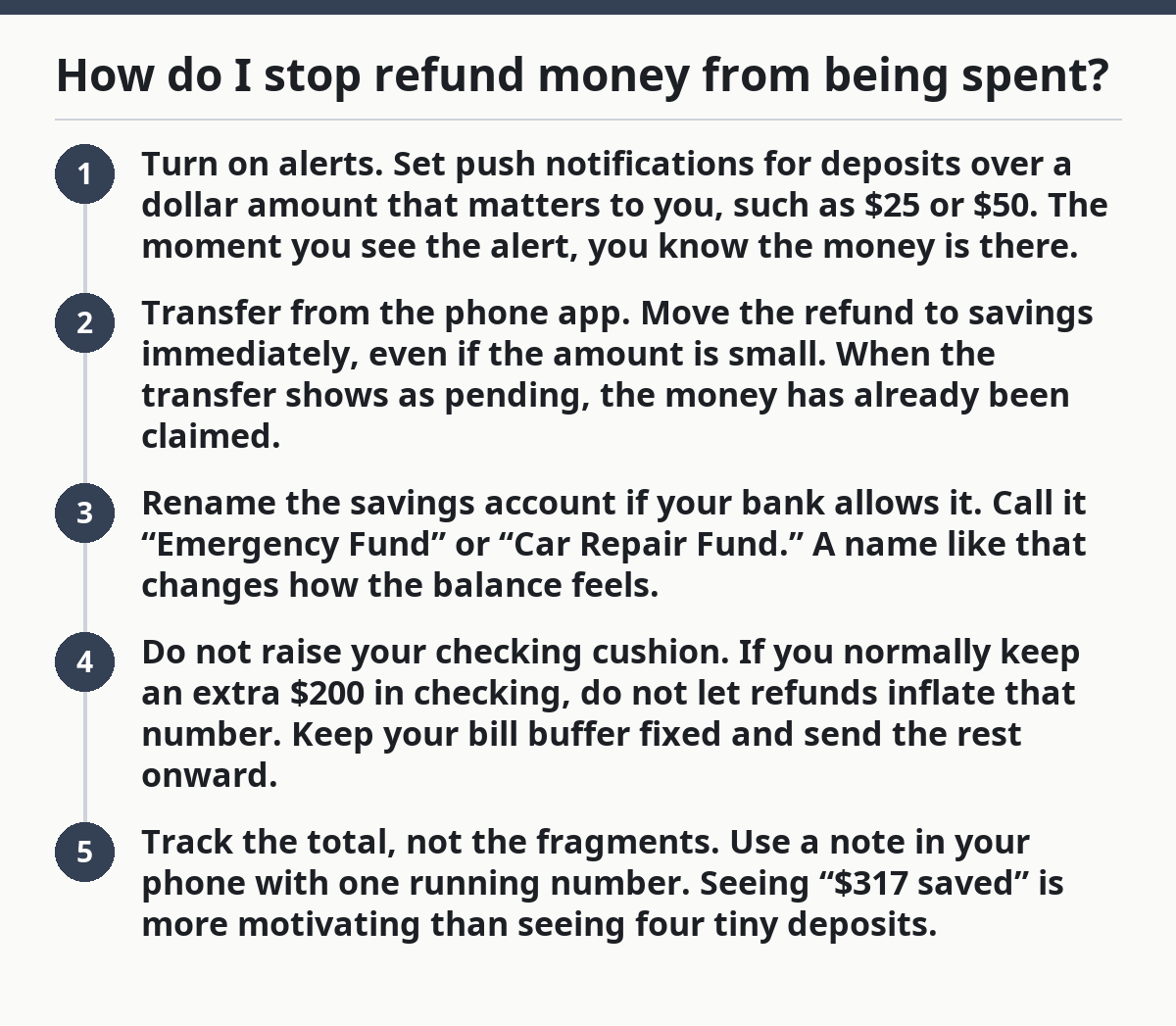
How do I stop refund money from being spent?
You stop refund money from being spent by removing the chance to spend it before it moves. A 5-minute transfer routine and a separate savings account do more than willpower ever will.
Picture this: a refund hits your checking account on Tuesday, and by Thursday it has vanished into a grocery top-up, a ride share, and a streaming charge. That happens because checking looks like spending money. Savings looks harder to raid.
Use this order every time:
- Turn on alerts. Set push notifications for deposits over a dollar amount that matters to you, such as $25 or $50. The moment you see the alert, you know the money is there.
- Transfer from the phone app. Move the refund to savings immediately, even if the amount is small. When the transfer shows as pending, the money has already been claimed.
- Rename the savings account if your bank allows it. Call it “Emergency Fund” or “Car Repair Fund.” A name like that changes how the balance feels.
- Do not raise your checking cushion. If you normally keep an extra $200 in checking, do not let refunds inflate that number. Keep your bill buffer fixed and send the rest onward.
- Track the total, not the fragments. Use a note in your phone with one running number. Seeing “$317 saved” is more motivating than seeing four tiny deposits.
On the flip side, if you leave refunds in checking “until the weekend,” the weekend usually wins.
Which refunds and rebates should you count?
Count any money that came back to you and was not already committed to a bill or purchase. That includes a tax refund, a cash-back rebate, and a merchant refund from a return, price adjustment, or canceled order.
Picture this: you return a $64 jacket, get $18 back from a rebate offer, and later receive a tax refund from your filing. Those are all different sources, but the handling is the same. If the money is extra and not promised to rent, utilities, or debt minimums, it can go to the first emergency fund.
Here’s the catch: not every deposit is free money.
Count these:
- Money returned after a store refund or exchange
- Cash-back rebates from a purchase
- Tax refund money that lands in your account
- Any rebate check or account credit that can be converted to cash
Do not count these as spare cash:
- Refunds already promised to cover another bill
- Money your employer withheld for a specific purpose and has not actually returned
- Credits that only work at one store if you were already planning to buy there anyway
A good rule is simple: if the money is usable in your bank account today, it belongs in the emergency fund today. If it is only a store credit with strings attached, treat it as a discount, not cash; if you are unsure how a credit should be treated, consult a financial professional or the terms of the offer. See IRS guidance on refunds and credits and Consumer Financial Protection Bureau guidance on using savings accounts for more detail.
Set up the bank transfer so the money moves on time
A bank transfer works best when it is pre-set, not improvised. If you wait to decide what to do after the refund posts, you have already added one more chance to spend it.
Start with the account you already use most often. Then set one of these up:
- Instant transfer from checking to savings in the bank app
- Scheduled transfer for a fixed day each week
- Direct deposit split for refunds that can be sent to savings first
Picture this: a tax refund lands on Monday, and your app shows a $300 deposit in checking. If the transfer is preloaded, you tap once and the money moves. If not, the money sits there while you think about it.
Use this order:
- Open the bank app and find the transfer screen.
- Add your savings account as the destination if it is not already saved.
- Save a transfer template for the full refund amount or the next deposit amount.
- Use the same destination every time so you do not have to hunt for the account again.
- Check that the savings balance changed after the transfer posts.
A transfer that takes 60 seconds is a transfer that actually happens. Since the money is already in the bank, this is usually the easiest way to move it. The Federal Deposit Insurance Corporation explains that savings accounts are designed for money you want to set aside.
What to do when refunds are tiny or irregular
Small refund money still matters because it builds the habit before it builds the balance. A $12 rebate looks weak alone, but four deposits like that can cover a flat tire or a prescription copay.
Picture this: you get three random refunds in one month—$9, $27, and $44. None of them feels like “emergency fund money” on its own. Put them together, and you have a real chunk of savings without touching your paycheck.
Use this method:
- Set a floor amount. If the refund is under a number you choose, like $10 or $20, you still move it.
- Batch the tiny ones. If your bank charges no transfer fee, move small rebates once a week rather than waiting for a big pile.
- Keep a running total. Write down the balance after each transfer so the fund feels like it is growing.
- Do not round up with spending money. If you get a $14 rebate, save $14, not $10.
This approach is not flashy. It is effective. A first emergency fund is often built from boring money, not one giant check.
Common mistakes that slow the first fund down
The biggest mistake is treating refund money like bonus spending. That mistake costs you speed, because every dollar spent on something else is a dollar that cannot cover a tire, a copay, or a busted phone.
Picture this: you get a $180 merchant refund and tell yourself you will “save most of it.” By the end of the week, most of it has vanished. The emergency fund is still empty, and now you have to start over.
Watch for these traps:
- Leaving money in checking. The cost is temptation. The fix is an immediate transfer.
- Using refunds as reward money. The cost is slow progress. The fix is to tie refunds to one job only.
- Mixing refund money with routine spending. The cost is confusion. The fix is a separate savings account.
- Waiting for a larger amount. The cost is delay. The fix is to save every deposit, even small ones.
- Counting store credit as cash. The cost is false progress. The fix is to save only money you can move to the bank.
A refund sent to savings is less fun today, but it can give you more options the next time life breaks something. For a broader plan, the Emergency Fund Funding Tactics hub can show you how this fits with other funding moves.
Key Takeaways
- Refunds and rebates grow a first emergency fund fastest when they move straight into savings.
- A separate savings account and a same-day transfer routine beat willpower.
- Use every tax refund, merchant refund, and cash-back rebate until your starter fund is full.
- Tiny refunds still matter if you move them right away.
- The main enemy is delay, because delayed money gets spent.
Should refunds go to debt or emergency savings?
If this page is your starting point and you have no emergency fund yet, refund money should build the emergency fund first. That gives you cash for surprise costs without reaching for a card. If you already have a starter fund, the next step depends on your larger debt and savings plan, so a financial professional can help you weigh the trade-off.
What refunds count as extra money?
Extra money is any refund or rebate that you can move into a bank account and use freely. That includes tax refunds, cash-back rebates, and merchant refunds from returns or cancellations. Store credits only count if they can be turned into cash or if they truly replace money you would have spent elsewhere. See the IRS and CFPB for related consumer guidance.
How do I stop refund money from being spent?
Move it the same day it arrives and keep it in a separate savings account. Push alerts help, but the real fix is a fast bank transfer before the money blends into checking. If you wait, the refund starts acting like spending money instead of emergency money.
Drafted with AI; not yet reviewed by a person.