How to Choose an Emergency Fund Account for a Household That Uses Cash

Last updated: November 20, 2026
Quick Answer: for most mixed-payment households, the answer is 2 accounts — a savings account for the reserve and a linked checking account for spending access. In the topic How to Choose an Emergency Fund Account for a Household That Uses Cash and Cards, the goal is to move money fast, get cash when needed, and avoid payment friction without turning the reserve into everyday spending money. For basic deposit-safety guidance, see the FDIC’s consumer page on deposit insurance and the CFPB’s page on bank accounts.
This guide is for mixed-payment households: people who pay some bills with cards, keep some spending in cash, and need one emergency fund that can work in both directions. I’ll lay out the choice in plain terms and point to the features that matter most, including transfer speed, branch access, and ATM access. For the basic safety rule on bank deposits, see the FDIC’s consumer page on deposit insurance and the CFPB’s page on bank accounts.
Key takeaways
- The emergency fund account should match how your household actually pays in a bad week, not in a perfect week.
- A savings account usually fits emergency money better than a checking account because it separates spending from savings.
- A linked checking account helps when you need quick card use or an ATM withdrawal, but it can tempt easy spending.
- Branch access matters if your household still needs cash in hand fast, not just digital transfers.
- The right setup is often two accounts working together, not one account trying to do everything.
What should a mixed-payment household look for?
Since a mixed-payment household needs speed, access, and separation, the account has to let you move money when a furnace breaks, a repair shop wants cash, or a card is declined, and it also has to keep the emergency fund from becoming everyday spending money.
That means the first questions are practical: can you transfer money the same day, can you get cash at an ATM, and can you reach the bank if you need a branch visit? A debit card matters only if it helps with those jobs without turning the emergency fund into a spending account. The account should also be easy to read on a phone screen so you can see the balance after a transfer or withdrawal.
For household use, a cash reserve is not just a pile of bills. It is money set aside so you can cover a short-term problem without borrowing. If your household uses both cash and cards, the account has to support both payment styles without forcing a long wait.
Savings account or checking account?
Therefore, a savings account usually wins for the core emergency fund, and a checking account wins for fast spending access. The savings account keeps the money mentally separate from monthly bills, while checking keeps it close to the payment tools you already use every day.
Here is the cleanest comparison.
| Criteria | Savings account | Checking account | Winner for this condition |
|---|---|---|---|
| Main job | Holds money you do not want to spend by accident | Handles daily spending and bills | Savings for emergency storage |
| Debit card use | Usually limited or absent, depending on the bank | Built for card spending | Checking for immediate card use |
| ATM access | Possible through linked cards at some banks | Common and direct | Checking for fast cash use |
| Transfer speed | Can be quick when linked to checking | Immediate for spending, slower for moving to savings later | Checking for same-day spending |
| Separation from daily money | Stronger | Weaker | Savings for discipline |
| Branch access | Useful for deposits or transfers | Useful for cash handling too | Tie, based on local branch network |
| Risk of accidental spending | Lower | Higher | Savings |
| Best for | Reserve money that should stay untouched | Household cash flow and short notice payments | Savings for the fund itself |
| Backup role | Good as the holding account | Good as the access account | Depends on the use case |
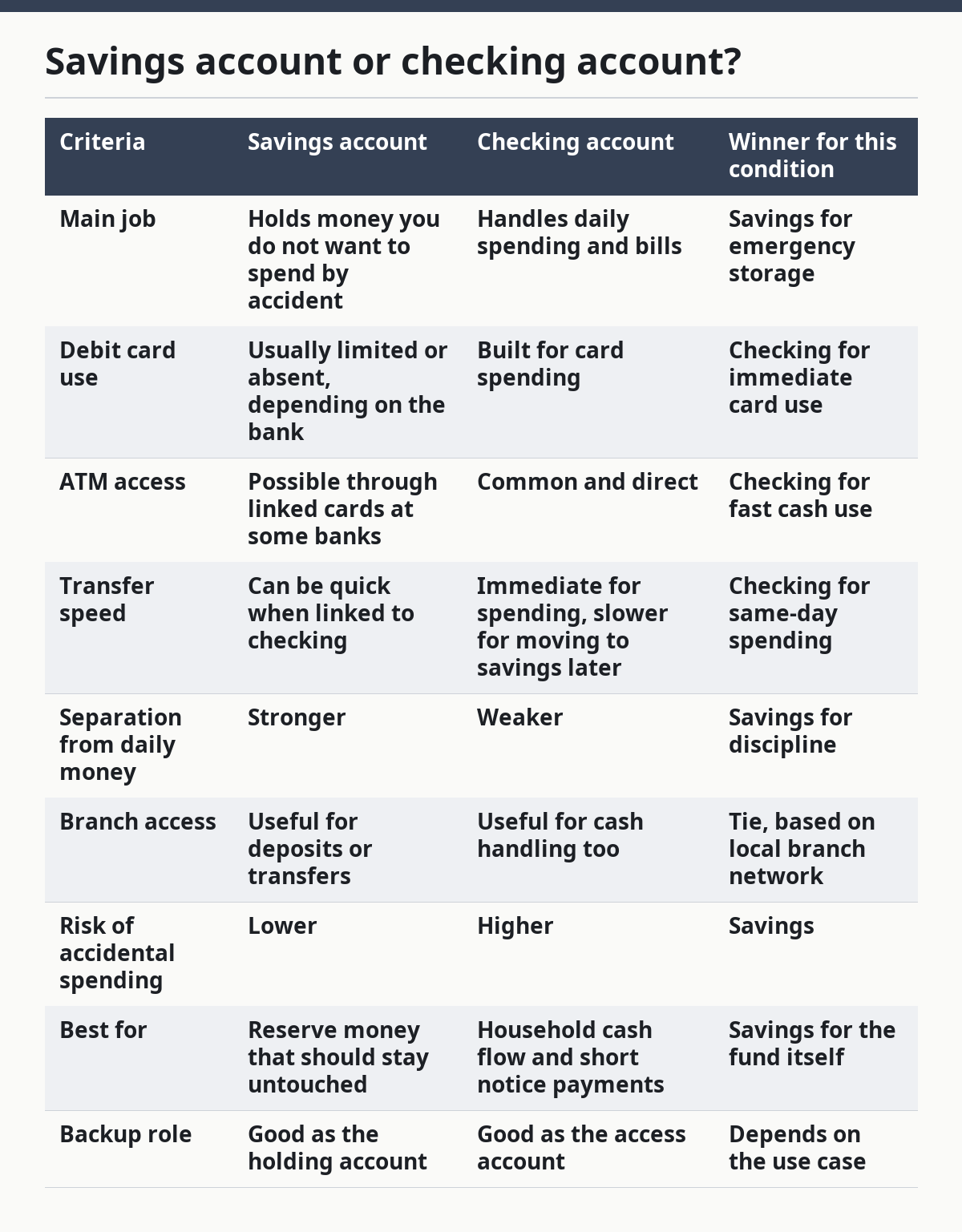
The savings account is the better home for the emergency fund itself because it creates friction before spending. That friction is useful when the money must survive a month of stress without becoming groceries, takeout, or a non-urgent repair. The downside is clear: if your household needs a debit card right away, savings can be slower to use unless it is linked to a checking account.
By contrast, checking is better when the emergency is payment-heavy and immediate. If a tow truck, a motel, or a repair shop needs a card or cash right now, checking is the faster tool. The weakness is that checking is too easy to raid for non-emergencies, which can shrink the reserve faster than the household expects.
When does a savings account win?
Because a savings account helps the household leave the money alone until a real problem appears, it is the better choice for people who already spend through cards and want the emergency money separated from the account they tap for rent, food, and subscriptions.
The strongest case is a household that can tolerate a small delay to move money from savings to checking. That setup works well when a transfer can happen the same day and the checking account already has a debit card ready for cash or purchases. The savings account then serves as the vault, not the wallet.
This choice is not for households that keep finding themselves in the bank app every few days. If the emergency fund sits beside the account used for groceries and gas, the line between “reserve” and “available” gets blurry. In that case, the savings account still may be right, but only if the linked checking account is the true spending account and the savings balance is treated as off-limits; if the household is unsure, a qualified financial professional can help confirm the setup, and the CFPB’s bank account guidance is a useful starting point.
A savings account also fits households that need a physical cash reserve but do not want to hold too much paper money at home. Money can stay in the bank until needed, then move to checking or be withdrawn through an ATM or branch. The point is control, not constant access.
When does a checking account win?
However, a checking account wins when the household values immediate card use and easy cash access more than separation. If the emergency fund is meant to cover a bill that could hit the same day, checking is the account with the fewest steps.
This matters for mixed-payment households that already rely on a debit card for a lot of normal life. If the car breaks down and the shop wants a card on the spot, the checking account is ready. If the family needs cash for a temporary situation, checking usually makes the ATM side of the process simpler.
The drawback is discipline. Checking invites ordinary spending, which makes it a weaker place to park a true emergency reserve. The money can look available every time the card comes out, and that can erase the separation a household needs to keep an emergency fund intact.
Checking is also a poor fit if the household wants the emergency money to sit quietly for months. It does not create enough distance between “saved” and “spent.” For a family that has trouble leaving money alone, checking solves the access problem and creates a new one.
How do cash access and branch access change the choice?
Because cash access and branch access decide whether your emergency fund is merely digital or genuinely usable in a short-notice crisis, the account should be linked to a debit card, an ATM network, or a branch that can handle withdrawals and transfers if the household sometimes needs physical cash.
A branch matters most when the family wants a human fallback. Some households feel safer knowing they can walk into a branch and move money without waiting on a long transfer chain. That matters when the emergency is a local one, not a planned bill.
ATM access matters when the problem is quick cash, not paperwork. The account should make that possible without turning the emergency fund into a spending account every time the card is swiped. If the household only needs cash once in a while, branch and ATM access can be a backup feature rather than the main reason to choose the account.
This is where mixed-payment households need to be honest about habits. If a family rarely carries cash, then branch-heavy features may not matter much. If the family regularly uses cash for tips, small purchases, or backup spending, then the account needs real cash access, not just an online balance.
The honest side-by-side for mixed-payment households
For a household that uses both cash and cards, the strongest setup usually pairs a savings account with a linked checking account. The savings account stores the reserve, and the checking account handles the actual spending when the emergency turns into a payment.
A plain checking account can work if the household needs the fastest possible access and is disciplined enough not to drain the fund for routine expenses. A plain savings account can work if the household has a reliable transfer path and does not need the money for card use right away. The weaker choice is any account setup that makes the emergency fund too easy to spend or too slow to use.
The deciding factor is not which account sounds better in theory. It is whether the household needs the money to be hidden, reachable, or both. Mixed-payment households often need both, which is why a two-account setup is usually stronger than one account trying to do two jobs.
One more practical point: bank deposits are generally covered by FDIC insurance at insured banks up to the standard limit of $250,000 per depositor, per insured bank, for each account ownership category. That protection does not solve access problems, but it does matter for keeping emergency money at a bank rather than in cash at home. See the FDIC’s “Your Insured Deposits” page for the exact rules.
What are the exception scenarios?
Overall, there are a few cases where the usual answer flips. If the household has a same-day money need and no patience for transfers, checking becomes the better short-term home for the fund. If the household is highly tempted to spend from checking, savings still wins even if it takes one extra step to move money.
A second exception is a household that uses cash often and has weak digital access. If card use is limited, the emergency fund may need a more cash-friendly setup, with branch access carrying more weight than app features. A third exception is a household that keeps a very small reserve and needs to grab it fast in a crisis; in that case, the account should be the one that is already tied to the household’s spending flow.
A fourth exception is a family that already has a strong cash reserve at home for small emergencies and only uses the banked fund for larger ones. That setup can justify a more restrictive savings account because the household has another layer of access. The risk there is obvious: more cash at home can mean more loss, damage, or temptation.
Choose this, not that
So, choose a savings account linked to a checking account if your household wants the emergency fund to stay protected, but still needs the option to move money fast for cash, debit, or a branch withdrawal. Choose a checking account if the household needs the money to behave like a payment tool today and can resist using it for normal spending. Neither if the fund will sit in the same place as everyday spending with no barrier at all, because that setup is too easy to drain and too weak for a real emergency.
Ultimately, the best answer for a mixed-payment household is usually not a single perfect account. It is a savings account for the reserve and a checking account for access. That combination gives the household both discipline and speed, which is the whole problem this choice is trying to solve.
How should the account be set up from the start?
Since the emergency fund should match the household’s weakest point first, start with savings if the problem is overspending. If the problem is urgent access, start with checking and keep the reserve linked to savings as soon as possible.
Then make the access path simple: one debit card, one linked transfer route, and one clear rule for when the money can move. The account should not require a long hunt through menus, multiple apps, or a confusing branch process. If it does, the emergency fund will feel farther away when stress is highest.
A mixed-payment household does best when the emergency fund is easy to reach but not easy to touch. That balance is what makes a cash reserve useful instead of merely available.
Drafted with AI; not yet reviewed by a person.