Emergency Fund Priority Order: What to Fund First Before Extra Savings

Last updated: November 19, 2026
Quick Answer: In the emergency fund priority order, most people should fund a starter emergency fund first, usually $500 to $1,000, then the employer match, then high-interest debt, then insurance gaps, then a full emergency fund and extra savings. Your emergency fund should usually start with a small cash buffer, then compete with high-interest debt, retirement contributions, insurance gaps, and short-term bill risks in that order. The right emergency fund priority order is not “save everything first”; it is “stop the next real financial hit first.”
Key Takeaways
- A starter emergency fund is a small cash buffer that helps you avoid credit card or overdraft use.
- High-interest debt often comes right after that buffer, because expensive interest can outrun safe savings returns.
- Retirement contributions usually follow the starter fund, but the employer match can come before extra debt payoff.
- Insurance gaps should be fixed before extra savings when one uncovered bill could wipe out progress.
The priority order that usually works best
For most people, the order is: 1) a starter emergency fund, 2) any employer retirement match, 3) high-interest debt, 4) insurance gaps that could wipe out cash flow, 5) a full emergency fund, and 6) extra savings goals. That sequence protects you from being forced back into debt every time a tire blows, a deductible hits, or a job gap lasts longer than expected.
The reason this order works is simple: some problems cost money once, and some cost money over and over. A $500 or $1,000 starter emergency fund keeps small shocks from turning into payday loan territory or credit card churn. A retirement match is free money you can lose if you skip it. High-interest debt, especially on credit cards, grows fast enough that it can beat the return on almost any safe savings account. Insurance gaps and bill timing problems can create a “fake emergency” where the cash is there on paper but not when the bill lands.
This is not a rule for every household. If you have unstable income, a job in a volatile industry, or a large deductible with thin cash flow, your bill buffer may deserve to sit closer to the front. If your debt is low-rate and manageable, you may move faster toward a larger emergency fund. The right order depends on what breaks first in your life.
What a starter emergency fund actually covers
A starter emergency fund covers the small, immediate shock that would otherwise hit a credit card or overdraft. Think of it as a 1- to 2-month stopgap for common interruptions, not a full 6-month safety net.
The cleanest target is usually a round number you can keep separate, such as $500, $1,000, or one month of bare-bones expenses if your budget is tight. The exact figure matters less than the job it does: it should be enough to handle a car repair, urgent copay, appliance failure, or a temporary gap in cash flow without derailing the rest of the plan.
This stage exists because full funding takes time. If you try to build a 6-month reserve while every small crisis goes on a card, the card balance can grow faster than the savings balance. A starter fund breaks that cycle. It buys you breathing room while you deal with the bigger priorities.
It is also the right place to stop if your income is highly unstable and your next dollar has to go to rent, utilities, and groceries. In that case, a 2-week or 1-month cushion may be more useful than pushing hard toward a larger number and leaving basic bills exposed. The goal is not a perfect textbook balance. The goal is fewer emergencies that become debt.
How emergency fund priority order changes when debt is involved
High-interest debt usually comes right after a starter emergency fund, because carrying credit card interest while you build a large cash pile is a losing trade. If the rate is high enough to make balances hard to dent, paying it down can free monthly cash faster than saving extra dollars in a low-yield account.
The key distinction is between high-interest debt and everything else. A 0% promotional balance, a low-rate installment loan, and a credit card charging double-digit interest do not deserve the same treatment. A consumer finance professional or qualified counselor can help you sort those balances, because the expensive debt is the one that can eat your margin every month. Once you have a starter fund, the next extra dollar often does more good attacking that balance than sitting in savings.
That said, I would not push someone to zero emergency savings just to crush debt. A completely empty checking account is fragile. One flat tire can send you right back to the card you are trying to pay off. That is why the starter fund stays in front of the debt payoff step.
A practical middle ground is this: keep the starter fund untouched unless a true emergency lands, then direct surplus cash to the highest-interest balance until the debt is under control. If the debt is large and the minimum payment is already straining your monthly budget, you may need to keep a small bill buffer alongside the starter fund so that timing problems do not trigger new borrowing.
Should retirement contributions come before a bigger emergency fund?
Retirement contributions should usually come after the starter emergency fund but before aggressive debt payoff, if an employer match is available. A match is part of your pay package, and skipping it can cost more than the short-term benefit of adding a few extra dollars to cash savings.
The practical order is often: contribute enough to get the full match, then fund the starter emergency reserve, then decide whether to attack high-interest debt or expand the emergency fund further. If your employer matches 50% on the first 6% of pay, for example, missing that match can mean turning down part of your compensation. A retirement plan administrator or HR benefits guide can show the exact formula for your plan.
There is a trade-off. Retirement money is harder to access, and if your emergency fund is too small, you may end up raiding a 401(k), taking a loan, or running up debt later. That is why I would not tell someone to pour every extra dollar into a retirement account while sitting on $0 in liquid reserves. The match gets priority because it is a free, concrete benefit; beyond that, the order depends on whether your emergency risk is bigger than your retirement opportunity.
This is not the place to chase investing returns before your household is stable. A diversified retirement account can compound over decades, but it does not help when a medical bill is due Friday. The short-term safety net has to exist first.
Which insurance gaps belong before extra savings?
Insurance gaps belong before extra savings when a single uncovered bill could erase months of progress. If your deductible, liability limits, or missing coverage would create a four-figure hole, that gap deserves attention before you pile more cash into long-term savings.
This is where a lot of generic advice goes wrong. It says “build an emergency fund” without asking what kind of emergency you are most likely to face. A health plan with a high deductible, a car policy with weak liability coverage, or no disability coverage can turn one event into a balance-sheet problem. In those cases, the right move may be to fund a deductible reserve or fix coverage before growing the full emergency fund.
The point is not to buy every policy under the sun. It is to identify the coverage gap that would force you to liquidate savings or borrow. A renter with no car may not need the same reserve shape as a commuter with a long drive, a family, and a large out-of-pocket max. The cash target should match the exposure.
I would treat insurance checks as a one-time priority review, not a monthly obsession, and I would verify the details with an insurer, broker, or other qualified professional if the coverage is unclear. Review the big items that can create a direct cash hit: health, auto, disability if relevant, and renters or homeowners coverage if applicable. If a gap is small and manageable, you can leave it alone. If it is large enough to blow up your plan, it belongs ahead of extra savings and sometimes ahead of debt acceleration.
How to decide what gets the next dollar
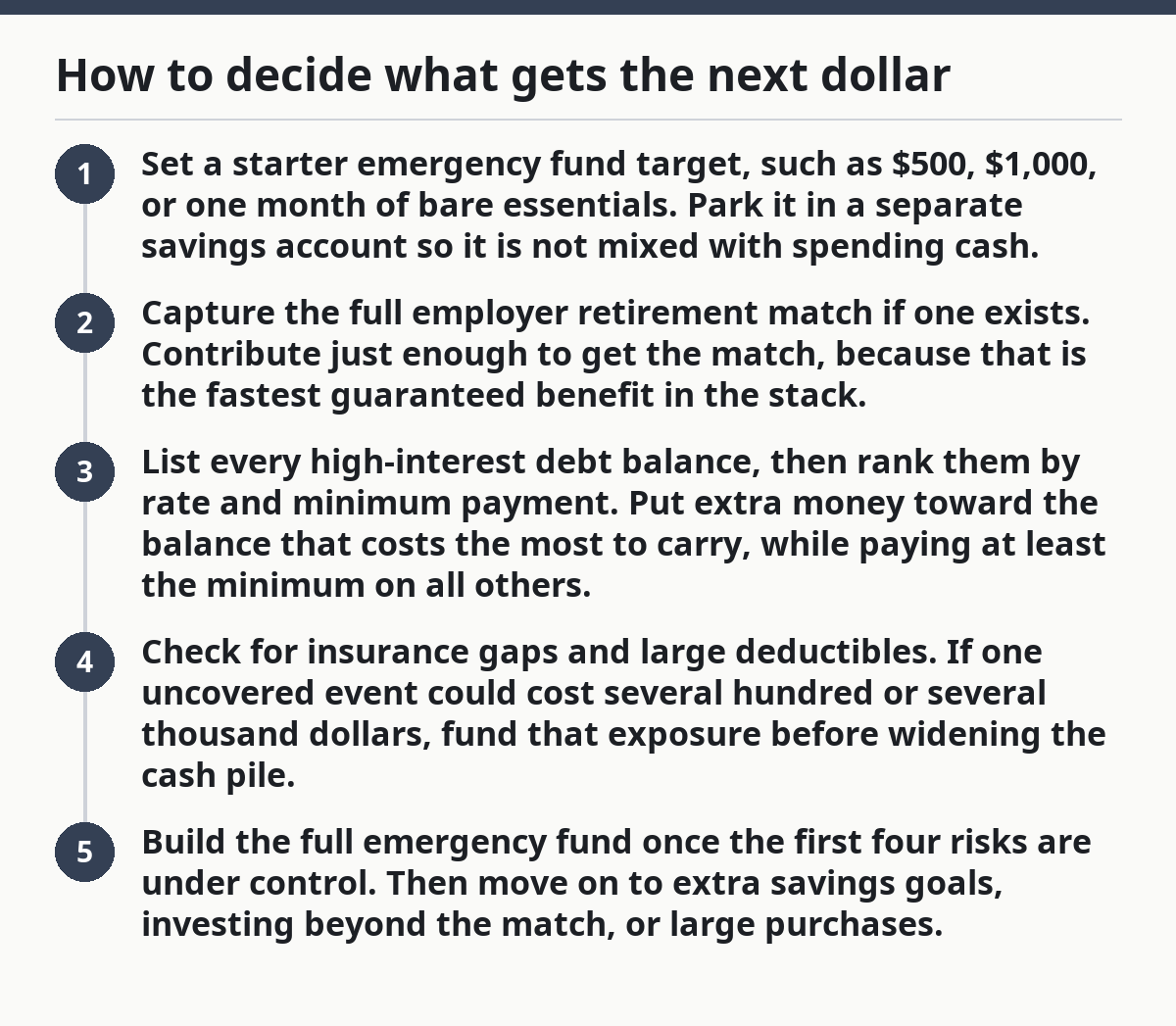
The next dollar should go where the next real financial blow is most likely to land first. If the question is not obvious, a simple five-step check can help: set a starter emergency fund target, capture the full employer retirement match if one exists, list high-interest debts, check for insurance gaps and large deductibles, and then build the full emergency fund. Park the starter money in a separate savings account so it is not mixed with spending cash.
- Set a starter emergency fund target, such as $500, $1,000, or one month of bare essentials. Park it in a separate savings account so it is not mixed with spending cash.
- Capture the full employer retirement match if one exists. Contribute just enough to get the match, because that is the fastest guaranteed benefit in the stack.
- List every high-interest debt balance, then rank them by rate and minimum payment. Put extra money toward the balance that costs the most to carry, while paying at least the minimum on all others.
- Check for insurance gaps and large deductibles. If one uncovered event could cost several hundred or several thousand dollars, fund that exposure before widening the cash pile.
- Build the full emergency fund once the first four risks are under control. Then move on to extra savings goals, investing beyond the match, or large purchases.
The result you want is not perfection; it is fewer forced trade-offs. A person with $1,200 in a savings account, a full retirement match, and no 22% credit card balance is in a stronger position than someone with $8,000 in cash but ongoing expensive debt and no deductible cushion.
The most common mistake is trying to rank every goal by emotion. Vacation savings feels good, a new car fund feels productive, and retirement feels responsible. But emergency fund priority order is about damage control. The next dollar should reduce the chance that one ordinary setback turns into a long, expensive mess.
For a broader framework on setting the overall reserve size and stage, see the hub on emergency fund strategy and goal setting.
What not to fund first, and why
Do not fund long-term extra savings before the money that prevents borrowing, missed bills, or avoidable penalties. The wrong first target is usually anything that looks good on a spreadsheet but fails in a real-life interruption.
A few examples make the trade-off clear. Putting every spare dollar into retirement while carrying credit card debt means you are paying interest to invest. Funding a big vacation before you have a starter emergency fund means a flat tire can turn into card debt. Chasing a large cash balance while ignoring an employer match means passing up compensation you already earned. All of those choices can be rational in a narrow case, but they are bad defaults.
The cost of getting this wrong is not abstract. It shows up as revolving debt, missed minimum payments, a drained checking account, or the need to raid money that was never meant for emergencies. A plan that looks disciplined on paper can still fail if it ignores timing and liquidity.
The right exception is a real near-term bill that is already due inside the next 30 days. If rent, a deductible, or a tax payment is due before your next paycheck, that bill may outrank everything else because it is not optional and not far away. In that case, the priority is not “save more” but “prevent a cash shortfall.”
Should i pay off debt before saving more?
Usually only after you have a starter emergency fund. A small cash buffer comes first because it prevents new debt when the next interruption arrives. After that, high-interest debt often becomes the next priority, especially if credit card rates are eating your monthly margin.
Should i save for retirement before finishing my emergency fund?
Only enough to get the employer match, if one exists. The match is the one retirement move that can outrank extra cash savings because it is part of your compensation. Beyond that, finishing a starter emergency fund usually comes first so you do not end up raiding retirement later.
What comes after a starter emergency fund?
After a starter emergency fund, the next step is usually either high-interest debt payoff, the full employer retirement match, or an insurance fix that closes a large coverage gap. The right choice is the one that would cost you the most if it broke today.
Drafted with AI; not yet reviewed by a person.