How to Prioritize Emergency Fund Replenishment When You Have Multiple

Last updated: November 20, 2026
Quick answer: put at least 1 paycheck’s worth of spare cash toward emergency fund replenishment first until the fund is back to a usable level, then split cash flow by purpose. If cash is tight, emergency savings usually comes before a vacation fund, a brokerage account, and extra retirement contributions, but it may come after a required debt payment and before optional sinking fund top-ups. For the broader framework, see the CFPB’s guidance on emergency savings and the FDIC’s discussion of liquid savings buffers.
Key takeaways
- Refill the emergency fund first when the withdrawal was for a real emergency and the balance is now too thin for the next surprise.
- Keep sinking funds separate from emergency savings so a car repair or annual bill does not get mixed up with a job loss or medical shock.
- If money is limited, rank goals by time frame, penalty, and flexibility, not by whichever account feels most urgent in the moment.
- A small, steady refill plan beats trying to restart every goal at once and then stalling after 2 paychecks.
- Retirement accounts and brokerage accounts are usually the last place to send spare cash when the emergency fund is still damaged, unless you have a match or a required payment at risk.
How do I rank savings goals after a withdrawal?
Rank savings goals by urgency, penalty, and purpose, then refill the emergency fund before most optional goals. This is the savings priority order that works when one account has been drained and three others still want money.
Use this order when cash flow is limited:
- Required debt payment — make the minimum payment first so the account does not go delinquent.
- Emergency fund replenishment — move the next available dollars here until the fund is back to a working level.
- Sinking fund — refill money set aside for known bills or planned purchases, such as insurance premiums or a car repair.
- Retirement account — continue only if there is a match, a required payroll deduction, or a plan you do not want to interrupt.
- Brokerage account — send extra cash here last, because this goal is flexible and has no penalty for waiting.
- Vacation fund — keep this at the bottom unless the trip is already booked and a cancellation fee would hurt more than a short delay.
That order is not a moral rule. It is a triage rule. A retirement account may deserve a higher spot if skipping it means losing a match, but a vacation fund almost never outranks a depleted emergency account.
The biggest mistake is treating all savings goals as equal just because they all live in separate buckets; if your situation is complicated, a qualified financial professional can help you decide the order. A $500 transfer to a brokerage account feels productive, but it does not help if the emergency fund still cannot cover a 1-month shock. The point of the savings priority order is to protect the next surprise before you fund the next want. For a related framework, see what comes first after an emergency fund withdrawal and how to split limited cash flow.
Which goals can wait 30 days?
Goals with the least penalty can usually wait 30 days or more, which makes them the easiest place to pause while you refill emergency savings. That pause gives your cash flow one job instead of five.
A vacation fund is usually the clearest delay. If the trip is not already locked in by a nonrefundable deposit, a 30-day pause rarely creates damage beyond a longer timeline.
A brokerage account is also flexible. You may want to keep investing, but if the emergency fund is thin, a pause is often less harmful than adding money to a taxable account while your checking balance stays fragile.
A retirement account is trickier. If an employer match is available, stopping the contribution can cost real money. If there is no match, the contribution can sometimes slow down for a month or two while you repair the emergency fund, though that trade-off should be judged against your age, taxes, and retirement timeline.
A sinking fund sits in the middle. If the goal is a predictable bill due in 60 days, you may need to keep feeding it. If the bill is far away, such as 6 months out, it can often wait while you restore the emergency account.
The wrong move is to stop every goal at once and then restart none of them. That creates a month of panic and a second month of drift. A better move is to pause only the goals that can truly wait and keep the rest on a small, steady track.
What comes first after an emergency fund withdrawal?
After an emergency fund withdrawal, required bills come first, then the refill plan starts. This is the part of the plan where timing matters more than motivation.
Use this order:
- Check the bill schedule — list every payment due in the next 30 days, including rent, utilities, insurance, and minimum debt payments.
- Protect required debt payments — keep mandatory payments current before moving money anywhere else.
- Set the refill target — choose the amount you want to restore, such as the amount you withdrew or a smaller temporary target if cash flow is tight.
- Automate the transfer — send a fixed amount from each paycheck into the emergency account until the target is met.
- Pause low-priority goals — stop or reduce vacation savings, brokerage transfers, and extra retirement contributions if they slow the refill too much.
- Restart the rest in order — once the emergency fund is back to the target, bring the paused goals back one by one.
The useful part of this order is that it keeps the decision simple on payday. You do not have to ask, “What should I fund this week?” You already answered that question when you set the ranking.
A good refill plan is usually boring. A transfer from every paycheck for 4 to 8 weeks is often easier to finish than a large catch-up move that competes with groceries, gas, and child care in the same month.
Should I refill my emergency fund before saving for other goals?
Yes, in most cases you should refill the emergency fund before adding new money to other optional goals. That is especially true when the withdrawal left you with less than you need for the next surprise.
This is where the emergency fund vs sinking fund split matters. A sinking fund is for a known cost: a car registration bill, a vet visit you expect, or a yearly insurance premium. An emergency fund is for the unexpected: a layoff, a broken appliance, or an urgent repair you did not plan for.
If a bill is known and the date is fixed, the sinking fund may need a small top-up even while emergency savings is recovering. If the spending is uncertain and the timing is loose, the emergency fund should usually win.
The same logic applies to a retirement account and a brokerage account. Those goals are valuable, but they are long-range goals. If you only have limited cash flow, they can wait behind a fund that protects you from using debt for the next surprise.
There is one real exception: if pausing a retirement contribution means losing a match, the match can justify staying partially active. Even then, the emergency fund should usually get the larger share of new cash until it is stable again.
This is not the right approach if your emergency fund is already full enough for your risk level and the withdrawal was small. In that case, you may split new money among several goals at once. The question is not “What sounds responsible?” It is “Which account is under the most pressure right now?”
How do I split limited cash flow?
Split limited cash flow by giving each dollar one job and keeping the emergency fund at the front of the line until it is stable again. That keeps you from sending $50 to five places and still leaving each goal short.
Use a simple split when paychecks are small or irregular:
| Goal | Usual place in line | Why it ranks there |
|---|---|---|
| Minimum debt payment | 1 | Missing it can trigger fees or damage |
| Emergency fund refill | 2 | It restores your shock absorber |
| Sinking fund | 3 | Known bills need predictable cash |
| Retirement account | 4 | Important, but usually less immediate |
| Brokerage account | 5 | Flexible and easy to pause |
| Vacation fund | 6 | Usually the easiest to delay |
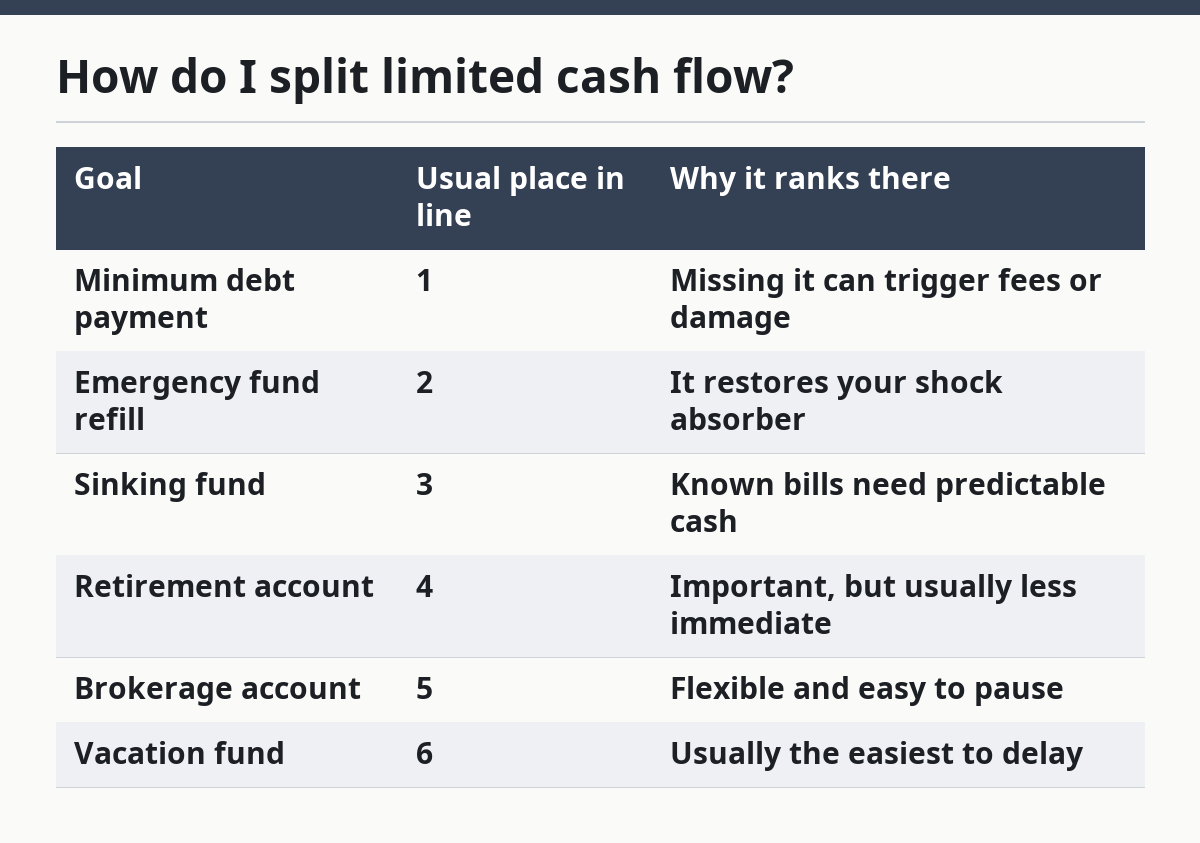
If your cash flow is tight enough that you cannot cover the top two items, the answer is not to spread the money thinner. The answer is to shrink the lower-priority goals for a while. A $25 transfer to a vacation fund does not help much if it delays a $200 emergency refill.
A good rule is to choose one refill amount and one backup amount. For example, you might send the full planned transfer to the emergency fund in every paycheck until the target is back in place. If that feels too aggressive, you can use a smaller backup amount that still keeps the account moving forward.
This section is not about perfection. It is about preventing goal pileup. When too many savings goals compete at once, the fix is usually fewer transfers, not smarter spreadsheets.
What mistakes slow the refill down?
The biggest mistakes are treating the emergency fund like an ordinary savings bucket, funding every goal at once, and using retirement or brokerage money as a hiding place for stress. Each mistake costs time, and time is what a depleted emergency fund does not have.
The first mistake is mixing emergency money with planned spending. If the account holds both a sinking fund and emergency savings, it becomes hard to know what is truly available. That can lead to an accidental shortfall later when a car repair and a job gap happen close together.
The second mistake is restarting every goal the same week. That feels balanced, but it often leaves the emergency fund half repaired for months. The cost is simple: you stay one surprise away from needing debt again.
The third mistake is putting off the refill because a brokerage account or vacation fund looks more exciting. The cost is not just lost progress. It is also a weaker buffer against the next shock, which can force another withdrawal before the first one is healed.
The fix is to label the money by job, not by feeling. Keep a clear emergency target, keep sinking funds separate, and let the nonessential goals wait. If you need a hard rule, use this one: when the emergency fund has been tapped, its refill gets the next meaningful share of free cash until it is back to a usable level.
A more careful version of this rule can be read alongside the hub on emergency fund withdrawal and replenishment rules, which sits above this page in the series.
When should retirement or brokerage savings come first?
Retirement or brokerage savings should come first only when the emergency fund is already healthy enough or when skipping them creates a direct loss. That usually means a retirement match, a deadline, or a contribution schedule that would be costly to restart.
A retirement account can move ahead of the emergency fund refill if the employer match is strong enough that pausing would leave money on the table. Even then, the choice is not “retirement or emergency.” It is “How much can I send to each without breaking the plan?”
A brokerage account almost never needs to outrank the emergency fund after a withdrawal. It is flexible by design. If cash is short, it can wait for a few pay periods while the emergency account gets rebuilt.
This is also where the person matters. Someone with irregular income, a single paycheck, or high fixed expenses may need a faster refill than someone with two incomes and low monthly bills. The same savings priority order does not fit every household the same way.
The honest limit here is that no article can choose the right split for every balance sheet. If debt terms are severe, taxes are complicated, or your retirement contribution affects a match, a qualified financial professional can help you decide how to divide the next dollar. The key idea still holds: when cash flow is limited, the emergency fund is usually the first nonrequired savings goal to restore. For more on the trade-off, see should I refill my emergency fund before saving for other goals.
Should I refill my emergency fund before saving for other goals?
Yes. When the emergency fund has been used, refilling it usually comes before vacation savings, brokerage investing, and extra retirement contributions. The main exception is a required debt payment or a retirement match you would lose by stopping. For the basics, review how to rank savings goals after a withdrawal.
What comes first after an emergency fund withdrawal?
Required bills come first, then the emergency fund refill. After that, the next dollars can go back to sinking funds, retirement, brokerage, or vacation savings in the order that fits your cash flow. See also which goals can wait 30 days.
How do I rank savings goals after using emergency savings?
Rank them by penalty and timing, not by preference. Minimum debt payments usually come first, emergency fund replenishment comes next, and flexible goals like a vacation fund or brokerage account come later. If a sinking fund has a near due date, keep it close to the top.
Drafted with AI; not yet reviewed by a person.