Last updated: November 20, 2026
If you live in another country, this guide to How to Choose an Emergency Fund Account Abroad starts with one question: which account can you reach fastest, in the currency you need, when a bill hits? Quick answer: for most people, that means one main account you can access in under 1 to 3 business days, plus one backup route. Your emergency fund account should give you fast cross-border access, low currency-loss risk, and a backup path if your main bank fails you.
Key Takeaways
- The right emergency fund account abroad is not just “safe”; it also has to work across borders when you actually need the money.
- Look at three things first: access speed, currency choice, and transfer routes between your home country bank and your local bank.
- A single account in the wrong currency can shrink your fund when exchange rates move.
- Split storage can help, but too many accounts can slow you down when the bill is due.
- The best setup is the one you can reach on a bad day, in the country you’re in, with the money already in a usable currency.
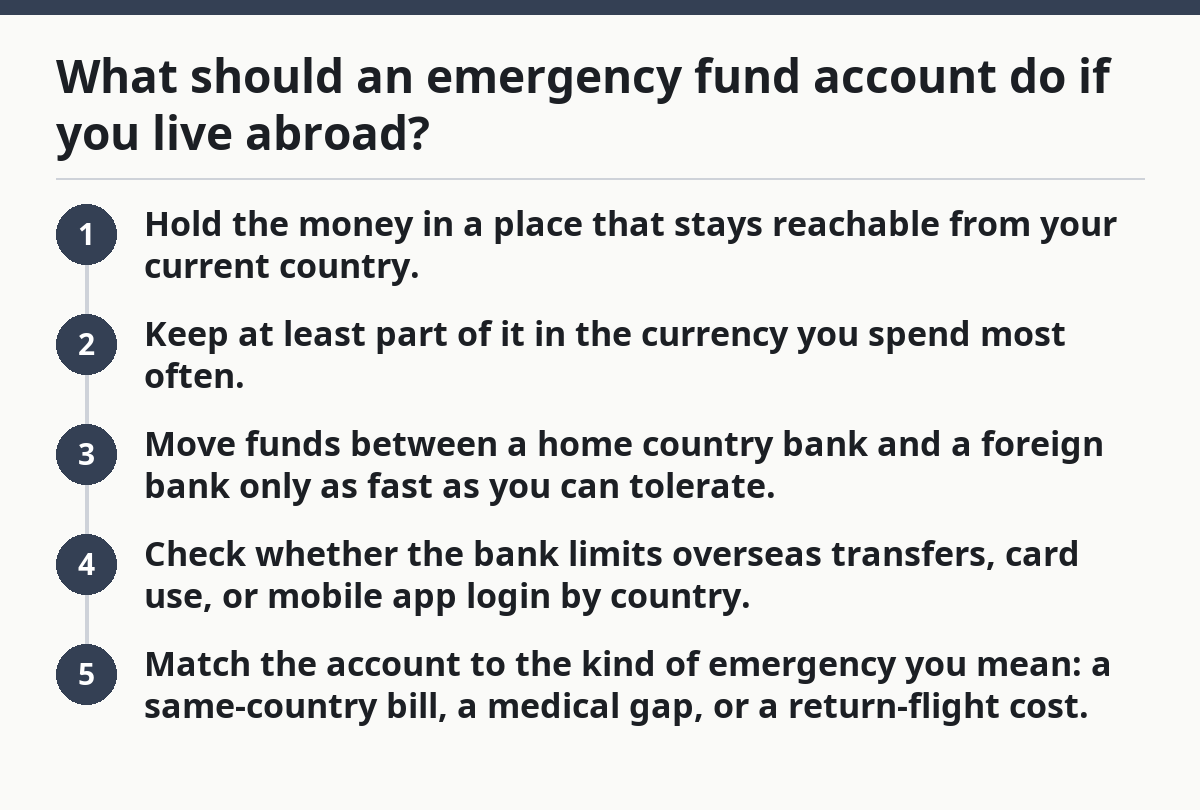
What should an emergency fund account do if you live abroad?
An emergency fund account abroad should protect the money, keep it reachable from your current country, and limit avoidable currency costs. That means cross-border access, a clear plan for foreign currency, and a transfer route that does not take days when you need cash fast.
Picture this: you’re an expat, your local rent is due, and your home country bank app works fine but your card is blocked abroad. The account that looked perfect on paper can still fail the only test that matters. The right choice is the one that still works when you are far from home, not the one with the prettiest online dashboard.
Start by separating the job of the account from the job of the money itself:
- Hold the money in a place that stays reachable from your current country.
- Keep at least part of it in the currency you spend most often.
- Move funds between a home country bank and a foreign bank only as fast as you can tolerate.
- Check whether the bank limits overseas transfers, card use, or mobile app login by country.
- Match the account to the kind of emergency you mean: a same-country bill, a medical gap, or a return-flight cost.
Here’s the catch: an emergency fund account is not just about interest. A higher rate can be useless if the transfer takes 2 business days and the cash lands in the wrong currency. Access beats yield for this job.
How do I compare a home country bank, a foreign bank, and a multi-currency account?
A multi-currency account is often a flexible starting point, but it is not automatically the best emergency fund account for every expat. A home country bank can help if you still have bills there. A foreign bank can be better if your life and expenses are now local. The right pick depends on where the emergency cost will actually hit.
Picture this: you keep your savings in a home country bank because it feels familiar, then your local landlord wants payment in local currency within 24 hours. That’s a transfer problem, not a savings problem. The account choice should fix the transfer problem before you worry about fine print.
Use this comparison to sort the main options:
- Home country bank
- Best for readers with debt, family obligations, or recurring bills back home.
- Weak point: foreign ATM use, card blocks, or transfer delays can make the money hard to reach.
-
Currency risk: if your spending is in another currency, the balance can lose buying power.
-
Foreign bank account
- Best for readers whose daily life, rent, and bills are all local.
- Weak point: it may be awkward to move money back to your home country bank in a hurry.
-
Good fit when you want the emergency fund in the same currency you spend every week.
-
Multi-currency account
- Best for readers who split life between countries or get paid in one currency and spend in another.
- Weak point: exchange fees and transfer rules can be hard to read, and the setup can be more complex.
- Strongest use: holding a main balance in one currency and a smaller buffer in another.
The truth is, most expats need at least one of these accounts to do something it was not originally built to do. That mismatch is where stress starts. If your bank can’t move money cleanly between your home country bank and your local bank, it is the wrong center of gravity for your emergency fund.
Which currency should the money sit in?
The best currency is the one you would spend in the first 24 hours of an emergency, with a second currency only if you still have real obligations elsewhere. That answer changes the whole account choice, because currency exchange is not free and exchange rates can move before the transfer lands.
Picture this: you live abroad, your emergency is local, and your savings sit in a stronger home currency. The balance looks healthy, but after conversion the amount you can spend is lower than you expected. That is the hidden cost of holding the wrong currency in the wrong place.
Use this rule of thumb:
- If your rent, food, transport, and urgent repairs are all in one country, keep the core emergency fund in that local currency.
- If you still pay school fees, a mortgage, or family support in your home country, keep a smaller second pocket in that home currency.
- If your income is split, a two-currency setup can reduce forced exchanges at bad rates.
A common mistake is treating “strong currency” as the same thing as “safer money.” That is not always true, and currency choice can affect your household risk in ways that are worth checking with a qualified financial professional or tax adviser. The European Central Bank and other central banks regularly note that exchange rates can move quickly, so a stronger currency today may not be the right currency for your emergency fund tomorrow. Currency mismatch can cost you even when the bank itself is stable. A fund that looks larger on a statement can buy less when you need to use it.
The better question is simple: what bill will show up first, and in which currency? If you cannot answer that, you are guessing with exchange risk.
How fast should the money move between countries?
The money should move fast enough that a delay of 1 to 3 business days does not break the plan, and the account should still be usable if the fastest route fails. Speed matters because emergencies do not wait for international transfer timing to clear.
Picture this: your emergency is not a total disaster, just a broken lease deposit or a flight change. You do not need a perfect system; you need money that lands before the penalty does. That means checking both transfer speed and the path the transfer takes.
Use this checklist before you commit to an account:
- Test the transfer route with a small amount before an emergency happens.
- Confirm whether the bank sends money through local rails, card rails, or a wire.
- Check if weekend transfers pause until Monday.
- Look for limits on daily outgoing transfers and incoming transfers.
- Keep one backup route, such as a second bank or a different transfer provider.
A bank that looks fine in one country can be awkward in another because the rails are different. Some transfers clear quickly inside a country and slowly across borders. Timing risk is part of the account choice, not an afterthought.
Before you add more accounts, ask whether the setup still fits on a bad day. Three backup accounts can make the money harder to find when you are tired, sick, or short on sleep. A simple setup with one main account and one backup route is usually enough for an emergency fund.
What account features matter most for an expat emergency fund?
The best account features are the ones that reduce friction: low transfer limits, clear foreign exchange costs, usable debit access abroad, and no surprise blocks on international activity. If a bank makes you call support every time you move money, it is not a strong emergency fund account.
Picture this: you are away from your home country, the bank flags the transfer, and support asks for a local number you no longer use. The money is still yours, but it is stuck. That is why account rules matter as much as the balance.
Look for these features:
- Two-factor login that still works when you’re abroad
- International transfer support with clear timing and fees
- Debit card access if you need to withdraw cash in a hurry
- No forced currency conversion when you already hold the right currency
- Simple account ownership rules if you moved countries but kept the old account
You do not need every feature. You need the right 3 or 4. A fund stored in the right place with clean transfer rules is better than a clever setup with five layers of conversion and login checks.
This is where expat banking gets messy, because a bank may be excellent for daily spending and terrible for holding savings. Do not confuse a good travel card with a good emergency fund account. They serve different jobs. For a related checklist on account features, see the guide to emergency fund storage choices.
When should I split the emergency fund across more than one account?
You should split the fund when one account cannot cover both currencies or both countries without delay. A split makes sense if you have a home country bank that still matters and a local account that pays the bills where you live. It does not make sense if splitting the money just creates confusion.
Picture this: you keep everything in one foreign bank account, then that bank freezes card use for a routine security check. Or you keep everything in your home country bank and discover the transfer route takes too long for local rent. Either version can turn a savings plan into a scramble.
A simple split often works best:
- Main balance in the currency you spend most.
- Small reserve in the currency for a second country, if you still owe money there.
- Backup access through a second bank or transfer method.
Do not split just because it sounds prudent. Every extra account adds one more login, one more fee schedule, and one more place to forget. If you cannot explain the purpose of each account in one sentence, the setup is too busy.
For related storage ideas, the hub on emergency fund storage choices can help you compare the bigger picture without repeating the same decision twice.
How to choose the right emergency fund account, step by step
The right emergency fund account is the one that matches your country, your currency, and your transfer speed before you need it. Use this 5-step filter and you will narrow the choice fast.
Picture this: you are comparing banks from a kitchen table in another country, and every option looks half-right. The fix is not more options. It is a clean order of checks.
- Map your likely emergency bills and note which country and currency each one uses.
- Choose the account type — home country bank, foreign bank account, or multi-currency account — that matches those bills.
- Check international transfer timing, foreign exchange costs, and any daily limits before you open or fund the account.
- Split the balance only if one account cannot cover both local and home-country needs without delay.
- Test the access path with a small transfer and a card check so you know the money can move when needed.
The mistake most readers make is starting with the bank they already know. That can work, but it can also lock you into the wrong currency or a slow transfer route. Start with the emergency itself. Need first, account second.
What account is best for emergency savings when living abroad?
The best account is the one that matches the country where you would spend the money and the currency you would spend it in. For many expats, that means a local bank account or a multi-currency account with clean international transfer options. A home country bank only wins if your emergency costs are still mainly back home.
How do I keep emergency money accessible across countries?
Keep the money in a bank or account you can log into, fund, and withdraw from in the country where you live now. Then keep a second access path, such as a home country bank or a backup transfer route, so one block does not trap the whole fund. A small test transfer is worth doing before an emergency.
Should I hold emergency savings in more than one currency?
Hold more than one currency only if you truly spend in more than one country or still have serious obligations in your home currency. A second currency can reduce exchange risk, but it also adds complexity and can slow you down. If all your urgent bills are local, one currency is usually cleaner.
Drafted with AI; not yet reviewed by a person.