Last updated: November 19, 2026
A savings account for emergency fund safety and access should be easy to reach, hard to raid, and protected if the bank fails. For what account features matter most for emergency fund safety and access, the quick answer is this: prioritize FDIC or NCUA insurance, reliable transfer access, a usable bank app, ATM access if cash matters to you, and limits you can live with. The features that matter most are those same basics, not flashy rates or bonus perks.
Key takeaways
- Safety starts with deposit insurance, not with a flashy rate or a slick app.
- Access means you can move money fast enough for a real emergency, usually by external transfer, debit card, or ATM card.
- Transfer limits, minimum balance rules, and delay policies matter because they can block you at the exact moment you need the cash.
- The right account keeps the money separate from daily spending without making it hard to use in a hurry.
- A plain savings account is often enough; the wrong choice is usually a feature mismatch, not a lack of yield.
The savings account features that actually protect an emergency fund
The most useful savings account features for an emergency fund are deposit insurance, simple access to cash, and rules that do not surprise you when you need money quickly. In the context of what account features matter most for emergency fund safety and access, that is the short version, and it matters more than a higher rate or a long list of bonus perks.
Start with insurance. If the account is at a bank, look for FDIC insurance. If it is at a credit union, look for NCUA insurance. Those are the two labels that tell you the institution participates in a federal deposit insurance system. The protection applies to deposit accounts, up to the applicable limits, and it is the first thing I would check before looking at anything else. A high rate is nice; insured principal is the point. For details, the FDIC deposit insurance overview and the NCUA share insurance information are worth checking directly.
Then look at access. A good emergency fund account should let you move money out without a 3-day headache every time. That usually means an external transfer to a linked checking account, plus a bank app that makes the transfer easy to start from a phone. If the account also includes an ATM card, that can help when you need cash in person, but it is not a replacement for transfer access.
The third layer is friction. Minimum balance rules, daily transfer limits, and withdrawal delays can turn a good-looking account into a bad emergency fund home. If you keep $1,000 to $2,000 in a backup cash pool, a $500 transfer limit can be a real problem. If a minimum balance triggers monthly fees, the account is working against the goal.
What this page is not about: I am not deciding whether a savings account beats a money market account or where an emergency fund should live overall. That comparison belongs elsewhere. This page is about the features that make an emergency fund account safe and usable. If you need the larger storage plan, start with the hub on emergency fund storage and maintenance.
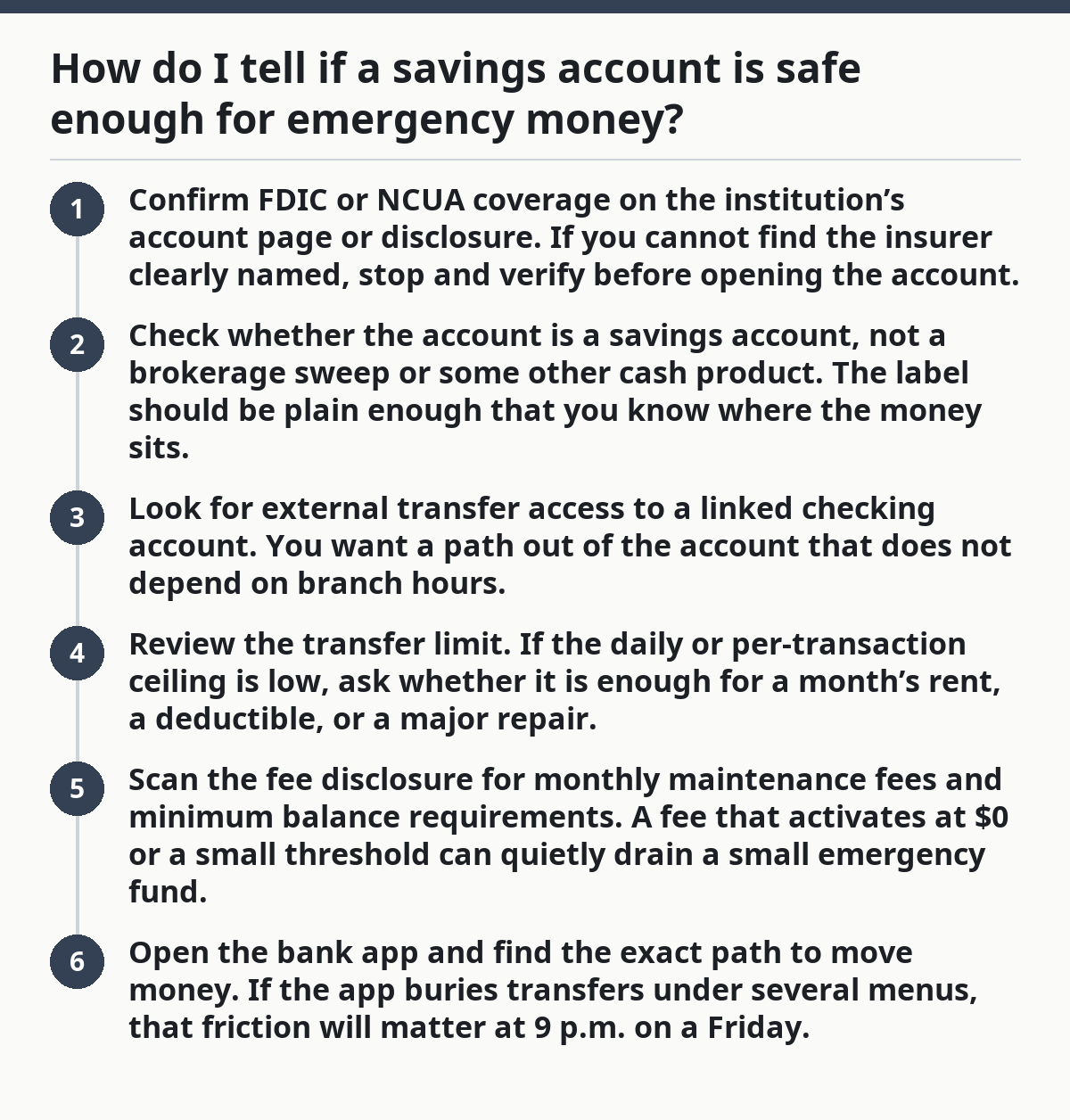
How do I tell if a savings account is safe enough for emergency money?
A savings account is safe enough for emergency money when it is insured, easy to monitor, and not tied to confusing rules. That means checking the insurer, the access methods, and the fee schedule before you move even $1.
Here is the practical check I would use:
- Confirm FDIC or NCUA coverage on the institution’s account page or disclosure. If you cannot find the insurer clearly named, stop and verify before opening the account.
- Check whether the account is a savings account, not a brokerage sweep or some other cash product. The label should be plain enough that you know where the money sits.
- Look for external transfer access to a linked checking account. You want a path out of the account that does not depend on branch hours.
- Review the transfer limit. If the daily or per-transaction ceiling is low, ask whether it is enough for a month’s rent, a deductible, or a major repair.
- Scan the fee disclosure for monthly maintenance fees and minimum balance requirements. A fee that activates at $0 or a small threshold can quietly drain a small emergency fund.
- Open the bank app and find the exact path to move money. If the app buries transfers under several menus, that friction will matter at 9 p.m. on a Friday.
The safe choice is usually the boring one: a plain insured savings account with ordinary transfer tools and no penalty for keeping a modest balance. That is especially true for a fund under a few thousand dollars, where a complex product is more likely to cause trouble than solve it.
Who this is not for: if you want to optimize every basis point of yield and are willing to manage multiple accounts, this simple setup may feel too plain. That is fine. Emergency money is supposed to be ready before it is impressive.
For the underlying insurance language, the official FDIC deposit insurance overview and the NCUA share insurance information are worth checking directly. Those pages explain the protection, the institution types, and the basic rules in plain terms.
FDIC and NCUA insurance: the first feature to check
FDIC and NCUA insurance matter more than any perk because they protect the deposit itself if the institution fails. That is the feature that separates a safe cash home from a risky one.
For a bank account, the FDIC is the name to look for. For a credit union, the NCUA is the name to look for. The difference sounds small, but it tells you who backs the deposits and what kind of institution you are using. If the account is at neither a bank nor a credit union, do not assume the money is protected the same way.
The practical point is simple: insurance protects against institutional failure, not against your own spending mistakes. It does not make the account immune to fraud, and it does not help if you move the money into an uninsured product by accident. If the account offers a sweep into a brokerage product or market fund, read the disclosures carefully. A friendly interface can hide a less friendly structure.
I would treat insurance as a pass-fail filter, but if you are unsure how a product is structured, consult the bank, credit union, or a qualified professional before opening it. If the account is not clearly FDIC- or NCUA-insured, it is not an emergency fund candidate for most people. That is a hard line, and it is there for a reason. Emergency money needs a low-drama home.
One subtle trade-off: insured accounts can still differ in speed and usability. An insured account with a clumsy app and a tiny transfer limit may be less useful than a slightly less polished one with clearer access tools. Insurance is necessary, not sufficient.
Access when the emergency is real
Emergency fund access matters because the money has to leave the account fast enough for the problem in front of you. A locked-away account is safe in a technical sense and useless in a practical sense.
The most useful access features are external transfers, an ATM card if you may need cash, and a bank app that makes both easy to find. An external transfer is the cleanest everyday route: money moves from savings to a linked checking account, then you spend from checking. That setup is good for rent gaps, car repairs, and surprise bills paid online.
An ATM card can change the equation when cash is the only thing that works. Think of a roadside tow, a small contractor who wants cash, or a place that does not take cards. Not every emergency needs cash, but some do. If your world includes those situations, ATM access deserves a look.
Still, ATM access is not the main feature for most people. The main feature is the ability to transfer money out without waiting for branch hours. A bank app that clearly shows available balance, transfer destinations, and pending transactions is often more valuable than any plastic card. The app should help you do three things quickly: see the balance, move the money, and confirm that the transfer is pending or complete.
Two honest drawbacks come with fast access. First, easier access can make it easier to spend the money on non-emergencies. Second, some accounts cap the number or size of outgoing transfers. That is why the next section matters so much.
Transfer limits and minimum balances can make or break the account
Transfer limits and minimum balances are the features most likely to turn a decent savings account into a bad emergency fund home. They are easy to ignore when you open the account, and hard to ignore when you need $1,500 right away.
A transfer limit is the ceiling on how much money you can move in a day, week, or transaction. Some accounts also have limits tied to the bank app, the external transfer network, or the linked checking account. If your emergency fund is meant to cover a $1,000 deductible, a $500 daily limit means you are waiting an extra day. That delay can be a real problem.
Minimum balance requirements matter in a different way. They usually show up as monthly maintenance fees or account restrictions. A fee is especially annoying in a small emergency fund, because the account is supposed to preserve cash, not chip away at it. If the minimum balance is higher than what you can keep comfortably, the account is a poor fit.
The common mistake is to pick an account because it looks clean in the app and then discover the hidden rule later. That costs time, and sometimes actual money. The fix is to read the fee schedule and the transfer terms before moving a single dollar.
I would also watch for external transfer delays. Some banks place new linked accounts under extra verification, and some transfers take one to three business days. That is normal enough, but you need to know it in advance. A transfer that takes until Tuesday is fine if the car repair can wait; it is useless if you need to pay today.
What to ignore when choosing an emergency fund account
A slightly higher rate should not outrank safety and access for an emergency fund. That is the judgment I would stand behind, and it is wrong for anyone who wants this money to behave like a small, reliable reserve instead of an investment account.
A lot of account marketing pushes features that sound good but do not help in an emergency. A sign-up bonus can be real money, yet it is a one-time event. A fancy rewards structure can look attractive and still leave you with a weak transfer process. A dozen budgeting widgets in the bank app may feel helpful, but they do not matter if the account has a low transfer cap or a fee for keeping less than a certain amount.
The wrong priorities usually look like this:
- Choosing the highest advertised rate first, then discovering a slow payout path.
- Opening an account with a minimum balance that is hard to maintain.
- Ignoring whether the account is FDIC- or NCUA-insured.
- Assuming an ATM card is enough even though the external transfer setup is clumsy.
- Treating the bank app as a nice extra instead of the place where the money will actually move.
The better question is: if something breaks tonight, can I get my cash out by tomorrow morning without paying a fee? That question cuts through most of the marketing noise.
A plain insured savings account usually wins for that reason. It is not glamorous, and that is the point. Emergency money should be easy to find, easy to move, and hard to damage.
A simple setup that fits most emergency funds
A simple insured savings account with a usable bank app and acceptable transfer limits is enough for most emergency funds. That setup covers the main job without turning cash management into a second hobby.
If I were checking an account from scratch, I would look for four things in order: FDIC or NCUA insurance, clear external transfer access, a transfer limit large enough for a real bill, and no minimum balance rule that drains the account. An ATM card would be a bonus, not a requirement, unless I knew I would need cash on short notice.
The nicest feature list is not always the best one. A product with cash-back extras, linked investing, or a complicated tier system can be fine for other goals and awkward for this one. Emergency funds do best in accounts that stay out of the way until the day they are needed.
That is why the right account is usually less about squeezing out extra yield and more about preserving options. If the money is insured, visible in the bank app, and movable within the account’s transfer rules, it is doing its job.
What makes an emergency fund account safe?
An emergency fund account is safe when the deposit is insured and the money is easy to track and move. FDIC insurance covers eligible bank deposits, and NCUA insurance covers eligible credit union deposits. Safety also depends on practical controls like secure app access, clear transfer rules, and, if you are unsure about a product, checking with the bank, credit union, or a qualified professional before you commit.
Do I need ATM access for an emergency fund?
You do not need ATM access for every emergency fund, but it can be useful if you sometimes need cash fast. Most emergencies are handled better through external transfers, online bill pay, or a linked checking account. An ATM card is a nice backup when card payment is not available or a cash-only situation shows up.
Should my emergency fund be insured?
Yes, your emergency fund should be insured if you want the cash protected against institution failure. FDIC insurance is for banks and NCUA insurance is for credit unions. That protection does not replace good account management, but it is the baseline feature I would want before trusting any savings account with emergency money.
Drafted with AI; not yet reviewed by a person.