Last updated: November 20, 2026
Quick answer: use the 3-question test—unexpected, necessary, and urgent—to decide whether an expense belongs in your emergency fund. This article answers related questions about emergency fund examples and what counts as a real emergency? related questions, and it keeps the focus on costs that cannot wait without causing a bigger problem. A flat tire, a sudden medical bill, a job loss, or a broken furnace can count; a vacation, a sale, or a nicer phone usually does not. The clearest test is simple: if you must pay now to protect your health, your work, your housing, or your safety, it belongs in the emergency fund.
Key takeaways
- A real emergency is about urgency, not desire.
- Use the “must pay now” test before you touch savings.
- Car repairs, medical bills, rent gaps, and major home fixes often qualify.
- Holidays, upgrades, and planned annual bills usually do not.
- Put emergency money where it is easy to reach in 1 business day, but not so easy that you spend it casually.
What counts as a real emergency?

A real emergency is a surprise expense that protects a basic need and cannot be delayed without harm. That usually means a cost tied to health, housing, transportation to work, or immediate safety.
Good examples include a doctor visit you cannot put off, a car repair that keeps you from getting to work, a furnace failure in winter, or rent after a sudden loss of income. A job loss is one of the main reasons people build an emergency fund in the first place, because it can cut cash flow for weeks or months.
The key question is not “Is this annoying?” The question is “If I do not pay this now, what gets worse?” If the answer is “nothing serious,” it probably is not an emergency.
Two sources help frame this clearly: the Consumer Financial Protection Bureau explains emergency savings as money for unexpected expenses, and the Federal Trade Commission treats surprise bills and repair needs as the sort of costs families should plan for ahead of time. Those are broad guides, not hard rules, so if the choice is unclear, consult a financial professional or another trusted adviser. You can also review the CFPB’s savings guidance and the FTC’s consumer advice before deciding.
What does not count?
A planned expense that you simply forgot to save for is usually not an emergency. That includes holiday gifts, school shopping, annual insurance premiums, car registration, a birthday trip, and a new couch because the old one looks tired.
A sale is not an emergency either. If something is cheaper today, that is still a choice, not a crisis. The same is true for travel deals, new clothes, or a phone upgrade. Those may be reasonable goals, but they do not belong in the emergency fund.
This is where many people drain savings too early. They treat “I want it now” as the same thing as “I need it now,” and if that line feels blurred, consult a financial professional before using the fund. That mistake makes the fund smaller when a real problem hits later.
One useful rule is the 24-hour check: if waiting one day changes the outcome from bad to much worse, it may be an emergency. If waiting one day only changes the mood, it is not.
How do I tell the difference fast?

A fast way to decide is to ask 3 questions. First, is it unexpected? Second, is it necessary? Third, does it need to be paid now?
If the answer to all 3 is yes, it is likely a real emergency. If even one answer is no, the expense probably belongs in a different bucket.
| Expense | Usually counts? | Why |
|---|---|---|
| ER visit, urgent medical bill | Yes | Health and safety come first |
| Car repair needed to get to work | Yes | Transportation can affect income |
| Rent after a job loss | Yes | Housing is basic survival |
| Broken furnace in winter | Yes | Safety and livability matter |
| Vacation deposit | No | Planned choice, not urgent |
| New phone because the old one is slow | No | Replacement may be wanted, not required |
| Holiday gifts | No | Predictable and deferrable |
| Annual car insurance bill | Usually no | Known expense that should be planned for |
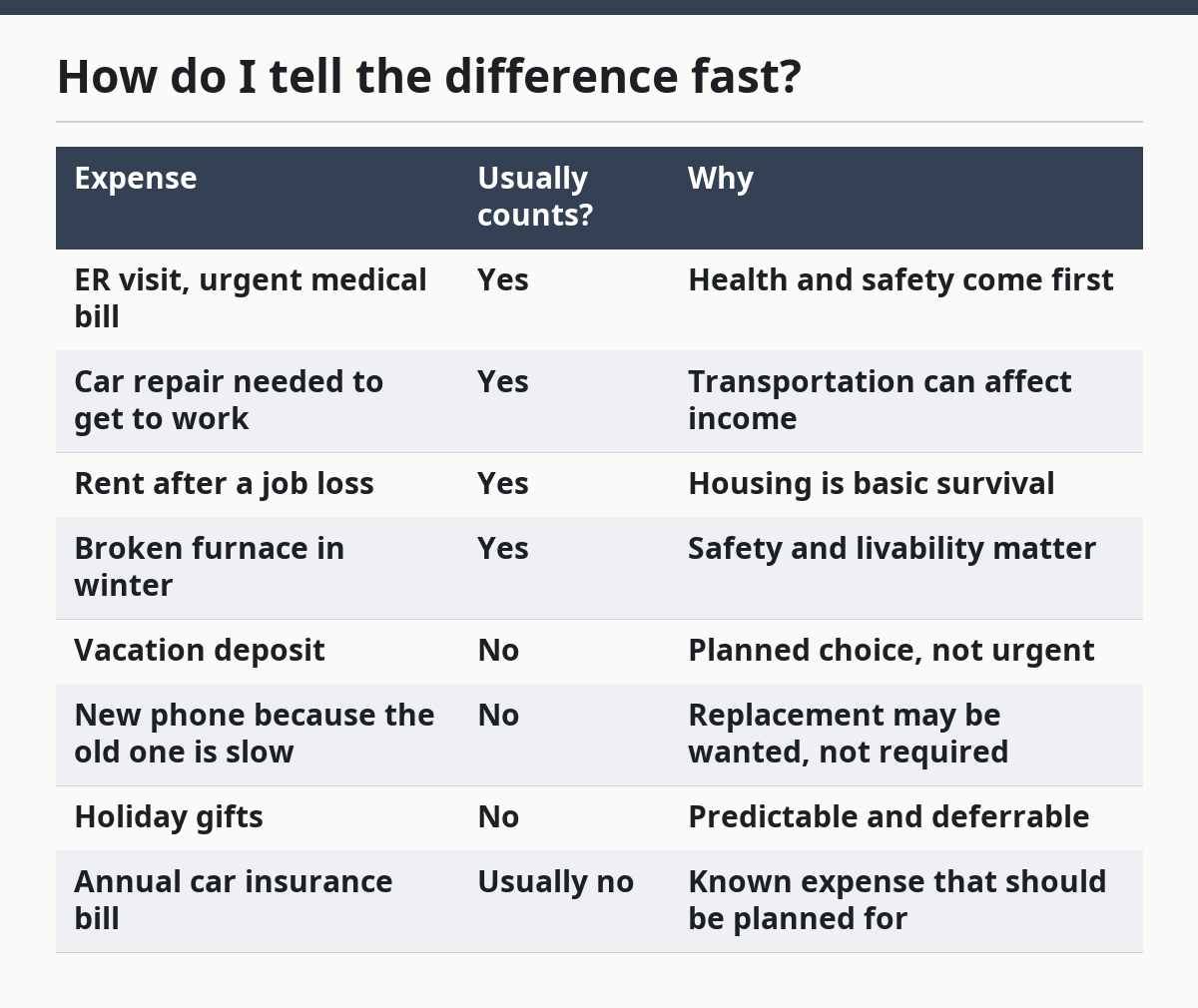
There are gray areas. A leaking roof may be an emergency if water is getting into the house. A cosmetic car repair usually is not. A dental issue may be urgent if pain or infection is involved, but not if it can safely wait for a scheduled visit, and when the line is unclear, consult a dentist or medical professional. The line is not perfection; it is urgency plus necessity.
What about medical bills, car repairs, and rent?
Medical bills, car repairs, and rent are three of the most common real emergencies because they can hit basic life in a single day. A medical bill counts when it is tied to treatment you cannot safely delay, and if you are unsure, consult a medical professional or billing office before deciding. A car repair counts when the car is needed for work, school, or care duties. Rent counts when income drops and missing payment would threaten housing.
The same rule applies to all 3: ask whether the expense protects a core need. If the answer is yes, the emergency fund can step in.
A reader who lives in a city with good public transit may not see a car repair as urgent in the same way as someone who needs a car to get to a shift job. A person with family support may have more room to wait on rent than someone with no backup. That is why emergency fund rules are guidelines, not a rigid script.
If the expense is partly urgent and partly elective, split it in your mind. Fix the brake repair. Skip the cosmetic trim. Pay the needed medical bill. Postpone the optional add-on. That keeps the fund from covering wants dressed up as needs.
Should I use my emergency fund or a credit card?
Use the emergency fund first when the expense is real, necessary, and immediate. A credit card can bridge a cash gap, but it also adds debt, interest, and one more bill next month.
A credit card may make sense if the cost is large and the emergency fund is too small to cover it fully. In that case, using both can be smarter than draining savings to zero. The goal is to keep enough cash on hand so the next surprise does not turn into a second crisis.
| Option | Best use | Main drawback |
|---|---|---|
| Emergency fund | Real emergencies you can’t delay | The balance falls when you need it most |
| Credit card | Short gap when cash is short | Debt can linger and grow |
| Payment plan | Large necessary bill with no cash | May add fees or strict terms |
The wrong move is using a credit card for a non-emergency and calling it “temporary.” That can blur the line so much that the emergency fund stops being a safety net and starts becoming another spending account. If the expense would still feel optional tomorrow, the card is not the answer.
Where should emergency money live?
Emergency money should be easy to reach, but not so easy that you spend it on impulse. A high-yield savings account or a money market account often fits that job better than cash at home or a long-term investment account.
For someone comparing a high-yield savings account vs money market account for emergency fund use, the real question is access and discipline. The best account is often the one you can use in a day or two for a true emergency, while still avoiding everyday spending. A bank account with a debit card attached can be too tempting. A locked-up investment account can be too slow.
A simple comparison helps:
| Place to keep it | Easy to access? | Good for emergency fund? | Main issue |
|---|---|---|---|
| Cash at home | Yes | Sometimes | Loss, theft, and no growth |
| Checking account | Very easy | Sometimes | Too easy to spend |
| High-yield savings account | Usually yes | Yes | May not be instant cash |
| Money market account | Usually yes | Yes | Features vary by institution |
| Stocks or funds | Not ideal | No | Value can drop when you need it |
For most readers, the best fit is the account that balances speed with restraint. The fund needs to be there on a bad day, not sitting in a place that invites daily use.
When should I rebuild the fund after using it?
You should rebuild it as soon as the emergency passes and your monthly cash flow allows it. If you used the fund for a real emergency, refilling it becomes the next financial job.
Start with the amount you spent, not with a vague promise to “save more later.” If you took out part of the fund for a car repair or medical bill, put a refill amount into your budget right away, even if it is small. A partial refill is better than waiting for a perfect month that never comes.
If the balance is empty after a real crisis, that is a signal to restore the buffer before the next surprise, and if you need help deciding how fast to do that, consult a financial professional. A 0 balance after a real crisis is not failure; it is a sign that the fund did its job.
FAQ
Is a vacation a real emergency?
No, a vacation is not a real emergency. It is a planned choice, even if the dates are close or the deal looks good. If paying for it would strain the emergency fund, it belongs in a travel fund instead.
Is a broken appliance an emergency?
Sometimes, yes. A broken refrigerator, heater, or stove can count if it affects food safety, heat, or basic living conditions. A broken TV or a second microwave usually does not.
Is job loss a real emergency?
Yes, job loss is one of the clearest emergency fund uses. It can hit rent, food, transport, and health care at the same time. That is why the fund exists: to buy time when income stops.
Can I use my emergency fund for annual bills?
Usually no, because annual bills are predictable. Car registration, insurance premiums, and holiday spending should be planned for ahead of time. If they keep surprising you, they need a separate sinking fund, not the emergency fund.
What is the quickest test for a real emergency?
Ask if the expense is unexpected, necessary, and urgent. If all 3 are true, it likely counts. If the answer is “I just did not plan well,” it probably does not.
Drafted with AI; not yet reviewed by a person.